

Walk into any Honda dealership and the Civic Si sits there like it owns the place. Sharp, aggressive, begging for a back road. Walk into a Volkswagen showroom and the Jetta GLI is parked nearby — quieter, more reserved, but packing a secret under the hood. Both are Sport sedans. Both have manual transmissions. Both cost roughly the same money. And yet, they could not be more different.
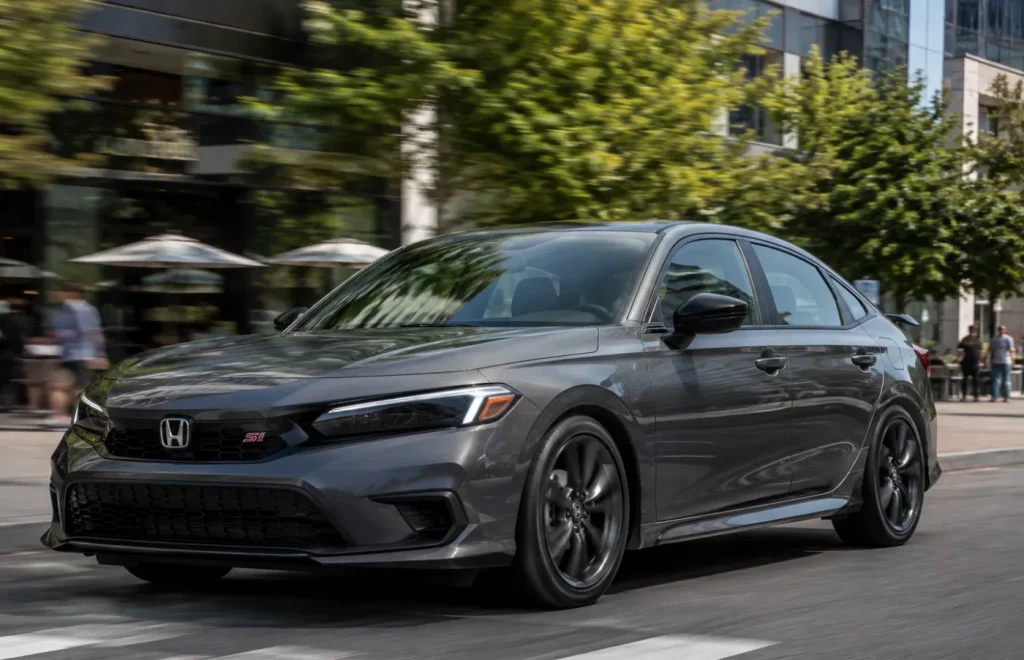
The Civic Si is built around a simple idea: light weight, sharp steering, and a manual gearbox that makes every drive feel like an event. It makes 200 horsepower and 192 lb-ft of torque from a 1.5-liter turbocharged four-cylinder. The Jetta GLI takes a different approach: more displacement, more torque, more comfort. Its 2.0-liter turbocharged four-cylinder produces 228 horsepower and 258 lb-ft of torque — enough to make the Civic feel underpowered on paper.
But paper doesn’t tell the whole story. The question isn’t which car is faster. The question is which car makes more sense over the long haul — and which one you’d actually want to drive every day.
The Jetta GLI delivers more power, more torque, and a more comfortable ride — it’s the better highway car and the better value for raw performance per dollar. The Civic Si delivers sharper steering, lighter weight, and a more engaging manual experience — it’s the better back-road car and the smarter long-term ownership proposition. Choose the GLI if you want effortless torque; choose the Si if you want involvement.
Two Different Ideas of a Sport Sedan
On the surface, these cars look like direct competitors. Both are sedans. Both have turbocharged four-cylinder engines. Both are available with a six-speed manual transmission. Both are priced in the low-$30,000 range. But the philosophy behind each car couldn’t be more different.
The Civic Si is a lightweight Sport Compact. It prioritizes steering feel, chassis response, and the joy of rowing your own gears. It’s not the most powerful car in its class, and it doesn’t try to be. Instead, it focuses on the experience — the way the steering loads up in a corner, the way the LSD pulls you through an apex, the way the manual transmission slots into gear with mechanical precision.
The Jetta GLI is a different animal. It’s a mini-GTI sedan with a torquey 2.0-liter engine, adaptive suspension, and a more grown-up character. It’s faster in a straight line, more comfortable on the highway, and better equipped for daily life. Autoblog’s comparison of these two cars notes that the Civic feels more engaging and agile, while the GLI feels more polished and refined — a more mature take on the sport sedan formula.
The Civic Si is the car you drive for fun. The GLI is the car you can enjoy without sacrificing comfort.
| Specification | Honda Civic Si | VW Jetta GLI |
|---|---|---|
| Engine | L15CA 1.5L turbo I4 | EA888 Gen 3 2.0L turbo I4 |
| Horsepower | 200 hp | 228 hp |
| Torque | 192 lb-ft | 258 lb-ft |
| Transmission | 6-speed manual only | 6-speed manual / 7-speed DSG |
| LSD | Helical mechanical | VAQ electronic (e-LSD) |
| Adaptive dampers | No | Yes (DCC) |
| Curb weight | ~2,952 lb | ~3,212 lb |
| EPA combined MPG | ~31 MPG | ~29 MPG |
Performance: The VW Has the Numbers — But Not the Whole Story
Look AT the spec sheet and the GLI wins. 228 horsepower beats 200. 258 lb-ft of torque absolutely crushes 192. The 2.0-liter engine has 66 more pound-feet of twist, and that difference changes everything about how these cars behave on the road.
The GLI’s torque advantage is the single biggest difference between these cars. You feel it immediately. The GLI doesn’t need to downshift to pass on the highway. It doesn’t need to be revved out to feel quick. The torque is just there, right from low rpm, making the car feel effortless in daily driving.
The Civic Si, by contrast, asks you to work for it. The 1.5-liter engine makes peak torque at 1,800 rpm and holds it through 5,000 rpm, but it runs out of breath above 5,500 rpm. You have to keep the revs up, choose the right gear, and manage the clutch to extract the car’s potential.
The GLI gives you torque. The Si gives you a reason to shift.
Straight-Line Performance: GLI Wins, But the Gap Isn’t the Whole Story
In straight-line testing, the GLI is the quicker car. Car and Driver recorded approximately 5.6 seconds to 60 mph for the GLI with the DSG transmission. Autoblog also cites around 5.6 seconds for the GLI, compared to roughly 6.6 seconds for the Civic Si.
That’s a full second difference. In the world of sport sedans, that’s a lifetime. From a stoplight, the GLI simply walks away. The extra torque and the DSG’s launch control make the Civic feel like it’s standing still.
But the Civic isn’t built to win drag races. It’s built to win corners. And on a back road, that full second difference starts to shrink.
Manual vs DSG: The Comparison Changes Completely
This is where the comparison gets complicated. The Civic Si is manual-only. You don’t get a choice. The Si is a six-speed manual, and that’s the only way it comes. It’s part of the car’s identity.
The Jetta GLI, at least in recent model years, has offered both manual and DSG options. The manual GLI is a more direct competitor to the Civic Si — both have three pedals, both require driver involvement, both reward good technique. The DSG GLI is a different car entirely. It’s faster, easier to drive in traffic, and equipped with launch control. It’s the car you buy if you want maximum straight-line performance with minimal effort.
The Civic Si competes with the manual GLI emotionally — but the DSG GLI competes with it mathematically.
Chassis: Lightweight Precision vs Adaptive Comfort
This is where the Civic Si starts to fight back. The Si weighs approximately 2,952 pounds, according to Edmunds’ specifications for the 2025 model. That’s significantly lighter than the GLI, which tips the scales at over 3,200 pounds.
Weight is the enemy of handling. The Si’s lower mass means it changes direction more eagerly, brakes more effectively, and feels more agile in tight corners. The chassis is stiff, the suspension is firm, and the Helical LSD works seamlessly to pull the car through corners.
The GLI counters with adaptive dampers — a feature the 11th-gen Civic Si lacks. Honda removed the adaptive suspension from the Si when they redesigned it for the 11th generation. Volkswagen kept it in the GLI. That’s a significant difference, and it changes the character of each car dramatically.
The Civic Si is a lightweight precision tool. The GLI is a comfort-oriented cruiser that can stiffen up when needed.
Why the More Powerful GLI Doesn’t Automatically Feel More Fun
Power isn’t everything. The GLI has more torque, more horsepower, and better straight-line acceleration. But the Civic Si often feels more fun to drive on a twisty road.
The Si’s steering is more direct, more communicative, and more engaging. The chassis is more willing to rotate. The manual gearbox is more satisfying to use. The lower weight makes the car feel more playful and responsive.
Autoblog’s direct comparison of these two cars highlights this exact dynamic: the Civic feels more engaging and agile, while the GLI feels more polished and refined. The GLI is the more mature car; the Si is the more entertaining one.
The GLI is faster with less effort. The Si makes you work for the speed — and that’s exactly why some drivers prefer it.
The Highway Test: Where the GLI Makes Its Case
Imagine a 300-mile road trip from Chicago to Nashville. Two lanes, long stretches of highway, and hours of driving. Which car would you rather be in?
The GLI, and it’s not close. The 2.0-liter engine cruises effortlessly, with torque available at any speed. The adaptive dampers in Comfort mode soak up road imperfections. The seats are more supportive for long stints behind the wheel. The cabin is quieter, more insulated, and more premium.
The Civic Si is fine on the highway, but it’s not the car you want for a long road trip. The manual transmission requires more effort. The ride is firmer. The road noise is more noticeable. The engine needs to be revved to pass.
The GLI is the highway car. The Si is the back-road car.
The Backroad Test: Where the Civic Si Fights Back
Now imagine a twisty two-lane road through the mountains. No traffic, good pavement, and a perfect driving day. Which car would you rather be in?
The Civic Si, and it’s not close. The lighter weight, sharper steering, and more direct chassis make the Si feel like it’s dancing through the corners. The manual transmission gives you complete control. The LSD pulls you through the apex. The car communicates everything the front tires are doing.
The GLI is capable on back roads, but it feels heavier and less eager. The adaptive dampers help, but they can’t hide the extra weight. The car is more prone to understeer at the limit. It’s fast, but it’s not as engaging as the Si.
The GLI is the better highway car. The Si is the better back-road car.
Features: The GLI Gives You More Car for Your Money
For the additional purchase price, the GLI offers more equipment. Recent comparisons highlight the GLI’s power driver’s seat with memory, ventilated front seats, adaptive suspension, and more premium interior materials as advantages over the Civic Si.
The Civic Si counters with a 9-inch touchscreen, wireless Apple CarPlay and Android Auto, and a 12-speaker Bose audio system — features that are genuinely nice to have. But it lacks the GLI’s premium touches.
The GLI charges more — but you can actually see where some of the money goes.
Fuel Cost: Civic Quietly Wins
This is one of those long-term ownership details that rarely makes it into the headline comparison but matters after 50,000 miles. The Civic Si gets approximately 31 mpg combined, according to EPA estimates. The GLI gets roughly 29 mpg.
The difference is small on a per-tank basis. But over 100,000 miles, that 2-mpg gap adds up to a meaningful difference in fuel costs — and the Si also runs on regular gasoline in many model years, which further enhances the long-term cost advantage.
The Civic Si is the cheaper car to fuel. It’s not a huge difference, but it’s real.
Reliability: The Section Everyone Wants — but Nobody Can Answer Honestly
There is no honest single-number answer to the question of Civic Si versus Jetta GLI reliability. Anyone who tells you otherwise is oversimplifying. What we can do is look at the patterns and make an informed judgment.
The Civic Si benefits from Honda’s reputation for durability, a relatively simple drivetrain, and a massive owner base that has documented nearly every possible issue. The 1.5-liter turbo engine is well-understood, the manual transmission is robust, and the chassis is proven.
The GLI’s EA888 engine is also well-understood, but it comes with more complexity. The DSG transmission, where equipped, requires regular service. The Water Pump and cooling system have historically been weak points on earlier iterations of the EA888 family. Some owners report oil consumption and cooling system issues.
None of this means the GLI is unreliable. It means the GLI has more systems that can potentially require attention as the miles add up.
The DSG Question: Fast but Expensive to Maintain?
If you’re comparing the Civic Si to a DSG-equipped GLI, the transmission question becomes critical. The DSG is a dual-clutch automatic that delivers lightning-fast shifts and excellent launch control. But it requires regular service — typically every 40,000 miles — and that service is more expensive than a manual transmission fluid change.
The DSG also introduces additional complexity. Mechatronics units can fail. Clutches can wear. Repairs are more expensive than manual transmission work.
This doesn’t mean the DSG is unreliable. It means the DSG adds complexity and potential repair exposure compared to the Civic’s manual-only drivetrain. If you’re buying a GLI with the DSG, you’re buying a more sophisticated transmission that requires more attention.
| System | Civic Si | Jetta GLI |
|---|---|---|
| Engine complexity | Moderate | Moderate |
| Turbo system | Small, proven | Larger, more torque |
| Manual transmission | Standard, proven | Available, proven |
| Dual-clutch system | Not applicable | DSG option available |
| Adaptive suspension | Not available | Yes (DCC) |
| Electronics complexity | Moderate | Higher |
Maintenance Cost: Routine vs Unexpected Repairs
The Civic Si wins the routine maintenance battle. Oil changes, filters, spark plugs, and brakes are cheaper and easier to access. The manual transmission requires no special service intervals. The car is simpler to work on.
The GLI has higher routine maintenance costs. The DSG service is expensive. European parts are generally more costly. The adaptive suspension adds complexity. Labor rates at Volkswagen dealers tend to be higher than at Honda dealers.
The GLI is the more expensive car to maintain. It’s not a massive difference on a month-to-month basis, but over five years, it adds up.
Five-Year Ownership Costs
This is where the Civic Si makes its financial case. Over five years, the Si typically costs less to own — and that’s before you even factor in depreciation.
The Civic Si has a lower purchase price, better fuel economy, cheaper maintenance, and stronger resale value. The GLI has more power, more torque, and more features — but you pay for those advantages at every step of the ownership experience.
The GLI is the better car on paper. The Si is the better car on the balance sheet.
Used Market: The Smart Buy May Change
This is where the comparison gets interesting for buyers who aren’t looking at new cars. The used Civic Si market is full of modified cars. Many Si examples have been tuned, modified, and driven hard. Finding a clean, stock example is getting harder.
The used GLI market has its own challenges. DSG service history matters. Cooling system repairs are common. Water pump replacements are expensive. Some GLI examples have also been modified, making inspection even more important.
Which used car is more dangerous to buy modified? Both can be, but for different reasons. A modified Si may have clutch issues. A modified GLI may have cooling problems. In both cases, a thorough pre-purchase inspection is non-negotiable.
Tuning Potential
Both cars have massive aftermarket support. The Civic Si’s L15CA engine responds well to ECU tuning, intake, and downpipe upgrades. The GLI’s EA888 engine has even more potential — a simple Stage 1 tune adds around 60 horsepower without hardware changes.
But the Si’s stock clutch is a weak point. A Stage 1 tune will make it slip. The GLI’s DSG, where equipped, can handle more torque than the manual transmission.
Which one reaches your power goal with less money? The GLI, generally — but you pay for that power in other ways. The Si has a more robust aftermarket, but the clutch limitation is real.
Depreciation and Resale
The Civic Si historically holds its value better than the GLI. Honda’s enthusiast reputation, the manual-only configuration, and the Si badge all contribute to strong resale value. The GLI depreciates more like a mainstream sedan.
This matters if you plan to sell the car after a few years. The Civic Si will cost you less in depreciation. The GLI will cost you more. It’s not a massive difference, but it’s real.
The $3,000 Question
Current 2026 comparisons show a starting price gap of roughly $2,250 between the Civic Si and the Jetta GLI, depending on trim and transmission choice. The GLI costs more up front — but you get more power, more torque, and more equipment.
The question is whether that extra power and equipment justifies the higher purchase price — and the potentially higher long-term ownership costs. For some buyers, the GLI’s torque and comfort are worth the premium. For others, the Si’s lower cost and stronger resale value are more important.
Who Should Buy the Civic Si?
Buy the Civic Si if the manual transmission is non-negotiable, steering feel matters more than peak torque, you want a lighter car for back roads, fuel economy is a priority, long-term ownership simplicity is important, and you want the lower entry price.
Who Should Buy the Jetta GLI?
Buy the GLI if you want more torque for effortless passing, you do a lot of highway driving, comfort matters more than ultimate sharpness, adaptive suspension is important to you, you want more equipment for the money, and the DSG option matters to your use case.
Verdict: Which Generation Wins?
The conclusion should be nuanced. Here’s how it breaks down.
| Category | Winner |
|---|---|
| Horsepower | GLI |
| Torque | GLI |
| Straight-line acceleration | GLI |
| Steering engagement | Civic Si |
| Manual experience | Civic Si |
| Highway comfort | GLI |
| Adaptive suspension | GLI |
| Fuel economy | Civic Si |
| Entry price | Civic Si |
| Features | GLI |
| Mechanical simplicity | Civic Si |
| Long-term repair risk | Civic Si |
| Tuning potential | Depends |
| Daily-driver refinement | GLI |
Final Thought
The Jetta GLI gives you more power, more torque, and more comfort. The Civic Si gives you a more focused driving experience — and potentially fewer reasons to worry about complexity as the miles pile up.
The GLI is the better bargain when you’re buying equipment. The Civic Si may be the better bargain when you’re buying miles.
If you spend most of your time on the highway and want effortless torque, the GLI is the obvious choice. If you spend your weekends on back roads and want a car that rewards every shift, the Civic Si is the car you’ll remember.
Both are excellent cars. They just serve different masters.
FAQ — Civic Si vs Jetta GLI
Which is faster, the Civic Si or the Jetta GLI?
The Jetta GLI is significantly faster in a straight line. Car and Driver recorded approximately 5.6 seconds to 60 mph for the GLI with DSG, compared to roughly 6.6 seconds for the Civic Si. The GLI’s torque advantage makes it feel much quicker in everyday driving. On a back road, the gap narrows due to the Si’s lighter weight and sharper chassis.
Does the Jetta GLI have a manual transmission?
In recent model years, the Jetta GLI has been available with both a six-speed manual and a seven-speed DSG dual-clutch transmission, though availability varies by market and model year. The Civic Si is manual-only.
Which car has better steering feel?
The Civic Si has better steering feel. It’s more direct, more communicative, and more engaging. The GLI’s steering is accurate but less involving. If steering feel matters to you, the Civic Si is the clear winner.
Is the Jetta GLI more reliable than the Civic Si?
The Civic Si has a reputation for simpler, more robust ownership. The GLI’s EA888 engine is well-known, but some owners report water pump issues and cooling system repairs in higher-mileage cars. The Si’s manual transmission is simpler and cheaper to maintain than the GLI’s DSG option. Neither car is unreliable, but the Si has fewer known weak points.
Which car is better for daily driving?
The Jetta GLI is better for daily driving. It has more torque for effortless acceleration, adaptive suspension for ride comfort, a more premium interior, and better highway manners. The Civic Si is more engaging but firmer and less refined in daily use.
Does the Civic Si have adaptive suspension?
No — Honda removed the adaptive dampers when they redesigned the Si for the 11th generation. The Jetta GLI still offers adaptive suspension, making it more adjustable for different driving conditions.
Which car is better for the money?
The Civic Si is generally better for the money over the long term. It has a lower purchase price, better fuel economy, cheaper maintenance, and stronger resale value. The GLI offers more power and more features but costs more up front and more to own.
Which car has better fuel economy?
The Civic Si has better fuel economy at approximately 31 mpg combined, compared to the GLI’s roughly 29 mpg combined. The difference is small but adds up over time.
Should I buy a Civic Si or Jetta GLI?
Buy the Civic Si if you want a sharper, lighter, more engaging manual-transmission sport sedan with lower long-term ownership costs. Buy the Jetta GLI if you want more torque, more comfort, more features, and a better highway car. The Si is the better driver’s car; the GLI is the better all-rounder.
Which car holds its value better?
The Civic Si holds its value significantly better than the Jetta GLI. Honda’s enthusiast reputation, manual-only configuration, and stronger demand in the used market all contribute to the Si’s superior resale value.