

Walk into any Honda dealership and you’ll see them parked side by side. Same body style. Same aggressive styling. Same black wheels. One says “Sport” on the trunk. One says “Si.” The price difference is about $4,000 to $5,000. And the average buyer looks at both and asks the same question: what am I actually paying for?
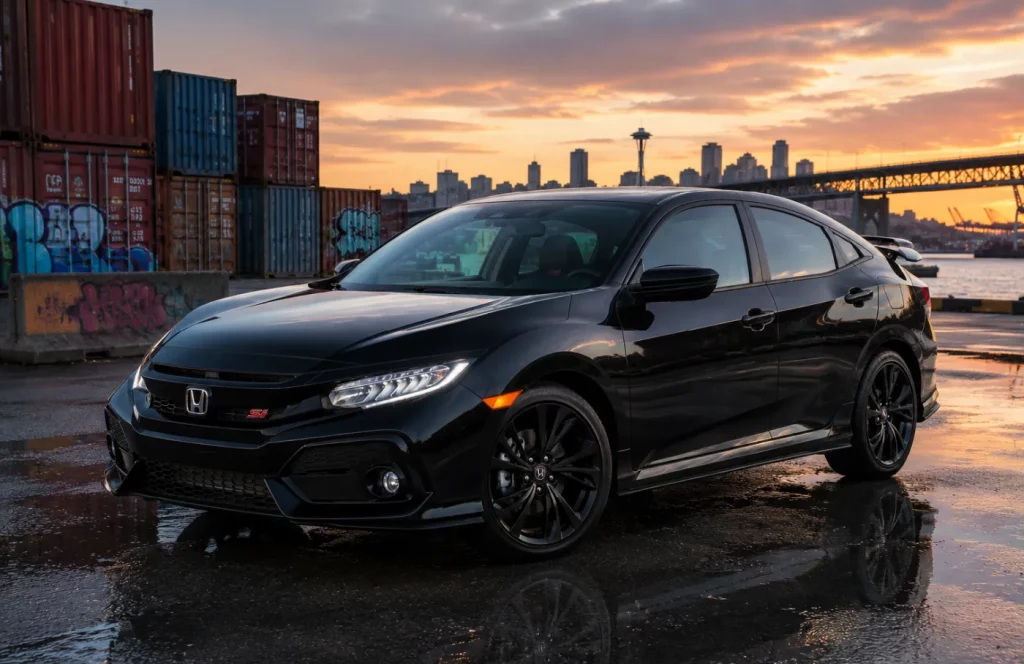
Is the Si just a Civic Sport with a Turbocharger and a sticker? Or is it a fundamentally different car that happens to share a body shell? The answer matters — because $4,000 is real money, and the difference between these two cars is much bigger than the horsepower figure suggests.
This isn’t a comparison about which car is faster. It’s about whether the driving experience of the Si justifies the premium over the Sport, and whether you’d be better off saving the money — or spending it.
The Civic Sport is the smarter choice for daily commuting, fuel economy, and ease of driving. The Civic Si is the smarter choice for drivers who want a manual transmission, a limited-slip differential, turbo power, and a genuinely engaging driving experience. You can make a Sport look like an Si. You cannot cheaply turn it into one.
The Price Gap: What Are You Actually Paying For?
The 2026 Civic Si starts AT $31,495, including destination. The Civic Sport is several thousand dollars less, depending on body style and equipment. That’s a significant gap. And it’s not just about horsepower.
The Si gets a turbocharged engine, a six-speed manual transmission with rev-match, a helical limited-slip differential, stiffer suspension, larger brakes, sport seats, a 9-inch touchscreen, wireless Apple CarPlay, and a 12-speaker Bose audio system. The Sport gets a naturally aspirated engine, a CVT, an open differential, softer suspension, smaller brakes, standard seats, a 7-inch touchscreen, wired CarPlay, and a basic audio system.
Is the price gap paying for performance — or just equipment? Mostly performance hardware. The Si is not just a Sport with a different engine; it’s a different car underneath.
The Biggest Difference Isn’t Horsepower — It’s the Transmission
This is the most important distinction between the two cars. The Civic Sport comes with a continuously variable transmission. The Civic Si comes exclusively with a six-speed manual transmission with rev-match control.
The CVT in the Sport is smooth and efficient. It’s perfect for commuting, stop-and-go traffic, and drivers who don’t want to think about shifting. It does its job quietly and competently. But it’s not engaging.
The Si’s manual transmission is one of the best in the business. The short, precise throws, the lightweight single-mass flywheel from the Type R, the rev-match system — every shift feels deliberate and satisfying. Honda’s official specifications confirm that the Si comes exclusively with a 6-speed manual transmission with Rev-Match Control and a helical limited-slip differential. There is no automatic option for the Si.
If you don’t want a manual, the comparison is already over: buy the Sport.
- CVT automatic
- Smooth, efficient
- No manual option
- Open differential
- Less driver involvement
- 6-speed manual only
- Rev-match downshifts
- Single-mass flywheel
- Helical LSD
- Full driver engagement
Engine: 150 HP vs 200 HP Is Only Half the Story
The Civic Sport uses a 2.0-liter naturally aspirated four-cylinder engine producing 150 horsepower and 133 lb-ft of torque. It’s a reliable, simple, and efficient engine designed for daily commuting. It’s not fast, but it doesn’t need to be. The Civic Si uses a 1.5-liter turbocharged four-cylinder producing 200 horsepower and 192 lb-ft of torque.
The difference is not just 50 horsepower. It’s 59 lb-ft of torque — and torque is what you actually feel when you press the accelerator. The Si’s turbocharger spools early, delivering peak torque from approximately 1,800 rpm. The Sport’s naturally aspirated engine builds power more linearly but never delivers the same shove.
The Si doesn’t feel 33% faster in everyday driving because torque delivery matters more than peak horsepower. But it feels much more alive when accelerating — especially in passing situations, highway merging, and corner exits. The Si’s engine responds immediately, while the Sport’s engine requires more revs to produce meaningful thrust.
Straight-Line Performance: Don’t Buy the Si Just for 0-60
If acceleration is your only metric, the Si is quicker but not dramatically so. Car and Driver recorded approximately 6.6 seconds to 60 mph for the Civic Si — quick enough but not class-leading. The Sport is significantly slower, taking around 8.5 to 9 seconds. That’s a real difference, but it’s not the primary reason to buy the Si.
The Si isn’t a drag-race bargain. If you want the fastest car for the money, there are better options. The Si’s value proposition is about handling, engagement, and the driving experience — not straight-line speed.
The LSD: The Hardware the Sport Doesn’t Have
This is one of the most important differences between the two cars, and it’s often overlooked. The Civic Si comes with a helical limited-slip differential. The Sport has an open differential.
What does that mean in practice? In a corner, the LSD distributes torque between the front wheels to maximize grip. The Sport’s open differential sends power to the wheel with less resistance, which means the inside wheel can spin uselessly when you accelerate out of a turn.
Honda explicitly highlights the helical limited-slip differential as a key component of the Si’s improved handling and traction. It’s not just marketing — it’s a real performance advantage that you can feel every time you drive the car hard.
The Sport will give you one-wheel peel on a wet road. The Si will put power down and pull you through the corner. That difference is worth the money for anyone who drives with enthusiasm.
Suspension: Daily Comfort vs Driver Focus
The Civic Sport is tuned for comfort. The suspension is soft enough to absorb road imperfections, making it a pleasant daily driver. The Civic Si has stiffer springs, thicker anti-roll bars, and firmer Bushings. It’s more aggressive, more controlled, and more responsive.
Car and Driver notes that the Si’s stiffer suspension improves handling while remaining controlled and not overly harsh. It’s a performance-oriented setup that doesn’t punish you for daily driving. But it is firmer than the Sport, and you will notice it on broken pavement.
The Sport is better for bad roads and commuting. The Si is better for canyon roads, spirited driving, and anyone who values handling over ride comfort.
Brakes: Another Difference People Forget
The Civic Si comes with larger front and rear brake rotors than the standard Civic. This matters for repeated hard braking — on mountain roads, at the track, or even during aggressive street driving.
The Sport’s brakes are adequate for daily driving. The Si’s brakes are designed to handle more heat and more abuse. This is another example of the Si being built for sustained performance, not just a single quick run.
Wheels and Tires: Why the Si Feels Different Before You Touch the Engine
The Civic Si comes with 18-inch wheels and summer performance tires on many models. The Sport comes with similar-sized wheels but with all-season tires focused on daily usability and appearance.
The Si’s summer tires provide significantly more grip than all-season tires. That grip is noticeable from the first turn of the wheel — the car feels planted, responsive, and eager. The Sport’s all-season tires are more practical for year-round driving but less capable in aggressive cornering.
Honda and independent reviews specifically highlight the Si’s summer tires as a significant performance upgrade that enhances cornering grip and steering response.
Interior: Is the Si Actually More Premium?
This is where the Si’s price premium becomes visible. The Sport has standard cloth seats, a 7-inch touchscreen, a basic audio system, and wired Apple CarPlay. The Si has sport seats with aggressive bolsters, a 9-inch touchscreen, wireless Apple CarPlay, and a 12-speaker Bose audio system with a subwoofer.
The Bose system alone is a significant upgrade — the Sport’s audio is fine, but the Si’s system transforms the cabin experience. The sport seats hold you in place during cornering, and the larger screen makes the infotainment system more usable.
More expensive doesn’t automatically mean more luxurious. The Si is a performance trim, not a luxury trim. But it does get real equipment upgrades that improve the daily experience.
| Feature | Civic Sport | Civic Si |
|---|---|---|
| Engine | 2.0L NA (150 hp) | 1.5L Turbo (200 hp) |
| Torque | 133 lb-ft | 192 lb-ft |
| Transmission | CVT | 6-speed manual |
| LSD | Open differential | Helical LSD |
| Suspension | Standard | Sport-tuned, stiffer |
| Brakes | Standard | Larger rotors |
| Touchscreen | 7-inch | 9-inch |
| CarPlay | Wired | Wireless |
| Audio | 8-speaker standard | 12-speaker Bose |
| Seats | Standard cloth | Sport seats |
The Daily Commute Test
Imagine 45 minutes of traffic every morning. Stop-and-go. Constant braking and accelerating. The Sport wins this test every time. The CVT is effortless — no clutch pedal, no gear selection, no rev-matching. You just steer and brake. The ride is softer, the engine is quieter, and the experience is less demanding.
The Si requires more involvement. The manual transmission is great when you’re driving for fun, but in traffic, it becomes work. The firmer suspension transmits more road imperfections. The engine is more responsive, which is great for performance but requires more attention in stop-and-go conditions.
The Sport makes driving easier. The Si makes driving more interesting.
The Weekend Test
Now imagine a Saturday morning on a twisty back road. No traffic, good pavement, and a perfect driving day. The Si is the obvious choice. You choose the gears, work the clutch, use rev-match on downshifts, feel the LSD working through corners, and use the full rev range.
The Sport is competent on back roads, but it’s not engaging. The CVT doesn’t give you control over the powerband. The open differential doesn’t provide the same traction. The softer suspension allows more body roll.
The difference between these cars on a back road is much larger than the 50-horsepower gap would suggest. The Si transforms the experience from transportation to driving.
Fuel Economy: The Sport Quietly Wins
The Sport gets approximately 34 mpg combined. The Si gets approximately 31 mpg combined. The difference is not huge, but it’s real. The Sport is the more efficient car, especially for drivers who do a lot of commuting or highway miles.
If fuel economy is a priority, the Sport has a clear advantage.
The $4,000 Modification Experiment
What could you do with the $4,000 you save by buying a Sport instead of an Si? You could buy wheels, tires, springs, a rear Sway Bar, brake pads, and an exhaust. You could make the Sport handle better and look more aggressive.
But you still won’t have the turbo engine, the six-speed manual, the LSD, the Si’s drivetrain, or the factory performance calibration. You can make a Sport look like an Si, but you cannot cheaply turn it into one.
If you want a genuine performance Civic, the Si is cheaper to buy from the factory than to build from a Sport.
Resale Value: Does the Si Pay You Back?
The Civic Si historically holds its value well. The Si badge, manual transmission, and enthusiast demand all contribute to strong resale value. The Sport is a more common car with less enthusiast appeal.
But there’s a catch. Modified Si examples can be difficult to sell — buyers are often wary of tuned cars with unknown histories. A clean, stock Si will command a premium. A modified Si may be harder to sell.
The Used Market Question
This is a different question for buyers with a limited budget. With $25,000 to spend, you have two options: a newer Sport or an older Si.
A newer Sport comes with warranty, lower mileage, and modern technology. An older Si comes with more performance but potentially more wear, less warranty, and unknown maintenance history. The right choice depends on your priorities.
If you want the Si, buy the best stock example you can find. Avoid modified cars unless you’re prepared for the potential maintenance costs.
Who Should Buy the Civic Sport?
Buy the Civic Sport if you hate manual transmissions, you commute in heavy traffic every day, you want the lowest possible entry price, fuel economy matters more than performance, you want the Civic design without needing the performance hardware, and you prefer a relaxed, easy daily driver.
The Sport is the smarter Civic for people who simply need a good car.
Who Should Buy the Civic Si?
Buy the Civic Si if you want a manual transmission because it’s a feature, not a compromise, you drive for enjoyment, you want a factory LSD, you plan occasional autocross or track use, you value handling more than luxury, and you would otherwise spend thousands modifying a Sport.
Honda positions the Si explicitly as a driver-focused compact with turbo power, a manual transmission, and an LSD. It’s for people who know why they want those things.
Verdict: Which Generation Wins?
The conclusion should be nuanced. Here’s how it breaks down.
| Category | Winner |
|---|---|
| Entry price | Sport |
| Fuel economy | Sport |
| Daily commuting | Sport |
| Ease of driving | Sport |
| Horsepower | Si |
| Torque | Si |
| Acceleration | Si |
| Manual transmission | Si |
| Handling | Si |
| Corner exit traction | Si |
| Braking hardware | Si |
| Modification starting point | Si |
| Powertrain simplicity | Sport |
| Driver engagement | Si |
Final Thought
The Civic Sport is the smarter Civic for people who simply need a good car. The Civic Si is the smarter Civic for people who would otherwise spend years trying to make a Sport feel like one.
The Sport is the better daily driver. The Si is the better driver’s car. The Sport will save you money at the pump and at the dealership. The Si will reward you every time you take a corner.
If you have to ask whether you need the Si, buy the Sport. If you already know why you want a manual and an LSD, buy the Si.
Both are excellent cars. They just serve different drivers.
FAQ — Civic Sport vs Civic Si
Is the Civic Si worth the extra money over the Sport?
For drivers who value performance and engagement, yes. The Si offers a turbo engine, manual transmission, limited-slip differential, sport suspension, larger brakes, and better audio. For drivers who primarily commute and prefer an automatic, the Sport is the better value.
Does the Civic Sport have a manual transmission?
In the US market, the Civic Sport sedan is typically offered with a CVT only. The hatchback Sport has occasionally offered a manual option, but the Si is the only Civic with a manual as the primary or exclusive transmission in its segment.
Which Civic has better fuel economy?
The Civic Sport has better fuel economy at approximately 34 mpg combined, compared to the Si’s 31 mpg combined. The Sport’s naturally aspirated engine and CVT are more efficient than the Si’s turbo engine and manual transmission.
Does the Civic Sport have an LSD?
No — the Civic Sport has an open differential. The helical limited-slip differential is exclusive to the Si and Type R models. This is one of the most significant performance differences between the two cars.
Can you tune a Civic Sport?
The Civic Sport’s K20C2 engine has very limited tuning potential. The naturally aspirated engine doesn’t respond well to modifications, and the CVT is not designed for increased power. The Si is a much better platform for tuning and modifications.
Which Civic is better for daily driving?
The Civic Sport is better for daily driving. The CVT is effortless in traffic, the ride is softer, and the fuel economy is better. The Si is more engaging but requires more driver effort in stop-and-go conditions.
Does the Civic Si have a CVT?
No — the Civic Si is manual-only. Honda does not offer the Si with a CVT or any other automatic transmission. If you want an automatic, the Si is not for you.
Is the Civic Si faster than the Sport?
Yes — the Civic Si is significantly faster due to its turbocharged engine, higher power output, and more aggressive gearing. Car and Driver recorded approximately 6.6 seconds to 60 mph for the Si, compared to approximately 8.5-9 seconds for the Sport.
Should I buy a used Si instead of a new Sport?
This depends on your priorities. A used Si offers more performance for less money but comes with higher mileage, less warranty, and potential modification risks. A new Sport offers modern technology, full warranty, and lower ownership costs. Both are valid choices — it depends on what you value.
Which Civic holds its value better?
The Civic Si typically holds its value better than the Sport due to enthusiast demand, limited production, and the manual-only configuration. However, a modified Si may be harder to sell than a clean, unmodified example.