

American car shoppers have been deciding between the Toyota Corolla and the Honda Civic since Richard Nixon was in the White House. The two best-selling compact cars end up in competition for your dollar so often because they’re both very good, with excellent reliability reputations, strong resale value, and a pleasant daily driving experience. But the hybrid versions of these two icons present a choice that’s more complicated than ever.
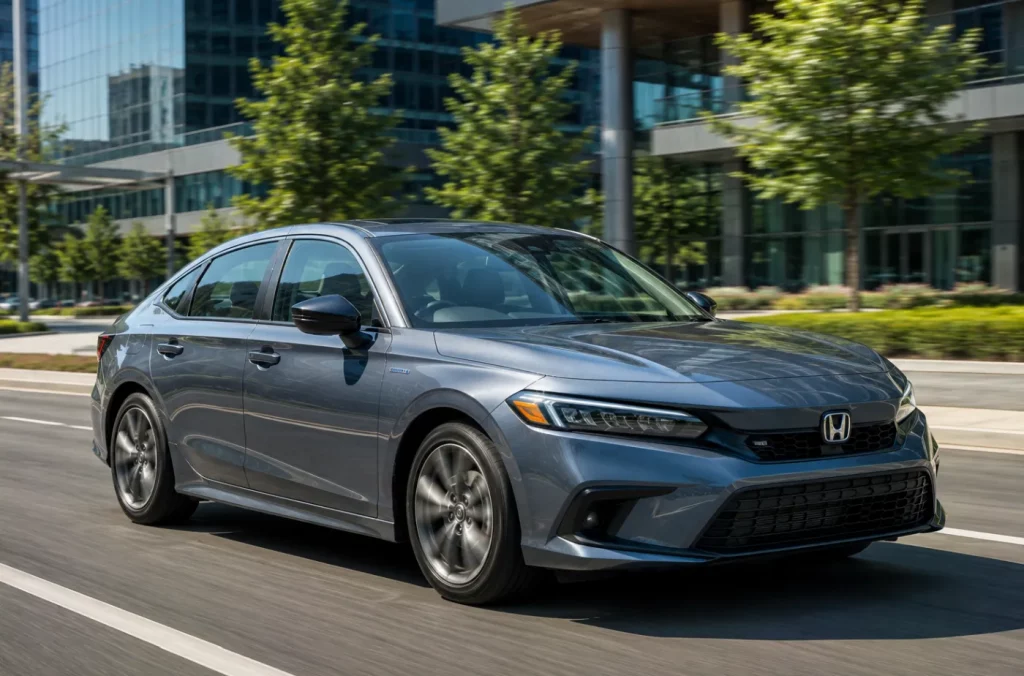
Honda takes a different approach to its 2026 Civic Hybrid. The company only builds hybrid editions of higher-end Civic trims. That makes the car look significantly more expensive, but comparably equipped models aren’t that far apart in price. The Civic Hybrid is significantly more powerful, but not available in AWD.
On the other side, Toyota builds hybrid versions of most Corolla trims, giving buyers plenty of choice. In the base Hybrid LE form, it’s the least expensive new hybrid in America this year. It’s a little low on power, AT just 138 horsepower, but an electric motor helps keep it from feeling sluggish.
This isn’t a comparison about which hybrid is greener. It’s a comparison about which hybrid makes more sense for your budget, your driving needs, and your daily life. Both cars represent a master class of sensible control layout. It’s remarkable how similar the two are in many respects. But the Civic Hybrid is much more powerful, while the Corolla Hybrid is the only one that can be had with all-wheel drive.
The Toyota Corolla Hybrid is the value champion — lower starting price ($25,970 vs $29,395), available all-wheel drive, and excellent fuel economy (up to 50 MPG combined). The Honda Civic Hybrid is the performance champion — 200 horsepower (vs 138), quicker acceleration (6.2-6.4 seconds 0-60 vs 9.0+ seconds), and a more engaging driving experience. Choose the Corolla Hybrid for value and AWD; choose the Civic Hybrid for power, interior space, and driving enjoyment.
The Price Gap — What You Actually Get for Your Money
The 2026 Toyota Corolla Hybrid starts at approximately $25,970 for the LE FWD sedan. The 2026 Honda Civic Hybrid starts at $29,395 for the Sport Hybrid sedan. That’s a $3,425 difference before options.
But there are important caveats. Toyota builds a hybrid version of the base-model Corolla LE, while Honda builds hybrid versions of only upper trims of the Civic. The higher-end Corolla Hybrid XLE adds features like faux leather seating and a larger digital gauge cluster, coming in almost $3,000 lower than a comparable top-of-the-line Civic Hybrid.
The top-of-the-line Civic Hybrid gets real leather seating (not faux), a 12-speaker premium audio system at no added cost on the Sport Touring trim, and a 12.3-inch touchscreen with Google built-in on the Sport Touring Hybrid. Comparably equipped models aren’t that far apart in price.
The difference is about $3,000 and a very different driving experience. Choose based on your priorities.
| Model | Starting Price | Horsepower | MPG Combined | AWD Available |
|---|---|---|---|---|
| 2026 Corolla Hybrid LE | ~$25,970 | 138 hp | 50 | Yes |
| 2026 Civic Hybrid Sport | $29,395 | 200 hp | 49 | No |
| 2026 Civic Hybrid Touring | ~$33,595 | 200 hp | 49 | No |
MPG Comparison — Who Wins at the Pump?
The fuel economy numbers are surprisingly close. The 2026 Toyota Corolla Hybrid LE with front-wheel drive achieves up to 50 mpg combined. The Honda Civic Hybrid sedan achieves 49 mpg combined — just one mpg behind.
But the story gets more interesting with different configurations. The Corolla Hybrid with all-wheel drive drops to 48 mpg combined, essentially matching the Civic Hybrid’s 49 mpg. The Civic Hybrid hatchback also achieves 48 mpg combined, giving up one mpg for significantly more cargo space.
The Corolla wins the efficiency battle, but not by enough to make the Civic look thirsty.
| Model | Combined MPG | City MPG | Highway MPG |
|---|---|---|---|
| 2026 Corolla Hybrid LE FWD | 50 | 53 | 46 |
| 2026 Corolla Hybrid LE AWD | 48 | 47 | 41 |
| 2026 Civic Hybrid Sedan | 49 | 50 | 47 |
| 2026 Civic Hybrid Hatchback | 48 | 50 | 45 |
The Real Fuel Cost Difference
At 15,000 miles per year with gas at $3.80 per gallon:
- Corolla Hybrid LE FWD (50 mpg): 300 gallons → $1,140/year
- Civic Hybrid Sedan (49 mpg): 306 gallons → $1,163/year
- Difference: Approximately $23/year
Over five years, the Corolla saves roughly $115 — less than the cost of a single tank of gas in some states. The Corolla wins the efficiency battle, but the financial gap is negligible.
Performance — This Isn’t Even Close
This is where the Civic Hybrid completely changes the conversation. The 2026 Honda Civic Hybrid produces 200 horsepower and 232 lb-ft of torque from its 2.0-liter hybrid system. That’s more power than the Civic Si. The Civic Hybrid reaches 60 mph in just 6.2-6.4 seconds, making it the fastest Civic in the current lineup.
The Toyota Corolla Hybrid produces just 138 horsepower and 156 lb-ft of torque from its 1.8-liter hybrid system. The Corolla’s power is described as “meek” and the acceleration as “leisurely.” While it moves around effectively, it never feels exciting.
The Civic Hybrid gives you roughly 45% more horsepower without giving up much fuel economy. That’s one of the most compelling arguments for spending the extra money.
- 200 HP / 232 lb-ft
- 0-60: 6.2-6.4 seconds
- 49 mpg combined
- FWD only
- Engaging, sporty character
- 45% more power
- 138 hp / 156 lb-ft
- 0-60: 9.0-9.3 seconds
- 50 mpg combined (FWD)
- AWD available
- Efficient but dull
- Lower price entry
Driving Experience — Economy Car vs Almost Sporty Hybrid
The Civic Hybrid’s driving dynamics are in a different league. The Civic has been known as one of the more engaging entries in the segment for generations, and while this newest version can still carve up corners with precise handling, it’s the way the suspension blends tautness without being harsh that makes it feel more like a premium European sedan than an economy car. The steering is nicely weighted and lets the driver place the car with accuracy. The Civic’s brakes offer strong stopping power and a more linear feel than what’s typically associated with the regenerative braking that comes with hybrids like this.
The Corolla Hybrid manages well enough, cornering dutifully but never joyfully or with any sort of sporting pretenses. The Corolla Hybrid feels heavier and clumsier than the Civic whether pressed hard for fun, or even just zipping through traffic. The steering is light and devoid of feedback, and the car quickly understeers when pushed.
Consumer Reports highlights the Civic Hybrid’s combination of high fuel economy, quicker acceleration, good handling, and comfortable ride. It’s a package that the Corolla simply cannot match.
City Driving — Different Strengths
The Corolla Hybrid excels in stop-and-go city driving where maximum efficiency matters most. Its smooth, predictable behavior makes it ideal for relaxed commuting. The Civic Hybrid offers stronger acceleration for merging and passing, making it better suited for more active urban driving.
Do you want the cheapest miles — or the best miles?
Highway Driving — Civic Pulls Ahead
On the highway, the Civic Hybrid is clearly superior. The additional power makes passing effortless, and the cabin is quieter at speed. The Corolla’s 138 horsepower becomes a limitation when merging onto fast-moving highways or passing at speed. The Civic’s 232 lb-ft of torque provides confident acceleration even with a full load of passengers and cargo.
Interior Space — Civic Is a Bigger Car
This is a significant difference that often gets overlooked. The Civic Hybrid offers approximately 99.0 cubic feet of passenger volume, compared to the Corolla Hybrid’s 88.6 cubic feet. That’s a 10.4 cubic foot difference — not a small gap.
The Civic has more rear legroom, more shoulder room, and more headroom. Tall passengers fit comfortably in the Civic’s rear seat; they will struggle in the Corolla. The Civic’s cabin feels spacious and airy, while the Corolla’s interior is notably tighter.
Cargo Space — The Hatchback Factor
If you’re shopping for a gas-powered model, both the Corolla and the Civic are available as sedans or hatchbacks. But only Honda builds a hybrid version of its hatchback.
The Civic Hybrid hatchback offers significantly more cargo space than the Corolla Hybrid sedan — approximately 24.5 cubic feet behind the rear seats. The Corolla Hybrid sedan offers just 13.1 cubic feet. That’s nearly double the cargo capacity.
For families or anyone who regularly hauls cargo, the Civic Hybrid hatchback is a compelling advantage.
All-Wheel Drive — The Corolla’s Advantage
This is the one area where the Civic Hybrid cannot compete. The Toyota Corolla Hybrid offers all-wheel drive for an additional $1,400. The Civic Hybrid is front-wheel drive only.
If you live where snow and ice sometimes cover the roads, the Corolla Hybrid with optional AWD might be the better choice for you. Even with AWD added, the Corolla still undercuts the Civic by a noticeable margin.
Reliability — The Most Important Section
Both cars carry strong reputations for dependability. The 2026 Toyota Corolla has a J.D. Power Quality and Reliability score of 81/100. The 2026 Honda Civic has a score of 84/100, slightly ahead on paper.
But reliability isn’t just about scores — it’s about what happens at 100,000, 150,000, and 200,000 miles.
Corolla Hybrid: Toyota has the longer real-world track record. The 1.8-liter hybrid system and e-CVT planetary transmission have been proven in millions of vehicles over decades. There’s a reason Corolla Hybrids are used as taxis and ride-share vehicles — they last.
Civic Hybrid: The current Civic Hybrid’s e:HEV system is newer to the Civic lineup. It uses direct injection, which can lead to carbon buildup on intake valves at higher mileage — a maintenance item the Corolla’s port-injected engine doesn’t have. However, Honda has extensive hybrid experience from the Accord and Insight. The Civic’s hybrid battery is covered by the same 10-year/150,000-mile warranty as the Corolla’s.
Key point: Toyota has the longer real-world track record. That is not the same thing as proof that the Civic Hybrid will be unreliable.
Both cars have the same hybrid battery warranty: 10 years / 150,000 miles.
Which Hybrid System Is Better at 100,000 Miles?
The Corolla Hybrid’s THS system is proven. There are countless 200,000+ mile Corolla Hybrids on the road. The platform is extremely mature, and there’s a massive database of high-mileage examples.
The Civic Hybrid’s e:HEV system is excellent, but we simply don’t yet have enough 200,000-mile examples of the current Civic Hybrid to make the same statistical claims. The system is robust, but it’s newer to the Civic lineup. Early indicators are positive, but long-term data is naturally limited.
This is a honest assessment that builds trust: Toyota has the proven long-term history; Honda has the more compelling driving experience.
Maintenance Costs
Both hybrids benefit from regenerative braking, which reduces brake pad wear. Both require standard maintenance: oil changes, filters, tire rotations.
The Corolla’s simpler port-injected engine avoids carbon buildup issues that the Civic’s direct-injected engine may experience at higher mileage. The Civic’s e:HEV system has two clutches and more complex electronics that require quality service.
Over 100,000 miles, the Corolla is likely to have lower maintenance costs. The Civic will be more expensive to maintain, but the difference is not dramatic for the average owner.
Resale Value
Both cars hold their value well. The Corolla has a strong reputation for reliability that supports resale value. The Civic’s stronger performance and more premium interior may appeal to used car buyers.
Kelley Blue Book estimates the Corolla Hybrid’s five-year total ownership cost at $37,071. The Civic Hybrid’s estimate is $35,612. The Civic is slightly cheaper to own over five years, despite its higher purchase price, due to lower maintenance and insurance costs.
The Corolla Hybrid’s lower entry price and available AWD still give it a strong value advantage.
Who Wins for Different Buyers?
Best for MPG: Toyota Corolla Hybrid LE FWD — 50 mpg combined
Best for Performance: Honda Civic Hybrid — 200 hp, 232 lb-ft, 6.2-second 0-60
Best for Handling: Honda Civic Hybrid — precise steering, composed chassis
Best for AWD: Toyota Corolla Hybrid — available AWD for $1,400
Best for Cargo: Honda Civic Hybrid Hatchback — 24.5 cu ft
Best Value: Toyota Corolla Hybrid — lower entry price, AWD option
Best Interior Space: Honda Civic Hybrid — 99.0 cu ft passenger volume
Best Family Daily Driver: Honda Civic Hybrid — space, power, comfort
Best for High-Mileage Drivers: Corolla Hybrid — lower entry price, excellent MPG
Best All-Around Compact Hybrid: Honda Civic Hybrid — if you can afford the higher purchase price
Final Verdict
The Toyota Corolla Hybrid is the smarter choice for budget buyers. It offers a lower entry price, available AWD, and excellent fuel economy at 50 mpg combined. It’s reliable, proven, and will last a long time. The Corolla is the car you buy with a spreadsheet.
The Honda Civic Hybrid is the smarter choice for buyers who want more from their car. It offers 200 horsepower, 232 lb-ft of torque, and a 6.2-second 0-60 time — making it the most powerful hybrid in the segment. It offers more interior space, a hatchback body style, and significantly better driving dynamics. The Civic is the car you buy with your heart and your head.
As one comparison noted: “Both cars represent a master class of sensible control layout. It’s remarkable how similar the two are in many respects.” But the Civic Hybrid is much more powerful, while the Corolla Hybrid is the only one that can be had with all-wheel drive.
The difference is about $3,000 and a very different driving experience. Choose based on your priorities.
FAQ — Civic Hybrid vs Corolla Hybrid
Which hybrid is more fuel-efficient, the Civic Hybrid or the Corolla Hybrid?
The Toyota Corolla Hybrid LE FWD is slightly more fuel-efficient at 50 mpg combined, compared to the Civic Hybrid’s 49 mpg combined. With AWD, the Corolla drops to 48 mpg combined, matching the Civic Hybrid hatchback.
Which hybrid is faster, the Civic Hybrid or the Corolla Hybrid?
The Honda Civic Hybrid is significantly faster. It produces 200 horsepower and reaches 60 mph in 6.2-6.4 seconds. The Toyota Corolla Hybrid produces just 138 horsepower and takes 9.0-9.3 seconds to reach 60 mph. The Civic is roughly 3 seconds quicker.
Does the Civic Hybrid have all-wheel drive?
No — the Honda Civic Hybrid is front-wheel drive only. The Toyota Corolla Hybrid offers all-wheel drive for an additional $1,400.
Which hybrid is cheaper, the Civic Hybrid or the Corolla Hybrid?
The Toyota Corolla Hybrid is significantly cheaper, starting at approximately $25,970 compared to the Civic Hybrid’s $29,395. Toyota builds a hybrid version of the base Corolla LE, while Honda only offers hybrid on higher trims.
Does the Civic Hybrid come as a hatchback?
Yes — Honda offers the Civic Hybrid as both a sedan and a hatchback. The Corolla Hybrid is sedan-only.
Which hybrid is more reliable?
Both have excellent reputations. Toyota has the longer real-world track record for its hybrid system, with millions of high-mileage examples. Honda’s e:HEV system is newer to the Civic lineup but has proven itself in other Honda models. Both have the same hybrid battery warranty: 10 years / 150,000 miles.
Which hybrid has more cargo space?
The Civic Hybrid hatchback offers significantly more cargo space (24.5 cu ft) compared to the Corolla Hybrid sedan (13.1 cu ft).
Which hybrid has better driving dynamics?
The Honda Civic Hybrid has significantly better driving dynamics. It’s described as “more engaging” with “precise handling” and “nicely weighted” steering. The Corolla Hybrid is described as “dutiful” but “never joyfully” driving.
Which hybrid is better for families?
The Honda Civic Hybrid is better for families. It offers more passenger space (99.0 cu ft vs 88.6 cu ft), more rear legroom, and significantly more cargo capacity with the hatchback option.
Should I buy a Civic Hybrid or a Corolla Hybrid?
Buy the Corolla Hybrid if you want the lowest price, available AWD, and proven long-term reliability. Buy the Civic Hybrid if you want more power, more space, a hatchback option, and a more engaging driving experience. The Corolla is the value champion; the Civic is the performance and space champion.