

American buyers are choosing hybrids in record numbers as gas prices and monthly budgets strain wallets. Two of the most familiar compact sedans — the Hyundai Elantra and Honda Civic — both offer hybrid editions. But the two companies take fundamentally different approaches to hybrid powertrains, making the choice more complicated than simply comparing MPG numbers.
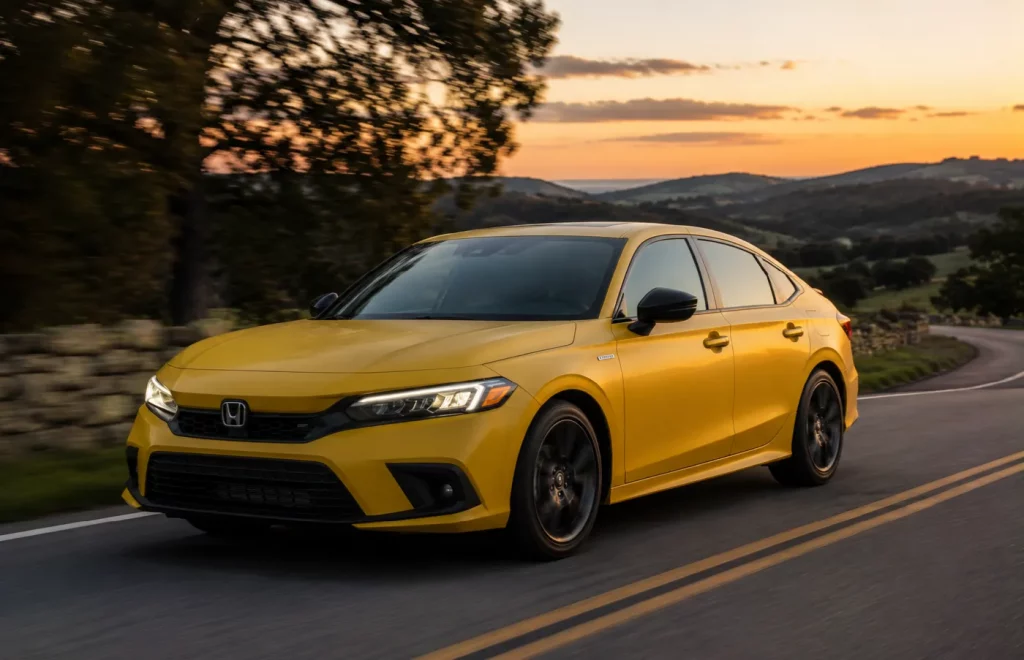
The Elantra Hybrid prioritizes value and efficiency, starting under $27,000 with up to 54 mpg. The Civic Hybrid delivers significantly more power and refinement, but AT a higher price point and with hybrid versions available only on premium trims. This isn’t a comparison about which hybrid is greener — it’s a comparison about which hybrid makes more sense for your budget, your driving style, and your long-term ownership priorities.
The sources themselves are split: Edmunds and Autoblog lean toward the Civic as a more complete product, while Road Ethos and KBB directly call the Elantra Hybrid the more advantageous choice “by the totality of what matters to most buyers” (price, fuel economy, warranty) — even while acknowledging the Civic is objectively more pleasant to drive. This is the central tension of the article: there is no single right answer, only two different sets of priorities.
The Hyundai Elantra Hybrid is the value champion — lower entry price ($26,695 vs $30,000+), best-in-class fuel economy (up to 54 mpg combined), and a 10-year/100,000-mile powertrain warranty. The Honda Civic Hybrid is the performance and refinement champion — 200 horsepower (vs 139), more engaging driving dynamics, a more premium interior, and available hatchback body style. Choose the Elantra Hybrid for maximum value and efficiency; choose the Civic Hybrid for power, driving enjoyment, and long-term ownership satisfaction.
The Price Gap — Where the Elantra Hybrid Wins
The Hyundai Elantra Hybrid is significantly more affordable. The 2025 Elantra Hybrid Blue starts at just $25,450 (2025 model year), making it one of the least expensive new hybrids available in America. More recent 2026 comparisons show the Elantra Hybrid at $26,695 against the Civic Hybrid at $30,590 — roughly a $3,900 difference. Honda, by contrast, builds hybrid versions only of higher-end Civic trims, so the least expensive Civic Hybrid starts at over $30,000.
However, the gap narrows when comparing similarly equipped models. The top-tier Elantra Hybrid Limited at $30,600 is only $500 more than the Civic Sport Hybrid sedan at $30,100 — yet the Limited comes significantly better equipped with cooled front seats, a 10.3-inch touchscreen, a 10.3-inch gauge cluster, Bose audio, and advanced adaptive cruise control.
The Civic Hybrid’s higher price does fetch a slightly higher level of luxury, including real leather seating (vs leatherette in the Elantra), a 12-speaker premium sound system (vs 8 speakers in the Elantra’s Bose setup), and Google built-in technology.
| Model | Starting Price | Horsepower | MPG Combined | Body Styles |
|---|---|---|---|---|
| 2025 Elantra Hybrid Blue | $25,450 | 139 hp | 54 | Sedan |
| 2026 Elantra Hybrid Blue | $26,695 | 139 hp | 54 | Sedan |
| 2026 Civic Hybrid Sedan | $30,100+ | 200 hp | 49 | Sedan |
| 2026 Civic Hybrid Hatchback | ~$31,300+ | 200 hp | 48 | Hatchback |
It’s worth noting that price figures vary between sources depending on model year and trim comparison (some materials show a $1,770 difference in other comparisons). Always verify the current MSRP on manufacturer websites at the time of purchase.
MPG Comparison — Elantra Wins, But the Gap Varies
The Elantra Hybrid Blue is the fuel-economy champion. It achieves 51 mpg city, 58 mpg highway, and 54 mpg combined — the best fuel economy in the compact hybrid class. More well-equipped Elantra Hybrid trims (SEL Sport, Limited) get 50 mpg combined — still better than any Civic version.
The Civic Hybrid sedan achieves 50 mpg city, 47 mpg highway, and 49 mpg combined. The hatchback version drops slightly to 48 mpg combined. The Civic Hybrid gives up 4-5 mpg to the base Elantra Hybrid Blue.
However, in independent real-world testing (not EPA laboratory cycles), both cars tied at 52 mpg during a short real-world loop. A Car and Driver 75-mph highway test recorded the Civic Hybrid at 47 mpg and the Elantra Hybrid at 48 mpg — demonstrating that the real-world difference is often smaller than the EPA ratings suggest. The official advantage is larger on paper, but actual results depend heavily on driving style and conditions.
At 15,000 miles per year, the Civic Hybrid’s 49 mpg would use approximately 306 gallons of fuel, while the Elantra’s 54 mpg would use approximately 278 gallons — a difference of about 28 gallons per year. At $3.80 per gallon, that’s roughly $106 per year. The gap is modest in real dollars.
Performance — The Civic Hybrid’s Knockout Punch
This is where the Civic Hybrid completely changes the conversation. The Honda Civic Hybrid produces 200 horsepower and 232 lb-ft of torque from its 2.0-liter two-motor hybrid system. That’s more power than the Civic Si. The electric assist improves power delivery, giving it the responses and power of a larger-displacement engine. In Edmunds testing, the Civic Hybrid reaches 60 mph in just 6.6 seconds — faster than even the standard Civic Si.
The Hyundai Elantra Hybrid produces just 139 horsepower and 195 lb-ft of torque from its 1.6-liter engine and electric motor. While it feels more powerful than its specifications suggest thanks to strong electric torque, it simply cannot match the Civic’s shove. The Elantra takes approximately 8.4-8.7 seconds to reach 60 mph — roughly 2.5 seconds slower than the Civic.
One reviewer noted: “The difference is a little misleading — the electric motors of both rivals provide enough low-end acceleration that they feel more alike than you might expect. But the Honda will pass on the highway with less use of the accelerator.” The Elantra’s 6-speed DCT can feel hesitant at low speeds, while the Civic’s CVT provides smooth, seamless power delivery.
- 200 HP / 232 lb-ft torque
- More powerful than Civic Si
- 0-60: 6.2-6.6 seconds
- Smooth CVT
- Engaging driving character
- 139 hp / 195 lb-ft torque
- Up to 54 mpg combined
- 0-60: 8.4-8.7 seconds
- 6-speed DCT (hesitant at low speed)
- Quieter, more laid-back
Hybrid Systems — Two Very Different Approaches
The Civic Hybrid uses Honda’s two-motor e:HEV system. A 2.0-liter Atkinson-cycle engine and two powerful electric motors produce 200 hp and 232 lb-ft of torque. There’s no traditional transmission — most city driving is done by the electric motor, with the gas engine acting as a generator. At highway speeds, a clutch directly connects the gas engine to the front wheels. This system provides instant electric torque and seamless power delivery.
The Elantra Hybrid uses a more conventional approach: a 1.6-liter Atkinson-cycle engine and a 43-hp electric motor producing 139 hp total. The electric motor produces 125 lb-ft of torque, and the system total is 195 lb-ft. The 6-speed DCT provides a more traditional shifting feel, which some reviewers found more satisfying than the Civic’s CVT — though others noted the DCT can be hesitant at low speeds.
Driving Experience — Civic Pulls Ahead
The Civic Hybrid is the more engaging car to drive. The steering is both cleaner and has better weighting, making it more predictable. The Civic’s suspension tuning strikes a nice balance between comfort and agility, with little body lean through corners. The brake pedal is firm and progressive, and the overall feedback is consistent. Honda’s Linear Shift Control artificially simulates gear shifts during acceleration, providing a more analog feel.
The Elantra Hybrid, by contrast, feels positively laid-back. It pitches and leans through corners, and its relatively small wheels and tires give up far earlier than those of the Civic. There’s very little feedback at the helm. While the Elantra’s base 16-inch wheels (and 17-inch on higher trims) contribute to its fuel economy advantage, they sacrifice handling precision.
As one review concluded: “Both cars are fuel-efficient, but the Civic is more fun to drive.” Another noted: “It’s almost impressive how un-sporty the Elantra is, if only to highlight the broad capabilities of the platform.”
Interior Quality and Comfort — Civic Feels More Premium
The Civic Hybrid’s interior looks and feels more upscale. Its clean, minimalist design features high-quality materials, and the seats feel supportive on longer drives. Rear passengers have slightly better headroom and visibility. The Civic’s restrained, premium-looking cabin gives it an edge in everyday usability.
The Elantra Hybrid’s interior is nicely laid out, very spacious, and filled with some cheap plastics that you can expect in a sub-$30,000 car. The dashboard design wraps around the driver with a cockpit-style layout, but the materials don’t match the Civic’s quality. The Elantra does offer a gamified efficiency indicator — a rolling ball that changes colors as you accelerate and brake, which reviewers found a handy fuel-economy coach.
The Civic Hybrid is also available as a hatchback, which Hyundai doesn’t offer in the U.S. The hatchback provides significantly more cargo versatility (24.5 cu ft) compared to the Elantra sedan’s 14.2 cu ft.
Technology — Both Are Well-Equipped
The Civic Hybrid offers wireless Apple CarPlay and Android Auto as standard equipment. The top-tier Sport Touring Hybrid features a 12-speaker Bose premium audio system, Google built-in, and a 9-inch touchscreen.
The Elantra Hybrid comes with an 8-inch touchscreen and wireless smartphone connectivity. The Limited trim adds a 10.3-inch infotainment screen, a 10.3-inch gauge cluster, and Bose premium audio (8 speakers). However, you will have to connect your phone manually to the Elantra’s system — it doesn’t offer wireless CarPlay as standard.
Warranty — The Elantra’s Advantage
Hyundai’s warranty is the single biggest advantage the Elantra Hybrid has over the Civic Hybrid. The Elantra comes with a 5-year/60,000-mile basic warranty and an outstanding 10-year/100,000-mile powertrain warranty. The Civic Hybrid’s warranty is the standard 3-year/36,000-mile basic and 5-year/60,000-mile powertrain coverage.
For long-term buyers, the Elantra’s warranty provides significant peace of mind. Major repair costs are covered for far longer, and surprise bills are far less likely.
Which One Should You Buy?
Buy the Hyundai Elantra Hybrid if:
- You want the lowest entry price (under $27,000)
- Maximum fuel economy (up to 54 mpg) is your priority
- You value the 10-year/100,000-mile powertrain warranty
- You want the most affordable hybrid in its class
- You’re willing to accept a less engaging driving experience for better efficiency
- You prefer the more traditional feel of a DCT transmission
Buy the Honda Civic Hybrid if:
- You want significantly more power (200 hp vs 139 hp)
- You value driving engagement and handling precision
- You want a more premium interior with better materials
- You need a hatchback body style for cargo versatility
- You’re willing to pay the premium for a more refined experience
- You spend significant time on the highway where the Civic’s power advantage is most noticeable
Final Verdict
The Hyundai Elantra Hybrid is the value champion. It costs less to buy, has the best fuel economy in the class, and offers the longest warranty. The Elantra Hybrid Blue at $26,695 is one of the most affordable hybrids you can buy, and its up-to-54-mpg fuel economy is unmatched.
The Honda Civic Hybrid is the better car to drive. It’s significantly more powerful, handles better, has a more premium interior, and offers a hatchback body style. The Civic Hybrid is for buyers who want hybrid efficiency without sacrificing driving enjoyment.
The difference is about $4,000 and a very different driving experience. Choose the Elantra Hybrid for maximum value and efficiency; choose the Civic Hybrid for power, refinement, and driving enjoyment.
FAQ — Civic Hybrid vs Elantra Hybrid
Which is more fuel-efficient, the Civic Hybrid or the Elantra Hybrid?
The Elantra Hybrid Blue is more fuel-efficient at 54 mpg combined. The Civic Hybrid achieves 49 mpg combined. More well-equipped Elantra Hybrid trims get 50 mpg combined — still better than any Civic version. However, real-world testing shows the gap is often smaller than EPA numbers suggest.
Which hybrid is faster, the Civic Hybrid or the Elantra Hybrid?
The Civic Hybrid is significantly faster with 200 horsepower and 232 lb-ft of torque, reaching 60 mph in 6.2-6.6 seconds — faster than the Civic Si. The Elantra Hybrid’s 139 horsepower takes 8.4-8.7 seconds to reach 60 mph.
Which hybrid is cheaper, the Civic Hybrid or the Elantra Hybrid?
The Elantra Hybrid is significantly cheaper, starting at $26,695 compared to the Civic Hybrid’s $30,000+ starting price. That’s roughly a $4,000 difference.
Does the Civic Hybrid come as a hatchback?
Yes — Honda offers the Civic Hybrid as both a sedan and a hatchback. The Elantra Hybrid is sedan-only in the U.S.
Which hybrid has better interior quality?
The Civic Hybrid has a more premium interior with higher-quality materials. The Elantra Hybrid is spacious but filled with more cheap plastics.
Which hybrid has better driving dynamics?
The Civic Hybrid has significantly better driving dynamics. It has more precise steering, better weighting, and a suspension that strikes a nice balance between comfort and agility. The Elantra Hybrid is more laid-back and less engaging.
Which hybrid has a better warranty?
The Elantra Hybrid has a better warranty — 5-year/60,000-mile basic and 10-year/100,000-mile powertrain. The Civic Hybrid offers 3-year/36,000-mile basic and 5-year/60,000-mile powertrain coverage.
Does the Civic Hybrid have wireless CarPlay?
Yes — the Civic Hybrid offers wireless Apple CarPlay and Android Auto as standard equipment. The Elantra Hybrid requires a wired connection.
Should I buy a Civic Hybrid or Elantra Hybrid?
Buy the Elantra Hybrid if you want the lowest price, maximum fuel economy (up to 54 mpg), and a longer warranty. Buy the Civic Hybrid if you want more power, better driving dynamics, a more premium interior, and a hatchback option. The Elantra is for value and efficiency; the Civic is for driving enjoyment and refinement.
What is the real-world MPG difference?
In one real-world test, both cars tied at 52 mpg during a short loop. Car and Driver’s 75-mph highway test recorded 47 mpg for the Civic and 48 mpg for the Elantra. The Elantra’s official advantage is larger, but actual results depend on driving style and conditions.