

For decades, enthusiasts have debated the merits of front-wheel drive versus all-wheel drive in affordable performance cars. The Honda Civic Si and Subaru WRX represent two very different answers to the same question: how do you make a practical sedan that’s genuinely fun to drive in all conditions?
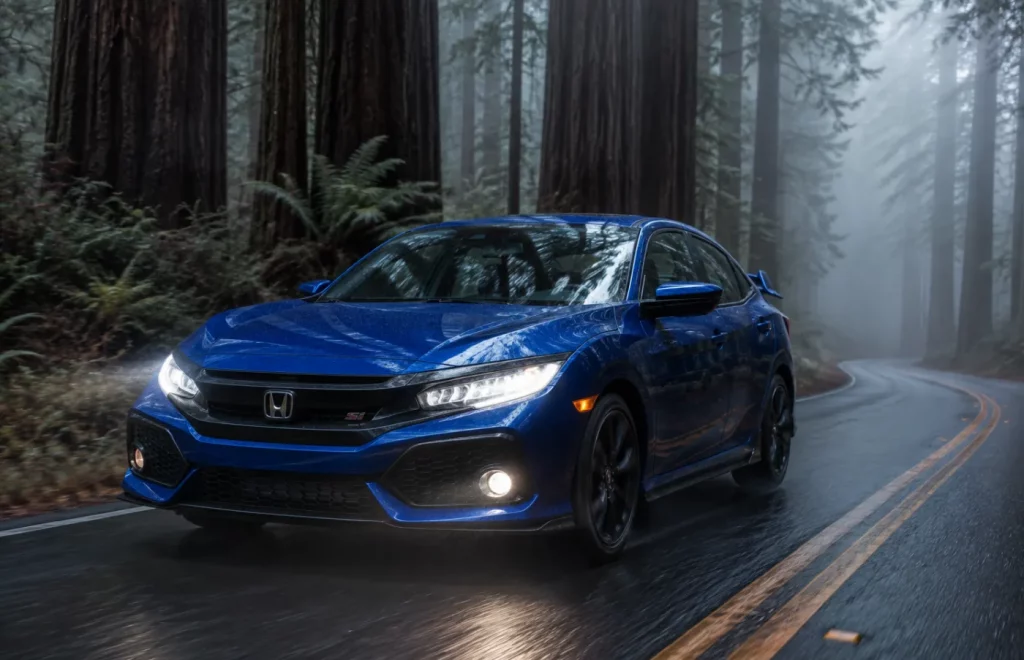
The Civic Si is a front-wheel-drive Sport Compact with a helical limited-slip differential, a 1.5-liter turbocharged engine producing 200 horsepower and 192 lb-ft of torque, and a price tag starting around $29,000. The Subaru WRX counters with a 2.4-liter turbocharged boxer engine producing 271 horsepower and 258 lb-ft of torque, standard Symmetrical All-Wheel Drive, and a starting price around $32,000.
This isn’t a comparison about which car is objectively better. It’s a comparison about which car makes more sense for your climate, your driving style, and your priorities. And it’s a comparison about whether AWD is really worth the fuel and weight penalty for most drivers.
The Subaru WRX offers significantly more power (271 HP vs 200 hp), standard AWD for all-weather confidence, and a more versatile driving experience. The Civic Si is lighter, more fuel-efficient, and more affordable, with sharper handling on dry pavement. The WRX is the better year-round performer in harsh winters; the Si is the better budget-friendly enthusiast car for milder climates. Choose based on your winter conditions and priorities.
Price Clarification — Understanding the Gap
One source suggests the WRX costs only $1,000 more than the Si in specific trim comparisons, while broader range data shows a much larger gap ($37,369-50,192 for WRX versus $25,743-32,395 for Civic). The key is comparing like-for-like trims rather than ranges against ranges. The Si is the affordable entry point; the WRX commands a premium for its AWD system and larger engine.
| Specification | Honda Civic Si | Subaru WRX |
|---|---|---|
| Engine | 1.5L turbo I4 | 2.4L turbo Boxer |
| Horsepower | 200 hp | 271 hp |
| Torque | 192 lb-ft | 258 lb-ft |
| Drivetrain | Front-wheel drive | All-wheel drive |
| Transmission | 6-speed manual only | 6-speed manual / SPT automatic |
| Curb weight | 2,952 lb | ~3,320 lb |
| 0-60 mph | ~6.6 seconds | ~5.4-5.5 seconds |
| EPA Fuel Economy (city/hwy/comb) | 27/37/31 mpg | 19/26/22 mpg |
| Starting price (approx.) | ~$29,000 | ~$32,000 |
The Real Winter Question: Do You Actually Need AWD?
This is the central question of the article. The answer depends on your specific winter conditions and driving habits.
Where AWD Truly Matters: Subaru’s Symmetrical All-Wheel Drive provides a real advantage in deep snow, unplowed roads, steep uphill starts, and when one wheel is on ice while another has grip. The system distributes torque mechanically to all four wheels, giving the WRX confidence that no FWD car can match in these conditions.
Where FWD + LSD Can Excel: The Civic Si’s helical limited-slip differential transfers torque from a slipping front wheel to the wheel with grip. This is a significant advantage over an open differential, which would simply spin the slipping wheel. In 95% of winter driving situations—plowed roads, packed snow, light slush—the Si with good winter tires is remarkably capable.
The Tire Factor: As one forum member noted: “Good winter tires on a FWD car often deliver better results in terms of handling than AWD on all-seasons.” The AWD system can help you get moving, but it doesn’t help you stop—that’s entirely about tires. A Civic Si on quality winter tires will out-brake and out-corner a WRX on all-seasons in snowy conditions. Don’t let marketing convince you that AWD replaces the need for proper tires.
- Excellent in plowed conditions
- LSD transfers torque to gripping wheel
- Stops and corners as well as AWD
- Lower fuel costs
- Lighter, more agile feel
- Superior in deep snow
- AWD provides ultimate confidence
- Excellent uphill starts
- Higher fuel consumption
- Heavier, more planted feel
FWD + Helical LSD — How Good Is the Si Actually?
The helical limited-slip differential in the Civic Si is one of its most underrated features. Unlike an open differential that sends power to the wheel with the least resistance, the LSD actively distributes torque to both front wheels based on available grip.
In practical terms, this means the Si can pull itself through snowy intersections where an open-diff FWD car would simply spin one wheel. On snow-covered corner exits, the LSD helps the car rotate and maintain forward momentum. On uphill starts, it reduces the chance of being stuck with one wheel on ice.
As Honda describes it, the Helical LSD reduces front-wheel slip and improves control during acceleration in corners. It’s not AWD, but it’s a significant step above a standard open differential.
WRX AWD — Where Subaru Actually Wins
There’s no point arguing against the obvious. The WRX’s Symmetrical AWD is superior in several specific winter scenarios:
- Deep snow: The WRX can plow through accumulations that would high-center the Si
- Steep uphill starts: AWD distributes torque to all four wheels, preventing wheelspin
- Uneven traction: When one wheel is on ice and another on pavement, AWD provides grip that FWD cannot match
- Slush and ruts: The WRX tracks more confidently through slushy conditions
- Unplowed roads: In rural areas without regular plowing, AWD is a genuine advantage
Subaru positions the WRX as a rally-inspired performance car with all-weather capability. The AWD system is the primary reason to choose the WRX over the Si.
Winter Tires: The Variable That Changes Everything
This is the single most important concept in this comparison. Many drivers overestimate what AWD provides and underestimate what tires provide.
AWD helps you go. Tires help you stop and turn. In winter conditions, stopping distance is often more important than acceleration. A Civic Si on Blizzak WS90s will stop significantly shorter than a WRX on all-seasons, regardless of which car has AWD.
For a fair comparison, both cars should be on quality winter tires. With that assumption, the WRX still has the advantage in deep snow and uphill starts, but the Si is remarkably capable in the majority of winter driving situations.
For the overwhelming majority of daily winter driving on plowed, treated roads, a FWD car with LSD and good winter tires is entirely adequate. AWD gives a real advantage mainly in frequent off-road or heavily snow-covered conditions—rural areas, mountain regions, unplowed roads.
Performance: WRX Is Simply Faster, Si Is More Agile
When the snow melts, the character of these cars diverges completely.
WRX Performance Advantage: With 271 hp and 258 lb-ft, the WRX reaches 60 mph in 5.4-5.5 seconds—more than a full second quicker than the Si. The AWD launch is brutal, and the boxer engine provides aural drama that the Si’s 1.5-liter cannot match.
Si Agility Advantage: The Si is approximately 370 pounds lighter than the WRX. This translates into sharper turn-in, less body roll, and a more nimble feel on back roads. The Si’s handling on dry pavement is precise and engaging, with steering that communicates directly to the driver.
One owner who owned both noted: “The SI will probably out-handle the WRX stock vs stock.” The Si is the better canyon carver; the WRX is the better all-weather performer.
Fuel Economy — The Si’s Decisive Advantage
The Civic Si achieves 27/37/31 mpg city/highway/combined. The Subaru WRX with the 6-speed manual achieves approximately 19/26/22 mpg. The difference is significant—roughly 9 mpg combined.
Over 15,000 miles per year, the Si uses approximately 484 gallons of fuel compared to the WRX’s roughly 682 gallons. AT $3.80 per gallon, the Si costs roughly $1,839 per year in fuel, while the WRX costs $2,592—a difference of $753 per year. Over five years, that’s nearly $3,800 in additional fuel costs for the WRX.
Interior and Daily Comfort — Si Wins
The Civic Si’s interior is widely regarded as superior. The Sport seats provide excellent lateral support, the 9-inch touchscreen is responsive, the 12-speaker Bose audio system is genuinely premium, and wireless Apple CarPlay is standard. The interior is quiet, well-assembled, and comfortable for daily use.
The WRX’s interior is functional but less refined. The vertical 11.6-inch Starlink screen can be slow and unintuitive. Climate controls are buried in menus. The cabin is noisier, with significant road and transmission noise. The materials are less premium, and the overall feel is more utilitarian than the Si.
As one owner noted: “The Si has a nicer interior than any WRX I’ve seen.”
Reliability — Civic Si Takes the Edge
Consumer Reports ranks Subaru first overall, with Honda fourth . However, real-world owner experiences suggest a more nuanced picture. The Civic Si is widely regarded as more reliable than the WRX. One forum member stated: “from a reliability standpoint, the Civic Si wins hands down.”
The WRX’s reliability reputation has improved, but the Civic Si’s simpler FWD drivetrain and less stressed engine contribute to its long-term durability. The WRX’s AWD system has more moving parts (transfer case, rear differential, driveshaft)—potentially more service points and failure points in old age.
iSeeCars data gives Honda a higher quality and reliability score than Subaru for the Civic, though specific figures vary by model year.
Which One Is Better for Winter?
| Scenario | Winner |
|---|---|
| Deep snow | WRX |
| Starting uphill in snow | WRX |
| Ice (with winter tires on both) | Depends heavily on tires |
| Packed snow | WRX |
| Plowed roads | Si (excellent with winter tires) |
| Cold dry pavement | Si |
| Fuel economy | Si |
| Straight-line performance | WRX |
| Daily commuting | Si |
| Winter confidence | WRX |
Which One Should You Buy?
Buy the Subaru WRX if:
- You live in a region with severe winters (5-6 months of snow, unplowed roads)
- You need the ultimate all-weather capability
- You frequently drive on unplowed or heavily snow-covered roads
- You value AWD traction above all else
- You’re willing to accept lower fuel economy and a less refined interior
Buy the Honda Civic Si if:
- You live in a city or suburb where roads are regularly plowed
- You’re willing to invest in quality winter tires
- You prioritize fuel economy and lower running costs
- You value a refined interior with premium audio and technology
- You prefer a lighter, more agile driving experience
Final Verdict
The Subaru WRX is the better car for severe winter conditions. Its Symmetrical AWD provides confidence and capability that no FWD car can match in deep snow, steep hills, and unplowed roads. The WRX is the ultimate all-weather performance sedan.
The Honda Civic Si is the better daily driver for most people. It’s lighter, more fuel-efficient, more refined, and more affordable. With quality winter tires, the Si’s FWD and LSD handle the vast majority of winter driving conditions. The Si is the smarter choice for drivers who prioritize fuel economy, interior quality, and daily driving engagement over ultimate all-weather capability.
As one owner who had both concluded: “That’s why I think the WRX is the best sports car out there if you can only have one car. Its fast, can be made faster easily, handles decent, brakes decent, its reliable and good on gas, it can be used all year long snow or shine, and they got 4 doors.” But for many, the Si is the more sensible and enjoyable daily driver.
FAQ — Civic Si vs Subaru WRX
Which is faster, the Civic Si or the Subaru WRX?
The Subaru WRX is significantly faster. With 271 horsepower and 258 lb-ft of torque, it reaches 60 mph in 5.4-5.5 seconds compared to the Civic Si’s 6.6-6.8 seconds. The WRX has a 71-horsepower advantage and AWD launch traction.
Which car is better in winter?
The Subaru WRX is significantly better in winter. Its Symmetrical All-Wheel Drive provides superior traction in snow and ice, especially on unplowed roads, uphill starts, and deep snow. The Civic Si with quality winter tires is capable in most winter conditions, but AWD is superior in severe weather.
Does the Civic Si have all-wheel drive?
No — the Civic Si is front-wheel drive only with a helical limited-slip differential. The Subaru WRX is the only car in this comparison with standard all-wheel drive.
Which car is more reliable?
The Civic Si has a stronger reputation for long-term reliability. While Consumer Reports ranks Subaru first overall, owner experiences suggest the Si is more durable and less prone to issues. The WRX’s AWD system has more moving parts and potential failure points.
Which has better fuel economy?
The Civic Si has significantly better fuel economy at 27/37/31 mpg compared to the WRX’s 19/26/22 mpg. The difference is about 9 mpg combined, saving roughly $750 per year in fuel costs.
Which car has better handling?
The Civic Si has better handling on dry pavement due to its lighter weight (2,952 lb vs 3,320 lb) and precise steering. The WRX has better handling in poor conditions due to its AWD system. Stock for stock, the Si is more agile; the WRX is more planted.
Is the WRX worth the extra money?
If you need all-weather capability and want more power, yes. The WRX offers 71 more horsepower and standard AWD. If you live in a mild climate and prioritize fuel economy and interior quality, the Si is the better value.
Which car has a better interior?
The Civic Si has a significantly better interior — premium materials, 12-speaker Bose audio, responsive 9-inch touchscreen, and comfortable sport seats. The WRX’s interior is functional but less refined, with a slower infotainment system and cheaper materials.
Should I buy a Civic Si or Subaru WRX?
Buy the Civic Si if you want a more affordable, fuel-efficient, refined daily driver with excellent handling on dry pavement. Buy the Subaru WRX if you need all-weather capability and want significantly more power. The Si is for value and engagement; the WRX is for performance and all-season confidence.
Do I need AWD for winter driving?
For most daily winter driving on plowed, treated roads, good winter tires on a FWD car with LSD are entirely sufficient. AWD provides a real advantage primarily in deep snow, steep unplowed hills, and rural conditions. If you live in a city or suburb with regular plowing, quality winter tires on the Si are often adequate.