

The 2025 Honda Civic Hybrid is not just another efficiency play. It’s a car that has redefined what a compact hybrid can be — and it has the hardware and the awards to prove it. Named North American Car of the Year, the 11th Gen Civic Hybrid delivers 200 horsepower and 232 lb-ft of torque while achieving up to 50 mpg combined. It’s more powerful than the Civic Si, yet it’s designed to sip fuel in city traffic and cruise effortlessly on the highway.
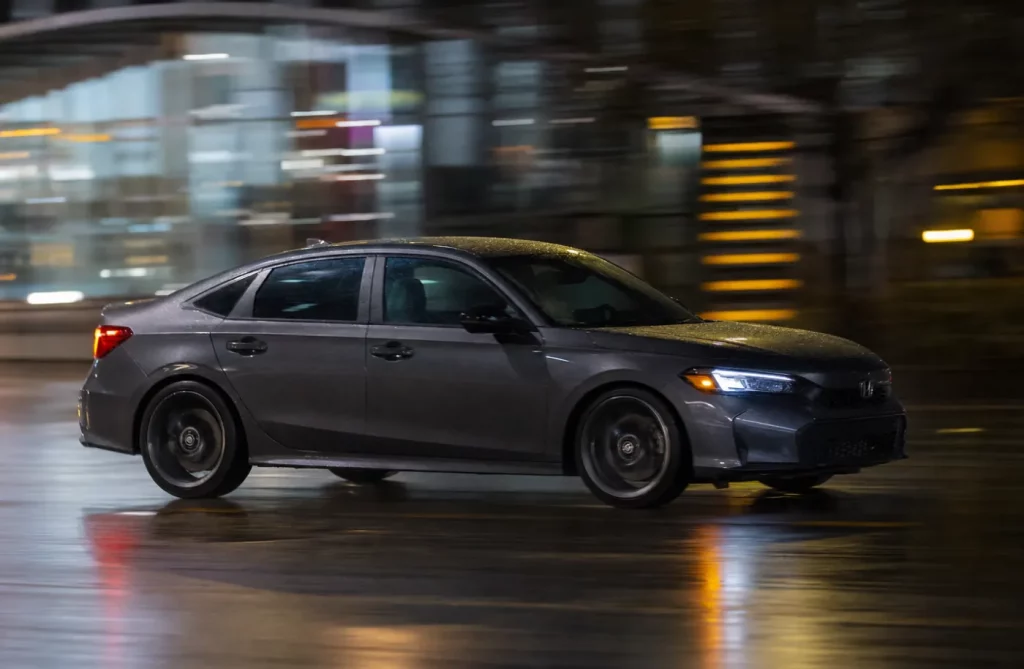
This guide covers everything you need to know about the 2025+ Civic Hybrid — specs, real-world fuel economy, common problems, recall status, and what to inspect before buying a used example. Because this is the first model year of a new generation, the used market is dominated by low-mileage examples — former lease returns, dealer demos, and trade-ins. That’s both an opportunity and a limitation. You get nearly new cars AT a discount, but you don’t get a decades-long reliability history. This guide is built around that reality.
The 2025+ Civic Hybrid is the best all-around Civic for most buyers — 200 hp, 232 lb-ft, 49-50 mpg combined, and available in sedan or hatchback body styles. Real-world fuel economy often exceeds EPA estimates in city driving, though highway efficiency drops at sustained 80 mph speeds. The main concerns are the sticky steering recall (NHTSA 24V-744), Fuel Pump Recall (24V-763), infotainment glitches, seat comfort complaints, and the lack of a spare tire. Long-term reliability data is limited because this is a first-year model. For used buyers, the 2025 model has depreciated roughly 14% in its first year, making it a compelling value. Always verify recall completion and check for software updates.
What You’re Actually Buying — The 11th Gen Civic Hybrid Story
The 11th Gen Civic Hybrid (FE3 sedan, FL3 hatchback) represents a major shift in Honda’s compact car strategy. For the first time in years, Honda has brought a hybrid back to the Civic lineup — and it’s not just an efficiency play. The Civic Hybrid has effectively replaced the top-tier gas-powered EX and Touring trims, becoming the flagship of the non-Si, non-Type R lineup.
This is a significant move. Honda is betting that buyers want hybrid efficiency without sacrificing performance, and the Civic Hybrid delivers on that promise. It’s more powerful than the outgoing gas-powered EX and Touring, more fuel-efficient, and more technologically advanced.
But because this is a new model, the used market is dominated by low-mileage examples — typically former lease returns, dealer demos, and trade-ins. This guide is designed for buyers who understand that “used” here means a car with a few thousand miles, not a decade-old machine with a known history of failures. That’s an important distinction, and it shapes everything that follows.
| Specification | 2025+ Civic Hybrid |
|---|---|
| Chassis Codes | FE3 (Sedan) / FL3 (Hatchback) |
| Engine | 2.0L Atkinson-cycle I4 + two electric motors |
| Combined Horsepower | 200 hp @ 6,000 rpm |
| Combined Torque | 232 lb-ft |
| Transmission | e-CVT (planetary gearset — no belt) |
| Drivetrain | Front-wheel drive |
| Battery Capacity | 1.05 kWh lithium-ion |
| EPA Fuel Economy (Sedan) | 50 city / 47 highway / 49 combined mpg |
| EPA Fuel Economy (Hatchback) | 50 city / 45 highway / 48 combined mpg |
| Fuel Tank Capacity | 10.6 gallons |
| Curb Weight | ~3,208 lbs (Sport sedan) |
| Cargo Space (Sedan) | 14.8 cu ft |
| Passenger Volume | 99.0 cu ft |
| Warranty (Basic) | 3 years / 36,000 miles |
| Warranty (Powertrain) | 5 years / 60,000 miles |
| Warranty (Hybrid Components) | 8 years / 100,000 miles |
Hybrid Architecture — How Honda’s e:HEV System Actually Works
Honda’s two-motor hybrid system in the Civic Hybrid is fundamentally different from Toyota’s e-CVT. Understanding how it works helps you appreciate why it drives the way it does — and what to expect from its long-term behavior.
The Engine: A 2.0-liter four-cylinder Atkinson-cycle engine with direct injection. The Atkinson cycle prioritizes efficiency over peak power by leaving the intake valves open longer during the compression stroke, effectively reducing the Compression Ratio. This improves thermal efficiency but reduces low-end torque — which is exactly why the electric motors are there to fill in.
The Electric Motors: There are two. One acts primarily as a generator, driven by the engine to produce electricity. The second is the traction motor, which drives the front wheels directly through a fixed reduction gear. There is no traditional transmission — no automatic, no CVT belt, no dual-clutch.
How It Drives: At low speeds and in city traffic, the traction motor does most of the work, drawing electricity from the battery or from the generator. The engine only runs when it needs to generate electricity or when the battery needs charging. At highway speeds, a clutch engages to connect the engine directly to the front wheels through a lock-up mechanism. This is the most efficient mode for sustained cruising because it eliminates the energy conversion losses of the hybrid system.
The result is a car that feels like an EV in the city — smooth, silent, and instant — and like a conventional efficient sedan on the highway.
- 200 HP / 232 lb-ft — most powerful compact hybrid
- No belt-driven CVT — planetary gearset
- Instant electric torque from 0 RPM
- Engine locks up directly at highway speeds
- Available sedan and hatchback
- First-year model — long-term reliability data limited
- Sticky Steering recall (24V-744) — verify completion
- Fuel Pump recall (24V-763) — verify completion
- No spare tire — fix-a-flat only
- Seat comfort complaints — test drive extensively
Marketing vs Reality — Real-World Fuel Economy
This is the section that matters most to pragmatic buyers. The EPA ratings are one thing; real-world fuel economy is another. And the Civic Hybrid’s real-world results are genuinely impressive — with some important caveats.
What Honda Promises (EPA Ratings):
- Sedan Sport/Touring Hybrid: 50 mpg city / 47 mpg highway / 49 mpg combined
- Hatchback Sport/Sport Touring Hybrid: 50 mpg city / 45 mpg highway / 48 mpg combined
What Owners Actually Report (11thCivic Forum Data):
In city driving, the Civic Hybrid often exceeds its EPA ratings. Owners report 52-54 mpg in dense urban traffic when using the regenerative braking paddles to maximize energy recovery. The engine shuts off frequently and the car operates on electric power alone for extended periods.
On the highway, the story changes. At sustained 75-80 mph — typical American interstate speeds — fuel economy drops to 41-43 mpg. At these speeds, the engine runs continuously to overcome aerodynamic drag, and the small 1.05 kWh battery can’t provide meaningful assistance. One long-term tester averaged 51.2 mpg over 1,830 miles of mixed driving, while a cross-country trip of 4,785 miles returned 53.8 mpg.
In mountain driving, the numbers drop further. One Colorado test recorded fuel economy falling to approximately 25 mpg in steep uphill sections, though it recovered on descents through regenerative braking.
The Realistic Average: Most owners achieve 46-48 mpg in mixed driving. That’s a fantastic result for a 200-horsepower car. But buyers should understand that if their daily commute is 100% highway at 80 mph, they won’t see 50 mpg — they’ll see closer to 41-43 mpg.
| Driving Condition | EPA Rating | Owner-Reported Average |
|---|---|---|
| City (stop-and-go) | 50 mpg | 52-54 mpg |
| Highway (65-70 mph) | 47 mpg | 45-48 mpg |
| Highway (75-80 mph) | 47 mpg | 41-43 mpg |
| Mountain driving | 47 mpg | ~25 mpg (uphill) / recovery on descent |
| Mixed average | 49 mpg | 46-48 mpg |
Practical Advice: If your typical route is mostly highway or mountain driving, expect closer to 38-42 mpg in average. If your driving is mostly city or suburban, expect 48-52 mpg. The Civic Hybrid excels in urban environments where its electric motors can do most of the work.
Performance — Faster Than You Expect
The Civic Hybrid is genuinely quick for an efficiency-focused car. The 232 lb-ft of torque is delivered instantly by the electric motors, giving it the feel of a larger-displacement engine. Independent testing has recorded 0-60 mph in approximately 6.2 seconds — faster than the Civic Si.
The e-CVT provides smooth, seamless acceleration. Unlike a traditional CVT, there’s no rubber-band effect — the electric motors fill in the gaps, and the gas engine engages only when needed. The transition between electric and gas power is virtually imperceptible. The Civic Hybrid also benefits from Honda’s Linear Shift Control, which simulates gear shifts during acceleration to provide a more traditional driving feel.
By comparison, the Toyota Corolla Hybrid produces just 138 horsepower, and the Hyundai Elantra Hybrid produces 139 horsepower. The Civic Hybrid’s 200 horsepower is a significant competitive advantage — it’s the only compact hybrid that feels genuinely quick.
Known Problems & Recalls — What to Check Before Buying
The 2025 Civic Hybrid is a new model, but it has already accumulated several documented issues. Understanding these before purchase is essential.
1. Sticky Steering Recall (NHTSA 24V-744): This is the most significant issue affecting the Civic Hybrid. The steering wheel can feel momentarily stuck when making small corrections at highway speeds, then suddenly release. This can cause overcorrection and loss of control. The recall affects approximately 1.7 million Honda and Acura vehicles, including the 2025 Civic Hybrid. The fix involves replacing the worm gear spring and redistributing grease. Verify the recall was completed on any used example.
2. High-Pressure Fuel Pump Recall (NHTSA 24V-763): The high-pressure fuel pump may crack and leak fuel, increasing fire risk. This recall affects 720,810 vehicles, including the 2025 Civic and Civic Hybrid. Dealers will inspect and replace the pump as necessary. Verify the recall was completed.
3. Infotainment Glitches: Owners report update errors, Android Auto disconnecting (wired and wireless), and system freezes. This is a common complaint across the Civic lineup. Specifically, some owners report the “power flow” display freezing or going black every 2-3 weeks.
4. Seat Comfort Issues: A significant number of owners complain about seat discomfort, particularly the lack of lumbar support. Some report tailbone and back pain after extended driving. This is one of the most common non-mechanical complaints.
5. No Spare Tire: The Civic Hybrid comes with a can of fix-a-flat instead of a spare tire. If you use it, it can throw off the wheel balance. This is a practical concern for road trips.
6. Thin Paint: Several owners report that the paint is thin and prone to chipping.
7. Road Noise: The cabin can be loud at highway speeds, making hands-free phone conversations difficult.
8. Brake Squeal at Low Speeds: On low-speed braking — parking or approaching a stoplight — the system blends regenerative and physical braking. Some owners report a squealing noise from the front Calipers after 10,000 miles. Cleaning and lubricating the guide pins typically resolves this.
9. Linear Shift Control Hanging: Early software versions had a tendency to “hang” RPMs after hard acceleration, with the engine staying at high RPM longer than expected. Dealer software updates have addressed this.
| Issue | Severity | Action |
|---|---|---|
| Sticky steering (24V-744) | High | Verify recall completion |
| Fuel pump leak (24V-763) | High | Verify recall completion |
| Infotainment glitches | Medium | Test CarPlay/Android Auto |
| Seat comfort | Medium | Test drive extensively |
| No spare tire | Medium | Consider purchasing spare |
| Brake squeal | Medium | Clean/lubricate guide pins |
| Thin paint | Low | Inspect for chips |
Trim Levels — Sport Hybrid vs Sport Touring Hybrid
The Civic Hybrid is available in two trims: Sport Hybrid and Sport Touring Hybrid. Both are available as sedan or hatchback.
Sport Hybrid: The value trim. Includes 18-inch alloy wheels, heated front seats, dual-zone automatic climate control, a 7-inch touchscreen with wired Apple CarPlay and Android Auto, an 8-speaker audio system, and Honda Sensing safety suite. This is the best-value hybrid trim if you want the hybrid powertrain without the premium price.
Sport Touring Hybrid: The premium trim. Adds a 9-inch touchscreen with wireless Apple CarPlay and Android Auto, a 12-speaker Bose premium audio system, a 10.2-inch digital instrument cluster, wireless phone charging, Google Built-in, leather-trimmed seats, and a power moonroof. Choose this if you want the most upscale equipment.
| Feature | Sport Hybrid | Sport Touring Hybrid |
|---|---|---|
| Touchscreen | 7-inch | 9-inch |
| Apple CarPlay/Android Auto | Wired | Wireless |
| Audio System | 8 speakers | 12-speaker Bose |
| Digital Instrument Cluster | No | 10.2-inch |
| Wireless Charging | No | Yes |
| Google Built-In | No | Yes |
| Leather Seats | No (cloth) | Yes |
| Moonroof | Yes | Yes |
Sedan vs Hatchback — Which Body Style?
The Civic Hybrid is available as both a sedan and a hatchback. The sedan offers a traditional trunk with 14.8 cubic feet of cargo space and slightly better highway fuel economy (47 mpg vs 45 mpg). The hatchback provides significantly more versatility with a liftgate and expanded cargo capacity, at the cost of 1-2 mpg on the highway.
For most buyers, the hatchback is the more practical choice. The wide opening makes loading and unloading easier, and the cargo area is more usable for large items. However, the sedan offers slightly better rear visibility and a quieter cabin.
2025 vs 2026 — What Changed?
For the 2026 model year, the Civic Hybrid carries over largely unchanged. There have been no major mechanical updates, and the powertrain remains the same. Minor changes include updated software for the infotainment system and the addition of new color options.
| Feature | 2025 | 2026 |
|---|---|---|
| Powertrain | 2.0L Hybrid, 200 hp | 2.0L Hybrid, 200 hp |
| EPA MPG (Sedan) | 49 combined | 49 combined |
| EPA MPG (Hatchback) | 48 combined | 48 combined |
| Infotainment | 7-inch / 9-inch | 7-inch / 9-inch |
| Recalls | 24V-744, 24V-763 | Same recalls addressed at factory |
| Changes | First year | Software updates, new colors |
Used Market — Why the 2025 Civic Hybrid Makes Financial Sense
The 2025 Civic Hybrid has depreciated significantly in its first year, making it a compelling used buy. Kelley Blue Book data shows the 2025 Civic Hybrid Sport Touring sedan has already depreciated approximately 14% in its first year, with a current resale value around $26,400 — down from an out-the-door MSRP of roughly $32,900.
That’s a substantial discount for a car that’s barely broken in, often still on its factory tires, and well within its original powertrain warranty. Current listings show 2025 Civic Hybrid models with low mileage (under 20,000 miles) priced in the $28,000-$30,000 range. For a car with this level of efficiency, performance, and Honda reliability, that’s a strong value proposition.
- ~14% first-year depreciation
- Still under factory warranty
- Functionally identical to new
- 2025 has most listings
- 29.7% are good/great deals
- Sticky steering recall completed
- Fuel pump recall completed
- CarPlay/Android Auto function
- Seat comfort on test drive
- Accident history (Carfax)
Reliability — An Honest Assessment for a First-Year Model
This is the most important caveat for used buyers. Because the current Civic Hybrid was introduced for the 2025 model year, there is no long-term reliability history. Consumer Reports rates the 2025 Civic Hybrid’s reliability as “average” compared to other vehicles of the same year — a neutral, not alarming, assessment. But it’s not a verdict, because the data simply doesn’t exist yet.
What we do know:
- The hybrid system is the same architecture used in the Accord Hybrid and CR-V Hybrid, which have established reliability records
- Honda offers an 8-year/100,000-mile warranty on hybrid components, separate from the standard powertrain warranty
- Two NHTSA recalls have been issued — the sticky steering recall and the fuel pump recall — both of which should be completed on any used example
What we don’t know:
- How the hybrid battery will degrade over 100,000+ miles
- How the e-CVT and hybrid control electronics will hold up over time
- Whether any long-term wear patterns will emerge in the engine or electric motors
For buyers who prioritize predictability, a used Accord Hybrid — which uses the same powertrain but has a longer market history — may be a safer choice. For buyers who want the latest technology and are willing to accept some uncertainty, the Civic Hybrid is a compelling option.
Pre-Purchase Inspection Checklist
Before buying a used 2025+ Civic Hybrid, run through this checklist.
Recalls & Software:
- Verify sticky steering recall (24V-744) completion
- Verify fuel pump recall (24V-763) completion
- Check for infotainment software updates
- Verify all open recalls are addressed
Test Drive:
- Steering feel at highway speeds — check for stickiness
- Seat comfort — spend at least 20 minutes driving
- Infotainment — test CarPlay/Android Auto connection
- Power flow display — check for freezing or black screen
- Acceleration — verify smooth electric/gas transitions
- Braking — check for smooth regenerative braking
- Regenerative paddle response — test all four levels
- Noise levels — assess road and wind noise
Battery & Hybrid System:
- Check hybrid battery state of health (SoH) with diagnostic scanner
- Verify no error codes in hybrid control module (IPU)
- Check Coolant levels for both engine and inverter cooling circuits
Visual Inspection:
- Paint condition — check for chips and thin areas
- Tire wear — verify even wear and remaining tread
- Wheel condition — check for curb rash
- Interior — check seat wear, especially driver’s bolster
- Cargo area — verify liftgate/trunk operation
History:
- Carfax or AutoCheck report
- Service records
- Accident history
- Number of owners
- VIN check for open recalls
Why the Civic Hybrid Stands Out Against Competitors
The Civic Hybrid competes primarily with the Toyota Corolla Hybrid and Hyundai Elantra Hybrid. Here’s how it compares.
Against Corolla Hybrid: The Corolla Hybrid produces 138 horsepower. The Civic Hybrid produces 200. That’s a 62-horsepower advantage. The Corolla Hybrid achieves 50 mpg combined; the Civic Hybrid achieves 49 mpg combined. The Civic is faster, more refined, and more engaging to drive. It costs more, but it delivers more.
Against Elantra Hybrid: The Elantra Hybrid produces 139 horsepower and achieves 54 mpg combined in Blue trim. The Civic Hybrid is significantly faster but slightly less fuel-efficient. The Elantra Hybrid has a lower entry price and a longer warranty. The Civic Hybrid has a better interior, better driving dynamics, and more available equipment.
For a full comparison of the Civic Hybrid vs Elantra Hybrid, see our dedicated article.
Final Thought
The 2025+ Honda Civic Hybrid is the best all-around Civic for most buyers. It delivers 200 horsepower, 232 lb-ft of torque, and 49-50 mpg combined — a combination that no other compact hybrid can match. Real-world fuel economy often exceeds EPA estimates in city driving, though highway efficiency drops at sustained 80 mph speeds.
The main concerns are the sticky steering recall, fuel pump recall, infotainment glitches, and seat comfort. These are documented issues that should be addressed before purchase. For used buyers, the 2025 model’s first-year depreciation makes it a compelling value — you get a nearly new car with full warranty coverage at a significant discount.
If you’re shopping for a used Civic Hybrid, prioritize examples with completed recalls, verified service history, and a thorough test drive to assess seat comfort and infotainment functionality. And remember: this is a first-year model, so long-term reliability data is limited. If predictability is your top priority, consider a used Accord Hybrid as an alternative with the same powertrain and a longer track record.
FAQ — 2025+ Civic Hybrid Buyer’s Guide
What is the real-world fuel economy of the 2025 Civic Hybrid?
Real-world fuel economy often exceeds EPA estimates in city driving (52-54 mpg), but drops at sustained highway speeds (41-43 mpg at 75-80 mph). Mixed driving averages 46-48 mpg. The EPA rates the sedan at 50/47/49 mpg (city/highway/combined) and the hatchback at 50/45/48 mpg.
How fast is the 2025 Civic Hybrid?
The Civic Hybrid reaches 60 mph in approximately 6.2 seconds — faster than the Civic Si. It produces 200 horsepower and 232 lb-ft of torque, with instant electric torque delivery.
What is the sticky steering recall on the Civic Hybrid?
The sticky steering recall (NHTSA 24V-744) affects approximately 1.7 million Honda and Acura vehicles, including the 2025 Civic Hybrid. The steering wheel can feel momentarily stuck at highway speeds, then suddenly release. The fix involves replacing the worm gear spring and redistributing grease.
Does the Civic Hybrid have a spare tire?
No — the Civic Hybrid comes with a can of fix-a-flat instead of a spare tire. If you use it, it can throw off the wheel balance. Consider purchasing a spare tire for road trips.
What are the most common complaints about the Civic Hybrid?
Common complaints include seat discomfort (lack of lumbar support), infotainment glitches (CarPlay disconnects, power flow screen freezing), no spare tire, thin paint, road noise at highway speeds, and brake squeal at low speeds.
Is the Civic Hybrid good for daily driving?
Yes — the Civic Hybrid is excellent for daily driving. It’s smooth, efficient, and comfortable. The e-CVT provides seamless power delivery, and the electric motors handle most city driving. The main drawbacks are seat comfort for some drivers and road noise at highway speeds.
What is the difference between Sport Hybrid and Sport Touring Hybrid?
Sport Hybrid is the value trim with a 7-inch touchscreen, wired CarPlay, and cloth seats. Sport Touring Hybrid adds a 9-inch touchscreen, wireless CarPlay, 12-speaker Bose audio, a 10.2-inch digital cluster, wireless charging, Google Built-in, and leather seats.
Is the Civic Hybrid faster than the Civic Si?
In 0-60 acceleration, yes — the Civic Hybrid reaches 60 mph in approximately 6.2 seconds, while the Civic Si takes about 6.6 seconds. The Hybrid’s instant electric torque gives it a strong advantage off the line.
What should I check before buying a used Civic Hybrid?
Verify the sticky steering recall (24V-744) and fuel pump recall (24V-763) are completed. Test the infotainment for glitches, specifically the power flow display. Spend at least 20 minutes assessing seat comfort. Check hybrid battery state of health. Get a Carfax report and verify service history.
Does the Civic Hybrid hold its value?
The 2025 Civic Hybrid has depreciated approximately 14% in its first year, making it a compelling used buy. The 2025 model years have held their value best, with the smallest year-over-year price changes. Clean examples with completed recalls and low mileage command premium prices.
Is the Civic Hybrid reliable?
Long-term reliability data is limited because this is a first-year model. Consumer Reports rates the 2025 Civic Hybrid’s reliability as “average” compared to other vehicles of the same year. The hybrid system shares its architecture with the Accord Hybrid and CR-V Hybrid, which have established records. Honda offers an 8-year/100,000-mile warranty on hybrid components.
Should I buy a used Civic Hybrid or wait?
Buy now if you want to be among the first users of a new platform, value the North American Car of the Year award, and want more power than competitors. Wait if predictability is your top priority — consider a used Accord Hybrid, which uses the same powertrain but has a longer market history.