

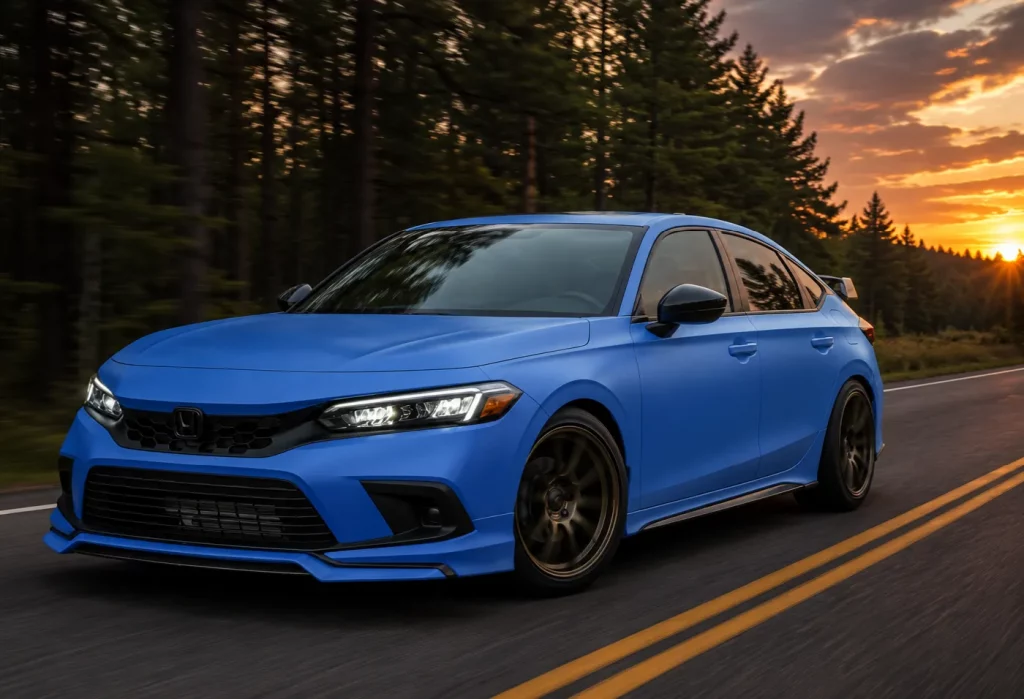
The 2025 Honda Civic Hybrid is a different car than any Civic that came before it. It is the first Civic hybrid sold in the US since the 2015 model year. It uses Honda’s fourth-generation two-motor hybrid system — the same architecture found in the Accord Hybrid and CR-V Hybrid — and produces 200 horsepower with 232 lb-ft of torque, which is more twist than the Civic Si. The EPA rates it AT 50 city / 47 highway / 49 combined MPG. On paper, it looks like the rational choice against the gas-only Civic, the Toyota Corolla Hybrid, and the Hyundai Elantra Hybrid. The first year of owner data and long-term press fleet testing gives a more complete picture than the spec sheet.
Real-World Fuel Economy — The Range Is Wide
The EPA numbers are achievable under the right conditions, but real-world fuel economy varies significantly depending on temperature, driving style, and road type. Three independent long-term tests cover the spread. Source: MotorTrend yearlong review (Kristen Lee, 16,058 miles over 11 months), The Drive two-month review (Jerry Perez, 1,830 miles), MotorTrend cross-country trip (3,090 miles, LA to NYC).
| Test Condition | MPG Achieved | vs EPA Combined (49) | Source |
|---|---|---|---|
| City-heavy driving (60% city) | 51.2 combined | +2.2 mpg (beats EPA) | The Drive, 1,830 mi |
| Long-term average (11 months) | 43.7 combined | -5.3 mpg | MotorTrend, 16,058 mi |
| Cross-country highway (75 mph avg) | ~38 mpg | -11 mpg | MotorTrend, 3,090 mi |
| Winter months (Dec–Jan) | 32.8 combined | -16.2 mpg (~20% drop) | MotorTrend, Northeast US |
| High-altitude mountain pass | 25.1 mpg | -23.9 mpg (worst recorded) | MotorTrend, Eisenhower Tunnel, 11,158 ft |
| Hypermiling (70 mph cruise, flat) | 44.7 mpg | -4.3 mpg | MotorTrend, Utah |
The key takeaway: the hybrid system is optimized for city driving, where regenerative braking and low-speed EV mode maximize efficiency. Highway cruising at 75+ mph drops MPG noticeably because the car is heavier than the gas Civic (3,252 lbs vs approximately 2,950 lbs for a gas Sport) and the 2.0-liter Atkinson engine is working harder to maintain speed. Winter cold reduces battery performance and forces the engine to run more frequently for cabin heat, cutting MPG by approximately 20%. Owners on Civic11Forum in cold climates (Wisconsin, the Northeast) report similar winter drops — some seeing as low as 30–33 mpg in January and February. Source: Civic11Forum — Cold weather mileage dropoff thread (sjq81, Wisconsin, December 2025).
The Hybrid Powertrain — What Owners Report
The fourth-generation two-motor hybrid system uses a 2.0-liter Atkinson-cycle four-cylinder engine paired with two electric motors and a 1.1 kWh lithium-ion battery. The system has no traditional transmission — Honda calls it an eCVT, but it is not a belt-driven CVT. It uses a direct-drive lockup clutch that connects the engine to the wheels at highway speeds, bypassing the electric motors entirely for efficiency. Sources: Honda Info Center — Two-Motor Hybrid System (2025 Civic Sedan Feature Guide), The Drive review.
The Drive’s Jerry Perez gave the car a 9.5/10 after two months of ownership. He noted that the transition between electric and gas power is seamless — “no clunk or jolt felt at the pedals or steering wheel.” The car can sustain EV mode up to 75 mph on a flat road, which is unusual for a non-plug-in hybrid. The 232 lb-ft of torque from 0 rpm gives it a “slingshot” feel off the line that several reviewers and owners describe as genuinely fun — more urgent than the gas Civic’s 158 hp and 138 lb-ft.
However, highway passing power is a weakness. The electric motor’s torque advantage fades above 60 mph, and the 2.0-liter Atkinson engine makes only 141 HP on its own. MotorTrend’s Kristen Lee noted “the lack of more passing power” on the highway. At high altitude (Colorado, Eisenhower Tunnel at 11,158 feet), the naturally aspirated Atkinson engine struggled — MPG dropped to 25.1 and the “engine droned more frequently.”
The only consistent powertrain annoyance reported by owners is the engine start-up noise. The gas engine is described as “unrefined and loud” when it turns on, briefly interrupting an otherwise quiet cabin (The Drive review). This is a characteristic of the Atkinson-cycle starter-generator design, not a defect.
Reliability — First-Year Data Is Encouraging but Incomplete
A Civic11Forum reliability poll of 2025–2026 Civic Hybrid owners asked: “Reliable or not due to issues?” All 25 respondents voted “Reliable” — 100% positive. Source: Civic11Forum — ’25-’26 Civic Hybrid reliability feedback (November 2025).
CarComplaints.com logs 16 total user complaints and 7 NHTSA complaints as of mid-2026. The most commonly reported issues are electronic — center display freezing, multiple warning lights appearing simultaneously, and one steering-related complaint. These are consistent with a first-model-year vehicle where software bugs are more common than mechanical failures. Source: CarComplaints.com — 2025 Honda Civic Hybrid.
The CEL / emissions warning has appeared on at least one car at 10,500 miles. Owner swEng13 on Civic11Forum reported a check engine light with an “Emissions Problem” message. The dealership diagnosed and repaired it under warranty, though the specific root cause was not posted. Source: Civic11Forum — Check Engine Light / Emissions Problem thread (September 2025).
| Issue | Frequency | Severity | Source |
|---|---|---|---|
| Center display freezing / multiple warnings | Low (3–5 reports) | Moderate — requires dealer reset | CarComplaints, Civic11Forum |
| Check engine / emissions warning | Single report at 10.5K mi | Warranty repair — root cause TBD | Civic11Forum |
| Steering system complaint | 1 NHTSA report | Unknown — single data point | NHTSA |
| Low-pressure fuel pump recall | Affects 720K Honda hybrids | Fuel leak risk — free dealer repair | NHTSA, Honda (October 2024) |
| Passenger seat weight sensor recall | Recall issued May 2026 | Airbag may deploy unintentionally | NHTSA, CR (May 2026) |
| MotorTrend fleet (16K mi) | 0 issues | No days out of service | MotorTrend yearlong review |
The Fuel Pump Recall (October 2024) affects approximately 720,000 Honda hybrid vehicles including 2023–2024 Accord Hybrid, 2025 Civic Hybrid, and others. The pump may crack and leak fuel. The repair is free and covered under a Honda safety recall. Source: NHTSA, GreenCarReports (October 2024).
What Owners Love
Seamless hybrid operation. The eCVT has no shift shock. Owners on Civic11Forum consistently praise how the car switches between EV and hybrid modes without the driver noticing. The car can run on electric power alone at speeds up to 75 mph, which makes it feel more like an EV than a traditional hybrid in daily driving.
City fuel economy. In stop-and-go traffic where the gas Civic returns 28–32 mpg, the hybrid returns 50+ in warm weather. Owners who drive primarily in urban areas report the biggest satisfaction gap versus the gas model. The Drive’s test achieved 53+ mpg on a city-only tank.
Low running costs. Two scheduled services in MotorTrend’s 16,058-mile test cost $118.83 each — oil change, tire rotation, TPMS recalibration. The 10.6-gallon tank costs approximately $28–38 to fill depending on regional fuel prices, and the car covers 400–420 miles between fill-ups in mixed driving. The regenerative braking pads should last significantly longer than a gas Civic’s.
Standard equipment on Sport Touring. The $33,100 trim includes heated leather seats, dual-zone climate control, a moonroof, wireless Apple CarPlay and Android Auto, a 12-speaker Bose sound system, Honda Sensing ADAS with excellent lane-keeping assist, and native Google apps with in-car LTE data for three years.
Driving dynamics. The Civic chassis remains class-leading even with the extra hybrid weight. The battery is mounted low in the floor, so the center of gravity is nearly identical to the gas car. The steering is direct and well-weighted — MotorTrend called it “a no-frills joy.” Several owners note that the hybrid’s instant torque makes it feel quicker in the city than the 200 hp number suggests.
What Owners Dislike
Small fuel tank. The 10.6-gallon tank is 1.8 gallons smaller than the gas Civic’s 12.4 gallons because the hybrid battery occupies space under the rear seat that the gas tank normally uses. MotorTrend noted “the Honda needed to stop more frequently than I did” on a cross-country trip. In real terms, the hybrid has a 400–420 mile range compared to approximately 450–500 miles for the gas car.
Highway fuel economy below expectations. The EPA highway rating of 47 mpg is optimistic for real-world conditions. Owners report 38–42 mpg at 70–75 mph. The car is aerodynamically efficient but the Atkinson engine is less efficient at sustained higher RPM than a traditional Otto-cycle engine. Buyers who do mostly highway driving will see less benefit from the hybrid premium.
Winter MPG drop. The approximately 20% winter efficiency loss is higher than the typical 10–15% drop seen in gas-only Civics. The hybrid battery loses capacity in cold weather, and the engine runs more frequently to keep the cabin warm. Owners in northern states (Wisconsin, Minnesota, New York) report 30–35 mpg in January. This is not unique to Honda — all hybrids lose efficiency in cold weather — but the gap between EPA rating and winter real-world numbers is larger than most buyers expect.
Missing features. No heated steering wheel at any trim level. No memory seat positions. No rear climate vents for passengers. No low windshield washer fluid warning (Canadian-spec Civics have it; US models do not). These omissions are frustrating on a $33,000 car. MotorTrend noted the lack of a heated steering wheel as “a significant miss.”
Thin seat foam. MotorTrend’s Kristen Lee developed hip pain within one hour of driving and had to buy a gel seat cushion at Walmart during a cross-country road trip. This is a subjective complaint — The Drive’s Jerry Perez did not mention it — but it came from a professional reviewer who spent thousands of miles in the car. Prospective buyers with back issues should test the seats before purchase.
Road noise. The Civic Hybrid’s cabin is quieter than the gas version at low speeds because the electric motor is silent, but at highway speeds road noise is noticeable. MotorTrend noted that “audiobooks are where the Civic’s loud road manners detract from the experience” — requiring the volume to be cranked up significantly.
Price creep. The Sport Hybrid starts at $30,490 and the Sport Touring Hybrid at $33,100. That is approximately $5,000–7,000 more than a base Civic LX and $3,000 more than a comparable gas Sport. The premium pays for itself in fuel savings over approximately 60,000–80,000 miles depending on driving conditions, but the upfront cost is a barrier for budget-conscious buyers.
Who Should Buy It vs Who Should Not
The Civic Hybrid makes sense for the urban and suburban driver who does 60% or more city miles, values fuel economy and low running costs, and wants a car that drives better than a Prius. The 200 hp powertrain is genuinely enjoyable in the city, and the 51+ mpg city rating is real in warm weather.
The Civic Hybrid is harder to justify for the highway commuter who drives 70+ mph for most of their miles. The fuel economy advantage over the gas Civic shrinks to 5–8 mpg on the highway, and the $3,000–5,000 price premium takes much longer to recover. For mountain drivers, the naturally aspirated Atkinson engine struggles at altitude. For cold-climate drivers, expect 30–33 mpg in the winter months.
Buyers who want the most engaging manual-transmission Civic should look at the Si. The Hybrid is not sporty in the Si sense — it is quick off the line but does not have the Si’s limited-slip differential, adaptive dampers, or shifter feel. The two cars serve different purposes.
Quick Reference
☐ Real-world MPG: 38–51 mpg depending on season, driving style, and road type. City driving delivers the best results
☐ Winter MPG drop: approximately 20% — expect 30–35 mpg in cold months
☐ Fuel tank: 10.6 gallons. Real range 350–420 miles. More fill-ups than gas Civic
☐ Reliability: 100% positive owner poll (25 votes, Civic11Forum). First-year data is encouraging but the car has only been on sale 18 months
☐ Recalls: Fuel Pump (October 2024, free repair) — check VIN at recalls.honda.com
☐ CEL / emissions issue reported at 10.5K miles on one car — not yet a pattern
☐ No heated steering wheel. No memory seats. No rear vents. Test seat comfort on long drives
☐ Highway passing power is adequate but not strong — plan passes with room
☐ Engine start-up noise is the most common NVH complaint
☐ eCVT is smooth — no shift shock. Can sustain EV mode up to 75 mph
☐ MotorTrend long-term fleet: 0 days out of service, 2 service visits in 16,058 miles at $118.83 each
☐ The Drive scored it 9.5/10 — the highest score from a major publication
☐ If buying used, verify the low-pressure fuel pump recall was completed via the dealer or NHTSA VIN lookup