

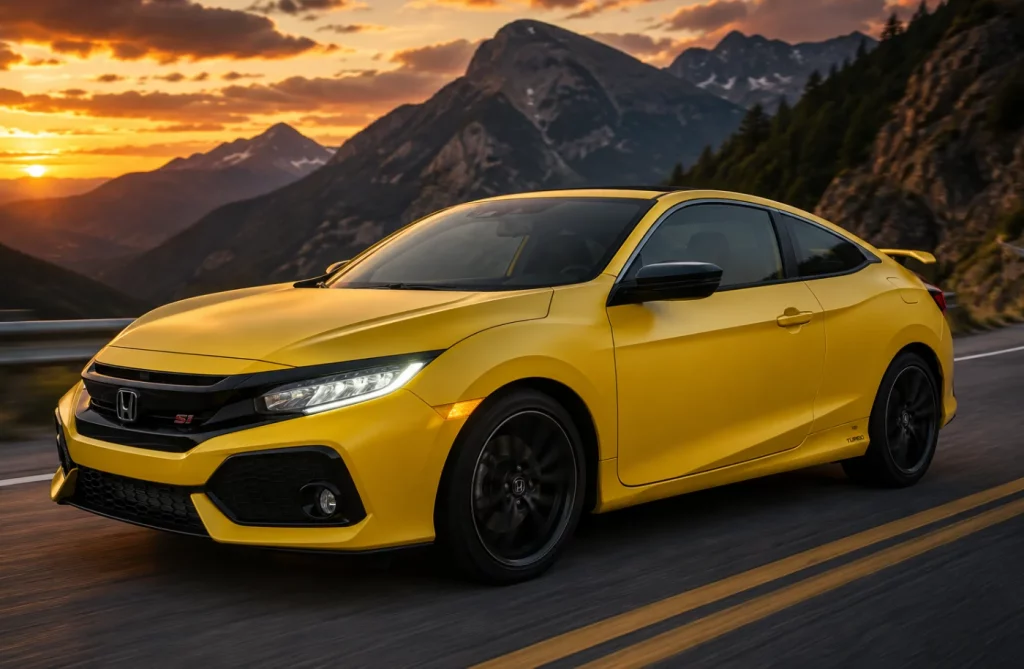
The 10th generation Civic Si (2017–2020) came with expectations that no Civic had carried before. It was the first turbocharged Si in the nameplate’s history. It replaced the high-revving K-Series with a 1.5-liter turbo four. It debuted a polarizing exterior that split the community between those who loved the angular aggression and those who called it “too fast and furious.” Five years after the last 10th gen Si rolled off the line, the owner data paints a clearer picture than launch reviews ever could. Owners rate the car consistently high — most give it an A or 9/10 — but the devil is in the specific year you buy and the dealer you buy it from.
Owner Satisfaction Grades — The Numbers
A 2020 CivicX owner survey of model-year satisfaction asked one question: “Year more satisfied with my X Si, less issues.” The results are not a large sample (20 voters), but they align with forum sentiment across hundreds of threads. Source: CivicX.com — X gen Si year satisfaction survey (July 2022).
| Model Year | Votes | Share | Key Reason for Ranking |
|---|---|---|---|
| 2019 | 8 | 40% | Volume knob restored. Oil dilution fix applied. Avoided 2020 price bump. |
| 2018 | 7 | 35% | LED headlights standard. First year of refinement over 2017. |
| 2020 | 3 | 15% | Honda Sensing standard. Higher MSRP. Fake engine noise disliked. |
| 2017 | 2 | 10% | No volume knob. No LED headlights. Early oil dilution issues. |
The 2019 model year is the consensus pick among owners. It received the volume knob that 2017 and 2018 cars lacked, Honda had refined the suspension calibration, and the oil dilution product update (January 2019) applied to earlier model years before the 2019s shipped. The 2020 model scored lower despite being the most feature-rich final year — owners cited mandatory Honda Sensing (blind spot monitoring, cross-traffic alert at $1,500-$2,000 effective price increase), fake engine noise piped through the speakers, and a higher starting MSRP.
Detailed Owner Grades by Category
A separate CivicX thread from December 2020 asked owners to grade their Si across seven categories. Fifteen owners responded with letter grades. The results are below. Source: CivicX.com — What’s your final grade of this 10th Gen Si? (December 2020).
| Category | Average Grade | Range | Common Complaints |
|---|---|---|---|
| Tunability | A / A+ | A- to A+ | — |
| Reliability | A- / A | B+ to A+ | Early fuel dilution on 2017-2018 |
| Driving Characteristics | A- / B+ | B to A | Low-revving, no VTEC, no high-rpm thrill |
| Comfort / Seats | B / B- | B- to A- | Rough ride on summer tires, seat lacking power adjust |
| Fit & Finish | B- | B- to B | Thin paint, panel gap variation, rattles |
| Technology / Infotainment | C / B- | C to A | “Utter crap” — slow infotainment, temp controls hard to use |
| Dealer Satisfaction | F- | D to F- | Markups, bid wars, poor post-sale service |
Two categories stand out: tunability and dealer satisfaction. Owners nearly unanimously rated the tuning potential as A or A+. “You can spend a few grand on bolt-ons, tune, and clutch and be making CTR power” (AudioSi, 2020 Si Coupe owner). Dealer satisfaction was the lowest-scored category across every respondent who rated it — multiple owners gave it an F- or D. “The dealership experience is obviously rough but once you get past that the Si is an outstanding and reliable sporty car” (ebhaynz, 2017 Si owner, Nevada).
Known Problems — What Actually Showed Up
Oil dilution (2017–2018, 1.5L turbo). The L15B7 engine in cold-weather states suffered fuel dilution in the engine oil during winter short-trip driving. Unburned fuel accumulated in the oil pan, raising the oil level above the fill mark and reducing lubrication properties. NHTSA complaint database logged over 1,200 complaints on 2017–2018 Civic models with the 1.5T engine. In January 2019, Honda issued Product Update 18-137 for 2016–2018 Civics and 2017–2018 CR-Vs sold in 22 cold-weather states, which reflashed the ECU and replaced the AC control unit to force the engine to warm up faster. In September 2020, a federal judge approved a nationwide class-action settlement covering Oil dilution claims. The 2019 and 2020 model years shipped with the fix applied. Owners of later cars report no oil dilution issues. Source: NHTSA (Service Bulletin MC-10152769-0001, January 2019), classlawdc.com (November 2020).
AC condenser failure (2016–2021, all trims). The AC Condenser developed micro-pinhole leaks at the tube walls due to a supplier manufacturing defect. The refrigerant leaked out over 1–3 years, and the AC stopped blowing cold. The repair cost at a dealer without warranty coverage was approximately $900–1,200. In May 2021, Honda extended the AC condenser warranty to 10 years from the original date of purchase, covering all 2016–2021 Civics. The extension was applied automatically — owners do not need to have a previous claim to qualify. The root cause was a supplier process issue, not a design flaw, and replacement condensers do not suffer the same failure. Source: Honda Service Bulletin 19-091 (May 2021, Version 5), NHTSA MC-10194978-0001.
Clutch weakness under tune. The stock clutch is the known weak point when tuning the Si past Stage 1 power levels. Multiple owners on CivicX report that the clutch begins slipping within 5,000–10,000 miles after a Stage 2 tune (approximately 240–260 whp). One owner documented making 45,000 miles on the stock clutch with a conservative Ktuner 23 PSI map and easy driving habits. The general consensus: if you tune, budget $1,200–1,800 for an aftermarket clutch (South Bend, ACT, Competition Clutch) and expect to install it at some point. Source: CivicX.com — Brake Info thread, owner-reported clutch data.
Fuel pump recall (all 2016–2020 Civics). The low-pressure Fuel Pump impeller could deform and cause the pump to fail, resulting in an engine stall with no restart. Honda issued recall 20V-314 in May 2020 (expanded in 2021 and 2023). The repair is a free fuel pump replacement at any Honda dealer. Owners who have not completed this recall should check their VIN at recalls.honda.com. Source: NHTSA (recalls 20V-314, 21V-044, 23V-813), Consumer Reports 2019 Civic reliability page.
OEM battery failure. The Johnson Controls battery supplied on 2016–2018 Civics had low water level issues leading to premature failure around 30,000–36,000 miles. The battery was warrantied for 3 years/36,000 miles, and some owners received a pro-rated replacement if they caught it just outside warranty. The replacement cost is approximately $120–150 AT a dealer or $70–100 for an aftermarket Interstate or Optima battery. Source: CivicX.com — Design’s long-term ownership thread (31K mile battery failure).
Paint quality. The 10th gen Civic paint is thin — approximately 3.5–4.0 mils on horizontal panels according to owner paint thickness gauge readings on CivicX. White pearl (Platinum White Pearl) and blue (Aegean Blue Metallic) are the most reported for chipping on the front bumper and Hood leading edge. The rear doors are prone to dings from SUV passengers. Many owners install paint protection film on the front end ($500–1,000). The 11th gen did not significantly improve paint quality — this appears to be a Honda cost target across all mass-market Civics. Source: CivicX.com owner paint survey threads.
What Owners Love
Value. The Si at $24,000–$26,000 new offered a helical limited-slip differential, adaptive dampers, 205 hp, and 0–60 in 6.3 seconds (Car and Driver). The closest competitor — the VW GTI S — was $27,500 and did not have an LSD. The Subaru WRX was $27,000 with AWD and 268 hp but returned 21 MPG combined to the Si’s 35 MPG. Owners consistently call the Si “the best handling FWD car under $30,000.”
Fuel economy. The Si’s EPA rating of 35 MPG combined (30 city, 40 highway) is real. Owners on CivicX report 32–34 MPG in mixed driving and 38–42 on highway trips. The 11.3-gallon fuel tank gives a real-world range of approximately 350–400 miles.
Tuning community. Hondata and KTuner support for the L15B7 is extensive. A Stage 1 tune ($695–$995) raises boost from 16.5 PSI to 23 PSI, adding approximately 25–35 hp and 30–40 lb-ft of torque. The 11th gen Si requires an ECU unlock ($400–$500 additional), but the 10th gen ECU is flashable without any hardware modification. This makes the 10th gen Si the cheaper platform to tune by approximately $400.
Practicality. The Si sedan has 14.7 cubic feet of trunk space, 60/40 split rear seats, and enough rear legroom for two adults at 6 feet tall. Several owners on CivicX report using their Si as a family car with one or two child seats. “Practicality is top notch — room for 3 kids and plenty of trunk space” (kingbudd, Honolulu, 2017 and 2019 Si owner).
What Owners Dislike
No VTEC engagement. The L15B7 does not use VTEC on the intake cam. It uses VTEC on the exhaust cam for low-end spool only — there is no crossover at 5,800 rpm like older K-series or B-Series engines. The engine feels flat past 5,500 rpm. “The lack of Vtec loses the desire to scream to redline” (kingbudd). “Trash for a real sporty feel. Slow and low revving compared to high-revving setups of the past” (oddwayne, 19 Si coupe owner).
Infotainment performance. The 7-inch touchscreen in 2017–2019 models is slow by modern standards. The volume controls in 2017–2018 are a haptic slider rather than a knob — widely disliked. The 2019 model brought the knob back, which contributed to its higher satisfaction score. Apple CarPlay and Android Auto are wired-only on 2017–2019 and require a USB connection that sometimes drops on older software versions.
Dealer experience. This is the lowest-scored category across every survey. Owners report price markups ($2,000–5,000 above MSRP in 2017–2018), bait-and-switch pricing, dealer-added accessories that cannot be removed, and poor post-sale service. “Dealers suck balls — I had a dealer try to pull me into a bid war for a car that wasn’t even there” (AudioSi, San Diego, 2020 Si Coupe). The Si attracts younger buyers who dealers often treat as less serious customers, which creates a feedback loop of bad experiences.
Styling controversy. The 10th gen design ages better than some owners expected but is not universally liked. One owner (oddwayne) gave the exterior a B-: “Black vents look terrible” (kingbudd). Multiple owners said the next generation (11th gen) was too conservative: “The next gen civic looks as exciting as a can opener. I would much rather keep my coupe for 10 years” (Cool Coupe, 2019 Si coupe owner).
Which Year to Buy Used
| Year | Typical Mileage | Used Price Range | Verdict |
|---|---|---|---|
| 2019 | 50K–80K | $19K–$24K | Best buy — oil dilution fix, volume knob, LED headlights |
| 2018 | 60K–90K | $17K–$22K | Good value if oil dilution fix was applied (check service records) |
| 2020 | 40K–70K | $22K–$27K | Most standard features but premium pricing. Last of its kind. |
| 2017 | 70K–100K | $15K–$19K | Skip unless significantly cheaper. No volume knob, no LED, oil dilution risk. |
The 2019 Si sedan is the most frequently recommended year by owners across CivicX. It has the oil dilution fix applied at the factory, the volume knob, standard LED headlights, and the mature suspension calibration. The 2020 adds Honda Sensing (blind spot monitoring, cross-traffic alert, auto high-beam) and Honda’s first application of the digital dash on the Si, but the price premium over the 2019 is roughly $3,000–$5,000 on the used market for effectively the same powertrain and chassis.
Quick Reference
☐ 2019 Si is the most recommended model year — volume knob, LED headlights, oil dilution fix at factory
☐ 2017–2018 Si: check whether oil dilution product update (18-137) was applied. If not, budget for it
☐ AC condenser has a 10-year warranty extension from original purchase date — do not pay for a repair
☐ Low-pressure Fuel Pump Recall (20V-314) affects all 2016–2020: check VIN at recalls.honda.com
☐ Stock clutch slips past Stage 2 tune levels (240+ whp). Budget $1,200–1,800 if tuning
☐ OEM battery is weak at ~30K miles — budget $70–100 for a replacement Interstate/AGM Battery
☐ Paint is thin (~3.5–4.0 mils). PPF on front end ($500–1,000) is a common owner investment
☐ Infotainment is slow. 2019+ has a volume knob. 2017–2018 has a haptic slider — test before buying
☐ Real-world MPG: 32–34 mixed, 38–42 highway. Range ~350–400 miles on 11.3-gallon tank
☐ 0–60 in 6.3 seconds (C&D). 1/4-mile in 14.8 seconds @ 96 mph
☐ Helical LSD is standard — the Si handles notably better than the non-Si in wet and tight corners
☐ If buying used, confirm AC condenser warranty extension was applied at your local dealer before purchase
☐ Car and Driver named the 2017 Civic Si to their 10Best list — the only Si generation to earn that distinction