

The 10th generation Civic Sport Hatchback with the 1.5-liter turbo and 6-speed manual transmission was the trim that Honda did not build for the spec sheet. It existed in a gap that Honda never officially acknowledged — a car that looked like a hot hatch, drove like one, but cost thousands less than the Si and tens of thousands less than the Type R. It shared the FK7 chassis code with the rest of the hatchback lineup but carried the same engine calibration as the Sport Touring with a manual gearbox that the Si did not get in hatchback form. For used buyers in 2026 who want the 10th generation’s most engaging driving experience without paying the Si or Type R premium, the Sport Hatchback 6MT is the trim that makes the most sense — and the one that almost nobody talks about.
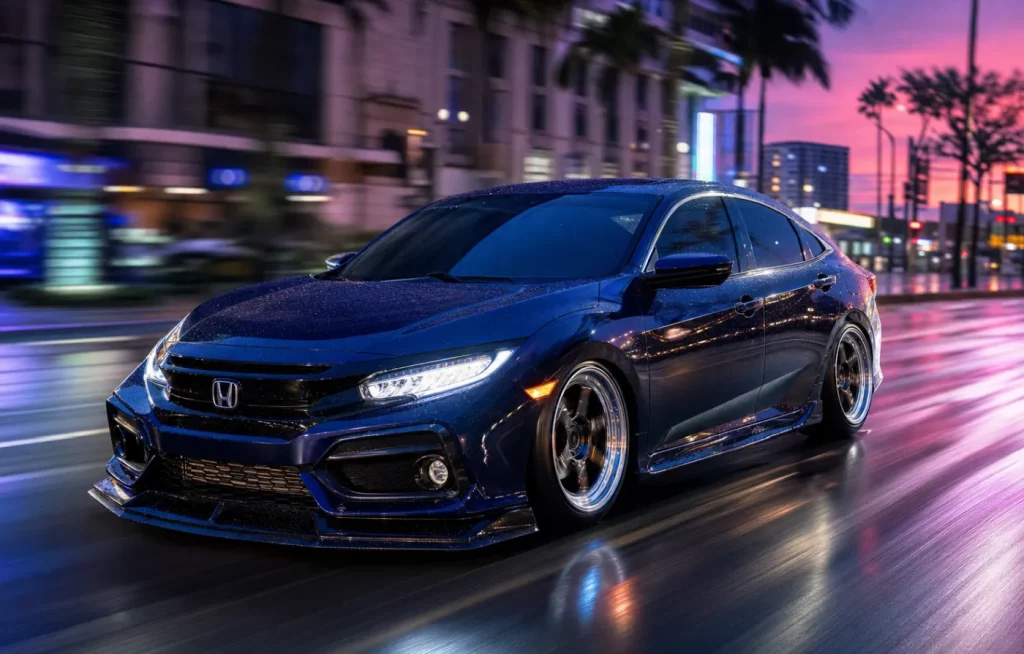
The Sport Hatchback 6MT was produced from 2017 through 2021, with availability varying by model year. It was never a high-volume trim — Honda sold far more CVT-equipped Sport models to buyers who wanted the hatchback styling with the 2.0-liter K20C2 — and finding a clean used example in 2026 requires patience. But for buyers who find one, the value proposition is difficult to beat.
The L15B7 in the Sport — Higher Tune, Same Engine, Manual Gearbox
The 2017-2021 Civic Sport Hatchback used the L15B7, the same 1.5-liter direct-injected turbocharged four-cylinder that powered the EX-T, EX-L, and Touring sedans, but with a different calibration. The Sport’s output was 180 horsepower at 5,500 rpm (6MT) and 177 lb-ft of torque from 1,900-5,000 rpm — 6 hp more and 10 lb-ft more than the LX/EX hatchback L15B7, which was rated at 174 hp / 167 lb-ft in the 6MT (Honda Newsroom, 2017 Civic Hatchback Specifications, September 2016).
The torque curve tells the important part: 177 lb-ft is available from 1,900 rpm and holds to 5,000 rpm. This is the same peak torque as the 2017-2019 Civic Si’s L15B7 (which makes 192 hp / 192 lb-ft) but arrives at the same engine speed and holds through the same range. The Si’s additional power comes from a larger turbo compressor (MHI TD04 vs. TD03 on the Sport), a different exhaust manifold, and a higher-boost calibration — not from a fundamentally different engine block.
The 6-speed manual transmission in the Sport uses the same gear ratios as the LX/EX hatchback manual:
| Gear | Ratio | Final Drive |
|---|---|---|
| 1st | 3.643 | 4.105 |
| 2nd | 2.080 | |
| 3rd | 1.361 | |
| 4th | 1.024 | |
| 5th | 0.830 | |
| 6th | 0.686 |
Source: 2017 Honda Civic Hatchback Specifications, American Honda Motor Co., September 2016.
The clutch and flywheel are the same single-mass unit used across the non-Si manual Civic lineup. The shift linkage is cable-operated with a rubber-insulated shifter base. The feel is light and precise but lacks the mechanical notchiness of the Si’s rigid-mounted shift assembly.
The key specification differences between the Sport Hatchback 6MT and the Si sedan/coupe (2017-2021) are:
| Specification | Sport Hatchback 6MT | Civic Si (Sedan/Coupe) |
|---|---|---|
| Engine | L15B7 (MHI TD03) | L15B7 (MHI TD04) |
| Horsepower | 180 @ 5,500 rpm | 205 @ 5,700 rpm |
| Torque | 177 lb-ft @ 1,900-5,000 rpm | 192 lb-ft @ 2,100-5,000 rpm |
| Redline | 6,500 rpm | 6,800 rpm |
| Curb weight | 2,871 lbs | 2,889 lbs (sedan) |
| Suspension | 25.5mm front bar, 16.5mm rear bar | 27.2mm front bar, 18.0mm rear bar |
| Dampers | Conventional twin-tube | Adaptive damper system (2017-2018 Active, 2019-2021 adaptive) |
| Steering ratio | 11.12:1 | 10.93:1 (quicker) |
| Turning circle | 37.8 ft | 35.7 ft |
| Wheels | 18×8-inch alloy, 235/40 R18 | 18×8-inch alloy, 235/40 R18 |
| Brakes (front/rear) | 11.1 in / 10.2 in | 12.3 in / 10.2 in |
| Limited-slip differential | No | Helical LSD |
| Rear seat pass-through | 60/40 split (hatchback) | Fold-down (sedan) |
Sources: 2017 Civic Hatchback Specifications and 2017 Civic Si Specifications, Honda Newsroom.
The Sport Hatchback 6MT weighed 2,871 lbs — 18 lbs less than the Si sedan and 52 lbs less than the Si coupe. The lower weight came from the smaller turbo, non-adaptive dampers, absence of the LSD, and the hatchback body structure’s lack of a rear bulkhead. The power-to-weight ratio of the Sport is 15.9 lbs/hp vs. the Si’s 14.1 lbs/hp — a measurable but not enormous gap that narrower gears partially close in normal driving.
The 0-60 mph time for the Sport Hatchback 6MT was tested by Car and Driver at 6.6 seconds — substantially quicker than the CVT Sport (7.5 seconds) and 0.2 seconds behind the Si sedan (6.4 seconds) (Car and Driver, “Tested: 2017 Honda Civic Hatchback 1.5T Manual,” May 2017; Car and Driver, “2017 Honda Civic Si Tested,” July 2017).
Source: EPA fueleconomy.gov; Car and Driver instrumented test data.
The Hatchback Body — Where the Sport Makes More Sense Than the Si
The 10th generation Civic hatchback was built on the same 106.3-inch Wheelbase as the sedan but with a different rear structure. The hatchback body measured 177.9 inches long — 11.7 inches shorter than the sedan — with the same 70.8-inch width and a 56.3-inch height (0.2 inches lower than the LX/EX hatchback).
The defining measurement for the Sport Hatchback is cargo volume: 22.6 cubic feet behind the rear seats with the rear seats up (due to the 235/40 R18 spare tire affecting cargo floor height) and 46.2 cubic feet with the 60/40 seats folded. That is 4.5 cubic feet less than the 11th generation hatchback but 50% more than the 10th generation Si sedan, which has a trunk-only 14.4 cubic feet with no pass-through (2017 Civic Si Specifications, Honda Newsroom).
The hatchback body also provided a different weight distribution: 60.0% front / 40.0% rear for the 6MT, compared with 60.7% front / 39.3% rear for the Si sedan. The rearward weight bias difference is small but noticeable on turn-in and mid-corner rotation under trailing throttle.
The rear suspension on the Sport uses the same multi-link geometry as the LX/EX hatchback, with a 16.5mm solid rear stabilizer bar and conventional dampers. The Si uses the same multi-link geometry but with an 18.0mm rear bar and adaptive dampers (Helical LSD at the front). The Sport’s non-adaptive dampers produce more body roll on turn-in but also generate more predictable breakaway at the limit — the Si’s adaptive system masks the transition, which some drivers prefer and others find disconnected.
The Sport hatchback also has a much better view out the rear than the Si sedan, thanks to the hatchback’s large rear glass area and the absence of the sedan’s high rear deck. The rear wiper is standard, and the hatchback’s rear spoiler at the top of the Tailgate reduces rear-window dirt accumulation in wet weather.
What the Sport Hatchback 6MT Included (And What It Left Out)
The Sport trim in the hatchback lineup sat above the LX and below the EX. It was a visual and equipment package designed to look aggressive without adding luxury content.
Visual and exterior equipment unique to Sport:
- Center-outlet dual exhaust system with chrome-finish tips (the single most identifiable feature of the Sport hatchback — no other non-Type R Civic had center exhausts)
- Full underbody spoiler kit (front lip, side skirts, rear diffuser)
- 18-inch alloy wheels in gloss black (model year 2017-2019) or dark gray (2020-2021) with 235/40 R18 91W all-season tires
- Black headliner and pillar trim (LX trim had beige/gray headliner)
- Gloss black rear hatch spoiler
- Sport-exclusive seat fabric with orange contrast stitching on the cloth seats (2017-2019)
- Leather-wrapped steering wheel and shift knob
- Sport pedals (aluminum-look)
- Fog lights
- Body-colored power side mirrors with integrated turn signals and heat
Interior equipment (2017-2019 Sport):
- 5-inch color LCD screen (non-touch, same as the LX)
- 160-watt audio system with 4 speakers
- Bluetooth HandsFreeLink and streaming audio
- USB audio interface
- Automatic climate control (single-zone)
- Cruise control
- Tilt and telescopic steering column
- Manual driver’s seat with height adjustment
- 60/40 split fold-down rear seats with reversible cargo cover
- Sliding armrest center console
What the 2017-2019 Sport did NOT include:
- 7-inch Display Audio with touchscreen (EX and above)
- Apple CarPlay and Android Auto (EX and above)
- 180-watt 8-speaker audio system (EX and above)
- Smart Entry with push-button start (EX and above — Sport had keyed ignition and key fob)
- Moonroof (EX and above)
- Honda Sensing safety suite (available only as an option through the 2018 model year — see below)
- Heated seats (EX-L and above)
- Dual-zone automatic climate control (EX and above)
- Honda LaneWatch (EX and above)
- SiriusXM and HD Radio (EX and above)
The infotainment gap was the most significant functional omission on the 2017-2019 Sport. The 5-inch non-touch screen could not display navigation, CarPlay, or backup camera dynamic guidelines. The audio system had only 4 speakers with no center channel or subwoofer. Many Sport hatchback owners upgraded to aftermarket head units with CarPlay, costing $200-$600 for the receiver plus installation.
Year-by-Year Changes — The 2020 Facelift Fixed the Big Problems
The mid-cycle facelift for the hatchback arrived for the 2020 model year (launched August 2019), one year after the sedan and coupe received their updates. Honda’s press release described the changes as “fresh exterior and interior styling” and “updated technology” — in practice, the changes to the Sport trim were substantial.
2017 (launch year): The Sport Hatchback debuted with the specifications listed above. The 6MT was offered on the Sport trim AT launch. Honda Sensing was not available on the Sport at all for 2017 — it was optional on LX and EX hatchbacks and standard only on Sport Touring. The 2017 model year is the cheapest entry point into the Sport Hatchback 6MT in 2026, but it carries the highest risk of early-production L15B7 issues and the least equipment.
2018: Carryover. No substantive changes to the Sport trim. Honda Sensing remained unavailable on the Sport — it was still LX and EX optional only, and standard on Sport Touring. Production of the 2018 hatchback shifted to include more CVT allocations for fleet sales, making 6MT examples rarer.
2019: Honda Sensing became standard across the entire Civic hatchback lineup, including the Sport for the first time. Every 2019 Sport Hatchback includes Collision Mitigation Braking, Road Departure Mitigation, Lane Keeping Assist, and Adaptive Cruise Control with Low-Speed Follow. The Sport trim also received the updated multi-information display required by Honda Sensing. Other changes: Honda added physical buttons and a volume knob to the 7-inch Display Audio on EX and Sport Touring trims, but the Sport retained the 5-inch non-touch screen for 2019. The 2019 model year also saw improvements to the L15B7’s engine calibration to reduce cold-weather fuel dilution (revised engine control module logic and earlier thermostat engagement).
2020 (facelift): The most significant update to the Sport trim. Changes, per Honda’s August 2019 press release:
- Revised exterior styling: updated front fascia with body-color crossbar in the lower bumper fog light housings, blackout headlight treatment, restyled lower rear bumper openings, new dark gray or black wheel designs
- Smart Entry with push-button start became standard on the Sport for the first time
- 7-inch Display Audio touchscreen became standard on Sport with Apple CarPlay, Android Auto, 8 speakers, SiriusXM, and HD Radio — the single biggest functional improvement to the trim
- CVT Sport models received remote start for the first time
- New Sport-exclusive seat upholstery and dash trim with embossed pattern
- Additional sound insulation in the floor, trunk, and front/rear fenders across all hatchback trims
- Sport Touring trim became available with a 6-speed manual transmission for the first time — the Sport Touring 6MT offered the same driving experience as the Sport 6MT with the addition of LED headlights, rain-sensing wipers, dual-zone climate, heated front and rear seats, leather interior, and a 540-watt 12-speaker premium audio system
The 2020 Sport with the 6MT had an MSRP of $22,750 plus $930 destination ($23,680 total) — $1,100 more than the 2019 Sport 6MT but with CarPlay, push-button start, and smart entry that addressed the trim’s two biggest complaints (Honda Newsroom, August 2019 pricing release).
2021: Final model year. Carryover from 2020 with no changes. Sport 6MT and Sport Touring 6MT remained available. Production was reduced as Honda prepared for the 11th generation launch.
Known Problems on the FK7 Sport 1.5T
The Sport Hatchback shares the L15B7 engine problems documented across the entire 10th generation 1.5T lineup. The 6MT avoids the CVT-related issues but inherits all engine-level failure modes.
Oil dilution from direct injection (all 2016-2021 L15B7): Gasoline mixing into the engine oil during cold-weather short-trip driving is the most documented issue on the 1.5-liter turbo. The problem was most severe on 2016-2018 model years in cold climates (Canada, Northeast US). Honda addressed the issue through a series of ECM recalibrations (Service Bulletin 18-101, revised thermostat, earlier engine warmup logic) and a class-action settlement (Gaskin v. Honda, 2020) that extended the powertrain warranty on affected vehicles to 8 years / unlimited miles. On the Sport Hatchback 6MT, the issue is less severe than on CVT models because the manual transmission allows the engine to operate at higher RPMs during warmup, reducing the amount of unburned fuel that bypasses the Piston rings. Owners in cold climates who make short trips (under 10 miles) should check oil level and smell the dipstick for fuel odor every 1,000 miles during winter.
Head gasket failure on L15B7 (documented across 1.5T models): A small but growing number of 1.5T owners have reported head gasket failures between 60,000 and 120,000 miles, typically on tuned cars or cars driven at sustained high load. The failure mode is external coolant loss at the head gasket seam on the exhaust side, sometimes accompanied by misfire codes (P0301-P0304) from coolant contamination in the combustion chamber. Repair cost: $1,800-$3,200 at an independent shop, $3,500-$5,500 at a dealer, depending on whether the cylinder head needs resurfacing. CivicX forum documentation shows approximately 1-2% of 1.5T owners reporting Head Gasket Failure on stock cars, with the rate significantly higher on tuned vehicles (CivicX.com, “The MOST Common 1.5T Engine Issue,” 2025).
Air conditioning condenser failure (SB 17-087): The same AC Condenser issue that affects all 10th generation Civics affects the Sport Hatchback. The condenser develops pinhole leaks at the bottom pass, causing complete refrigerant loss. Honda extended the warranty on the condenser to 10 years / unlimited miles (Service Bulletin 17-087). Replacement cost: $900-$1,500 at a dealer if outside the extension.
Denso fuel pump recall (NHTSA 20V-173): All 2017-2020 Civics are covered by the Denso Fuel Pump Recall for impeller cracking. The Sport Hatchback 6MT is included. Verify completion via VIN lookup at the Honda recall portal before purchasing used.
Center exhaust heat shield rattle: The Sport hatchback’s dual center-outlet exhaust system has a heat shield assembly that can loosen over time, producing a metallic rattle at 2,000-3,000 rpm under load. The fix is re-tightening or replacing the heat shield fasteners. This is not a mechanical failure but a common owner-reported nuisance (CivicX forum, multiple threads).
Clutch pedal vibration on 6MT: Some 2017-2019 Sport 6MT owners report clutch pedal vibration at 3,000-4,000 rpm, typically traced to the dual-mass flywheel’s damper springs. The condition does not affect clutch operation or longevity but is a NVH annoyance. The 2020-2021 models use a revised flywheel with different damper rates.
6MT reliability: The C635 manual transmission in the Sport Hatchback has a strong reliability record. Synchro wear is rare below 120,000 miles with normal driving. The clutch slave cylinder can develop slow leaks on higher-mileage examples. Clutch replacement cost: $1,200-$1,800 at a dealer.
Used Market Pricing — The Sport 6MT Commands a Premium Over the CVT (2026)
The Sport Hatchback 6MT is a rare configuration in the used market of 2026. Honda never produced the Sport 6MT in high volume, and the combination of the 1.5T, 6-speed manual, and hatchback body attracts enthusiast buyers who hold the cars longer. Clean, unmodified examples command a significant premium over equivalent CVT Sport models and frequently trade above Kelley Blue Book values.
| Model Year | Typical Used Price (2026) | Typical Mileage | 6MT Premium Over CVT | Key Consideration |
|---|---|---|---|---|
| 2017 | $14,000-$16,500 | 80k-110k | $1,000-$1,500 | No Honda Sensing, early L15B7 calibration, cheapest entry |
| 2018 | $15,500-$18,000 | 70k-95k | $1,200-$1,800 | No Honda Sensing, lowest production year for 6MT |
| 2019 | $17,000-$20,000 | 55k-80k | $1,500-$2,000 | Honda Sensing standard, improved 1.5T calibration, sweet spot |
| 2020 | $19,000-$22,500 | 35k-65k | $2,000-$3,000 | CarPlay, push-button start, smart entry, facelift styling |
| 2021 | $21,500-$25,000 | 20k-45k | $2,500-$3,500 | Final year, lowest mileage, hardest to find |
| 2020-2021 Sport Touring 6MT | $24,000-$28,000 | 25k-55k | N/A | Rarest configuration — LED headlights, leather, heated seats, premium audio |
Sources: Kelley Blue Book Fair Purchase Price estimates, 2026 market data; Cars.com and Autotrader listing analysis; CivicX forum marketplace pricing discussions.
The 2019 Sport Hatchback 6MT at $17,000-$20,000 is the strongest value in the range. It has standard Honda Sensing (collision avoidance and adaptive cruise) with the improved 1.5T calibration, and it avoids the 2020 price premium. The 2020 Sport 6MT at $19,000-$22,500 is a better car overall thanks to CarPlay and push-button start, but the typical $2,000-$3,000 premium over the 2019 is a material decision point.
The 2020-2021 Sport Touring 6MT is the rarest and most desirable configuration in the lineup. It combines the manual gearbox with LED headlights, leather interior, heated seats, dual-zone climate, and the 540-watt 12-speaker audio system. Only about 500-800 Sport Touring 6MT units are estimated to have been sold in the US market over its two-year production run. Expect to pay $24,000-$28,000 for a clean example with reasonable mileage.
Sport Hatchback 6MT vs. Si — Which to Buy in 2026
The decision between the Sport Hatchback 6MT and the Civic Si is not as straightforward as the spec sheet suggests.
Buy the Sport Hatchback 6MT if:
- Cargo space matters — the hatchback’s 46.2 cubic feet with seats folded vs. the Si’s 14.4 cubic feet trunk is a decisive advantage for anyone who transports bikes, luggage, home improvement supplies, or pets
- You prefer a naturally progressive chassis over the Si’s adaptive dampers — the Sport’s conventional dampers give more consistent feedback at the limit
- Budget is a constraint — a 2020 Sport 6MT typically costs 15-20% less than a comparable-age Si sedan, and the savings gap widens on the used market
- You plan to modify the car — the Sport’s L15B7 responds to the same tuning upgrades (KTuner/Hondata flash, downpipe, intercooler, turbo upgrade) as the Si, and the manual gearbox can handle 250+ whp on a stock clutch with proper tuning
- You want the center-outlet exhaust aesthetic without paying Type R money
Buy the Civic Si instead if:
- You want the fastest stock 10th generation non-Type R — the Si is 0.2 seconds faster to 60 and 0.5 seconds faster through the quarter-mile
- You want the helical limited-slip differential — the LSD transforms corner exit power delivery on dry pavement and is difficult and expensive to retrofit to the Sport ($2,500-$4,000 for the MFactory helical LSD plus installation)
- You want the adaptive damper system with sport mode — the Si’s dampers provide real ride quality adjustability that the Sport cannot match
- You value resale value — the Si depreciates slower and has a larger enthusiast buyer pool
- You want the quicker steering ratio and tighter turning circle
- You do not need hatchback cargo capacity — the Si sedan is 11.7 inches longer and has a trunk instead of a cargo area
The Consumer Reports comparison of the 2017 Si versus the Sport concluded that the Si is the better performance car by a measurable margin but the Sport offers “similar driving experiences with a different sticker price” — and for buyers who value the hatchback’s utility, the Sport is the more practical choice (Consumer Reports, “The 2017 Honda Civic Dilemma: Si or Sport?,” July 2017).
Modification Potential — The Sport 6MT as a Tuning Platform
The Sport Hatchback 1.5T 6MT has become a recognized tuning platform in the 10th generation community because it offers the manual gearbox without the Si’s price premium, leaving budget for modifications. The block architecture is identical to the Si’s L15B7 — open-deck aluminum, 73.0 mm bore x 89.5 mm stroke, 10.6:1 Compression Ratio, MHI turbo — with the only material difference being the smaller TD03 turbo compressor versus the Si’s TD04.
The typical tuning path for the Sport 6MT (full disclosure: modifications void the factory warranty and reduce reliability):
Stage 1 (flash tune only): Ktuner V2 base map or Phearable 1.5 tune on the Sport adds approximately 30-40 whp (220-230 whp total) and 40-50 lb-ft of torque using 91-93 octane fuel. The stock TD03 turbo is the limiting factor above 230 whp. Cost: $450-$650. The stock clutch handles this power level with proper driving habits.
Stage 2 (downpipe + flash tune): Adding a catted or catless downpipe to a Stage 1 tune unlocks approximately 240-250 whp. The exhaust note changes noticeably, and the center exhaust configuration makes the Sport sound aggressive at full throttle. Cost: $700-$1,200 for the downpipe plus tuning.
Stage 3 (intercooler + downpipe + 27Won or PRL turbo upgrade): The Sport’s TD03 cannot support more than about 260 whp. Upgrading to a TD04-sized turbo (27Won W1, PRL Cobra) requires a new Turbocharger, downpipe, intercooler, and retune, producing 300-320 whp on E30 fuel. Cost: $3,500-$5,500. The stock clutch begins to slip at 280+ whp; an upgraded clutch (ACT, South Bend, Competition Clutch) adds $800-$1,200.
Source: CivicX Forum, 10th Gen Dyno Database and Tuning Experience Thread.
For buyers shopping a used Sport Hatchback 6MT, the single most important pre-purchase question is whether the car has been tuned. Tuned cars with stock clutch wear patterns, boost pressure logs, and maintenance history should be approached with caution. A stock, unmodified Sport 6MT with service records is worth a significant premium over a modified example.
Quick-Reference Checklist
☐ The Sport Hatchback 6MT uses the L15B7 1.5T rated at 180 HP / 177 lb-ft — 6 hp and 10 lb-ft more than the LX/EX hatchback L15B7, 25 hp and 15 lb-ft less than the Si
☐ The 6-speed manual is the same C635 transmission used across the non-Si manual Civic lineup — gear ratios are identical to the LX/EX manual hatchback
☐ Curb weight: 2,871 lbs (6MT) — 18 lbs lighter than the Si sedan, 52 lbs lighter than the Si coupe
☐ 0-60 mph: approximately 6.6 seconds (Car and Driver tested) — 0.2 seconds behind the Si sedan, 0.9 seconds quicker than the CVT Sport
☐ The Sport 6MT offers 46.2 cubic feet of cargo space with rear seats folded — more than three times the Si sedan’s trunk capacity
☐ Center-outlet dual exhaust is unique to the Sport and Type R in the 10th generation Civic lineup
☐ 2017-2019 Sport models lack Apple CarPlay, Android Auto, push-button start, and smart entry — the 5-inch non-touch screen is the trim’s biggest functional limitation
☐ The 2020 facelift added the 7-inch Display Audio with CarPlay, push-button start, and smart entry to the Sport trim — the 2020 model is significantly better equipped than earlier years for a roughly $2,000-$3,000 price premium
☐ The 2020-2021 Sport Touring 6MT is the rarest FK7 configuration — LED headlights, leather, heated seats, 540W 12-speaker audio — with an estimated 500-800 US sales total
☐ Oil dilution from direct injection affects the 1.5T — less severe on the 6MT than CVT, but short-trip cold-climate owners should monitor oil level and fuel smell in winter
☐ Head Gasket failure is documented on tuned and high-mileage 1.5T engines — repair cost is $1,800-$5,500 depending on shop
☐ AC condenser failure (SB 17-087) and Denso Fuel Pump recall (20V-173) apply — verify completion before purchase
☐ The Sport 6MT responds well to Stage 1-2 tuning (220-250 whp) on the stock turbo and clutch — verify a prospective car is stock before paying a premium
☐ The helical LSD from the Si cannot be retrofit without significant driveline work — the Si’s corner-exit traction is a genuine advantage the Sport cannot match at reasonable cost
☐ The 2019 Sport 6MT with standard Honda Sensing is the best used value ($17,000-$20,000) — the 2020 with CarPlay is the better car if the budget allows