

The EPA window sticker on a new Honda Civic is a controlled laboratory measurement. The number on it comes from a dynamometer test with standardized drive cycles, temperature controls, and a professional driver following a prescribed acceleration curve. It is useful for comparing one car to another under identical conditions. It is not a prediction of what any individual owner will see AT the pump.
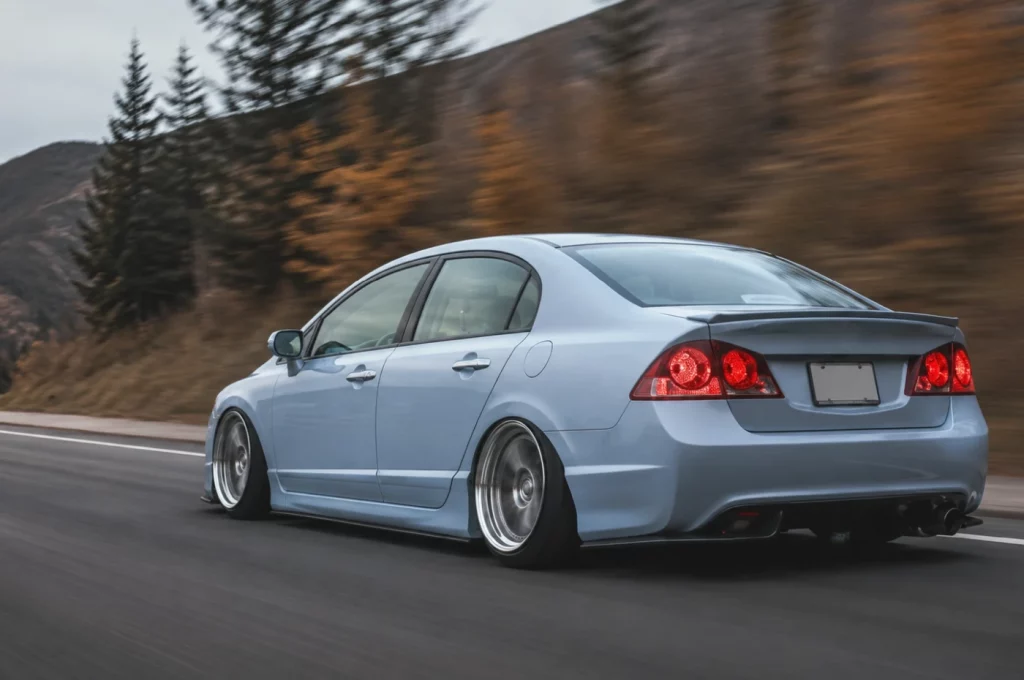
The gap between EPA estimates and real-world fuel economy varies by generation, engine, transmission, and driving conditions. On some Civic powertrains, owners routinely beat the EPA number by 5 to 10 percent. On others, real-world figures fall 10 to 15 percent below the sticker. The reasons are specific to how each engine and transmission combination behaves in actual driving — not a failure of the test procedure, but a reflection of the difference between a laboratory cycle and a commute with traffic, hills, climate control, and a driver who is not trying to maximize fuel economy.
The data below comes from three sources: Fuelly (crowd-sourced tank-by-tank logging with 17,000+ Civic vehicles and over 400 million miles tracked), fueleconomy.gov user-submitted MPG estimates, and forum-reported owner data from CivicX, 8thCivic, 11thGenForum, and 10thCivicForum. EPA figures are from the official fueleconomy.gov database and Honda’s published ratings.
8th Generation (2006–2011): The R18 Era
The 8th-generation Civic was available with the 1.8L R18 i-VTEC four-cylinder in LX and EX trims, the 2.0L K20Z3 in the Si, and the 1.3L hybrid powertrain. The R18 was Honda’s first engine designed specifically for the Civic after the split from the K-Series in non-Si models, and its fuel economy was a priority from the start.
Fuelly data from 854 2006 Civic owners shows a combined average of 31.0 MPG across all trims and transmissions, based on 24 million miles of driving. The 2006 Civic 1.8L with the 5-speed automatic averaged 30.9 MPG among EX-trim vehicles with 308 fuel-ups logged. The 1.8L with the 5-speed manual averaged 36.2 MPG among 493 fuel-ups — a significant 5.3 MPG advantage for the manual that persisted across the entire generation run.
The EPA rated the 2006 Civic EX automatic at 30 city / 38 highway / 33 combined. The Fuelly average of 30.9 MPG for the automatic is about 6 percent below the combined rating. The manual’s Fuelly average of 36.2 MPG is about 8 percent above the EPA combined estimate, likely because the manual allows the driver to keep the engine in its most efficient operating range more consistently than the 5-speed automatic.
By 2011, the final year of the 8th generation, Fuelly data from 338 vehicles shows the overall average dropping slightly to 29.37 MPG. The 2011 LX 1.8L automatic averaged 26.0 MPG among logged fuel-ups, while the EX 1.8L automatic averaged 29–31 MPG. The decline from 2006 numbers is likely related to the age of the vehicles in the sample — older cars with higher mileage and worn components tend to report lower fuel economy.
The EPA for the 2011 Civic 1.8L automatic was 25 city / 36 highway / 29 combined. The Fuelly average of 29.37 MPG across all vehicles is essentially dead on the EPA combined rating. For a 14-year-old car platform, matching the EPA estimate in real-world driving is unusual. Source: Fuelly, “2006 Honda Civic MPG”; fueleconomy.gov, “2006 Honda Civic Shared MPG Estimates.”
The 8th-gen Si with the K20Z3 and 6-speed manual is a different story. Fuelly data from the 2006 Si shows approximately 22–25 MPG combined. The EPA rated the Si at 21 city / 29 highway / 24 combined. Real-world numbers from owners on 8thCivic.com cluster around 22–26 MPG in mixed driving, with highway-only trips producing 27–30 MPG. The Si’s VTEC engagement point at 5,800 RPM and the 8,000 RPM redline encourage driving that does not prioritize fuel economy, and the numbers reflect that.
9th Generation (2012–2015): The Transition Year
The 9th generation launched with the same 1.8L R18 engine but added a 2.4L K24 in the Si and, by 2014, introduced the CVT as an option on the 1.8L. The 2012 model year was a refresh of the 8th-gen platform, not a clean-sheet redesign, and the fuel economy numbers reflect evolutionary rather than revolutionary changes.
Fuelly data from 857 2012 Civic owners shows an average of 31.89 MPG across all trims, based on 23.8 million miles of driving. The 2012 LX 1.8L with the 5-speed automatic averaged 31–36 MPG depending on the individual vehicle and driving patterns. The fueleconomy.gov user-submitted data for the 2012 1.8L automatic shows 58 vehicles averaging 33.7 MPG with a range from 22 to 52 MPG.
The EPA for the 2012 LX 1.8L automatic was 28 city / 39 highway / 32 combined. The Fuelly average of 31.89 MPG and the fueleconomy.gov user average of 33.7 MPG both bracket the EPA combined rating closely. The wide range — 22 to 52 MPG on fueleconomy.gov — reflects how much individual driving style and route composition affect the R18’s efficiency. A 2012 LX owner in Wallingford, CT logged 614 consecutive fuel-ups on Fuelly, averaging 33.5 MPG over the life of the vehicle with a best tank of 59.2 MPG (almost certainly a pure highway run at low speed). Source: fueleconomy.gov, “2012 Honda Civic Shared MPG Estimates”; Fuelly, user ctgull.
By 2015, the Civic had moved to a CVT for most automatic trims. Fuelly data from 510 2015 Civic owners shows an average of 30.61 MPG. The 2015 EX 1.8L CVT averaged approximately 34 MPG in Fuelly logs. The EPA for the 2015 Civic 1.8L CVT was 30 city / 39 highway / 33 combined. The real-world average for the CVT-equipped cars is close to the EPA number, with a slight deficit in mixed driving and a slight surplus in highway driving.
The 9th-gen Si with the 2.4L K24 engine and 6-speed manual was rated at 22 city / 31 highway / 25 combined by the EPA. Fuelly data from 2012 Si owners shows approximately 24–26 MPG combined in mixed driving. Owners on 9thCivic.com report 27–30 MPG on highway trips. The K24 in the 9th-gen Si is less efficient than the 1.8L, but the tradeoff is substantially more torque across the RPM range.
10th Generation (2016–2021): The Turbo Era
The 10th generation was the biggest change in Civic powertrain strategy in decades. The base engine was a 2.0L naturally aspirated four-cylinder (K20C2), and the upgrade was a 1.5L turbocharged four-cylinder (L15B7) paired with a CVT. The Si used a detuned version of the 1.5T with a 6-speed manual. The Type R used a 2.0L turbo (K20C1) with a 6-speed manual.
Fuelly data from 812 2016 Civic owners shows a combined average of 33.71 MPG across all trims, based on 24.7 million miles. The 1.5T with CVT averaged 35–40 MPG in mixed driving depending on trim and driving style. The 2016 Touring 1.5T CVT averaged 39.5 MPG among 496 fuel-ups logged by one owner. Another 2016 Touring owner logged 456 fuel-ups and averaged 30.2 MPG — the difference is entirely driving style and route composition.
The EPA rated the 2016 Civic 1.5T CVT at 31 city / 40 highway / 35 combined. The Fuelly data shows that owners who drive primarily highway miles and use Eco mode consistently can match or exceed the EPA highway estimate by a significant margin. One CivicX forum owner with a 2016 EX-L 1.5T averaged 44.2 MPG over 54 fuel-ups, with a best tank of 53.2 MPG on a highway trip. The same owner logged multiple tanks above 50 MPG on summer highway trips. Source: Fuelly, user b00bies; CivicX.com, “Real World MPG” thread (2019).
The 2016 1.5T with the 6-speed manual returns lower numbers. Owners on CivicX report 32–37 MPG in mixed driving and 38–42 MPG on highway trips. The manual’s shorter gearing and the driver’s ability to control boost more precisely than the CVT’s logic means the manual can match the CVT in steady-state highway cruising but falls behind in stop-and-go and mixed driving.
The 10th-gen Si (1.5T, 6-speed manual, 2017–2021) was rated at 28 city / 38 highway / 32 combined by the EPA. Fuelly data from Si owners shows approximately 28–33 MPG combined. One 10thCivicForum owner with a 2019 Si averaged 32.6 MPG over 28 fuel-ups with a best of 42.6 MPG on a highway trip at 80+ MPH. A 2018 Si owner reported 36.2 MPG over a year of mixed driving using tank-to-tank calculation. Source: 10thCivicForum.com, “Real world MPG” (2019).
The CivicX forum thread on 1.5T vs 2.0L fuel economy (2016–present) reveals a consistent pattern: the 1.5T delivers higher peak MPG on the highway than the 2.0L, but its city MPG is more sensitive to throttle input. One Canadian 1.5T owner reported 5.8 L/100km (40.6 MPG) on a 600 km highway trip. The same owner noted city driving at 8.5 L/100km (27.7 MPG). A 2.0L owner on the same thread reported 37.9 MPG combined on the same commute. The 2.0L was more consistent across driving conditions; the 1.5T had a higher ceiling and a lower floor. Source: CivicX.com, “What is the best real world MPG average you are getting from 2.0l or 1.5l” (2016).
11th Generation (2022–2024): Refinement and Reality
The 11th generation carried over the same engine lineup as the late 10th generation: a 2.0L naturally aspirated engine (K20C2) in LX, Sport, and EX trims, and a 1.5L turbo (L15B7) in EX-L, Sport Touring, and Si trims. The Type R continued with the K20C1.
Fuelly data from 163 2022 Civic owners shows an average of 31.01 MPG, based on 3.5 million miles of driving. The 2022 LX 2.0L CVT averaged approximately 36 MPG among logged fuel-ups. The 2022 EX 1.5T CVT averaged 37–38 MPG in mixed driving. Owners on 11thGenForum with the 2022 EX 1.5T report 37–42 MPG in combined driving with Eco mode enabled. One owner reported 42–46 MPG on highway trips in Eco mode. Source: 11thGenForum.com, “2022 Civic Mileage” (2022).
The EPA for the 2022 Civic 2.0L CVT was 31 city / 40 highway / 34 combined. For the 1.5T CVT, the EPA was 30 city / 38 highway / 33 combined. The Fuelly averages are within 2–3 MPG of the EPA combined estimates, with the 1.5T slightly underperforming in city driving and slightly overperforming on the highway.
The 2022–2024 Civic Sport Touring hatchback with the 6-speed manual and 1.5T was rated at 28 city / 37 highway / 31 combined by the EPA. An owner on 11thGenForum tracked every fill-up over the first 3,000 miles and reported an actual average of 35.8 MPG — 15 percent above the EPA combined rating. The trip computer showed 38.06 MPG, meaning the dashboard readout was optimistic by about 6 percent. The owner noted that the car runs on 87 octane regular fuel, unlike their previous car that required premium, saving approximately $500 per year in fuel costs. Source: 11thGenForum.com, “2024 Civic Sport Touring Hatchback 6MT fuel economy data” (2024).
The 11th-gen Si (2022–present, 1.5T, 6-speed manual) was rated at 27 city / 37 highway / 31 combined by the EPA — slightly lower than the 10th-gen Si due to the removal of the adaptive dampers and a small weight increase. Fuelly data from 2022–2024 Si owners shows approximately 27–32 MPG combined, with highway trips producing 35–38 MPG. The Si forces the driver to use premium fuel, which increases per-mile cost regardless of MPG.
The 11th-gen Type R (FL5, 2023–present) was rated at 22 city / 28 highway / 24 combined. Fuelly data from 2023–2024 Type R owners shows 22–26 MPG combined. One 2023 Type R owner on 11thGenForum reported 24.2 MPG over 8,000 miles of mixed driving. The 2.0L turbo’s fuel economy is secondary to its performance character, and the numbers reflect that.
2025 Hybrid: The Outlier That Beats the EPA
The 2025 Civic Hybrid represents a fundamental change in how the Civic achieves fuel economy. The 2.0L Atkinson-cycle four-cylinder paired with two electric motors and an e-CVT produces 200 total horsepower while the EPA rates it at 50 city / 47 highway / 49 combined for the sedan and 50/45/48 for the hatchback.
Fuelly data from 159 2025 Civic owners shows a combined average of 41.88 MPG across all trims — but this number is pulled down by the non-hybrid 2.0L and Si and Type R vehicles in the same sample. The Sport Hybrid trim averages 49.1 MPG on Fuelly with 255 fuel-ups logged. One 2025 Sport Hybrid owner in Westborough, MA logged 46 fuel-ups averaging 48.6 MPG, with a best tank of 56.9 MPG and recent consecutive tanks of 52.5, 52.3, and 52.3 MPG. A Sport Touring Hybrid owner averaged 47.0 MPG over 22 fuel-ups with a best of 58.3 MPG. Source: Fuelly, users LilSlugga2002 and Tailwagger.
Cars.com conducted a controlled real-world MPG test on the 2025 Civic Hybrid hatchback using an identical 200-mile mixed route they used for the Corolla Hybrid and Elantra Hybrid. The Civic Hybrid returned 52.0 MPG at the pump, 8 percent above its EPA combined rating of 48 MPG. The test was conducted in 45–50 degree Fahrenheit weather with the climate control on Auto, no cruise control, and normal driving — neither aggressive nor hypermiling. Source: Cars.com, “What Real-World MPG Does the 2025 Honda Civic Hybrid Get?” (January 2025).
The hybrid consistently exceeds its EPA combined rating in real-world driving, which is unusual for any vehicle. The Atkinson-cycle engine runs more efficiently in its narrow operating range than the Otto-cycle engines in the non-hybrid Civics, and the electric motor handles low-efficiency low-speed operation where internal combustion engines waste the most fuel.
| Generation | Engine / Trim | EPA Combined | Fuelly Avg | Real vs. EPA | Sample Size |
|---|---|---|---|---|---|
| 8th (2006) | 1.8L R18 auto | 33 MPG | 30.9 MPG | −6% | 854 vehicles |
| 8th (2006) | 1.8L R18 manual | 33 MPG | 36.2 MPG | +10% | 493 fuel-ups |
| 9th (2012) | 1.8L R18 auto | 32 MPG | 31.9 MPG | ≈0% | 857 vehicles |
| 10th (2016) | 1.5T L15 CVT | 35 MPG | 34–38 MPG | ±3% | 812 vehicles |
| 10th (2017) | Si 1.5T manual | 32 MPG | 28–33 MPG | −3 to −6% | Forum data |
| 11th (2022) | 2.0L K20C2 CVT | 34 MPG | 31–37 MPG | −3 to +9% | 163 vehicles |
| 11th (2023) | Type R 2.0T manual | 24 MPG | 22–26 MPG | −4 to +8% | 104 vehicles |
| 11th (2025) | Hybrid 2.0L e-CVT | 49 MPG | 47–52 MPG | +4 to +8% | 159 vehicles |
Sources: Fuelly.com (17,042 Civic vehicles, 403.8M miles tracked); fueleconomy.gov user-submitted MPG data; Cars.com real-world hybrid test (January 2025); CivicX and 11thGenForum owner-reported data. EPA figures from official fueleconomy.gov database.
Why the Gap Exists: What Actually Affects Real-World MPG
The EPA tests are run on a dynamometer under controlled conditions with a professional driver following a specific speed trace. The test does not account for temperature extremes, traffic congestion, elevation changes, aftermarket modifications, tire pressure variation, or the driver’s right foot. Every Civic owner operates in a subset of these conditions, and the subset determines whether the real-world number lands above or below the EPA estimate.
Driving speed. The 1.5T engine’s fuel economy drops approximately 4–5 MPG between 65 MPH and 75 MPH on the highway, based on CivicX owner logs. The 2.0L naturally aspirated engine is less sensitive to speed because it does not build boost, but it also cannot match the 1.5T’s peak highway MPG. The Type R drops from approximately 26 MPG at 65 MPH to 22–23 MPG at 80 MPH.
Engine temperature and trip length. Short trips of less than 5 miles prevent the engine from reaching full operating temperature. The R18 in the 8th and 9th generations is particularly sensitive to this — it runs in open-loop enrichment mode for the first 2–3 minutes of operation, and owners on 8thCivic report short-trip averages of 22–25 MPG compared to 30–33 MPG on the same route when the engine is warm.
Fuel grade. The Si and Type R require premium fuel. The 1.5T in non-Si trims recommends regular but will slightly retard timing and reduce efficiency on higher-octane fuel without any benefit. Some 10thCivicForum owners reported a 0.5–1.5 MPG improvement on premium in the Si, with the caveat that the cost of premium wiped out the savings from the small efficiency gain.
Eco mode. The 1.5T CVT combination benefits measurably from Eco mode, which modifies throttle response, reduces A/C compressor engagement, and encourages earlier upshifts. Owners on CivicX report a 2–4 MPG improvement in mixed driving with Eco mode on, primarily because it reduces the frequency of turbo spool events that consume extra fuel.
Dashboard optimism. The trip computer on most Civic generations reads 3–6 percent higher than actual pump-calculated fuel economy. The 11thGenForum owner with the 6-speed manual reported a 6 percent discrepancy between the dashboard reading (38.06) and the calculated number (35.89). This is consistent across all generations — the dashboard number is useful for trends and relative comparisons, but it is not accurate enough for cost calculations.
Which Civics Beat Their EPA Ratings and Which Do Not
The pattern across all four generations is consistent: naturally aspirated Civics with manual transmissions tend to match or exceed their EPA combined ratings, especially in the hands of experienced drivers. The 2006 1.8L manual at 36.2 MPG versus a 33 MPG EPA rating is the clearest example. The manual allows the driver to keep the engine below the VTEC engagement point more consistently than the automatic, which shifts based on throttle position and load.
The 1.5T CVT combination meets its EPA highway rating consistently and often exceeds it by 3–8 percent on highway trips. The city rating is more variable — owners who drive in heavy traffic and accelerate aggressively see numbers 8–12 percent below the EPA city estimate.
The 2025 hybrid is the only Civic that consistently beats its EPA combined rating across all driving conditions. The Atkinson-cycle engine’s narrow efficiency band is offset by the electric motor’s torque-fill capability, and the regenerative braking recovers energy that the EPA city cycle captures but that real-world city driving produces even more of.
The Type R does not beat its EPA rating in normal driving, because the engine is not operated in the range where the EPA test measures it. The EPA cycle does not include wide-open-throttle acceleration, sustained high-RPM cornering, or track use. No one buys a Type R for fuel economy, and the numbers reflect the driving style the car encourages.
What to Expect Based on Your Driving
☐ Highway commuter (70+ MPH, 30+ miles each way): 1.5T CVT or 2.0L CVT in the 10th or 11th generation will return 38–44 MPG. The 1.5T at 65 MPH will beat its EPA highway rating by 3–5 MPG. The hybrid will return 50–52 MPG on the same route.
☐ City driving (stop-and-go, short trips under 10 miles): 2.0L naturally aspirated is more consistent than the 1.5T. Expect 27–32 MPG on the 10th or 11th gen 2.0L. The 1.5T will drop to 25–30 MPG in heavy traffic. The hybrid is the only Civic that maintains 45+ MPG in city driving.
☐ Mixed driving (50/50 city and highway): 10th or 11th gen 2.0L CVT returns 33–37 MPG. 1.5T CVT returns 34–40 MPG depending on how often the turbo is spooled. The 8th gen 1.8L manual returns 34–37 MPG. The 9th gen 1.8L CVT returns 30–34 MPG.
☐ Si driving (mixed with occasional hard acceleration): 10th gen Si, expect 28–33 MPG. 11th gen Si, expect 27–32 MPG. Highway-only trips in the Si produce 35–38 MPG. Premium fuel cost adds approximately $0.03–$0.05 per mile compared to regular.
☐ Type R driving: expect 22–25 MPG in mixed driving and 25–28 MPG on highway trips. Track days will produce 8–12 MPG. The fuel economy is not a design target.
☐ Used Civic buyer considering fuel costs: the 8th gen 1.8L manual returns the best real-world MPG of any pre-turbo Civic at 36 MPG combined, but the car is 15–20 years old and will need maintenance that offsets the fuel savings. The 10th gen 1.5T CVT is the best balance of modern reliability and real-world MPG at 34–38 MPG combined. The 2025 hybrid is the most efficient Civic ever produced, but the purchase price premium over the 2.0L gas model requires approximately 30,000–40,000 miles to break even on fuel savings alone, based on a $2,000–$3,000 price difference and $0.15 per mile fuel cost difference.