

What Is Honda Sensing and How Does CMBS Work
Honda’s automatic emergency braking system is marketed as Collision Mitigation Braking System (CMBS) and is part of the broader Honda Sensing suite of driver-assistance technologies. CMBS uses a forward-facing camera and millimeter-wave radar mounted behind the front grille to detect vehicles and pedestrians ahead. If the system determines a collision is imminent and the driver has not taken action, it provides a visual and audible warning, then applies brake pressure — first as a preparatory assist, then as full automatic braking. The system is designed to reduce impact speed or avoid a crash entirely within certain speed ranges.
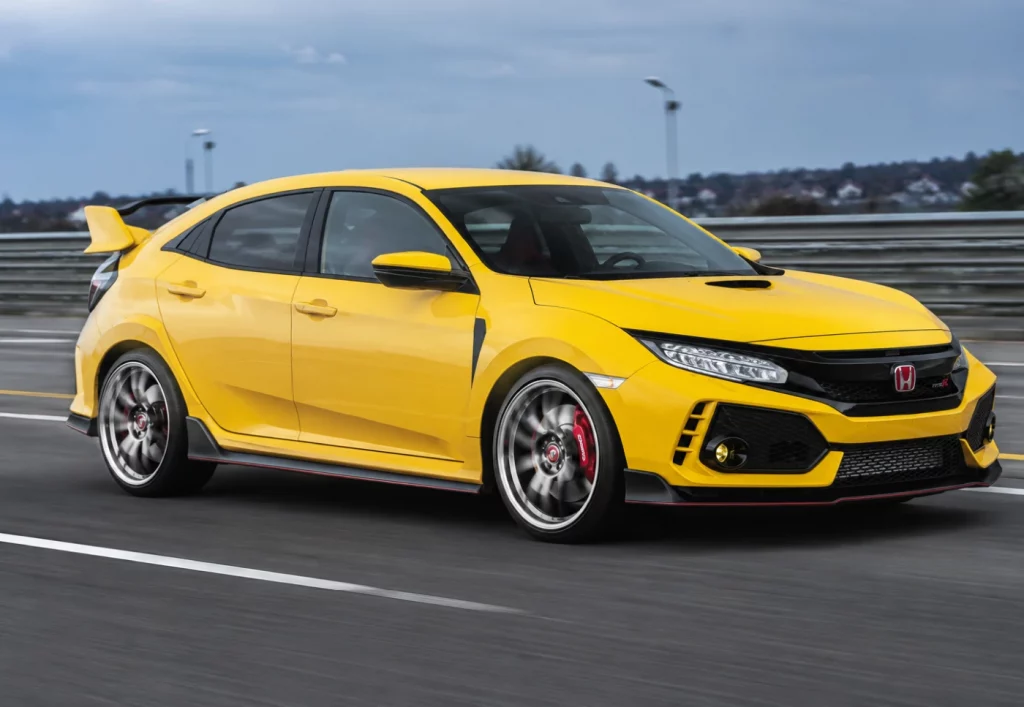
Honda Sensing was introduced on the Civic in the 10th generation (2016 model year), initially as an optional package on mid-range and higher trims. Over the course of the 10th generation’s run, it moved from optional to standard across the entire lineup. The 11th generation (2022-present) includes CMBS as standard equipment on every Civic trim, including the base LX. Sources: Honda Newsroom, 2016 Civic trim walk documents; IIHS FCP ratings for 2016–2025 Honda Civic models.
10th Generation (2016–2021): Optional to Standard Transition
The 10th-generation Civic was a ground-up redesign that introduced a stiffer platform and Honda Sensing for the first time on a Civic. But the rollout was staggered by trim and model year, creating important distinctions for used buyers.
2016–2018 Model Years: Honda Sensing was optional on EX, EX-T, EX-L, and Touring trims. The LX and Sport trims did not offer CMBS at all. Buyers who wanted automatic emergency braking had to step up to EX trim or above and select the Honda Sensing Package. IIHS testing of the 2016–2018 Civic equipped with the optional system rated it Superior for vehicle-to-vehicle front crash prevention — the system avoided collisions in both the 12 mph and 25 mph tests. However, pedestrian detection was not yet part of the IIHS evaluation protocol during these model years. Sources: IIHS 2016–2017 Honda Civic sedan ratings; 2016 Civic specifications and highlights (Honda).
2019 Model Year: Honda made Honda Sensing standard across all Civic trims — including LX and Sport — for the 2019 model year. This was a meaningful change that meant every 2019+ Civic, regardless of trim, included CMBS, adaptive cruise control, lane-keeping assist, and road departure mitigation. IIHS began evaluating pedestrian front crash prevention (daytime) during this period. The 2019 Civic earned Superior on both vehicle-to-vehicle and pedestrian (day) tests. The pedestrian system avoided collisions with a crossing child at 12 mph and a crossing adult at both 12 and 25 mph. Sources: IIHS 2019–2020 Honda Civic sedan ratings; Honda Newsroom 2019 Civic feature guide.
2020–2021 Model Years: Standard across all trims continued. IIHS ratings remained Superior for both vehicle-to-vehicle and pedestrian (day). The 2020 Civic’s pedestrian system avoided a collision with a crossing adult AT both test speeds and reduced impact speed by 20 mph when striking a crossing child at 25 mph. For the parallel adult scenario at 37 mph, impact speed was reduced by 35 mph on Si trim and 32 mph on other trims. Sources: IIHS 2020–2021 Honda Civic sedan ratings.
| Model Year | Availability | IIHS V2V Rating | IIHS Pedestrian (Day) |
|---|---|---|---|
| 2016 | Optional — EX trim and above | Superior | Not tested |
| 2017–2018 | Optional — EX trim and above | Superior | Not tested |
| 2019 | Standard — all trims | Superior | Superior |
| 2020–2021 | Standard — all trims | Superior | Superior |
11th Generation (2022–Present): Standard Across All Trims from Launch
The 11th-generation Civic, introduced for the 2022 model year, made Honda Sensing — including CMBS — standard on every trim from day one, including the base LX. The system hardware was carried over from the late 10th-generation cars but with updated calibration software. The 11th gen also introduced a new low-speed braking control feature for parking lot maneuvers that IIHS does not evaluate. Sources: Honda Newsroom, 2022 Civic release; IIHS 2022–2025 Civic ratings.
IIHS testing for 2022–2023 models used the original (Pre-2024) FCP rating scale. The 2022 Civic hatchback earned Superior for both vehicle-to-vehicle and pedestrian (day), and Advanced for pedestrian (night) — the latter being a rating that IIHS began issuing in 2019 for night-time pedestrian detection performance. The pedestrian night rating is notable because the Civic’s CMBS performed better with high beams activated than with low beams, which is typical for camera-based systems. Sources: IIHS 2022 Honda Civic 4-door hatchback, FCP ratings.
Starting with the 2024 model year, IIHS updated its FCP rating scale, replacing Superior/Advanced/Basic with Good/Acceptable/Marginal/Poor to align with crashworthiness ratings. The 2025 Civic hatchback earned Good on both vehicle-to-vehicle and pedestrian tests under the new scale. The 2025 Civic sedan earned Good on headlights and Acceptable on both vehicle-to-vehicle and pedestrian — a gap between the two body styles that IIHS attributes to differences in system calibration between sedan and hatchback production batches. Sources: IIHS 2025 Honda Civic hatchback and sedan ratings.
| Model Year | V2V Rating | Pedestrian (Day) | Pedestrian (Night) | Headlights | IIHS Award |
|---|---|---|---|---|---|
| 2022–2023 (hatchback) | Superior | Superior | Advanced | G | TSP+ (2022) / TSP (2023) |
| 2024 (hatchback) | Superior | Superior | Advanced | G | TSP |
| 2025 (sedan) | A (Acceptable) | A | A | G | TSP |
| 2025 (hatchback) | G | G | G | G | TSP+ |
Sources: IIHS 2022–2025 Honda Civic 4-door sedan and hatchback ratings; IIHS news release September 12, 2024 on 2025 Civic TSP+ award.
What the IIHS Ratings Actually Mean for Real-World Performance
The IIHS FCP tests measure a system’s ability to avoid or mitigate a collision in controlled scenarios. The vehicle-to-vehicle test evaluates the car approaching a stationary target from behind at 12 mph and 25 mph. Avoiding a collision at both speeds earns the highest rating (Superior under the old scale, Good under the new one). The Civic’s CMBS has achieved avoidance at both speeds on every model year tested since 2016 — meaning it has consistently been one of the better-performing compact car AEB systems since introduction. Sources: IIHS FCP test protocol; IIHS ratings for all tested Civic model years.
The pedestrian (day) test adds three scenarios: a child running across the street from between two parked cars (12 and 25 mph), an adult crossing the road (12 and 25 mph), and an adult walking parallel to the road on the shoulder (25 and 37 mph). The 2022 Civic hatchback avoided collision in all five day scenarios. The pedestrian (night) test, which IIHS added in 2019, uses only adult crossing and parallel scenarios at night. The Civic’s Advanced rating in this category means it avoided or substantially mitigated impact in all night scenarios, but performance dropped when using low beams alone — a limitation shared with most camera-based AEB systems on the market at the time. Sources: IIHS 2022 Civic hatchback FCP ratings, pedestrian night test.
Sedan vs Hatchback Differences in the 11th Generation
IIHS data shows a small but measurable gap between the Civic sedan and hatchback on FCP testing for 2025 models. The hatchback earned Good on both vehicle-to-vehicle and pedestrian tests under the updated rating scale, while the sedan earned Acceptable on both. According to IIHS documentation, the sedan avoided collisions at some test speeds but not all — the system reduced speed but did not fully avoid impact in certain scenarios. The root cause appears to be calibration differences rather than hardware, as both body styles use the same CMBS camera and radar hardware. Sources: IIHS 2025 Civic sedan and hatchback ratings.
This gap is relevant for buyers choosing between the two body styles in the current generation. The difference is not large enough to make the sedan unsafe — Acceptable is still a solid rating — but the hatchback is clearly the better performer in crash avoidance testing.
Headlight Performance Alongside AEB
One of the most significant improvements between the 10th and 11th generations is headlight quality. AEB systems rely on adequate forward illumination to detect obstacles at night, and the 10th-gen Civic’s poor headlight performance across most trims (all halogen-equipped models rated Poor by IIHS for the entire 2016–2021 run) likely contributed to the gap between daytime and nighttime pedestrian detection performance. The 11th generation switched to LED reflector headlights across all trims, earning a Good rating from IIHS and providing the camera-based CMBS with better illumination to work with at night. Sources: IIHS headlight ratings for 2016–2021 and 2022–2026 Civic models.
Used Buyer Guidance
For used buyers, the AEB capability of a Civic depends heavily on model year and trim:
2016–2018 Civic: CMBS was optional on EX trims and above. Many used cars from this period do not have it. A buyer looking at a 2016–2018 Civic should verify whether the car has Honda Sensing — look for the camera housing at the top center of the windshield and the “Honda Sensing” badge on the rear decklid or check the original window sticker. If the car does not have it, there is no retrofit path. These cars still have good crashworthiness (IIHS Top Safety Pick+ for 2016 coupe) but lack forward collision warning and automatic braking. Sources: IIHS 2016–2017 Civic ratings; Honda 2016 Civic specifications and highlights.
2019–2021 Civic: CMBS is standard on every trim. Every 2019+ Civic has at least the same vehicle-to-vehicle and pedestrian day AEB capability, regardless of whether it is a base LX or a fully loaded Touring. The headlight quality still varies by trim — halogen headlights on LX/Sport/EX/EX-L are rated Poor by IIHS, while the Touring LED headlights (post-November 2019 build date) earned Good. Buyers who drive frequently at night should prioritize Touring or Si trims from this generation or move to the 11th generation. Sources: IIHS 2019–2021 Civic sedan ratings, headlight evaluations.
2022+ Civic: CMBS is standard across all trims, headlights are Good across all trims, and night pedestrian detection is available (Advanced or Good depending on year and body style). The 2022 model year is the cutoff where every Civic, regardless of trim, has a strong AEB system with adequate headlight support. Sources: IIHS 2022–2025 Civic hatchback and sedan ratings.
Quick Reference
☐ CMBS (automatic emergency braking) was first available on the 2016 Civic as an option on EX and above trims only. It became standard on all trims starting with the 2019 model year.
☐ IIHS rated the 10th-gen Civic’s vehicle-to-vehicle AEB as Superior for every model year tested (2016–2021) — the system avoided collisions at both 12 and 25 mph.
☐ Pedestrian (day) AEB was first rated on the 2019 Civic, and it earned Superior. The 2022 Civic avoided collisions in all five daytime pedestrian scenarios.
☐ Pedestrian (night) AEB earned Advanced on the 2022–2024 Civic. Performance is better with high beam assistance, which is standard on all 11th-gen trims.
☐ The 10th-gen Civic’s halogen headlights (LX, Sport, EX, EX-L) were rated Poor throughout the generation’s run, limiting the AEB system’s effectiveness at night. The Touring LED headlights earned Good after a November 2019 revision.
☐ The 11th-gen Civic (2022+) has Good-rated LED headlights across all trims, eliminating the trim-dependent headlight weakness of the 10th generation.
☐ The 2025 Civic hatchback earned Good on all three FCP tests under IIHS’s updated rating scale. The 2025 sedan earned Acceptable on vehicle-to-vehicle and pedestrian — a real but minor gap.
☐ Used buyers should prioritize 2019 or newer Civics for guaranteed AEB coverage. For 2016–2018 models, verify Honda Sensing was equipped — most base-trim examples lack it.
☐ No Civic from any generation can be retrofitted with CMBS if it was not equipped from the factory. Choose the model year and trim carefully when AEB capability is a priority.