

When you’re shopping used Civics, forget the infotainment screen. Forget the leather seats. What actually matters is what’s hiding under the paint — the crash cage that’s going to keep your ass alive when some lifted F-250 runs a red light and T-bones you AT 45 mph.
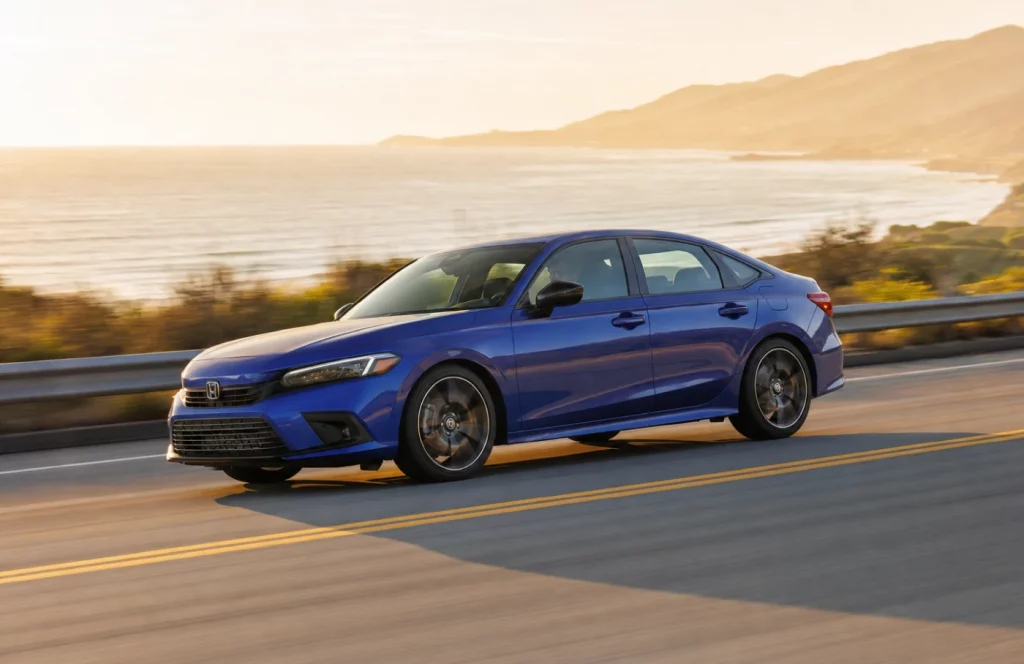
Here’s the raw truth about how Honda’s body structure evolved from generic sheet metal into a laser-brazed, glue-soaked, ultra-high-strength steel fortress. And why fixing the new ones will make your body shop cry.
8th Gen (2006–2011) — The First ACE Cage, Soft on the Sides
The 8th Gen (FA5/FG2) was a massive deal when it dropped. Honda introduced the ACE body structure to the compact segment — a fancy way of saying they finally figured out how to keep a Civic from getting pancaked by an SUV in a head-on. The idea was simple: route crash forces through the upper frame rails instead of just the floor pans, so the car actually plays nice with taller vehicles.
The steel: 50% high-strength steel (HSS), mostly 340–590 MPa stuff. Nothing special by today’s standards. Torsional rigidity jumped 35% over the ancient 7th Gen, which was impressive for 2006.
The real-world flaw: Side impact protection was weak. Under the IIHS side test, the B-Pillar intruded a brutal 10.5 cm from the seat centerline. Translation: if you get T-boned in an 8th Gen, that pillar is coming into the cabin. Not good. Roof strength-to-weight ratio (SWR) was 4.24 — safe enough for 2006, but absolutely obsolete now.
Used buyer verdict: Decent front structure, but the sides are soft. Avoid if highway side-impact safety is a priority. The 8th Gen is the “I’m on a tight budget and I know the risks” choice.
9th Gen (2012–2015) — ACE II and the First Taste of 1500 MPa Steel
The 9th Gen (FB6/FG4) was Honda’s panic response after the 2012 model got trashed by critics for feeling cheap. They rushed the ACE II refresh in 2013 to handle tougher frontal offset crashes.
The steel: Total HSS ticked up to 55-56%. More importantly, Honda used 1500 MPa ultra-high-strength steel (UHSS) for the first time ever in a Civic. The catch? It was only about 1% of the entire body, used strictly to beef up the B-pillar stiffeners. Just a taste, not a meal.
The crash result: That 1% of hot-stamped steel actually worked. B-pillar intrusion improved from 10.5 cm to 13.5 cm. The 2013+ models also survived the new IIHS Small Overlap front crash test with a Good rating — the 8th Gen never even faced that test. Roof SWR stepped up to 5.28. The cabin was getting tougher.
Used buyer verdict: Acceptable budget pick. It survived the first-gen small overlap test and stiffened the B-pillar. But it’s still mostly mild steel with a tiny sprinkle of the good stuff.
10th Gen (2016–2021) — The Great Steel Revolution
This is where Honda went absolutely ballistic with metallurgical engineering. The 10th Gen (FC1/FC3/FK7/FK8) completely changed how compact cars are built. If the 9th Gen was a steel snack, the 10th Gen was a full-course meal.
The steel: Total HSS jumped to 59%. But the jaw-dropping stat is the 1500 MPa hot-stamped UHSS content: it skyrocketed from 1% to 14%. That’s a 14x increase in military-grade steel wrapping around your legs and torso. Let that sink in.
Breaking it down per the Honda Body Repair Manual:
- 14% — 1500 MPa hot-stamp (the good shit)
- 12% — 980–1180 MPa UHSS
- 29% — 590–780 MPa advanced HSS
- 9% — 340–440 MPa HSS
- 37% — 270 MPa mild steel (the cheap stuff)
The inner frame magic: Instead of welding individual stamped brackets together like an old-school car, Honda welded the entire inner chassis framework as a single, ultra-rigid unit first, then wrapped the outer skin over it. This dropped 44 pounds off the bare body-in-white while exploding stiffness.
Short-pitch welding: In critical door areas, Honda placed spot welds just 20 mm apart instead of the industry standard 45 mm. It was essentially a factory-seam-welded race car structure. The result? A 25% increase in torsional rigidity over the 9th Gen.
Side impact dominance: Under the standard IIHS side test, the 10th Gen logged an incredible 18.5 cm of clearance from the seat centerline. The B-pillar barely budged. Roof SWR maxed out at a phenomenal 7.6 — nearly double the 8th Gen’s 4.24.
Used buyer verdict: The sweet spot. 14% hot-stamped steel creates a brutal roll-cage effect inside the doors. Incredible side impact score and rock-hard roof strength. Easier and cheaper to repair than the 11th Gen after a minor smash. This is the generation to buy if you want maximum safety for reasonable repair costs.
11th Gen (2022–Present) — The Glue, Laser, and Aluminum Era
The 11th Gen (FE1/FL1/FL5) doesn’t look as wild on paper regarding raw steel percentages. But the assembly tech is pure 21st-century wizardry. This is where Honda went from “let’s add more steel” to “let’s rethink how we put the car together.”
The adhesive revolution: The 11th Gen uses 10 times more structural adhesive (industrial glue) than the 10th Gen. Every major seam on the underbody, floor pan, and door rings is continuously glued and baked, creating a seamless monocoque that eliminates chassis squeaks and cuts road noise. It’s like the difference between IKEA furniture held together with screws versus a solid wood cabinet glued and clamped.
Laser-brazed roof: Look at the roof ditch on an 11th Gen — those ugly black plastic strips are gone. Honda used high-intensity lasers to fuse the roof panel directly into the side frames. This drastically increases rollover and twisting stiffness. But here’s the catch: if you dent the roof, your body shop needs a $5,000 specialized tool to separate the laser joint.
The front upper member: To pass the brutal new NHTSA oblique impact and updated IIHS offset tests, Honda added a massive HSS upper ring around the top of the engine bay. This steers crash energy around the cabin walls rather than letting it push the front wheel into your footwell. In plain English: in an offset crash, the 11th Gen routes the impact force through the upper frame, not your legs.
Weight shaving: For the first time in Civic history, the Hood is 100% aluminum, and both the front and rear bumper beams are thick aluminum extrusions. This keeps weight down despite the massive addition of safety tech. But if you dent that aluminum hood, you can’t just hammer it out — it’s a $1,200+ replacement part.
The stricter test reality: In the new, heavily updated IIHS side crash test — which hits the car with a 4,200-lb barrier mimicking a modern EV truck instead of the old 3,300-lb sedan sled — the 11th Gen scored an Acceptable with 17.5 cm of pillar clearance. Don’t let the “Acceptable” scare you. Surviving this new test with 17.5 cm of deflection means this chassis is actually tougher in the real world than the 10th Gen was against the old, lighter sled. The test got harder, and the car still passed.
Roof strength: Peak rigidity at 7.62 SWR — basically identical to the 10th Gen’s 7.6 but against a stricter rollover standard.
Used buyer verdict: Tank mode. Smarter energy routing for oblique offset crashes, full inner/outer 1500 MPa door rings, and an ultra-stiff glued assembly. Objectively the most structurally resilient Civic ever engineered. But expect high insurance premiums because fixing this advanced metallurgy and glue setup is incredibly complex.
| Steel Grade | 8th Gen | 9th Gen | 10th Gen | 11th Gen |
|---|---|---|---|---|
| Total HSS (340MPa+) | 50% | 55–56% | 59% | 38–57%* |
| 1500 MPa hot-stamp | None | ~1% | 14% | 7% (980+MPa) |
| Structural adhesive | Minimal | Minimal | Moderate | 10x more |
| Roof construction | Spot-welded | Spot-welded | Spot-welded | Laser-brazed |
| Hood material | Steel | Steel | Steel | Aluminum |
| Bumper beams | Steel | Steel | Aluminum front | Aluminum front + rear |
| B-pillar intrusion (side) | -10.5 cm | -13.5 cm | -18.5 cm | -17.5 cm** |
| Roof SWR | 4.24 | 5.28 | ~7.6 | 7.62 |
| Torsional rigidity gain | +35% vs 7th | +10% vs 8th | +25% vs 9th | +8–19% vs 10th |
*11th gen HSS varies by source — 38% excludes dual-phase steel (19%) which meets the 340 MPa threshold. **11th gen tested against 4,200-lb barrier at 37 mph vs 3,300-lb at 31 mph for 10th gen.
The Nightmare of Collision Repair — 10th vs 11th Gen
If you wreck a modern Civic, your neighborhood generic body shop is going to have a minor panic attack. Here’s why:
10th Gen rules:
- The 1500 MPa B-pillars cannot be sectioned (cut and spliced). If a shop tries to weld a patch sleeve into a damaged 10th Gen B-pillar with a standard MIG welder, they ruin the heat treatment, turning that military-grade steel into soft butter.
- Squeeze-Type Resistance Spot Welding (STRSW) equipment is mandatory. Most small shops don’t have it.
- The entire pillar assembly must be swapped wholesale. No shortcuts.
11th Gen rules — it gets worse:
- The laser-brazed roof cannot be cut out normally. It requires a highly specialized tool to separate the laser joint. Most shops don’t own this tool.
- If a shop replaces a rear floor Crossmember or a door ring, they have to meticulously clean, apply, and cure specific factory-approved structural adhesives in a pinpoint layout. Miss a spot, and the structural integrity is compromised.
- The aluminum hood can’t be pulled or repaired with steel tools. It’s a $1,200+ replacement part, not a repair job.
- The aluminum bumper beams — if they’re tweaked, they’re replaced, not straightened. Aluminum work-hardens; bending it back creates micro-cracks that fail in the next crash.
The bottom line: Minor Fender benders on 11th Gen Civics quickly turn into total-loss write-offs from insurance carriers. This is why your premium is higher on the 11th Gen — the repair bill for a moderate hit can exceed the car’s value in labor alone.
What Each Generation’s Body Structure Means for You
8th Gen (2006–2011): Outdated. Decent front structure, but soft B-pillars and weak roof (4.24 SWR). The B-pillar intrudes 10.5 cm into the cabin in a side hit — that’s scary close to your ribs. Avoid if highway side-impact safety is your main priority. This is a “I’m on a tight budget and I know the risks” car.
9th Gen (2012–2015): Acceptable budget pick. Survived the first-gen small overlap test and stiffened the B-pillar to 13.5 cm of deflection. Still mostly mild steel with only 1% of the good stuff. The roof SWR of 5.28 is a clear step up from the 8th Gen.
10th Gen (2016–2021): The sweet spot. 14% hot-stamped steel creates a brutal roll-cage effect inside the doors. Incredible side impact score (18.5 cm) and rock-hard 7.6 roof strength. Easier and cheaper to repair than the 11th Gen after a minor smash. This is the generation to buy if you want maximum safety without the nightmare repair bills.
11th Gen (2022+): Tank mode. Smarter energy routing for oblique offset crashes, full inner/outer 1500 MPa door rings, and an ultra-stiff glued assembly. Objectively the most structurally resilient Civic ever engineered. But expect high insurance premiums because fixing this advanced metallurgy and glue setup is incredibly complex. The 11th Gen protects you better in a crash, but you’ll pay for it every month and if you ever have to fix it.
Quick Reference
☐ 8th Gen (2006–2011): 50% HSS. ACE body introduced. B-pillar intrusion: -10.5 cm. Roof SWR: 4.24. NHTSA 4/5. Outdated side structure. Avoid for highway safety.
☐ 9th Gen (2012–2015): 55–56% HSS, ~1% 1500 MPa. ACE II body (2013+). B-pillar intrusion: -13.5 cm. Roof SWR: 5.28. NHTSA 5/5. Acceptable budget pick. Survived small overlap test.
☐ 10th Gen (2016–2021): 59% HSS, 14% 1500 MPa hot-stamp. Crash stroke front rails. Inner frame weld system. B-pillar intrusion: -18.5 cm (best of any Civic under original side test). Roof SWR: ~7.6. NHTSA 5/5. IIHS TSP+. The sweet spot. Best balance of safety and repair cost.
☐ 11th Gen (2022+): 38–57% HSS (definition-dependent). 10x more structural adhesive. Laser-brazed roof. Aluminum hood + bumper beams. B-pillar intrusion: -17.5 cm (tested against 4,200-lb barrier). Roof SWR: 7.62. NHTSA 5/5 (29/30 pts). IIHS updated side: Acceptable. Tank mode. Most structurally resilient, but repair nightmare.
☐ Repair complexity escalation: 8th/9th Gen: conventional steel repair. 10th Gen: 1500 MPa B-pillars require STRSW — no sectioning. 11th Gen: laser-brazed roof, 10x adhesives, aluminum hood — specialized equipment mandatory for every structural repair.
☐ The 11th Gen’s Acceptable side rating under the updated IIHS test is actually better real-world protection than the 10th Gen’s Good under the old test — the barrier is 27% heavier and hits 19% faster.
☐ If you’re buying used: 10th Gen is the value sweet spot for safety. 11th Gen is the pinnacle of protection but budget for higher insurance and repair costs.