

The short answer: the Sport package is a $2,000 wheel-and-audio upgrade on an otherwise identical car. You get the same 2.0L engine, the same CVT, the same platform, and the same 158 horsepower in both trims. The difference is entirely about equipment that changes how the car feels to sit in and drive — not what it can do. Whether that is worth $2,000 depends on which specific items matter to you and which ones you would add anyway.
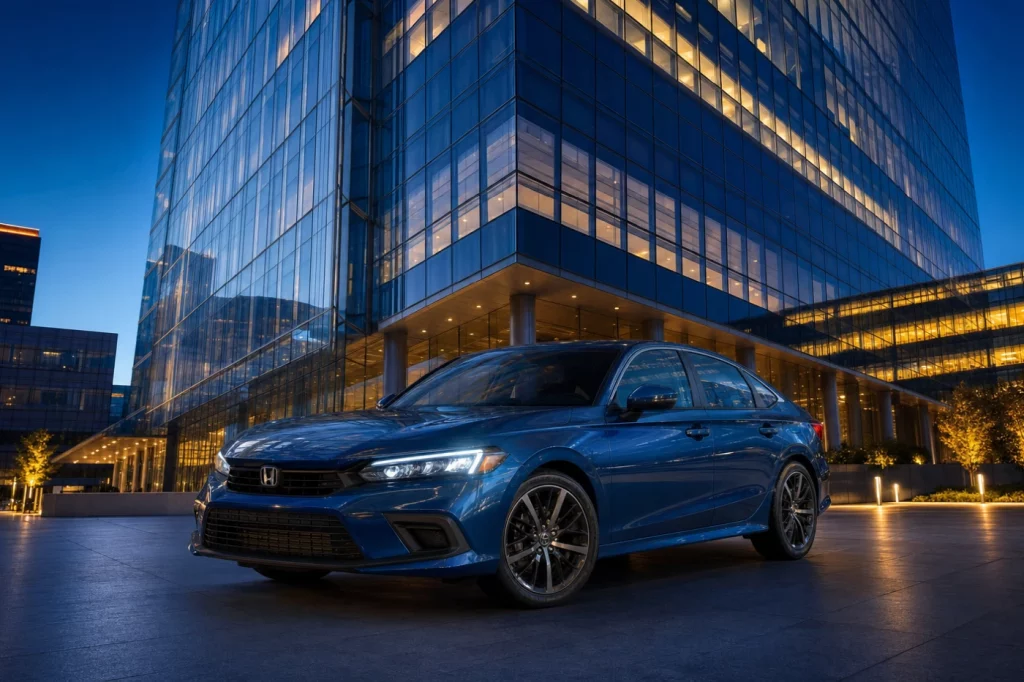
Don’t confuse the Sport trim with the Civic Si. The Sport is a cosmetic and convenience package, not a performance model. The Si is a completely different car with a turbocharged engine, manual transmission, limited-slip differential, and sport suspension. The Sport shares the same 2.0L engine as the LX — just with better wheels and a leather steering wheel.
Quick Verdict — LX vs Sport in 30 Seconds
| Factor | LX | Sport | Winner |
|---|---|---|---|
| Price (2026) | $24,695 | $26,695 | LX |
| Engine | 2.0L (158 hp) | 2.0L (158 hp) | Tie |
| Wheels | 16-inch steel | 18-inch alloy | Sport |
| Steering wheel | Urethane | Leather | Sport |
| Audio | 4 speakers | 8 speakers | Sport |
| Smart Entry | No | Yes | Sport |
| Remote start | No | Yes | Sport |
| Sport drive mode | No | Yes | Sport |
| MPG combined | 36 | 34 | LX |
| Ride quality | Softer | Firmer | LX |
| Best value | Yes | — | LX |
| Best looks | — | Yes | Sport |
The bottom line: The Sport is not $2,000 faster. It is $2,000 better equipped and better looking. The LX is the smarter financial decision. The Sport is the better car for buyers who want the nicer factory equipment without going aftermarket. Neither choice is wrong — it depends on what you value.
What You Get for $2,000 — The Full Delta
The table below covers every difference between the LX and the Sport sedan for the 2022–2026 model years. The only significant year-over-year change is pricing: the gap has held steady AT approximately $2,000 through the generation.
| Category | LX | Sport |
|---|---|---|
| Starting MSRP (2026) | $24,695 | $26,695 |
| Engine | 2.0L K20C2, 158 hp | 2.0L K20C2, 158 hp |
| Transmission | CVT | CVT with paddle shifters |
| Drive modes | ECON / Normal | ECON / Normal / Sport |
| Wheels | 16-inch steel with covers | 18-inch gloss black alloy |
| Tires | P215/55R16 all-season | P235/40R18 all-season |
| Remote start | Not available | Key fob remote engine start |
| Keyless entry | Remote entry only | Smart Entry with Walk Away Auto Lock |
| Audio system | 160-watt, 4 speakers | 180-watt, 8 speakers |
| Steering wheel | Urethane | Leather-wrapped |
| Shift knob | Urethane | Leather-wrapped |
| Seats | Full cloth | Combination (cloth with synthetic leather bolsters) |
| Pedals | Standard rubber | Aluminum sport pedals |
| Exterior mirrors | Body-colored | Gloss black |
| Exhaust finisher | Hidden | Chrome (visible) |
| Combined MPG | 36 mpg | 34 mpg |
| Curb weight | 2,875 lb | 2,926 lb |
Sources: Honda official feature-by-trim PDF (2023 Civic Sedan), Honda.com 2026 Civic Sedan specs, TrimAtlas comparison data.
The Items Worth Paying For
18-inch wheels and wider tires. The jump from 16-inch steel wheels with covers to 18-inch gloss black alloys is the single most visible upgrade. The Sport runs P235/40R18 tires versus the LX’s P215/55R16. The wider contact patch and lower profile improve steering response and cornering grip noticeably. The tradeoff: the Sport rides firmer over broken pavement, and replacement tires cost more — approximately $140–$180 per tire for the 18-inch size versus $100–$130 for the 16-inch size. The LX rides softer and absorbs expansion joints better.
Leather-wrapped steering wheel and shift knob. This is the interior item most LX owners notice first. The urethane wheel on the LX feels thin and hard. The Sport’s leather wheel is thicker, warmer in winter, and provides better grip. Honda’s leather wrap on the Civic is decent for the price point — forum owners on Civic11Forum frequently cite this as a reason they chose the Sport over the LX. The shift knob is a smaller difference but the leather version does not get cold in winter like the urethane item does.
Smart Entry with Walk Away Auto Lock. The LX requires pressing a button on the key fob to lock and unlock. The Sport unlocks when you touch the door handle and locks automatically when you walk away. This is one of those convenience features that becomes invisible after a week of ownership but hard to give up on the next car.
Sport drive mode and paddle shifters. The Sport trim adds a third drive mode (ECON, Normal, Sport) that sharpens throttle response and holds the CVT in a lower ratio range. This does not change horsepower but it makes the car feel more responsive when you want to move quickly. The LX has ECON and Normal modes only. The Sport also adds paddle shifters that allow manual selection of simulated CVT ratios — a gimmick on a CVT, but some drivers prefer the control.
Audio upgrade. The Sport’s 180-watt, 8-speaker system sounds noticeably fuller than the LX’s 160-watt, 4-speaker setup. It is not Bose-level quality (you need the Touring for the 12-speaker system), but it is a meaningful improvement for daily listening. On the Civic11Forum, owners describe both systems as adequate but the Sport’s delivers bass presence the LX lacks (Civic11Forum, LX vs Sport Sound System thread, 2023).
The $2,000 calculation: A leather steering wheel wrap costs $40–$80. Aftermarket 18-inch alloy wheels with tires run $1,000–$1,600. Smart Entry is difficult to retrofit cost-effectively. An aftermarket audio upgrade of similar quality costs $300–$600. The Sport’s value is in having these items factory-installed, covered under warranty, and included in financing.
The Items That Do Not Matter
Sport pedals. Aluminum pedal covers look sporty but do not change how the car drives. The standard rubber pedals on the LX work identically.
Chrome exhaust finisher. A cosmetic tip that covers the pipe. No performance effect.
Gloss black mirrors. A style choice. The LX body-colored mirrors look less aggressive but are functionally identical.
Combination seats. The Sport uses cloth seating surfaces with synthetic leather bolsters. The LX uses full cloth. This is primarily a visual difference — the LX cloth is easier to clean in practice because there is no faux-leather section that can crack or peel.
Remote start. The LX does not have factory remote start, but a $100–$200 aftermarket remote start module can be added to the LX and will work as well as the factory system. This is the easiest item on the Sport’s list to add after purchase.
What You Lose by Going Sport
Fuel economy. The EPA rates the LX at 32 city / 41 highway / 36 combined versus 31 city / 39 highway / 34 combined for the Sport CVT. The difference is entirely from the wider 18-inch tires and 51 additional pounds of curb weight. Over 15,000 miles per year at $3.50 per gallon, the LX saves roughly $100–$125 annually in fuel.
Ride quality. The 18-inch wheels with 40-series tires transmit more road noise and impact harshness than the LX’s 55-series tires. On smooth pavement the difference is minor. On imperfect urban streets and highway expansion joints, the LX is noticeably quieter and more compliant. Owners on Civic11Forum and CivicXI who cross-shopped both trims consistently cite ride quality as the LX’s advantage, with several LX buyers specifically choosing the base trim to avoid the firmer ride (Civic11Forum, “You chose the Sport or LX 2.0, why?”, 2024).
Running costs. The 235/40R18 tires cost more per replacement and wear faster than the LX’s 215/55R16 tires. The 18-inch wheels are also more prone to curb rash and damage from potholes. Over a typical ownership period of 5–7 years, these costs add up to several hundred dollars.
The 18-Inch Wheel Question — The Real Trade-off
The wheel difference is the single most impactful upgrade on the Sport — and the single biggest trade-off. The LX’s 16-inch wheels with 55-series tires absorb road imperfections significantly better than the Sport’s 18-inch wheels with 40-series tires.
Cost difference over 5 years:
- Tires: LX ($600–$800 per set) vs Sport ($800–$1,200 per set). Over 5 years with two tire replacements, the Sport costs $400–$800 more.
- Winter tires: LX ($500–$700 per set) vs Sport ($700–$1,000 per set). If you live in a snowy climate, the Sport costs $200–$300 more per winter set.
- Wheels: OEM 18-inch Sport wheels cost $400–$600 each vs $250–$350 for the LX’s 17-inch wheels. A single replacement wheel costs twice as much on the Sport.
- Curb rash: The Sport’s 18-inch wheels are more visible and more prone to damage. Repairing a machine-finished 18-inch wheel costs $150–$250 vs $50–$100 for a steel wheel with a cover.
Ride quality difference: The LX’s taller sidewall (55-series vs 40-series) absorbs potholes and road imperfections more effectively. The Sport’s lower-profile tires transmit more impact harshness to the cabin. On poorly maintained roads, the LX is noticeably more comfortable.
The wheel rule: 16-inch wheels are cheaper to live with. The 18-inch wheels on the Sport look better and handle slightly better, but the LX saves you money on every tire replacement and delivers a more comfortable ride on rough roads. If you live in the Rust Belt or drive on potholed streets, the LX’s 16-inch wheels are a genuine advantage.
What the Sport Does NOT Give You
It is just as important to understand what the Sport does not add. The Sport does not include:
- Turbocharged engine (that is the EX/Touring)
- Heated seats (EX and above)
- Moonroof (EX and above)
- Blind spot monitoring (EX and above)
- Leather seats (Touring only)
- Bose audio (Touring only)
- Larger infotainment screen (same 7-inch as LX)
- Wireless CarPlay (Touring only)
- Digital instrument cluster (Touring only)
The Sport is not a halfway point to the EX. It is a fully equipped LX with cosmetic and convenience upgrades. If you want heated seats, a moonroof, or the 1.5T turbo engine, you need the EX or higher.
The Manual Transmission Exception
Through the 2024 model year, the Sport was the only Civic trim where the 2.0L engine could be paired with a 6-speed manual transmission (sedan discontinued manual after 2021, hatchback carried the manual Sport through 2024). If you wanted a stick shift Civic without stepping up to the Si, the Sport hatchback was the only option. This changes the value equation entirely — the manual adds engagement that no feature list captures. For anyone cross-shopping LX versus Sport and wanting a manual, the question answers itself. Note that the Si manual cannot replace this role because the Si starts approximately $4,800 above the Sport and adds turbo engine maintenance costs.
Aftermarket — Can You Turn an LX Into a Sport?
One way to evaluate the Sport premium is to ask: “What could I do with the same money on an LX?”
- $100–$200: Aftermarket remote start — comparable to factory remote start on the Sport
- $40–$80: Leather steering wheel wrap — not factory quality, but close
- $300–$600: Speaker upgrade (front components, rear coaxials) — exceeds the Sport’s 8-speaker system
- $800–$1,200: 18-inch aftermarket wheels with tires — comparable to the Sport’s wheel package
- $20–$50: Aluminum pedal covers — cosmetic only
- $100–$300: Window tint or black mirror caps — cosmetic only
For $1,500–$2,500, you can address most of the Sport’s advantages aftermarket. The exceptions are Smart Entry (difficult to retrofit) and the Sport drive mode (which is integrated into the ECU and transmission calibration). If those are important to you, the Sport is the only way to get them. If they are not, the LX plus aftermarket upgrades can match or exceed the Sport’s equipment for a similar total cost.
Used Market — This Is Where the Answer Changes
In the used market, the gap between LX and Sport narrows. A 2022 LX with 30,000–40,000 miles trades for approximately $20,000–$22,000. A 2022 Sport with similar mileage trades for approximately $21,500–$23,500. The gap is typically $1,000–$2,000, depending on condition, location, and the specific car.
The used-market calculation is different from the new-car calculation. A $1,000 gap between LX and Sport is easy to justify — the Sport’s wheels and leather wheel are worth that premium. A $2,500 gap is harder to justify — the LX is the better value.
Used-market rule: Don’t buy the Sport if it forces you into the worse car. A clean LX with 35,000 miles and service records is a better buy than a Sport with 80,000 miles and no history — even if the Sport has nicer wheels. Condition and maintenance history matter more than trim level.
LX vs Sport — Real Ownership Costs Over 5 Years
| Cost Category | LX (5-Year) | Sport (5-Year) | Difference |
|---|---|---|---|
| Purchase price | $24,695 | $26,695 | +$2,000 |
| Fuel | ~$6,600 | ~$7,100 | +$500 |
| Tires (one replacement set) | $700 | $1,000 | +$300 |
| Insurance | ~$8,750 | ~$9,750 | +$1,000 |
| Total 5-year cost | ~$40,745 | ~$44,545 | +$3,800 |
Assumptions: 15,000 miles/year, $3.50/gallon, 36 mpg (LX) vs 34 mpg (Sport), $1,750/year insurance (LX) vs $1,950/year (Sport), one tire replacement. Actual costs vary by region and driving habits.
The Sport costs approximately $3,800 more over five years than the LX. That is $760 per year, or $63 per month. The question is whether the 18-inch wheels, leather wheel, Smart Entry, better audio, and Sport drive mode are worth that premium to you.
LX vs Sport by Buyer Type
| Buyer Type | Better Choice | Why |
|---|---|---|
| First-time buyer | LX | Lower price, lower running costs, still has Honda Sensing and CarPlay |
| Daily commuter | LX | Better MPG, softer ride, cheaper tires |
| Long highway miles | LX | Quieter ride, better fuel economy |
| Wants better looks | Sport | 18-inch wheels, gloss black trim, sportier appearance |
| Wants remote start | Sport | Factory remote start included |
| Wants paddles/Sport mode | Sport | Paddle shifters and Sport drive mode |
| Plans aftermarket wheels | LX | You’d replace the wheels anyway — save the $2,000 |
| Long-term owner (10+ years) | LX | Lower running costs, cheaper tires, less equipment to fail |
| Wants factory equipment included in financing | Sport | Wheels, leather wheel, audio, and Smart Entry covered under warranty |
Quick Decision Block
Buy the LX if: You prioritize the lowest purchase price, prefer a softer ride, plan to add aftermarket wheels and audio later, or want maximum fuel economy. The LX retains all of Honda Sensing, the same infotainment with Apple CarPlay/Android Auto, and the same core car underneath. Nothing the Sport has changes the driving character at a fundamental level.
Buy the Sport if: You want the factory 18-inch wheels and leather-wrapped steering wheel included in your financing, prefer a firmer sportier ride, want Smart Entry keyless access, or are buying a hatchback with the 6-speed manual. The Sport also makes sense if you plan to keep the car unmodified and simply want the nicer standard equipment.
Neither choice is wrong. The LX and Sport share the same engine, same CVT, same safety equipment (Honda Sensing is identical), same infotainment screen size (7-inch in both), same platform, and same interior space. The $2,000 buys cosmetic and convenience upgrades that change how the car feels, not what it can do.
Frequently Asked Questions
Is Civic Sport faster than LX?
No. Both trims have the same 2.0L engine producing 158 HP and 138 lb-ft. The Sport is slightly heavier (51 lb) due to the larger wheels, so it is marginally slower in 0–60 testing — not that you would notice in normal driving.
Is the Sport worth $2,000 more?
It depends on what you value. If you want the 18-inch wheels, leather steering wheel, Smart Entry, and 8-speaker audio, yes. If you don’t care about those features, no.
Does the Sport have a turbo?
No. The Sport shares the 2.0L naturally aspirated engine with the LX. The 1.5T turbo engine is available on the EX, EX-L, and Touring.
Does the Sport have heated seats?
No. Heated seats start on the EX trim.
Does the Sport have a moonroof?
No. The moonroof is available on EX and above.
Does the Sport have blind spot monitoring?
No. Blind spot monitoring starts on the EX trim.
Does the Sport have a manual transmission?
The Sport hatchback offered a 6-speed manual through the 2024 model year. The Sport sedan was CVT-only. For 2025, the manual was discontinued on all non-Si trims.
Is the Sport’s ride harsh?
The Sport’s 18-inch wheels with 40-series tires transmit more road noise and impact harshness than the LX’s 55-series tires. On smooth roads, the difference is minimal. On rough roads, the LX is noticeably more comfortable.
What MPG does the Sport get?
The EPA rates the Sport at 31 city / 39 highway / 34 combined. The LX gets 32/41/36 — about 2 mpg better combined.
Can I add remote start to the LX?
Yes. Aftermarket remote start modules cost $100–$200 and work as well as the factory system on the Sport.
Is the LX a good car?
Yes. The LX has Honda Sensing, Apple CarPlay, Android Auto, a 7-inch touchscreen, LED headlights, and the same 2.0L engine as the Sport. It is a well-equipped car by any standard.
Which is better for long-term ownership?
The LX is better for long-term ownership. It has lower running costs (tires, fuel), a softer ride, and fewer expensive components to fail. The Sport’s 18-inch wheels and 40-series tires cost more to maintain over time.
Quick Reference Checklist
☐ LX and Sport share the same 2.0L engine — no performance difference
☐ Sport adds 18-inch wheels, leather wheel, Smart Entry, 8-speaker audio, Sport driving mode
☐ LX rides softer and gets 2 mpg better combined fuel economy than Sport
☐ Sport hatchback offered 6-speed manual through 2024 — only way to get stick with the 2.0L
☐ LX is the better value for budget-focused buyers; Sport is the better choice for those who want factory-installed upgrades
☐ $2,000 gap adds approximately $35/month on a 60-month loan
☐ Over 5 years, the Sport costs approximately $3,800 more to own than the LX
☐ The Sport is not a halfway point to the EX — it is a fully equipped LX with cosmetic and convenience upgrades
☐ If you plan to modify the car (wheels, audio, remote start), the LX can make more sense
☐ The Sport makes sense if you want factory equipment included in financing and covered under warranty
Sources: Honda official feature-by-trim PDF (2023 Civic Sedan), Honda.com 2026 Civic Sedan specs, TrimAtlas comparison data, EPA fuel economy ratings, Civic11Forum owner reports, CivicXI forum discussions. Prices are approximate and may vary by region and market conditions.