

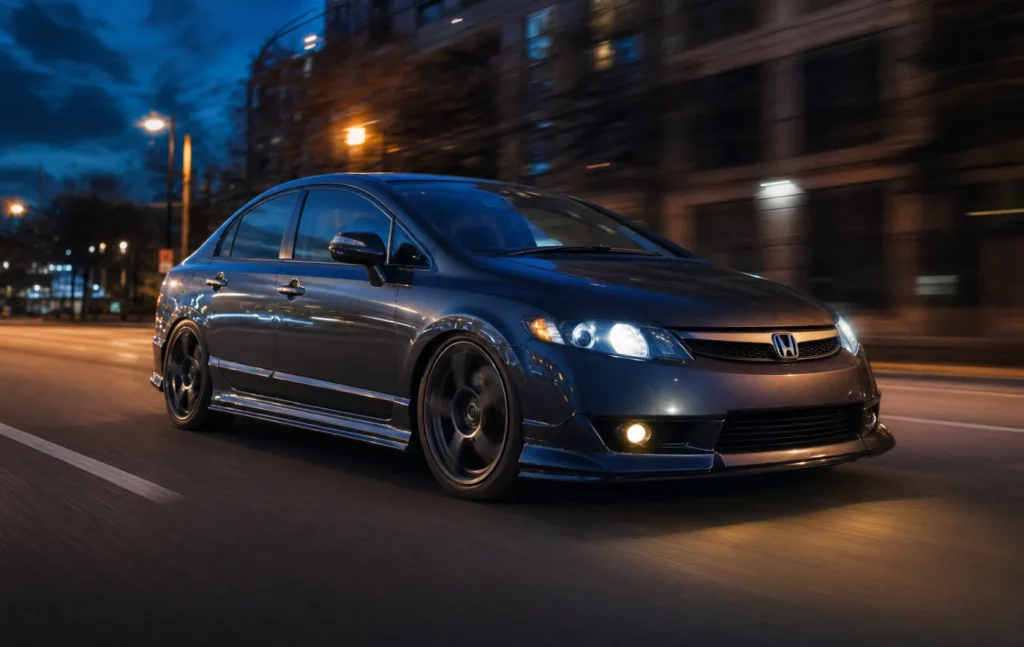
The 8th-generation Honda Civic Si (2006–2011) is powered by the K20Z3, a 2.0-liter naturally aspirated four-cylinder that represents the peak of Honda’s high-revving K-Series philosophy for the Civic platform. Rated at 197 hp at 7,800 rpm and 139 lb-ft at 6,100 rpm at the crank, the K20Z3 features dual i-VTEC (intake and exhaust cam control), a traditional bolt-on exhaust manifold (header), and an 8,000+ rpm redline. Unlike the 9th-gen K24Z7 that followed, the K20Z3 has no integrated exhaust manifold, no single-cam VTEC compromise, and a cylinder head that responds well to aftermarket modifications.
The aftermarket for the K20Z3 is one of the most mature in the Honda ecosystem. The engine shares its basic architecture with the K20A2 (RSX Type-S), K20Z1 (RSX-S), and K20A (JDM Type R), meaning a vast catalog of parts developed over two decades is directly applicable. This article documents dyno-verified output at every stage: stock, bolt-ons without tuning, bolt-ons with FlashPro tuning on 91 octane, bolt-ons with tuning on 93 octane, and the additional gains from E85 ethanol blends.
8th Gen Civic Si K20Z3 Dyno Results at a Glance
There is no single “stock WHP” number for the K20Z3. Different dynos, weather, correction factors, and the car’s mileage all affect the result. The table below shows observed results from published dyno tests and community data.
| Setup | Typical WHP Range | Typical WTQ Range | Fuel |
|---|---|---|---|
| Stock | 175–191 | 125–142 | 91–93 |
| Bolt-ons (no tune) | 178–185 | 134–140 | 91–93 |
| FBO + tune (91 oct) | 210–215 | 150–155 | 91 |
| FBO + tune (93 oct) | 215–223 | 155–160 | 93 |
| FBO + E85 | 225–235 | 160–170 | E85 |
| FBO + cams + E85 | 240–255 | 165–175 | E85 |
These are observed ranges from published dyno results, not guaranteed results for every car. The most meaningful comparison is the delta on the same dyno.
Stock Output: What the K20Z3 Delivers to the Wheels
The K20Z3 is known for producing wheel horsepower figures that closely approach its crank rating, a result of relatively low drivetrain loss through the 6-speed manual transmission and the engine’s willingness to rev. On a Dynojet chassis dynamometer, a healthy stock K20Z3 typically produces 175–191 whp and 125–142 wtq, depending on the specific dyno, ambient conditions, fuel octane, and mileage. The factory ECU adapts its fuel trims over time, and cars with higher mileage that have been run on premium fuel consistently tend to produce slightly higher numbers than low-mileage cars still running the factory break-in calibration.
Import Tuner Magazine documented a 2008 Civic Si at 172.1 whp and 121.7 wtq on their baseline dyno. A 2011 Si owner on 8thCivic.com reported 189.8 whp and 142 wtq at 1,000 miles on a Dynojet. Another 2009 owner reported 191 whp stock. The Temple of VTEC test car produced approximately 175 whp. The range reflects dyno variation more than engine variation: a Dynojet 248C typically reads higher than a Mustang or Dynapack, and correction factors vary by shop. (Sources: Import Tuner Magazine, Power Pages, May 2008; 8thCivic.com, stock dyno threads, 2007–2011; Temple of VTEC, 2011)
The torque curve is the K20Z3’s defining characteristic relative to the K24Z7. Peak torque of approximately 125–142 wtq arrives at approximately 6,100 rpm, and the engine needs to be kept above 5,500 rpm to feel strong. Below 4,000 rpm, the K20Z3 feels noticeably softer than the 2.4-liter engine, but from 6,000 rpm to the 8,000 rpm redline, it pulls with a linear, building surge that the K24 cannot match. The dual VTEC system engages both intake and exhaust cam profiles at approximately 5,800–6,200 rpm (stock calibration), producing an audible crossover and a noticeable increase in power delivery.
| Configuration | WHP | WTQ | Dyno Type | Source |
|---|---|---|---|---|
| Stock (2008) | 172.1 whp | 121.7 wtq | Dynojet | Import Tuner Magazine |
| Stock (2011, 1k mi) | 189.8 whp | 142 wtq | Dynojet | 8thCivic owner |
| Stock (2009) | 191 whp | ~135 wtq | Dynojet | 8thCivic owner |
| Stock (2007) | 183 whp | ~130 wtq | Dynojet | 8thCivic owner |
| Stock (typical range) | 175–191 whp | 125–142 wtq | Multiple | Community consensus |
Bolt-Ons Without Tuning: The ECU Fights Back
The K20Z3’s factory ECU is adaptive and emissions-focused. Adding a cold air intake, header, or cat-back exhaust without recalibrating the ECU produces minimal peak power gains and, in some cases, reduces power. The ECU detects the altered MAF signal from an aftermarket intake and adjusts fuel trims to maintain stoichiometric operation, often running rich and causing Misfire at high rpm. The same issue applies to the header: the factory ECU does not know how to take advantage of the improved exhaust flow and may pull timing if it detects knock from the altered exhaust scavenging characteristics.
Import Tuner Magazine’s 2008 Power Pages project tested this systematically. They added an AEM cold air intake, Vibrant header with high-flow Catalytic Converter, and Vibrant cat-back exhaust to a 2008 Si, one part at a time, on the stock ECU. The intake added 3.1 whp. The header added 5.1 whp. The cat-back added 2.1 whp. Total gain: 10.3 whp over the 172.1 whp baseline, for a final output of 182.4 whp. The magazine noted that the ECU was clearly compensating for each change and that a tune would unlock significantly more power. (Source: Import Tuner Magazine, Power Pages, May 2008)
This is consistent with owner reports on 8thCivic.com and K20A.org. An intake alone on a stock ECU typically adds 0–5 whp and may reduce power in hot weather when the ECU pulls timing. A header alone adds 5–10 whp. A cat-back exhaust alone adds 2–5 whp. The combination without tuning typically lands at 180–190 whp, which is barely above the upper end of the stock range. The real gains come from recalibrating the ECU to take advantage of the improved airflow.
Full Bolt-Ons + FlashPro Tune on 91 Octane
The Hondata FlashPro is the standard engine management solution for the K20Z3, providing full access to fuel maps, ignition timing, VTEC engagement, VTC cam phasing, rev limit, and speed limiter. A custom dyno tune or e-tune with FlashPro transforms the car’s behavior and unlocks the potential of bolt-on modifications.
A well-documented example from TDC Tuning (Hubert @ TDCauto) on a 2009 Civic Si with a Skunk2 header, Buddy Club exhaust, Injen cold air intake, and FlashPro tune produced 216.8 whp and 154.6 wtq on a Dynojet. The stock baseline on the same dyno was approximately 198.8 whp and 151 wtq (the car already had the intake and exhaust installed before the baseline, so the true stock figure would have been lower). The gain from the tune alone was approximately 18 whp. (Source: K20A.org, TDC Tuned FlashPro results, 2010)
Another 8thCivic owner with a similar setup (AEM CAI, Buddy Club race header, Skunk2 70mm throttle body, P2R spacer) reported 220–223 whp on 93 octane with a custom dyno tune from Chameleon Tuning. The same thread noted that most FBO cars on 91 octane land AT 210–215 whp, while 93 octane cars reach 215–223 whp. (Source: 8thCivic.com, “WHP from Full Bolt Ons + Custom Tune,” 2017)
JD-Tuning documented a 2008 Si that arrived with basic bolt-ons (CAI, header, exhaust, RDX injectors) running rich on the stock tune at 201 whp. After installing FlashPro and a custom dyno tune, the same car produced 215 whp and 152 wtq — a gain of 14 whp and significant torque improvement across the midrange. (Source: JD-Tuning.com, 8th Gen Civic Si build article, 2021)
The typical FBO K20Z3 on 91 octane with a FlashPro tune lands at 210–215 whp and 150–155 wtq on a Dynojet. The VTEC engagement point is typically lowered to approximately 4,500–5,200 rpm (from the factory 5,800–6,200 rpm), extending the high-lift cam profile across a broader portion of the rev range. The rev limiter is raised from 8,000 rpm to approximately 8,200–8,400 rpm, adding usable power at the top end. The torque curve fills in significantly from 4,000–6,000 rpm, where the stock calibration feels flat.
Full Bolt-Ons + FlashPro Tune on 93 Octane
The jump from 91 to 93 octane allows the tuner to add approximately 2–3 degrees of ignition timing in the high-load, high-rpm range where the K20Z3 is most knock-sensitive. The result is typically 5–10 additional whp over the same setup on 91 octane. The most aggressive FBO K20Z3 builds on 93 octane reach 220–225 whp on a Dynojet, with peak torque of approximately 155–160 wtq.
An 8thCivic owner in New York with 93 octane fuel, AEM CAI, Buddy Club race header, and Skunk2 70mm throttle body reported 220–223 whp on a Dynojet with a custom tune. This is at the upper end of what a K20Z3 can achieve with bolt-ons and pump gas without internal engine modifications. (Source: 8thCivic.com, FBO dyno thread, 2017)
The limiting factor at this stage is the factory intake manifold (RBC or RSP depending on the year). The 2006–2008 Si uses the RSP intake manifold, which has smaller plenum volume and shorter runners than the RBC manifold found on the 2009–2011 Si and the RSX Type-S. Swapping to an RBC manifold (or porting the RSP) is the next step beyond basic FBO and typically adds 5–8 whp on a tuned car.
| Configuration | WHP | WTQ | Gain over Stock | Fuel |
|---|---|---|---|---|
| Stock | ~180 whp | ~130 wtq | — | 91 octane |
| I/H/E (no tune) | ~182 whp | ~132 wtq | +2 whp | 91 octane |
| FBO + FlashPro tune | 210–215 whp | 150–155 wtq | +30 to +35 whp | 91 octane |
| FBO + FlashPro tune | 215–223 whp | 155–160 wtq | +35 to +43 whp | 93 octane |
| FBO + RBC + tune | 220–228 whp | 155–162 wtq | +40 to +48 whp | 93 octane |
E85: The Ethanol Advantage
E85 (85 percent ethanol, 15 percent gasoline) has an effective octane rating of approximately 105–108, significantly higher than pump premium. Ethanol also has a higher latent heat of vaporization, which cools the intake charge and reduces the engine’s tendency to knock. For the K20Z3, this allows the tuner to add substantial ignition timing advance and, in some cases, increase compression effectively through more aggressive cam timing.
The eFlexFuel kit is the most common plug-and-play solution for the 8th-gen Si, adding a flex fuel sensor that reads ethanol content and adjusts the tune accordingly. The kit requires upgraded fuel injectors (550–1,000 cc, depending on power goals) and a Fuel Pump capable of flowing enough volume for ethanol’s lower energy density. The stock 310 cc injectors cannot support E85 at WOT because ethanol requires approximately 30 percent more fuel volume than gasoline for the same air mass.
eFlexFuel published dyno results from a 2015 9th-gen Civic Si (K24Z7) showing a gain of 15.35 peak whp and 7.77 peak wtq on E85 versus premium gas, with gains of 20–30 whp across the VTEC powerband. While this is a 9th-gen test, the principle applies directly to the K20Z3, which responds even more aggressively to octane because of its higher specific output per liter. (Source: eFlexFuel.com, Fuel Wars dyno test, 2025)
On the 8th-gen Si specifically, a 9thGenCivic.com test (which included an 8th-gen comparison) showed a 2012 Si with bolt-ons and an E85 tune producing 225 whp and 200 wtq on a Dyno Dynamics dyno, versus 218 whp and 190 wtq on 92 octane — a gain of 7 whp and 10 wtq. The test car had an 8th-gen AEM CAI, RBC intake manifold, 550 cc injectors, and a high-flow catted downpipe. (Source: 9thGenCivic.com, 92 octane vs E85 dyno results, 2013)
An 8thCivic owner running a basic E85 conversion box (no FlashPro, no tuning) on a car with only a cat-back exhaust and drop-in filter reported 174.2 whp on a Dyno Dynamics dyno, estimating approximately 188–190 whp on a Dynojet. This is roughly 10 whp above what a stock car would make on the same dyno, suggesting that even without calibration, the higher octane and cooling effect of E85 provide a small benefit. With FlashPro and proper tuning, the gains are substantially larger. (Source: 8thCivic.com, E85 dyno charts, 2009)
The typical FBO K20Z3 on E85 with a proper FlashPro tune produces 225–235 whp on a Dynojet, representing a gain of approximately 10–15 whp over the same setup on 93 octane. The torque gain is more modest, typically 5–10 wtq, because the K20Z3’s torque curve is already limited by the engine’s displacement and intake manifold flow rather than knock sensitivity. The real benefit of E85 is consistency: the engine makes its peak power on every pull, even in hot weather, because the fuel’s cooling effect keeps intake temperatures and knock counts low.
| Configuration | WHP | WTQ | Gain over 93 Octane | Required Upgrades |
|---|---|---|---|---|
| FBO + FlashPro (93 oct) | 215–223 whp | 155–160 wtq | — | Standard FBO |
| FBO + FlashPro (E85) | 225–235 whp | 160–170 wtq | +10 to +15 whp | 550cc+ injectors, fuel pump, flex kit |
| FBO + RBC + cams (E85) | 240–255 whp | 165–175 wtq | +25 to +30 whp over FBO 93 | Cams, valvetrain, RBC, tuning |
Cams and Beyond: The Next Step
Aftermarket camshafts are the next step beyond FBO for the K20Z3, and the options are extensive. The K20Z3 shares its valvetrain architecture with the K20A2 and K20Z1, meaning camshafts designed for those engines are directly compatible. Skunk2 Tuner Stage 2 cams (22–25 hp gain), BC Stage 2 (BC0042), IPS K2, and Drag Cartel are the most common options.
A K20A.org member with a 2009 Si running BC Stage 2 cams (BC0042), Supertech dual valve springs and titanium retainers, Skunk2 Alpha header, Rev9 3-inch exhaust, Ktuned 3.5-inch CAI, ported RBC manifold with J37 70mm throttle body, and RDX injectors on 94 octane produced 225 whp at 8,600 rpm and 160 wtq at 5,200 rpm. The tuner noted that the car was likely leaving power on the table due to the stock Compression Ratio and that higher compression pistons would push the car past 240 whp. (Source: K20A.org, K20Z3 dyno results thread, 2023)
IPS K2 cams on a K20Z3 with supporting bolt-ons have been documented at 227–248 whp depending on the dyno and supporting modifications. The higher figure (248 whp) was achieved on a Dynojet with a full bolt-on setup, RBC manifold, and aggressive tuning. (Source: K20A.org, IPS K2 cam results, 2010)
E85 amplifies the gains from camshafts. A cam-equipped K20Z3 on E85 with RBC manifold, ported head, and aggressive tuning can reach 240–255 whp on a Dynojet. The combination of higher octane, increased timing advance, and the Camshaft‘s higher lift and duration allows the engine to breathe more effectively at high rpm and produce power that approaches the limits of the stock bottom end.
The Powerband: What the Curves Look Like at Each Stage
The stock K20Z3 torque curve is relatively flat from 4,000–7,000 rpm, with a gentle peak at approximately 6,100 rpm. Horsepower climbs steadily from 4,000 rpm to its peak at approximately 7,800 rpm, then drops off as the engine approaches the 8,000 rpm redline. The VTEC crossover at approximately 5,800–6,200 rpm is audible and produces a noticeable increase in the rate of acceleration, but the torque curve does not spike — it transitions smoothly.
A tuned FBO K20Z3 on 93 octane shifts the torque curve upward by approximately 20–25 wtq from 4,000–7,000 rpm. The VTEC crossover is typically lowered to 4,500–5,200 rpm, which means the engine spends more of its operating range in the high-lift cam profile. The horsepower curve peaks higher (approximately 7,800–8,200 rpm) and holds stronger to the raised redline. The car feels significantly stronger from 4,500 rpm to redline, and the midrange torque improvement makes it more responsive in daily driving without requiring the engine to be wound out on every shift.
An E85-tuned FBO K20Z3 adds another layer of top-end power. The torque curve is similar to the 93 octane tune below 5,000 rpm, but from 5,500 rpm to redline, the engine pulls harder and holds power longer. The ethanol fuel allows the tuner to add timing in the high-rpm range where the K20Z3 is most knock-limited on pump gas, and the result is a powerband that feels stronger at the top end without sacrificing midrange.
A cam-equipped K20Z3 on E85 shifts the entire powerband upward. Torque below 4,500 rpm is typically reduced compared to a stock-cam FBO setup, but from 5,500 rpm to the 8,400+ rpm redline, the engine produces substantially more power. The trade-off is that the car requires more revving to move quickly and loses some of the low-end responsiveness that makes the stock K20Z3 pleasant for daily driving.
Cost per WHP: Where the Value Is
FlashPro + custom dyno tune ($800–1,100): On a stock car, the gain is approximately 10–15 whp from the tune alone, plus drivability improvements, lowered VTEC, and raised rev limiter. Cost per whp: approximately $70–90. The real value is enabling future modifications.
FBO + FlashPro tune ($2,500–3,500): Cold air intake ($250–400), race header ($400–700), cat-back exhaust ($400–800), FlashPro ($695–795), custom tune ($300–500). Total gain of approximately 35–43 whp over stock. Cost per whp: approximately $65–85.
FBO + E85 conversion ($3,500–4,500): Everything in FBO plus flex fuel kit ($300–500), 550cc injectors ($300–500), fuel pump ($100–200), and retune. Total gain of approximately 45–55 whp over stock. Cost per whp: approximately $70–85.
FBO + cams + E85 ($5,000–7,000): Everything above plus camshafts ($600–1,200), valve springs and retainers ($400–600), installation labor ($500–1,000), and retune. Total gain of approximately 60–75 whp over stock. Cost per whp: approximately $75–100.
The K20Z3’s cost per whp is higher than the L15B7‘s because the naturally aspirated engine requires more hardware to achieve the same gains. A 1.5T gains 55 whp from a $600 tune; the K20Z3 requires $2,500+ in hardware and tuning to gain 40 whp. But the K20Z3 offers a powerband character that the turbocharged engine cannot match: linear throttle response, a building surge to an 8,000+ rpm redline, and the audible VTEC crossover that has defined Honda performance for decades.
Why K20Z3 Dyno Numbers Are All Over the Place
One of the most important things to understand about K20Z3 dyno results is that the numbers vary widely. The same engine on the same dyno on different days can produce significantly different numbers. This is not a flaw in the engine or the dyno — it is a feature of naturally aspirated tuning.
Reasons for variation:
- Dyno type: Dynojet, Mustang, Dynapack, and Dyno Dynamics dynos read differently. A Dynojet typically reads 5–10 percent higher than a Mustang dyno.
- Weather: Temperature, humidity, and barometric pressure all affect air density. A hot day can cost 5–10 whp.
- Fuel: 91 octane vs 93 octane vs E85 — each fuel type produces different power.
- Correction factors: SAE, STD, and uncorrected dyno numbers cannot be directly compared.
- Engine condition: Mileage, maintenance history, and compression affect output.
- Intake air temperature: A heat-soaked engine bay reduces power.
- Transmission: Gear selection during the pull affects dyno results.
- Calibration: Even the same FlashPro calibration can produce different results on different cars.
DSPORT demonstrated this clearly. In their first test, they recorded a stock K20Z3 at 195.7 whp. In a second test on the same car, they re-established a baseline of 205.0 whp because the weather and the car’s condition had changed. The delta between the two baselines was 9.3 whp — larger than the gain from some individual modifications.
The lesson: when comparing dyno results, always look at the delta within a single session on the same dyno. Absolute numbers from different sources are not directly comparable.
Quick Reference — K20Z3 Dyno Results
☐ Stock K20Z3 WHP on Dynojet: 175–191 (varies by dyno, weather, fuel)
☐ FBO + FlashPro tune (91 oct): 210–215 WHP / 150–155 WTQ
☐ FBO + FlashPro tune (93 oct): 215–223 WHP / 155–160 WTQ
☐ FBO + E85: 225–235 WHP / 160–170 WTQ
☐ FBO + cams + E85: 240–255 WHP / 165–175 WTQ
☐ Bolt-ons without a tune produce almost no gain — the ECU compensates
☐ 93 octane adds 5–10 WHP over 91 octane on the same setup
☐ E85 adds 10–15 WHP over 93 octane on the same FBO setup
☐ E85 requires upgraded injectors (550cc+) and a fuel pump
☐ Stock 310cc injectors cannot support E85 — they max out on 93 octane at ~230 WHP
☐ RBC intake manifold swap adds 5–8 WHP on a tuned car
☐ The VTEC engagement point is lowered from 5,800–6,200 rpm to 4,500–5,200 rpm
☐ The rev limiter is raised from 8,000 rpm to 8,200–8,600 rpm
☐ Aftermarket cams require upgraded valve springs and retainers
☐ DSPORT baseline 195.7 WHP stock / 205.0 WHP baseline — dyno variation is real
☐ Import Tuner stock baseline: 172.1 WHP — different dyno, different result
☐ 8thCivic owners report 220–223 WHP FBO on 93 octane with custom tunes
☐ eFlexFuel test showed 15.35 WHP gain on E85 over premium gas on a 9th-gen Si
☐ K20A.org IPS K2 cams: 227–248 WHP depending on supporting modifications
☐ The K20Z3’s cost per WHP is higher than the L15B7’s — NA tuning requires more hardware
☐ Dyno numbers are not directly comparable across different dynos and conditions
☐ The K20Z3 offers a powerband character that turbocharged engines cannot match
FAQ — K20Z3 Dyno Results
How much WHP does a stock K20Z3 make?
A stock K20Z3 typically produces 175–191 WHP on a Dynojet, depending on the specific dyno, weather, and fuel. The factory crank rating is 197 HP. Drivetrain loss through the 6-speed manual is approximately 10–15 percent.
How much WHP does an FBO K20Z3 make on 91 octane?
An FBO K20Z3 (intake, header, exhaust) with a FlashPro tune on 91 octane typically produces 210–215 WHP and 150–155 WTQ. The gain over stock is 30–35 WHP.
Does E85 add power to a K20Z3?
Yes — E85 adds approximately 10–15 WHP on an FBO K20Z3 with proper tuning. The ethanol fuel allows more ignition timing and produces more consistent power in hot weather. E85 requires upgraded injectors (550cc+) and a fuel pump.
Can a K20Z3 make 240 WHP naturally aspirated?
Yes — with aftermarket camshafts, an RBC intake manifold, full bolt-ons, E85 fuel, and a custom tune, a K20Z3 can reach 240–255 WHP on a Dynojet. This requires upgraded valve springs, retainers, and a fuel system capable of supporting E85.
Is a tune worth it on a stock K20Z3?
A FlashPro tune on a stock K20Z3 adds 10–15 WHP and significantly improves throttle response, VTEC engagement, and drivability. The real value is enabling future modifications and lowering the VTEC engagement point.
Does an intake add power to a K20Z3?
An intake alone adds 0–5 WHP on a stock ECU. The real gains come from tuning the ECU to take advantage of the improved airflow. On a tuned car, an intake contributes to the overall package but is not the primary power adder.
Does a header add power to a K20Z3?
A header adds 5–10 WHP on a stock ECU and 10–15 WHP on a tuned car. The K20Z3 responds well to an aftermarket header because the factory header is restrictive and the engine’s high-rpm powerband benefits from improved exhaust flow.
What is the best tune for a K20Z3?
The Hondata FlashPro is the standard engine management solution for the K20Z3. A custom dyno tune or e-tune from a reputable tuner is the best option. Off-the-shelf calibrations (like the base FlashPro maps) are a good starting point but do not maximize power for a specific car.
How much horsepower can a stock-block K20Z3 handle?
A stock-block K20Z3 can handle 240–250 WHP reliably with proper tuning and maintenance. Beyond that, the stock pistons and connecting rods become the limiting factors. For 300+ WHP, forged internals are recommended.
Why do different dynos show different WHP?
Dynojet, Mustang, Dynapack, and Dyno Dynamics dynos use different measurement methods and calibration. Weather, altitude, correction factors, and the specific dyno unit all affect the number. Direct comparisons between different dynos are not reliable — compare gains on the same dyno instead.