

Brake Rotor diameter and thickness specifications determine which replacement rotors fit your Civic and define the minimum safe thickness before a rotor must be replaced. Running a rotor below its discard thickness reduces thermal mass, increases the risk of brake fade under hard use, and can cause the rotor to crack. This reference covers front and rear rotor diameter, OEM thickness, minimum discard thickness, and lateral runout limit for every U.S.-market Honda Civic from the 7th generation (2001–2005) through the 11th generation (2022–2025), broken down by trim where the specification differs.
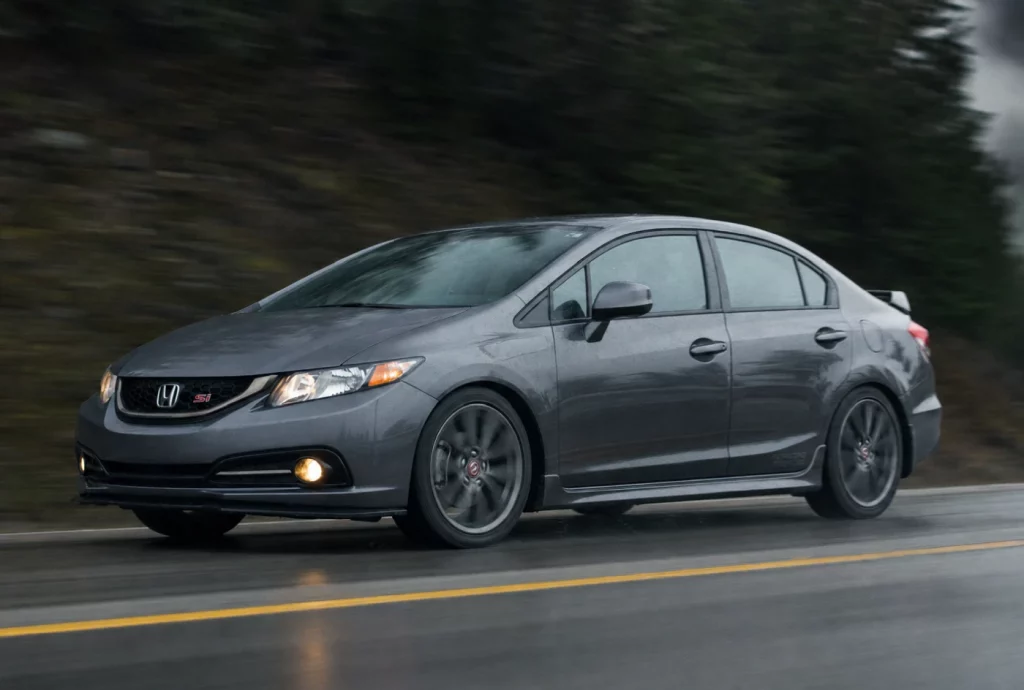
7th Generation (2001–2005)
The 7th gen Civic uses solid (non-vented) rear rotors on all trims. The front rotors are vented on all trims. The Si hatchback (EP3) uses the same front and rear rotor diameter and thickness as the LX/EX. The EP3 does not receive a larger or thicker rotor from the factory — the brake upgrade on the EP3 is in the caliper and pad compound, not the rotor size. The rear rotor on the EP3 is 260mm, larger than the 239mm solid rear used on the LX/EX sedan and coupe.
| Trim | Position | Diameter | OEM Thickness | Discard Thickness | Type |
|---|---|---|---|---|---|
| LX / EX / HX | Front | 262mm (10.3″) | 20mm | 18mm | Vented |
| LX / EX / HX | Rear | 239mm (9.4″) | 10mm | 8mm | Solid |
| Si EP3 | Front | 262mm (10.3″) | 20mm | 18mm | Vented |
| Si EP3 | Rear | 260mm (10.2″) | 10mm | 8mm | Solid |
8th Generation (2006–2011)
The 8th gen introduced a larger front rotor on the Si compared to the LX/EX. The rear rotors are solid on LX/EX and solid on the Si as well — the 8th gen Si did not receive vented rear rotors. The EX-L shares the same rotor specification as the EX.
| Trim | Position | Diameter | OEM Thickness | Discard Thickness | Type |
|---|---|---|---|---|---|
| LX / EX / EX-L | Front | 262mm (10.3″) | 20mm | 18mm | Vented |
| LX / EX / EX-L | Rear | 239mm (9.4″) | 10mm | 8mm | Solid |
| Si FG2 / FA5 | Front | 300mm (11.8″) | 28mm | 26mm | Vented |
| Si FG2 / FA5 | Rear | 282mm (11.1″) | 10mm | 8mm | Solid |
9th Generation (2012–2015)
The 9th gen carried over the same front rotor dimensions as the 8th gen on both LX/EX and Si trims. The Si front rotor remains 300mm (11.8″) — identical to the 8th gen Si — not a larger diameter as sometimes claimed. Rear rotors remain solid across all 9th gen trims. The Si rear rotor is 282mm, same as the 8th gen Si.
| Trim | Position | Diameter | OEM Thickness | Discard Thickness | Type |
|---|---|---|---|---|---|
| LX / EX / EX-L | Front | 262mm (10.3″) | 20mm | 18mm | Vented |
| LX / EX / EX-L | Rear | 239mm (9.4″) | 10mm | 8mm | Solid |
| Si sedan / coupe | Front | 300mm (11.8″) | 28mm | 26mm | Vented |
| Si sedan / coupe | Rear | 282mm (11.1″) | 10mm | 8mm | Solid |
10th Generation (2016–2021)
The 10th gen brought a significant brake upgrade across all trims compared to the 9th gen. The base LX received larger front rotors than any previous non-Si Civic. The Si and Type R received substantially larger brakes, with the FK8 Type R using Brembo 4-piston front Calipers and the largest rotors ever fitted to a production Civic at that time. The Sport and EX trims share the same rotor dimensions as the LX on the 10th gen.
| Trim | Position | Diameter | OEM Thickness | Discard Thickness | Type |
|---|---|---|---|---|---|
| LX / Sport / EX / EX-L / Touring | Front | 296mm (11.7″) | 25mm | 23mm | Vented |
| LX / Sport / EX / EX-L / Touring | Rear | 262mm (10.3″) | 10mm | 8mm | Solid |
| Si sedan / coupe | Front | 320mm (12.6″) | 28mm | 26mm | Vented |
| Si sedan / coupe | Rear | 282mm (11.1″) | 10mm | 8mm | Solid |
| Type R FK8 | Front | 350mm (13.8″) | 32mm | 30mm | Vented |
| Type R FK8 | Rear | 305mm (12.0″) | 11mm | 9mm | Solid |
11th Generation (2022–2025)
The 11th gen carried over the 10th gen brake dimensions on most trims. The FL5 Type R uses the same 350mm front rotor diameter as the FK8 — not a larger 355mm rotor as sometimes stated. The FL5 front rotor is a two-piece floating design with a thinner hat section compared to the FK8’s one-piece rotor, but the swept diameter is identical at 350mm. The 11th gen Hybrid uses the same rotor dimensions as the standard 1.5T trims. The Si uses the same front rotor as the 10th gen Si.
| Trim | Position | Diameter | OEM Thickness | Discard Thickness | Type |
|---|---|---|---|---|---|
| LX / Sport / EX / Sport Touring / Hybrid | Front | 296mm (11.7″) | 25mm | 23mm | Vented |
| LX / Sport / EX / Sport Touring / Hybrid | Rear | 262mm (10.3″) | 10mm | 8mm | Solid |
| Si sedan | Front | 320mm (12.6″) | 28mm | 26mm | Vented |
| Si sedan | Rear | 282mm (11.1″) | 10mm | 8mm | Solid |
| Type R FL5 | Front | 350mm (13.8″) | 27mm | 25mm | Vented |
| Type R FL5 | Rear | 305mm (12.0″) | 11mm | 9mm | Solid |
Lateral Runout Limit
Lateral runout is the side-to-side wobble of the rotor face as it rotates. Excessive runout causes brake pedal pulsation and accelerates uneven pad wear. Honda’s service limit for lateral runout is 0.10mm (0.004″) on all Civic generations from the 7th through the 11th. This limit applies to both front and rear rotors. Runout is measured with a dial indicator positioned against the rotor face approximately 10mm from the outer edge while the rotor is mounted on the Hub. If runout exceeds 0.10mm, the rotor must be either machined on the vehicle (on-car lathe) or replaced. Machining a rotor that is already near its discard thickness is not recommended — the material removed during machining will bring it below the discard limit.
Rotor Replacement vs. Resurfacing
Honda’s service manual position is that rotors should be replaced rather than resurfaced whenever they are worn to within 2mm of the discard thickness, show hard spots, deep grooves, or heat cracks, or when new brake pads are being installed on a rotor with significant wear grooves. The discard thickness stamped on the rotor hat is the absolute minimum — a rotor AT exactly the discard thickness has zero machining allowance and should be replaced immediately. In practice, most independent shops resurface rotors that are 1mm or more above the discard limit and show no hard spots or cracks. On-car lathes (Pro-Cut, Ranger) produce better runout results than bench lathes because they compensate for hub runout.
For the 10th and 11th gen Type R, rotor replacement is strongly preferred over resurfacing. The FK8 and FL5 Type R rotors are large-diameter, high-carbon iron castings that are expensive to replace but also expensive to machine correctly. Track use accelerates rotor wear significantly on the Type R — owners who run track days should inspect rotor thickness after every event and budget for replacement every 2–3 track days depending on driving intensity.
Aftermarket Rotor Upgrades
For 7th through 9th gen non-Si Civics, the most common rotor upgrade is a direct-fit slotted or cross-drilled rotor in the OEM diameter. Brands commonly used include Brembo OE Replacement, EBC GD series, and StopTech Sport. These are direct bolt-on replacements using the OEM diameter and thickness. Upsizing the rotor diameter on 7th–9th gen Civics requires a big brake kit with a Caliper Bracket and is not a simple rotor swap.
For 10th and 11th gen non-Type R Civics, the Si rotor is a popular upgrade on LX/Sport/EX trims. The Si uses a 320mm front rotor versus the 296mm on the base trims. This swap requires the Si caliper bracket in addition to the larger rotor — the OEM caliper will not reach the larger rotor without the bracket. The Si rear rotor (282mm) is also a direct upgrade over the base 262mm rear rotor and requires the Si rear caliper bracket.
For the FK8 and FL5 Type R, Brembo, StopTech, and AP Racing offer direct-fit replacement and upgrade rotors. The FK8 Type R’s 350mm front rotor is a common replacement with Brembo UV coated rotors (part number 09.D131.11) being the most widely used OEM-equivalent. The FL5 Type R uses the same 350mm diameter and is served by the same direct-fit options from Brembo and StopTech.
Rotor Diameter and Thickness — Quick Reference:
☐ All Civic rear rotors from the 7th through 11th generation are solid (non-vented). All front rotors are vented on all trims and all generations.
☐ 7th–9th gen LX/EX front: 262mm × 20mm OEM, 18mm discard. 10th–11th gen LX/Sport/EX front: 296mm × 25mm OEM, 23mm discard.
☐ EP3 Si (2002–2005) uses the same 262mm front rotor as the LX/EX — not a larger diameter. The EP3 rear rotor is 260mm, larger than the 239mm used on the LX/EX sedan/coupe.
☐ Si front rotors: 8th gen 300mm, 9th gen 300mm (same as 8th gen, not larger), 10th gen 320mm, 11th gen 320mm. All Si front rotors from the 8th gen onward are 28mm OEM thickness, 26mm discard.
☐ Type R front rotors: FK8 350mm × 32mm OEM (30mm discard). FL5 350mm × 27mm OEM (25mm discard). FK8 and FL5 share the same 350mm diameter. Type R rear rotors: both FK8 and FL5 use 305mm × 11mm OEM (9mm discard).
☐ Lateral runout service limit is 0.10mm (0.004″) on all Civic generations, front and rear. Measure with a dial indicator 10mm from the outer edge of the rotor face.
☐ The discard thickness is the absolute minimum. A rotor at exactly the discard thickness has zero machining allowance and must be replaced. Do not resurface a rotor within 1mm of the discard limit.
☐ Upsizing to Si rotors on a 10th or 11th gen base Civic requires the Si caliper bracket in addition to the larger rotor. The OEM caliper will not reach the larger rotor without the bracket.