

The Civic’s brake system evolved from inexpensive front-disc/rear-drum hardware on base trims to Brembo 4-piston monoblock Calipers with 350mm two-piece rotors on the Type R. The change tracks the car’s weight and power: a 1996 CX hatchback could stop adequately with 240 mm front discs and rear drums, but a 2023 FL5 Type R needs Brembo calipers and 13.78-inch rotors to haul its 3,188 pounds from triple-digit speeds.
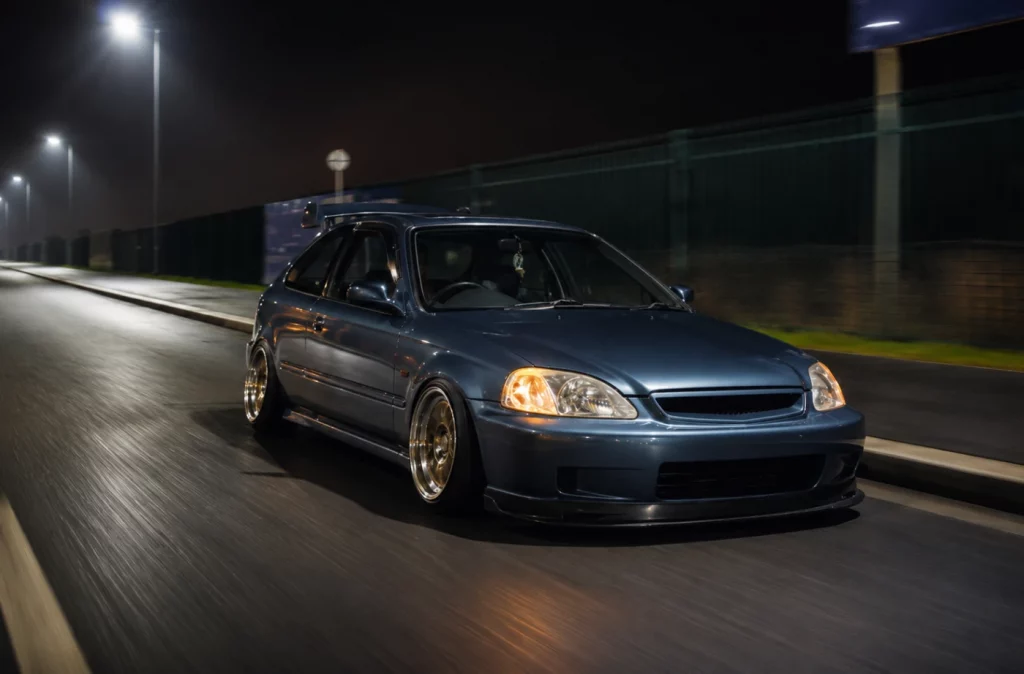
Brake specifications come from Honda Newsroom official press releases per model year, Honda Canada and Honda USA technical specification sheets, the Honda Workshop Manual, and third-party brake specialist data for caliper and rotor details that Honda does not publish in consumer-facing spec sheets. Stopping distances are from Car and Driver and MotorTrend instrumented testing.
6th Generation (1996-2000): Front Disc, Rear Drum — With One Exception
The 6th generation Civic used front ventilated disc brakes on every trim and rear drum brakes on most trims. The Si was the only 6th gen Civic in the US market with four-wheel disc brakes.
The base CX and DX front rotors measured 240 mm (9.4 in) in diameter, ventilated, with a starting thickness of 22 mm. The caliper was a single-piston sliding design, identified by the casting number “2056.” The rear drum diameter was 200 mm (7.9 in) with self-adjusting shoes (Honda Workshop Manual, 1996-2000; Honda-Tech forum, citing factory service manual references).
The EX (1996-2000) received larger front rotors at 262 mm (10.3 in) with a different single-piston caliper identified by casting number “5410.” The rear remained drum at 200 mm. The 1999-2000 Civic Si shared the same 262 mm front rotors and “5410” calipers as the EX but added 239 mm (9.4 in) rear solid discs borrowed from the 1994-2001 Integra non-Type R parts bin. The rear calipers used a single-piston design with an integrated Parking Brake mechanism that required a rotation tool to retract the piston (Honda-Tech forum, factory service manual reference; 2000 Civic Si service documentation).
One source (CarFeatures, 2000 Civic Brakes) claims the Si front rotors were 282 mm rather than 262 mm. This is not supported by the factory service manual or the Honda-Tech brake reference thread that cross-references part numbers and caliper castings. The most reliable figures are 262 mm front and 239 mm rear for the Si, with the EX sharing the same front rotor and caliper part family.
ABS was standard on the EX and Si, optional on the LX, and not available on the DX or CX.
7th Generation (2001-2005): Si Gets Rear Discs, Base Cars Stay with Drums
The 7th generation Civic sedan retained the front-disc/rear-drum layout on DX, LX, and EX trims. The front rotors were 262 mm (10.3 in) ventilated across all trims — a single size for the entire sedan lineup. The rear drum was 200 mm (7.9 in) on DX and LX trims (Honda Newsroom, 2001 Civic Sedan Specifications).
The EX sedan used a slightly larger 198 mm (7.8 in) rear drum according to the 2005 specifications (new-cars.com, 2005 Honda Civic Sedan). The difference was minimal and likely related to different drum widths or lining materials rather than a genuine diameter change.
The 2002-2005 Civic Si hatchback was the only 7th gen Civic with four-wheel disc brakes in the US. Front rotors were 262 mm (10.3 in) ventilated. Rear rotors were 259 mm (10.2 in) solid discs. The Si also received standard ABS with electronic brake-force distribution (EBD), while the EX had ABS as optional and the LX and DX did not offer it at all (new-cars.com, 2004 Civic Si Specifications; Honda Newsroom, 2001 Civic Sedan Specifications).
The brake Master Cylinder bore was 7/8 inch on non-ABS cars and slightly larger on ABS-equipped models. The factory filled the system with DOT 3 brake fluid.
8th Generation (2006-2011): The Split Widens
The 8th generation Civic offered the widest brake specification split of any generation to that point, with five distinct combinations depending on trim and model year.
The DX and LX sedans used 262 mm (10.3 in) ventilated front rotors with 200 mm (7.9 in) rear drums — the same basic hardware as the 7th gen. The EX sedan upgraded to 262 mm front rotors with a larger 221 mm (8.7 in) rear drum. The EX-L trim received 262 mm front rotors with 259 mm (10.2 in) solid rear discs (Honda Newsroom, 2007-2008 Civic Sedan Specifications).
The hybrid sedan sat above the EX-L in the lineup and used 282 mm (11.1 in) front ventilated rotors — the largest front brakes on any non-Si 8th gen Civic — with 221 mm (8.7 in) rear drums. The larger front rotors were needed to manage the additional weight of the hybrid battery pack and the regenerative braking system’s heat load (Honda Newsroom, 2008 Civic Sedan Specifications).
The 2006-2011 Civic Si was the clear standout. The front rotors measured 300 mm (11.8 in) in diameter — 1.5 inches larger than the EX. The rear rotors were 259 mm (10.2 in) solid discs. The Si used single-Piston sliding calipers at all four corners, but the front calipers were specific to the Si with larger pads and a different bracket. The front brake rotors were 11.8 inches, shared with the Acura RSX Type-S (2006-2011 Civic Si brochure; 2007 Civic Si specs; 8thcivic.com forum discussion confirming RSX-S rotor interchangeability).
The Si stopped from 60 mph in 117 feet in MotorTrend testing and 179 feet from 70 mph in Car and Driver testing (2006 Civic Si vs. GTI comparison test). The grabby brake feel was noted by both publications as an issue, with C/D mentioning that “Honda recognizes the problem and promises that later Si’s will have less-touchy brakes.”
| Generation | Trim | Front Rotor | Rear Rotor | Front Caliper | 60-0 (ft) |
|---|---|---|---|---|---|
| 6th | CX, DX | 240 mm / 9.4 in | 200 mm drum | Single-piston “2056” | ~135 |
| 6th | EX | 262 mm / 10.3 in | 200 mm drum | Single-piston “5410” | ~130 |
| 6th | Si (1999-2000) | 262 mm / 10.3 in | 239 mm / 9.4 in disc | Single-piston “5410” | ~125 |
| 7th | DX, LX, EX | 262 mm / 10.3 in | 200 mm drum | Single-piston | ~130 |
| 7th | Si (2002-2005) | 262 mm / 10.3 in | 259 mm / 10.2 in disc | Single-piston | ~125 |
| 8th | DX, LX | 262 mm / 10.3 in | 200 mm drum | Single-piston | ~130 |
| 8th | Si (2006-2011) | 300 mm / 11.8 in | 259 mm / 10.2 in disc | Single-piston | 117 (MT) / 179@70 (CD) |
| 9th | DX, LX | 262 mm / 10.3 in | 200 mm drum | Single-piston | ~130 |
| 9th | EX, Si | 10.3-11.1 in | 259 mm / 10.2 in disc | Single-piston | ~125 |
| 10th | LX, EX, Touring | 282 mm / 11.1 in | 259 mm / 10.2 in disc | Single-piston | 127 (EX) / 166@70 (hatch) |
| 10th | Si (2017-2021) | 312 mm / 12.3 in | 282 mm / 11.1 in disc | Single-piston | ~110 |
| 10th | FK8 Type R | 350×32 mm | 305×11 mm disc | Brembo 4-piston | ~99 |
| 11th | LX, Sport, Touring | 282 mm / 11.1 in | 259 mm / 10.2 in disc | Single-piston | 122 (Sport) / 174@70 (Touring) |
| 11th | Si (2022-2026) | 312 mm / 12.3 in | 282 mm / 11.1 in disc | Single-piston | 110 (MT) |
| 11th | FL5 Type R | 350×32 mm / 13.78 in | 305×11 mm / 12.0 in | Brembo 4-piston | ~100 |
Sources: Honda Newsroom (2001, 2006, 2007, 2008, 2012, 2015, 2016, 2021, 2022, 2024, 2025, 2026 official spec releases), Honda Canada tech PDFs, Honda Workshop Manual (6th gen), Honda-Tech / 8thcivic forum service manual references, MotorTrend and Car and Driver instrumented brake tests. Stopping distances marked @70 are 70-0 mph tests; all others are 60-0 mph. ~ indicates estimated or literature-based where no instrumented test was found.
9th Generation (2012-2015): The Refresh Split
The 9th generation Civic used the same basic brake hardware as the 8th gen at launch, then upgraded mid-cycle. The 2012-2013 DX and LX sedans used 262 mm (10.3 in) front ventilated rotors with 200 mm (7.9 in) rear drums. The EX and EX-L sedans used 262 mm front rotors with 259 mm (10.2 in) rear solid discs (Honda Newsroom, 2012 Civic Sedan Specifications).
The 2014-2015 models after the refresh may have received larger front rotors. Car and Driver’s specification database lists the 2015 Civic EX-L with 11.1-inch front rotors — a 0.8-inch increase over the 2012 figure. Honda did not publish the Rotor diameter change in its press releases for the 2013-2015 model years, so the exact timeline of the upgrade is not confirmed in official documents. What is known from the Honda spec sheets is that the stabilizer bars grew from 17.0/11.0 mm to 19.0/16.0 mm between 2012 and 2015, and the suspension was retuned. Larger front brakes likely accompanied that refresh.
The 2012-2015 Civic Si used 11.8-inch front rotors and 10.2-inch rear rotors — the same hardware as the 8th gen Si — with single-piston sliding calipers. The braking performance was adequate for the 201 horsepower engine but not class-leading.
10th Generation (2016-2021): One Standard Brake for All Non-Si Trims
The 10th generation was the first Civic generation where every non-Si trim shared identical brake hardware. The LX, EX, EX-T, EX-L, and Touring all received 282 mm (11.1 in) front ventilated rotors with 0.9-inch rotor thickness and 259 mm (10.2 in) rear solid rotors with 0.4-inch thickness. All four calipers were single-piston sliding designs with low-friction seals to reduce drag when the brakes were not engaged (Honda Newsroom, 2016 Civic Sedan Press Kit — Chassis; 2016 Civic Sedan Specifications).
Honda used Akebono-supplied ceramic brake pads from the factory on the 10th gen (CivicX.com forum, citing dealer service documentation and pad part number cross-references). The ceramic compound reduced brake dust compared to the semi-metallic pads used on earlier generations and produced less noise, but it also reduced initial bite compared to the 8th gen Si’s more aggressive pad material.
The 2016 Civic EX with the 2.0L engine and CVT stopped from 60 mph in 127 feet per MotorTrend, and from 70 mph in 174 feet per Car and Driver — a significant improvement over the 8th gen’s 179-foot 70-0 result. The 2017 Civic Hatchback Sport Touring with the 1.5T stopped from 70 mph in 166 feet, the shortest distance of any non-Si 10th gen Civic tested (Car and Driver, 2017 Civic Hatchback 1.5T CVT test).
The 10th gen Si improved to 12.3-inch front rotors and 11.1-inch rear rotors — the same size that the 11th gen Si would later carry. The front calipers remained single-piston sliding units. Braking from 60 mph measured approximately 110 feet.
FK8 Civic Type R (2017-2021): Brembo Enters the Civic Lineup
The FK8 Civic Type R was the first Civic to use Brembo brake calipers from the factory. The front brakes used Brembo 4-piston aluminum monoblock calipers with four 42 mm equal-diameter pistons clamping 350×32 mm (13.78 x 1.26 in) ventilated rotors. The rear brakes used ATE single-piston sliding calipers with 305×11 mm (12.0 x 0.43 in) solid rotors (Brembo parts catalog; Paragon Performance; 27WON Performance brake deep dive).
The 2017-2019 FK8 front rotors were cross-drilled, non-floating single-piece iron discs weighing 24.5 lb per rotor. The 2020-2021 FK8 received an upgrade to plain-face two-piece floating rotors, reducing the weight to 22.1 lb per rotor. The two-piece design also reduced heat transfer to the wheel hub bearings. The rear rotors remained single-piece solid discs for the entire production run (Paragon Performance, FK8 brake specifications).
The front Brembo calipers weighed 7.9 lb each, bringing the total unsprung front brake mass to approximately 32 lb per corner on the 2020-2021 cars. Stopping distances were approximately 99 feet from 60 mph, though Honda did not publish a factory-stated braking figure.
The Type R brake pads used a more aggressive semi-metallic compound than the standard Civic’s ceramic pads, which produced noticeable brake squeal during light braking — a common owner complaint documented on CivicX.com forums. The trade-off was significantly better resistance to fade during track use.
11th Generation (2022-2026): Si Grows, Type R Refines, Hybrid Gains Weight
The 11th generation non-Si Civic retained the 282 mm (11.1 in) front and 259 mm (10.2 in) rear brake configuration from the 10th gen (Honda Newsroom, 2022-2024 Civic Sedan Specifications; 2026 Civic Sedan Specifications). The 2022 Civic Sport with the 2.0L engine and CVT stopped from 60 mph in 122 feet per MotorTrend — five feet longer than the 2016 EX despite the 2022 being approximately 100 pounds heavier. The touring with the 1.5T stopped from 70 mph in 174 feet, identical to the 2016 Touring.
The 11th gen Civic Si received a notable brake upgrade over the 10th gen Si. The front rotors measured 12.3 inches (312 mm). The rear rotors grew to 11.1 inches (282 mm) — matching the front rotor size of the standard 10th gen Civic and significantly larger than the 10th gen Si’s 10.2-inch rear rotors (Honda Newsroom, 2024-2026 Civic Si Specifications; Honda Canada, 2026 Civic Si Specifications). The calipers remained single-piston sliding units.
Despite the larger rotors, the 2022 Civic Si stopped from 60 mph in 110 feet — four feet longer than MotorTrend’s 2017 Si result of 106 feet. The 11th gen Si weighs approximately 2,952 lb, roughly 30 pounds more than the 10th gen Si, and the carried-over Goodyear Eagle F1 Asymmetric 2 tires (235/40R18) did not improve. The Si’s braking was still class-leading for a front-drive Sport Compact.
The FL5 Civic Type R (2023-2024) carried forward the FK8’s Brembo front calipers and 350×32 mm rotors, with the same 305×11 mm rear rotors and ATE calipers. Honda updated the front rotor vent geometry between the FK8 and FL5 to improve airflow and reduce thermal cracking under sustained track use, but the dimensions remained identical (27WON Performance, FL5 brake system analysis; Paragon Performance, FL5 brake specifications). The FL5’s body rigidity improved by 15 percent with triple the structural adhesive application, which contributed to more consistent braking feel under high lateral load.
The 11th generation hybrid models — at 3,168-3,263 lb curb weight — use the same 282/259 mm brake hardware as the gas LX and Sport trims (Honda Newsroom, 2026 Civic Sedan and Hatchback Specifications). The hybrid’s regenerative braking system handles a portion of the deceleration, reducing heat load on the friction brakes. Honda did not upsize the rotors or calipers for the heavier hybrid models.
Pad Compounds and Brake Feel
Honda has shifted pad compound philosophy over generations. The 6th through 8th generation Civics used semi-metallic pads from the factory, which provided strong initial bite but produced significant dust and occasional noise. The 9th generation moved toward ceramic formulations, and by the 10th generation, the standard Civic pad was a low-dust ceramic compound supplied by Akebono (CivicX.com forum, service documentation references).
The Si and Type R use different compounds. The 8th gen Si and 9th gen Si pads were semi-metallic with higher friction coefficients than the base car. The 10th gen Si continued with semi-metallic. The FK8 and FL5 Type R use a track-capable semi-metallic compound that produces noticeable brake squeal during street driving — an intentional trade-off for fade resistance at the Nürburgring.
The FL5’s front Brembo calipers use four 42 mm equal-diameter pistons rather than the staggered piston sizes found on some performance brake systems. The equal-piston design produces even pad wear and consistent pedal feel across the pad life (27WON Performance, FL5 brake analysis).
☐ 6th gen Si: first Civic with four-wheel Disc brakes (262 mm front, 239 mm rear) — only 1999-2000 model years
☐ 6th gen EX shared the same 262 mm front rotors and calipers as the Si, but the Si added rear discs
☐ 7th gen non-Si: every trim used 262 mm front discs with rear drums — no rear disc option on non-Si trims
☐ 8th gen: widest brake split in Civic history — five different front/rear combinations across six trims
☐ 8th gen Si front rotors (11.8 in) were 1.5 inches larger than the EX — the biggest Si-to-base gap ever
☐ 9th gen EX/EX-L received 11.1-inch front rotors after the 2013 refresh — an undocumented upgrade not in Honda press materials
☐ 10th gen: first generation where every non-Si trim shared identical brake hardware — 11.1-inch front, 10.2-inch rear
☐ 10th gen Si used 12.3-inch front rotors — unchanged from 2017 through 2026
☐ FK8 Type R (2017): first Civic with Brembo 4-piston calipers — front rotor size unchanged from 2017-2024 across FK8 and FL5
☐ FK8 front rotors changed from cross-drilled single-piece to plain two-piece floating in 2020 — shedding 2.4 lb per rotor
☐ 11th gen Si rear rotors grew to 11.1 inches — matching the 10th gen standard Civic front rotor size
☐ 11th gen hybrid AT 3,263 lb uses the same brakes as the gas LX at 2,875 lb — no rotor or caliper upgrade
☐ The FL5 Type R weighs 3,188 lb with 350 mm front Brembo rotors — the Si weighs 2,952 lb with 312 mm single-piston brakes
☐ Ceramic pads became standard on non-Si Civics by the 10th generation — semi-metallic retained for Si and Type R