

Turning Diameter Comparison — 10th Gen vs 11th Gen Civic Si
The Civic Si‘s turning diameter increased slightly between generations, but the real-world impact depends on where you drive. The 10th gen Si (2017–2021) has a published curb-to-curb turning diameter of 37.8 feet. The 11th gen Si (2022–present) needs 38.1 feet (source: Honda Newsroom, 2022 Civic Si Specifications). The difference is 0.3 feet — 3.6 inches — which is less than the width of a standard parking space line.
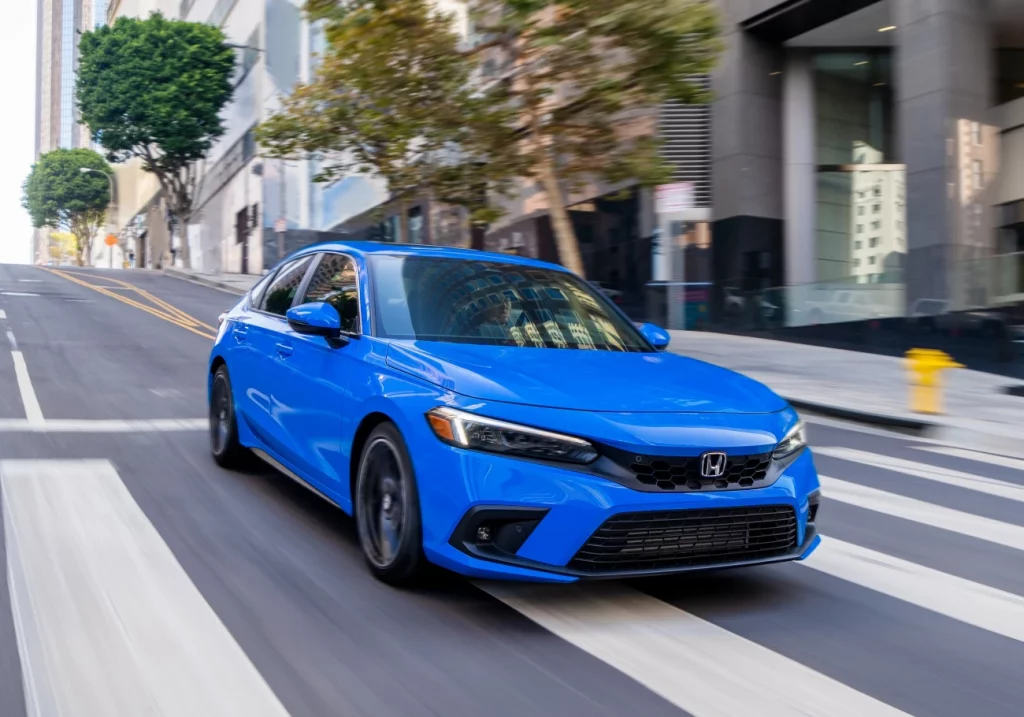
The increase comes from the longer Wheelbase. The 10th gen rides on a 106.3-inch wheelbase. The 11th gen stretches to 107.7 inches (source: Honda Newsroom, 2017 and 2022 Si specifications). The steering hardware is nearly identical: both use an electric power-assisted rack with 2.17 turns lock-to-lock and an 11.46:1 steering ratio (confirmed by the 2022 Si spec sheet). The rack did not change — the car got longer, so the turning circle grew proportionally.
Turning Diameter and Dimensions Comparison
| Specification | 10th Gen Si | 11th Gen Si |
|---|---|---|
| Turning diameter (curb-to-curb) | 37.8 ft | 38.1 ft |
| Steering turns lock-to-lock | 2.17 | 2.17 |
| Steering ratio | 11.46:1 | 11.46:1 |
| Wheelbase | 106.3 in | 107.7 in |
| Overall length | 182.8 in | 184.0 in |
| Width | 70.8 in | 70.9 in |
| Curb weight | 2,906 lbs | ~3,147 lbs |
What 38.1 Feet Means in Real Driving
U-turn on a standard two-lane road. A typical two-lane road in the US measures approximately 24 feet from curb to curb. Neither the 10th gen (37.8 ft) nor the 11th gen (38.1 ft) can complete a u-turn in one motion on a road of this width. Both require either using the opposite shoulder or executing a three-point turn. The 3.6-inch difference between the two generations does not change this outcome — both cars behave the same way in this scenario.
U-turn on a wider residential street. Many residential streets measure 28–32 feet wide. AT 30 feet, the 10th gen Si has a 7.8-foot gap between its turning circle and the curb. The 11th gen has a 7.5-foot gap. Both can complete the turn in one motion, but the 10th gen requires less steering input and leaves more room for error. In practice, drivers of either generation will manage the turn comfortably.
Parking lot maneuverability. The typical parking stall is 18–20 feet wide with aisles of 22–24 feet. The Si’s turning diameter of 37.8–38.1 feet is average for the compact sedan segment. It will not do a single-sweep 90-degree park into a tight space from a narrow aisle — you will need to reverse and correct, same as most sedans in this class. The 11th gen’s extra 241 pounds of curb weight makes it feel heavier in low-speed parking lot maneuvers, but the steering effort does not change because both use electric power assist with variable effort mapping.
Parallel parking. The turning diameter has minimal effect on parallel parking. What matters is overall length (182.8 in vs 184.0 in) and steering wheel cut (identical at 2.17 turns lock-to-lock). The 11th gen is 1.2 inches longer, which makes no practical difference in finding a parking spot. Both cars parallel park the same way.
Turning Diameter vs Competitors
| Model | Turning Diameter (ft) | Wheelbase (in) | Length (in) |
|---|---|---|---|
| 11th Gen Civic Si | 38.1 | 107.7 | 184.0 |
| 10th Gen Civic Si | 37.8 | 106.3 | 182.8 |
| Subaru WRX (2022+) | ~36.0 | 105.2 | 183.8 |
| VW Jetta GLI (2021–2024) | ~36.0 | 105.6 | 186.5 |
| Mazda 3 (2019+) | ~35.4 | 107.3 | 183.5 |
The Civic Si’s turning diameter is 2.1 feet wider than the WRX and GLI — both of which manage better numbers thanks to shorter wheelbases and different Steering Rack designs. The Mazda 3 is the tightest of this group with a 35.4-foot diameter, roughly 2.7 feet tighter than the 11th gen Si. Si owners shopping for city maneuverability should test a WRX or Mazda 3 before deciding. Source: manufacturers’ published specifications.
Why the Turning Diameter Increased
The 11th gen Si uses the same steering rack, the same number of steering turns, and the same steering ratio as the 10th gen. The turning diameter increase is entirely a function of the longer wheelbase. Honda stretched the wheelbase by 1.4 inches to improve rear legroom and high-speed stability. The trade-off is a wider turning circle. No aftermarket modification — tuning, suspension, tires, or steering wheel — changes the physical turning diameter. The steering rack geometry and wheelbase are fixed. The published Honda specification applies regardless of modifications (source: Honda Newsroom, 2022 Civic Si Specifications).
How the Si Compares to Non-Si Civics
The non-Si 10th gen Civic (LX, EX, Sport) also has a 37.8-foot turning diameter — the same as the 10th gen Si. The non-Si 11th gen Civic (LX, Sport, EX-L) has a 37.0-foot turning diameter according to some published sources, which is slightly tighter than the 11th gen Si’s 38.1 feet. The Si has unique front suspension knuckles and a helical limited-slip differential that may affect the Ackermann steering geometry. In practice, non-Si 11th gen owners report the car feels slightly more maneuverable in parking lots than the Si. Source: Honda Newsroom, CivicX and Civic11Forum owner discussions.
What to Expect When Test-Driving
Before buying either generation, test the turning circle in the specific scenarios you deal with daily:
Find a residential street you regularly park on. Attempt a u-turn from a stop. Measure whether the car completes it in one motion or needs a reverse correction. Try a 90-degree park into a tight space from a narrow aisle. Check if the car’s width (70.8–70.9 inches) fits your garage opening or parking structure width without folding the mirrors.
The 3.6-inch turning diameter difference between generations is measurable on paper but rarely noticeable in daily driving. The weight difference — 241 pounds — is more noticeable in low-speed parking maneuvers than the turning circle change. If tight-space maneuverability is your priority, the Si is not the class leader regardless of generation. The WRX and Mazda 3 both turn tighter and park easier.
Quick Reference
☐ 10th gen Si turning diameter: 37.8 ft (curb-to-curb)
☐ 11th gen Si turning diameter: 38.1 ft — 0.3 ft wider than 10th gen
☐ Steering rack is identical between generations (2.17 turns, 11.46:1 ratio)
☐ Wheelbase increased from 106.3 in to 107.7 in — that is the cause of the wider circle
☐ Neither generation can u-turn on a standard 24-ft two-lane road in one motion
☐ Both generations can u-turn on a 30-ft residential street in one motion
☐ The Si’s turning diameter is 2.1 ft wider than the WRX and GLI
☐ The Mazda 3 turns the tightest in this class at ~35.4 ft
☐ No modification changes the physical turning diameter
☐ Test the specific car on your own streets before buying — published numbers don’t account for curbs, gutters, or approach angle
☐ 11th gen non-Si turns tighter (37.0 ft) than the 11th gen Si (38.1 ft) according to published data