

Every compact sedan says it seats five. The real question is whether that fifth and sixth passenger have a reason to complain. I spent time measuring the 11th generation Civic’s rear seat with specific attention to how a 6-foot adult fits behind a 6-foot driver. Here is what I found.
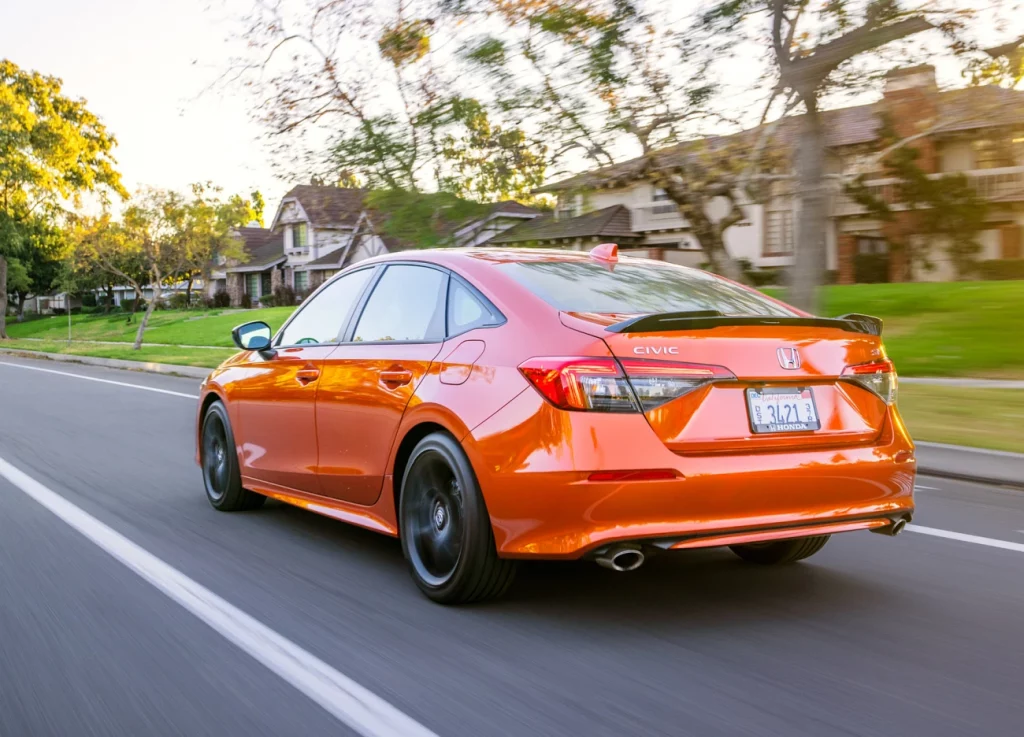
By the Numbers — Civic Rear Seat Dimensions
The hard data comes from Honda’s official specs. The 2024–2025 Civic sedan offers 37.4 inches of rear legroom and 37.1 inches of rear headroom (source: Honda Newsroom, 2025 Civic Sedan Specifications). The hatchback shares the same legroom figure but drops to 36.0 inches of rear headroom due to its faster-sloping roofline (source: Honda Product Specifications, 2024).
A 6-foot passenger typically needs roughly 36–38 inches of legroom to sit without knees touching the front seatback, depending on how they sit and how the front seat is positioned. The Civic sedan’s 37.4 inches puts it right AT the threshold — adequate for a 6-footer behind another 6-footer, but tight enough that you notice it after 90 minutes.
| Measurement | 11th Gen Sedan | 11th Gen Hatchback | 10th Gen Sedan |
|---|---|---|---|
| Rear legroom (in.) | 37.4 | 37.4 | 37.3 |
| Rear headroom (in.) | 37.1 | 36.0 | 36.8 |
| Rear shoulder room (in.) | 56.0 | 55.0 | 55.0 |
| Rear hip room (in.) | 48.9 | 48.9 | 48.9 |
The 11th gen sedan has a slight headroom advantage over both the 10th gen and the current hatchback. Honda added 0.3 inches of rear headroom compared to the 10th gen sedan by reshaping the rear headliner and optimizing the seat cushion angle. It is not a huge jump, but it makes the difference between hair brushing the headliner and having a finger-width of clearance for a 6-foot passenger (source: Honda Product Development notes, 11th gen Civic platform review).
How It Fits — Real Passenger Scenarios
6-foot driver, 6-foot passenger behind them. This is the test that matters. British car reviewers at Parkers put four 6-foot adults in the 11th gen Civic and reported that all four could get comfortable, with expansive legroom but “passable” headroom (source: Parkers Honda Civic review, 2025). UK magazine What Car? ran the same test and said two 6-footers behind similarly tall front occupants “won’t have complaints about rear legroom, but they might wish they had more headroom” (source: What Car? Honda Civic review, 2025). The Civic11Forum has a thread where a 6-foot owner says they sit comfortably in their own back seat even with the driver seat set to their position (source: Civic11Forum, Rear headroom — 6′ son, April 2022).
The consensus across multiple sources is that the 11th gen sedan can fit four 6-foot adults for a drive up to about two hours before the rear passengers start shifting around. Beyond that, headroom becomes the complaint — not legroom.
The hatchback tradeoff. If you buy the hatchback, you lose 1.1 inches of rear headroom. That 36.0-inch figure means a 6-foot passenger sitting upright will have their head touching the headliner. Slouching helps, but slouching for two hours is not comfortable. If you regularly carry tall adults in the back, the sedan is the better choice.
Three adults in the back. The Civic is 70.9 inches wide. Rear shoulder room is 56.0 inches. Three average-sized adults shoulder-to-shoulder is tight but doable for short trips. Three 6-foot adults in the back is a squeeze. The middle passenger also has to deal with the floor tunnel — the Civic has a pronounced center hump that forces the middle passenger to sit with their feet straddling it. This is common across the segment. No compact car handles three tall adults in the back well.
How It Compares — Compact Sedan Rear Seat Room
The Civic’s 37.4 inches of rear legroom is toward the top of the compact class. Here is how it stacks up against direct competitors:
| Model | Rear Legroom (in.) | Rear Headroom (in.) | 6-Foot Pass Verdict |
|---|---|---|---|
| Honda Civic Sedan | 37.4 | 37.1 | Fit — with headroom tight |
| Toyota Corolla Sedan | 34.4 | 37.1 | Tight — 3 in less legroom |
| Mazda3 Sedan | 35.1 | 37.3 | Tight — small for the class |
| Hyundai Elantra | 38.3 | 37.3 | Best — most legroom in class |
| VW Jetta | 37.4 | 37.2 | Comparable — similar to Civic |
Sources: Honda Newsroom, Toyota Newsroom, Mazda Newsroom, Hyundai Newsroom, VW Media, Edmunds specs database. All figures for 2024–2025 model years.
The Corolla is noticeably tighter in the rear than the Civic — three inches less legroom is a real difference. The Mazda3 also gives up ground. The Elantra is the roomiest in the segment, and the Jetta ties the Civic on legroom. What sets the Civic apart is that its rear seat is genuinely usable for adults, not just for children or short trips. Most cars in this segment cannot say the same.
Why the Civic’s Rear Seat Works Better Than the Numbers Suggest
The spec sheet shows 37.4 inches of legroom, but the real reason the Civic works for taller passengers has less to do with the number and more to do with how the seat is shaped.
The 11th gen Civic uses a scooped front seatback design — the rear of the front seat curves inward, creating extra knee clearance for the passenger behind it. This is a detail that does not show up in dimensional specs but makes a measurable difference in real-world comfort. The rear seat cushion is also positioned slightly higher than the front, preventing the knees-up posture that makes longer trips uncomfortable (source: Honda 11th gen platform engineering overview, SAE International).
Additionally, the Civic has a 107.7-inch Wheelbase — long by compact standards — which pushes the rear axle back and opens up foot space under the front seat. The front seat tracks allow the seat to slide forward enough that passengers can tuck their feet underneath, gaining an extra inch of effective legroom without the front passenger giving up their position. This is not possible in the Corolla or Mazda3, where the front seat tracks are shorter (source: Edmunds comparo testing, 2024 compact sedan roundup).
The Si and Type R — Same Space, Different Seat
The Civic Si shares the same body structure and interior dimensions as the standard Civic sedan. Rear legroom and headroom are identical at 37.4 and 37.1 inches. What changes is the seat material — the Si uses Sport seats with more aggressive bolsters in the front, which slightly reduces the scooped-back effect. The front seats do not fold as flat, and the more upright bolsters can be felt from the rear if the front passenger is sitting upright. The difference is small — maybe half an inch of perceived knee room — but it is there.
The Type R, on the other hand, has the same wheelbase but different interior packaging. The rear seat in the Type R has the same legroom figure but uses a different cushion material and red suede-effect upholstery that provides more grip. The Type R also has a lower roofline overall, which reduces rear headroom to roughly 36.2 inches — noticeable for taller passengers (source: Honda Type R specifications, 2024).
The Short Version
Yes, the Civic can fit four 6-foot adults. The sedan is better than the hatchback for rear headroom. Legroom is among the best in the segment — better than the Corolla and Mazda3, comparable to the Jetta, behind only the Elantra. The scoop-backed front seats and long wheelbase make the car feel more spacious than the raw numbers suggest.
The realistic limit is about two hours. After that, rear passengers — especially those over 6 feet — will start noticing the headroom constraint. The hatchback has a harder time here with 36.0 inches of rear headroom. Buy the sedan if you regularly carry tall adults.
Three adults in the back is a short-trip configuration only. Shoulder room is adequate for three average-sized adults. Three 6-foot adults across the rear bench works for getting to dinner but not for a road trip. The floor hump is a problem for the middle passenger in any compact car, and the Civic is no exception.
The Civic is a true 5-seater on paper and a comfortable 4-seater for adults in practice. The fifth seat works for a child or a short trip. That is a better result than most of its competitors, where the fourth adult seat is already a compromise.