

The Honda Civic is one of the last affordable compacts to offer a choice between a manual transmission and an automatic. For the 10th and 11th generations, the automatic is a continuously variable transmission (CVT), not a traditional torque-converter automatic. The two transmissions serve fundamentally different purposes, and the choice between them determines how the car feels in every driving scenario.
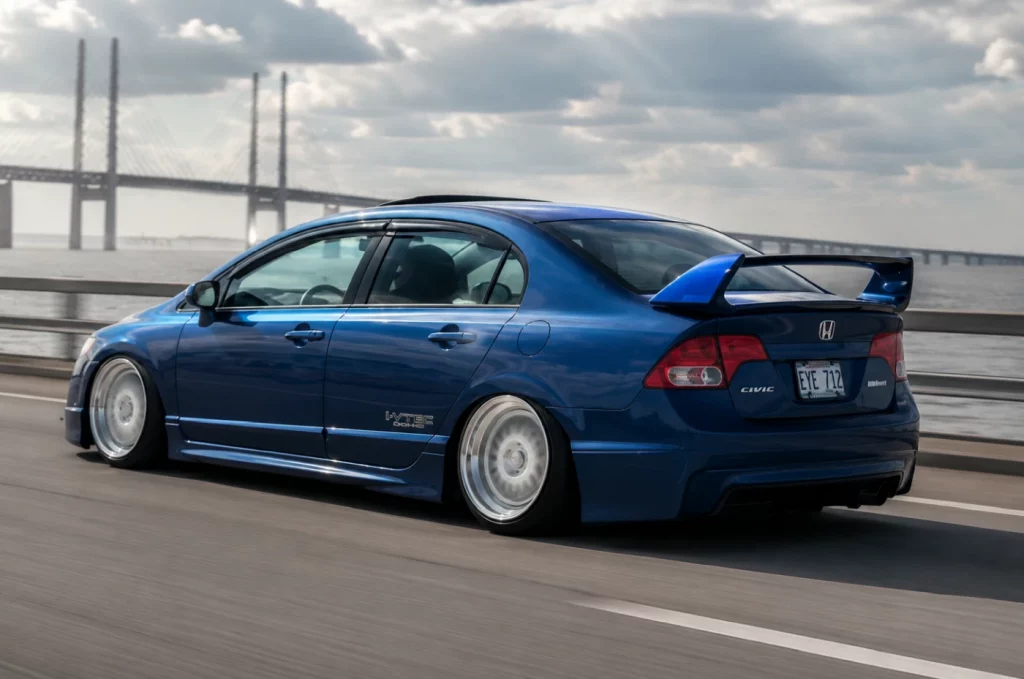
This article covers the differences across the powertrain combinations available on 10th-generation (2016–2021) and 11th-generation (2022–present) Civics, including the 2.0-liter naturally aspirated engine and the 1.5-liter turbocharged engine, each offered with both transmissions at different trim levels.
How Each Transmission Changes the Driving Experience
The manual transmission in the 10th and 11th generation Civic is a six-speed unit shared across multiple powertrains. The gearbox itself is a cable-shifted design with rubber-isolated shift cables, which Honda tuned for low effort and smooth engagement rather than notchy mechanical precision. The clutch pedal is light, with a take-up point that is easy to learn. The result is a manual that is genuinely pleasant to use in traffic — not tiring, not fussy, and forgiving of imperfect shifts.
The shifter feel varies by generation. The 10th-generation manual has a slightly longer throw and more rubbery feel at the engagement point. The 11th-generation manual received revised shift cables and a different shift-arm design that tightened the engagement. On the Si, the shifter is the best-in-class for a front-wheel-drive compact — short throws, positive detents, and a direct mechanical feel that the base manual does not fully share.
The CVT in the Civic is Honda’s own design, built in-house rather than sourced from Jatco or Aisin. It uses a steel push-belt system with a torque converter for launch, not a clutch pack. Honda calibrated the CVT to simulate stepped gear shifts under hard acceleration, which addresses the traditional complaint of CVTs holding at a fixed rpm and droning. Under light throttle, the CVT operates in its natural stepless mode, holding the engine at its most efficient rpm and varying the ratio smoothly as speed increases. Under full throttle, the transmission simulates seven or eight stepped shifts depending on the model year and trim.
Owners on CivicX.com who have driven both transmissions report that the CVT is responsive and well-calibrated for daily driving, but lacks the connection of the manual. One CivicX user who drove both the 1.5T with CVT and the 2.0L with manual noted that the 1.5T with CVT felt quicker in a straight line due to the Turbocharger‘s low-end torque, but the 2.0L with manual was significantly more engaging on a winding road. Source: CivicX.com, “1.5l T vs 2.0l and CVT vs 6 speed manual” (July 2018).
A notable difference is the rev-hang behavior. The 10th-generation manual Civics (non-Si) had pronounced rev-hang programmed into the ECU to smooth shifts and reduce emissions. The engine holds rpm for approximately one to two seconds after the throttle closes, which makes quick upshifts feel delayed. The Si has less rev-hang, and the 11th-generation manual reduced it further. The CVT does not have this issue — ratio changes are instantaneous because there are no gears to synchronize.
Fuel Economy: Real Differences Between the Two Transmissions
The CVT is more fuel-efficient than the manual across every engine and trim combination, but the gap is smaller than many buyers expect. The EPA ratings for the 10th generation illustrate the difference.
On the 2.0-liter naturally aspirated engine (LX, Sport trims), the CVT is rated at 31 mpg combined (28 city, 38 highway) while the manual is rated at 30 mpg combined (26 city, 36 highway). The CVT advantage is approximately 1 mpg combined. Source: EPA fueleconomy.gov, 2018 Honda Civic fuel economy data.
On the 1.5-liter turbocharged engine (EX, EX-L, Sport Touring), the CVT is rated at 34 mpg combined (30 city, 39 highway) while the manual (available only on the Sport Touring hatchback) is rated at 33 mpg combined (30 city, 40 highway). The CVT advantage is again approximately 1 mpg combined. Source: EPA fueleconomy.gov, 2018 Honda Civic fuel economy data.
The 11th generation narrowed the gap further. The 2022 Civic 2.0L with CVT is rated at 33 mpg combined (30 city, 38 highway) versus the manual at 32 mpg combined (28 city, 38 highway). The 1.5T with CVT achieves 34 mpg combined (31 city, 39 highway) versus the manual at 33 mpg combined (30 city, 39 highway).
In real-world driving, many manual owners report achieving the same or better fuel economy than the CVT EPA ratings, because the driver controls shift points and can keep the engine in its most efficient range by short-shifting. The CVT cannot be manually controlled in the same way — the transmission decides the ratio, and under steady highway cruising, it sets the engine speed at the lowest possible rpm for the given speed.
| Powertrain | Transmission | City / Highway / Combined | Annual Fuel Cost* |
|---|---|---|---|
| 2.0L (10th gen) | CVT | 28 / 38 / 31 | $1,650 |
| 2.0L (10th gen) | 6MT | 26 / 36 / 30 | $1,700 |
| 1.5T (10th gen) | CVT | 30 / 39 / 34 | $1,500 |
| 1.5T (10th gen) | 6MT | 30 / 40 / 33 | $1,550 |
| 2.0L (11th gen) | CVT | 30 / 38 / 33 | $1,600 |
| 2.0L (11th gen) | 6MT | 28 / 38 / 32 | $1,650 |
| 1.5T (11th gen) | CVT | 31 / 39 / 34 | $1,550 |
*Annual fuel cost based on 15,000 miles, 55% city / 45% highway, $3.50/gallon regular unleaded. Source: EPA fueleconomy.gov.
Reliability and Common Problems by Transmission
The Honda CVT has a mixed reputation that depends heavily on maintenance. Honda’s CVT uses a steel push-belt system manufactured by Subaru or Honda’s own subsidiary, depending on the year and plant. The transmission requires Honda HCF-2 CVT fluid, which is a low-viscosity synthetic fluid specifically formulated for the Honda CVT.
The most common failure mode on the 10th-generation CVT is belt slip or belt damage under high torque. The 1.5T engine produces 177 lb-ft of torque at 1,700 rpm, which is close to the torque limit of the CVT belt system. Owners who tune their 1.5T engines to 220–250 lb-ft of torque frequently report CVT shudder, belt wear, or complete transmission failure. A CivicX.com user reported a CVT belt failure at only 14,000 miles on a 2017 Civic 1.5T, and another reported a complete transmission replacement at 50,000 miles on a stock 2019 Civic EX at a cost of approximately $8,000 at a dealer. Source: CivicX.com, “CVT belt failure at 14k miles” (February 2019); “Stock 2019 Civic EX CVT Transmission Blown at 50k Miles” (April 2024).
Honda issued a Technical Service Bulletin (17-003) in March 2017 addressing a grinding noise from the CVT on hot restart, affecting 2016–2017 Civic 1.5T models. The repair involved replacing the CVT’s pump gears. The bulletin noted that the noise occurred for approximately two seconds under a specific hot-restart condition and did not affect durability in most cases, but the repair was covered under warranty. Source: NHTSA, Honda Service Bulletin 17-003 (March 2017).
The consensus on CivicX and 11thGenForum is that the CVT is reliable with consistent fluid changes every 30,000 miles, even though Honda’s Maintenance Minder may not trigger a B3 service (CVT fluid change) until 50,000–60,000 miles under normal driving. Owners who change the fluid every 30,000 miles report trouble-free operation beyond 100,000 miles. Owners who follow the Maintenance Minder only report a higher incidence of shudder and premature wear. Source: CivicX.com, “10TH GEN CVT ISSUES — CVT fluid change strongly recommended every 30,000 miles” (March 2023).
The manual transmission has different failure points. The clutch is the most common problem area, particularly on the 10th-generation Si. The factory clutch on the Si is designed for the stock 192 lb-ft torque output and does not hold up well to tuned power or aggressive driving. Honda issued Service Bulletin 22-017 in September 2022 addressing clutch slippage, difficulty shifting, and the vehicle not moving when in gear on 2020–2021 Civic 1.5T models with manual transmissions. The bulletin attributed the problem to a supplier production issue with the friction disc material. Source: NHTSA, Honda Service Bulletin 22-017 (September 2022).
The throwout bearing is the second most common manual transmission complaint. Owners report a chirping or squeaking noise that disappears when the clutch pedal is pressed. The noise does not indicate imminent failure in most cases, but it is a known annoyance. Replacement requires removing the transmission, and the labor cost is the main expense.
On the 11th generation, early clutch failures have been reported at unusually low mileage. A Civic11Forum.com user reported major clutch slippage at under 8,000 miles on a 2022 Sport Touring 6MT, with the issue initially mistaken for turbo lag. The cause was diagnosed as a premature clutch friction disc failure. Source: Civic11Forum.com, “Sport Touring 6MT Early clutch failure” (December 2022).
The manual transmission’s advantage is that individual components (clutch disc, pressure plate, throwout bearing, master cylinder) are serviceable independently. A CVT failure typically requires a complete transmission replacement. A clutch replacement on a Civic 6MT costs approximately $1,200–$1,800 at an independent shop. A CVT replacement costs $5,000–$8,000 at a dealer.
Which Transmission Matches Which Engine
The CVT pairs best with the 1.5T engine. The turbocharger’s flat torque curve provides smooth, linear acceleration that the CVT translates into consistent forward thrust without the gear-hunting behavior that occurs when a CVT is paired with a naturally aspirated engine. On the 2.0L engine, the CVT tends to hold the engine at higher rpm during acceleration because the naturally aspirated engine needs to rev to produce power — the CVT cannot hide the 2.0L’s lack of low-end torque.
The manual transmission also pairs best with the 1.5T, but for a different reason. The 1.5T’s torque peak at 1,700 rpm means the engine is responsive from idle, making the manual easy to drive without excessive clutch slipping. On the 2.0L, the manual requires more rev-matching and gear selection to stay in the powerband — the engine makes its peak horsepower at 6,500 rpm, and the driver needs to keep the engine above 4,000 rpm for strong acceleration.
The manual transmission is not available on the 11th generation 1.5T in the United States for model year 2025 and later. Honda discontinued the manual on the 1.5T Sport Touring hatchback for the 2025 model year, leaving the manual available only on the 2.0L base engine and the Si. This means the manual is no longer paired with the more powerful engine on non-Si trims, which reduces the performance gap between the CVT and manual powertrains.
Which One Should You Choose?
The CVT is the right choice for daily commuting, stop-and-go traffic, fuel-conscious driving, and anyone who does not enjoy operating a clutch pedal. The Civic’s CVT is one of the better calibrations in the segment — it is responsive, avoids droning under most conditions, and returns slightly better fuel economy than the manual. The reliability risk is manageable with 30,000-mile fluid changes, and the transmission is well-suited to a car that will be driven as a practical appliance.
The manual is the right choice for anyone who values driver engagement, wants to feel connected to the car, or plans to modify the engine. The Civic’s manual transmission is a genuine pleasure to use — not as precise as a Mazda MX-5 Miata’s shifter, but better than anything else in the compact car segment. The manual also avoids the CVT’s torque limitations, which is relevant for anyone considering tuning.
The used market makes the decision easier. A 10th-generation Civic 1.5T with the manual transmission is the most desirable combination for enthusiasts, and these cars hold value better than their CVT equivalents. On the 11th generation, the 1.5T manual is already disappearing, which will make these cars collectible in the near term. The 2.0L manual is adequate but underwhelming — the engine lacks the torque to make the manual engaging, and most buyers will prefer the CVT with the 2.0L for daily driving.
Quick-Reference Checklist
☐ CVT fuel economy advantage over the manual is approximately 1 mpg combined in EPA testing. Real-world gap is smaller and may favor the manual with an experienced driver.
☐ The manual transmission is more engaging and more fun to drive in all situations. The CVT is smoother and less tiring in traffic.
☐ CVT requires fluid changes every 30,000 miles for long-term reliability. The Maintenance Minder interval of 50,000+ miles is not frequent enough for severe-duty driving.
☐ The manual transmission’s clutch is a wear item. Budget for replacement AT 60,000–100,000 miles depending on driving style. The factory Si clutch does not hold up to tuned power.
☐ CVT Failure typically requires a complete transmission replacement at $5,000–$8,000. Manual transmission components (clutch, pressure plate, throwout bearing) are serviceable individually at $1,200–$1,800 for a full clutch job.
☐ The 1.5T engine is the better match for both transmissions. The 2.0L engine lacks low-end torque and feels strained with either transmission, but the manual helps make the most of the available power.
☐ The 10th-gen 1.5T with 6MT is the most desirable used combination for enthusiasts. The 11th-gen manual is being phased out on non-Si trims, which will push used prices up.
☐ The CVT cannot handle tuned power reliably. The manual can handle moderate tuning (230–250 HP) with a clutch upgrade. The Si’s manual is stronger than the base manual and handles bolt-on power better.
☐ The manual’s rev-hang on 10th-gen non-Si models is a known annoyance that can be reduced with aftermarket ECU tuning (Ktuner, Hondata). The CVT has no equivalent issue.
☐ Both transmissions are reliable with proper maintenance. The manual is more forgiving of neglect. The CVT requires strict adherence to fluid change intervals.