

The Honda Civic has been sold with three fundamentally different transmissions over the past two decades: a conventional CVT (continuously variable transmission), a traditional hydraulic automatic (5-speed in the 8th and early 9th generations), and a 6-speed manual on specific trims. Beginning with the 2025 refresh, a fourth type emerged — the eCVT used in the hybrid powertrain, which is mechanically distinct from the belt-driven CVT and more closely related to the system in the Toyota Prius and Honda Accord Hybrid. Choosing between them is not a simple preference question. The transmission determines the car’s driving character, its long-term reliability trajectory, its fuel economy, and its resale market. This guide covers every transmission option in the Civic lineup across three relevant generations.
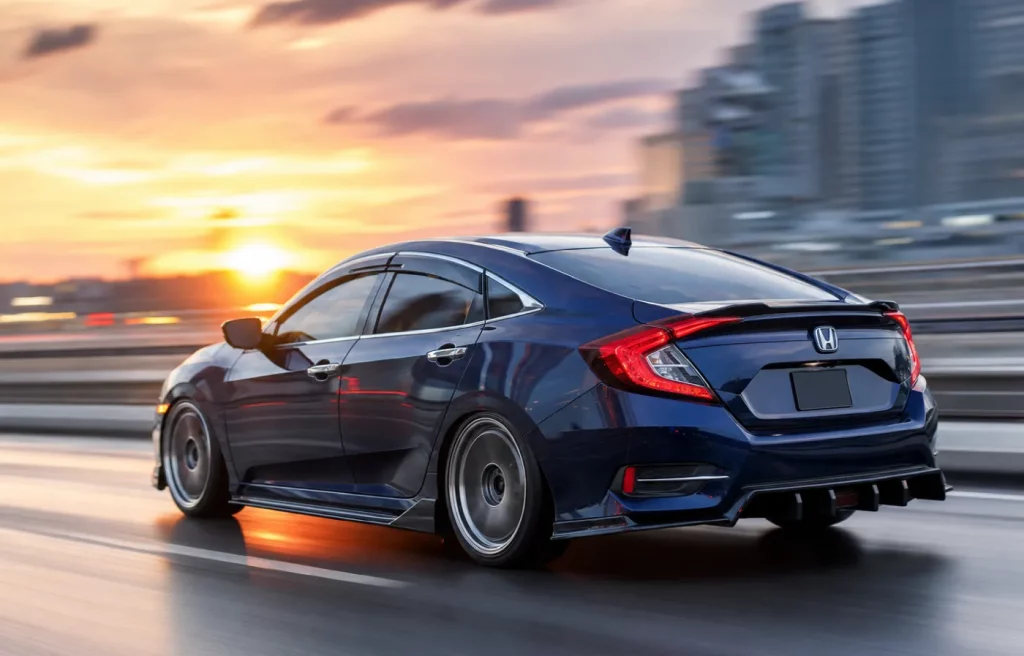
The most important rule of Civic transmissions: Under the word “automatic,” Honda hides three completely different mechanical systems — a 5-speed torque-converter auto, a belt-driven CVT, and an electric eCVT. They have different reliability, different maintenance requirements, and different costs. Do not assume they are interchangeable.
Quick Answer — Which Transmission Should You Choose?
| Your Priority | Best Transmission | Why | Available In |
|---|---|---|---|
| Driver engagement | 6MT | Best shift feel, full control, connected driving | Si, Type R, 2022–2024 Sport hatch |
| Old-school reliability | 5AT | Bulletproof, 250K+ miles, cheap to maintain | 8th–early 9th gen |
| Best daily commuter | eCVT (Hybrid) | Smooth, instant torque, 49 mpg, no belt/pulley wear | 2025+ Sport Hybrid, Sport Touring Hybrid |
| Budget modern | CVT (11th gen) | Improved design, fewer issues than 10th gen | 2022+ LX, Sport, EX, Touring |
| Used value | 5AT or 6MT | Proven durability, lower repair risk than 10th gen CVT | 8th–9th gen |
Transmission Availability by Generation
| Generation | Manual | Automatic/CVT | eCVT (Hybrid) |
|---|---|---|---|
| 8th Gen (2006–2011) | 5MT (LX/EX), 6MT (Si) | 5AT | — |
| 9th Gen (2012–2015) | 5MT (LX/EX), 6MT (Si) | 5AT (2012–2013), CVT (2014–2015) | — |
| 10th Gen (2016–2021) | 6MT (LX sedan, Sport hatch, Sport Touring hatch, Si, Type R) | CVT | — |
| 11th Gen (2022–2024) | 6MT (Sport hatch, Sport Touring hatch, Si, Type R) | CVT | — |
| 11th Gen (2025+) | Si, Type R only | CVT (LX, Sport) | Sport Hybrid, Sport Touring Hybrid |
Source: Honda official spec sheets, Edmunds trim comparison.
The 5-Speed Automatic (5AT) — The Bulletproof Vintage
The 5-speed automatic in the 8th and early 9th generation Civics is a traditional torque-converter automatic with planetary gearsets. It is not a CVT. It has fixed gear ratios, a hydraulic torque converter, and a valve body that controls shift timing. Honda used this transmission from approximately 2001 through 2013 across multiple models, and it has a proven track record of durability.
Why it rules the budget market: Unlike the fragile automatics from European competitors of that era, Honda’s 5AT is mechanically robust. It uses wet clutch packs similar to a manual transmission, with solenoids controlling the hydraulic pressure. The torque converter locks up early in the RPM range for fuel economy, which reduces heat generation and extends fluid life.
Common issues: The 3rd-to-4th gear flare is the most reported problem — the transmission momentarily loses drive during the shift, causing the RPM to flare. This is caused by worn pressure switches or a failing shift solenoid. The fix is replacing the pressure switches ($150–$300 parts and labor) or cleaning the valve body. Transmission fluid changes with genuine Honda ATF DW-1 every 30,000–40,000 miles prevent most issues. The 5AT regularly reaches 250,000+ miles with basic maintenance.
Maintenance: Use only Honda ATF DW-1 fluid. Do not use universal ATF. The correct procedure is a drain-and-fill (3x method) rather than a full flush under pressure — flushing can dislodge debris and clog the valve body. A drain-and-fill changes approximately 3 quarts of the ~8-quart capacity. Three drain-and-fill cycles with driving between each cycle replaces roughly 85% of the fluid.
5AT buyers: If you are looking AT an 8th or early 9th gen Civic with the 5AT, check the transmission fluid condition. Brown fluid with a burnt smell indicates neglect. Factor in a drain-and-fill service ($100–$200 at an independent shop) immediately after purchase if the service history is unclear.
The CVT — The Modern Fuel-Economy Warrior
The CVT in the 9th (2014–2015), 10th (2016–2021), and 11th (2022–present) Civics is Honda’s Earth Dreams CVT. It uses a steel belt running between two variable-width pulleys. There are no fixed gear ratios — the transmission continuously adjusts the ratio to keep the engine in its most efficient RPM range. The benefit is fuel economy. The trade-off is driving feel — the CVT produces a characteristic “rubber band” effect under hard acceleration, where the engine RPM rises and stays fixed while the car accelerates.
Honda’s CVT improvements: The 11th generation CVT received a redesign with improved belt materials, a revised Oil Pump, and updated control logic. Honda calls this G-Design Shift — it simulates stepped gear shifts under moderate acceleration to reduce the CVT drone that many drivers dislike. The effect is convincing enough that most drivers do not notice it is a CVT during normal driving. Under full throttle, it reverts to continuous ratio adjustment for maximum acceleration.
Reliability by model year:
- 2016–2017: Highest complaint volume. Torque converter shudder at 20–40 mph during gentle acceleration is common. Honda addressed this through TSBs for fluid reformulation and software recalibration. These years are the highest-risk CVT purchases.
- 2018–2019: Improved but still report significant shudder complaints. Better than 2016–2017, but still a risk.
- 2020–2021: Significantly better. Most of the early issues were resolved by this point.
- 2022+: Redesigned CVT with substantially fewer complaints. Too early to have long-term data, but early reports are positive.
CVT maintenance: The single most important maintenance item is CVT fluid changes with genuine Honda HCF-2 fluid every 30,000 miles. Do not use universal CVT fluid. Do not skip this service. A neglected CVT will fail between 80,000 and 120,000 miles. The fluid change costs $150–$250 at an independent shop and $250–$400 at a dealer. The external CVT filter should be replaced every 60,000 miles.
CVT replacement cost: A new CVT installed at a dealer runs $3,000 to $4,500. A remanufactured unit at an independent shop costs $2,500 to $3,500. A used CVT from a salvage yard costs $1,500 to $2,500 installed. Labor alone is $500 to $1,200. The failure tends to occur between 80,000 and 120,000 miles, with approximately 10–15% of Civics experiencing significant transmission issues within that range according to Rohnert Park Transmission’s 2026 analysis.
⚠️ CVT tuning limit: If you are modifying a 1.5T Civic with a CVT, the transmission is the limiting factor. The stock CVT can handle 220–230 lb-ft of torque reliably. If you raise the torque above that (with aggressive ECU tunes), the steel belt will slip on the pulleys, causing rapid wear. A CVT replacement costs $3,000–$4,500 — more than the cost of most bolt-on modifications. If you want to tune your Civic, buy a manual.
The 6-Speed Manual — The Enthusiast’s Gold Standard
Honda has been building excellent manual transmissions for decades. The 6-speed units in the Civic — whether the standard unit in the 10th-gen Sport hatchback or the performance-tuned version in the Si and Type R — are consistently praised for short, precise throws, light clutch effort, and positive shift engagement. Edmunds describes the Si’s shifter as “slick-shifting,” and CivicX forum members rank the 10th-gen 6MT as one of the best gearboxes Honda has ever produced.
Availability: The manual was available on the LX and Sport hatchback trims through the 2024 model year. For 2025, Honda removed it from all standard trims. The only manual options going forward are the Si ($31,495) and the Type R ($47,395). This makes the manual a scarcity item — if you want a standard Civic with a manual, you need to buy a 2024 or earlier hatchback Sport or Sport Touring.
Known issues by generation:
- 8th-gen Si (2006–2010): 3rd-gear grind / pop-out is the most common issue. Worn synchronizers cause the transmission to grind when shifting into 3rd under hard acceleration. The fix ranges from a fluid change with ACDelco Synchromesh (in mild cases) to a full synchro rebuild ($800–$1,500 at an independent shop). Honda issued a service bulletin for this, but the affected cars are now outside warranty coverage.
- 9th-gen: Clutch and synchro condition should be checked. The gearbox itself is robust.
- 10th-gen (2016–2021): Rev-hang is the most common complaint — the engine RPM holds briefly between shifts, particularly at higher RPM, to meet emissions requirements. Aftermarket tunes (KTuner, Hondata) can eliminate this but void the powertrain warranty. The clutch on the 1.5T is a weak point if the car is tuned — it starts slipping above 240 lb-ft of torque.
- 11th-gen (2022+): The Si gets rev-matching on downshifts, which is a significant improvement. The clutch is light enough for daily driving but still feels connected.
Clutch replacement cost: A clutch replacement on a Civic runs $1,200–$1,800 at an independent shop and $1,500–$2,500 at a dealer. The clutch typically lasts 80,000–120,000 miles on a well-driven car and 40,000–60,000 miles on a tracked or aggressively driven car.
Manual buyers: If you are buying a used 8th-gen Si, test 3rd gear specifically. Accelerate to 4,500+ RPM in 2nd, shift to 3rd, and listen for grinding or feel for the shifter popping out. If it grinds, budget $800–$1,500 for synchro repair. If you are buying a 10th-gen 1.5T manual, check the clutch condition — if the car has been tuned, the clutch may be worn.
The eCVT — A Different Animal Entirely
The hybrid Civic uses Honda’s two-motor eCVT system, which is not a CVT in the belt-and-pulley sense. It has no steel belt, no pulleys, and the “e” prefix matters: the eCVT uses an electric motor as the primary drive source, with the gasoline engine connected through a fixed-gear clutch that engages only in a specific highway overdrive range (approximately 40 to 80 mph). Below that range, the engine acts as a generator, and the wheels are driven entirely by the electric motor. This is the same architecture used in the Honda Accord Hybrid, CR-V Hybrid, and Insight — systems that have proven robust across millions of vehicles.
How it works:
- At low speeds, the electric motor drives the wheels. The gasoline engine is off or acts as a generator.
- At moderate speeds, the engine runs at a constant RPM to generate electricity for the motor and battery.
- At highway speeds, a clutch engages the engine directly to the wheels through a fixed gear ratio.
Reliability: The eCVT has essentially no wear items in the traditional sense. There are no clutch packs, no steel belts riding on pulleys, and no torque converters. The gearbox is a fixed-ratio unit that connects the electric motor to the wheels. Honda specifies an eCVT fluid change interval, but owners on the Civic11 forum report that even at 134,000 miles, their Accord Hybrid eCVT had never been serviced and was functioning normally. The eCVT’s long-term reliability is expected to significantly exceed the belt-driven CVT, though the technology is still relatively new in the Civic — the first model year was 2025.
Maintenance: The eCVT fluid should be changed per the Maintenance Minder. Honda does not specify a fixed mileage interval — the car calculates when the fluid needs service based on driving conditions. The eCVT fluid change is simpler and cheaper than a conventional CVT fluid change because there are no belts or pulleys.
eCVT vs CVT — don’t confuse them: The eCVT in the hybrid is not the same as the belt-driven CVT in the gas models. The eCVT has no steel belt, no pulleys, and no torque converter. It is a fundamentally different transmission architecture. The reliability discussion for the eCVT is different from the CVT.
Performance Comparison — CVT vs Manual vs eCVT
| Metric | 10th Gen 1.5T CVT | 10th Gen 1.5T 6MT | 11th Gen Si 6MT | 2025+ Sport Hybrid eCVT |
|---|---|---|---|---|
| 0–60 mph | 6.9 sec | 7.0–7.5 sec | 6.8 sec | ~7.0 sec |
| 5–60 mph (rolling) | 7.3 sec | 7.7 sec | ~7.2 sec | ~6.8 sec |
| Quarter mile | 15.4 sec @ 91 mph | 15.2 sec @ 94 mph | ~15.0 sec | ~15.3 sec |
| MPG combined | 34 | 31 | 31 | 49 |
| Annual fuel cost (15K mi) | $1,750 | $1,900 | $1,900 | $1,250 |
0-to-60 and quarter-mile data from Car and Driver instrumented testing. Fuel cost calculated at $3.50/gal using EPA combined ratings and 15,000 miles per year.
The key takeaway: In straight-line performance, the CVT and manual are close, with the CVT holding a slight advantage from a stop and the manual gaining at higher speeds. The hybrid eCVT matches the manual’s 0-to-60 time while delivering dramatically better fuel economy — but without the engagement of a manual shift. The Si’s advantage is not straight-line speed (both the hybrid and CVT 1.5T are close) but cornering capability, thanks to the limited-slip differential and Sport-tuned suspension.
Transmission Reliability by Generation
| Transmission | Generations | Common Issues | Failure Mileage | Replacement Cost |
|---|---|---|---|---|
| 5AT | 8th–early 9th | Pressure switch wear, 3rd–4th flare | 200K+ with maintenance | $2,000–$3,000 |
| CVT (10th gen 2016–2017) | 2016–2017 | Torque converter shudder, fluid breakdown | 80K–120K | $3,000–$4,500 |
| CVT (10th gen 2018–2019) | 2018–2019 | Improved but still some shudder | 100K–130K | $3,000–$4,500 |
| CVT (10th gen 2020–2021) | 2020–2021 | Significantly improved, fewer complaints | Insufficient data | $3,000–$4,500 |
| CVT (11th gen) | 2022+ | Redesigned, substantially fewer issues | Insufficient data | $3,500–$4,500 est. |
| 6MT standard | 10th–11th | Rev-hang, clutch wear on tuned cars | 200K+ with clutch replacements | $1,500–$2,500 (clutch) |
| 6MT Si (8th gen) | 2006–2010 | 3rd gear grind / pop-out | 60K–120K | $800–$1,500 (synchro) |
| 6MT Si (10th–11th gen) | 2017–2026 | No widespread issues, revised synchros | 200K+ with clutch replacements | $1,500–$2,500 (clutch) |
| eCVT (hybrid) | 2025+ | No reported failures; proven in Accord/CR-V | 135K+ (Accord data) | Limited data |
Sources: Rohnert Park Transmission (2026 Honda CVT analysis), CivicX forum owner reports, NHTSA complaint database.
Fuel Economy — The eCVT Changes Everything
The conventional CVT provides a modest fuel economy advantage over the manual — roughly 2 to 3 mpg combined, depending on the engine pairing. For the 10th-gen 1.5T, this delta is 34 mpg (CVT) versus 31 mpg (manual), per EPA fueleconomy.gov data. For the 2.0L naturally aspirated engine, the gap narrows to approximately 1 mpg.
The eCVT in the hybrid is a different category entirely. The 2025+ Sport Hybrid delivers 50 city / 47 highway / 49 combined — approximately 44 percent better fuel economy than the CVT 2.0L and 58 percent better than the manual 1.5T. At 15,000 miles per year and $3.50 per gallon, the hybrid saves approximately $500 to $650 per year compared to the gas CVT models and $650 to $800 per year compared to the manual models. Over five years, that is $2,500 to $4,000 in fuel savings alone. For buyers who plan to keep the car for 7 to 10 years, the hybrid powertrain basically pays for its premium over the base models.
Resale Value — Manual Premium or Discount?
The manual transmission in the Civic presents a counterintuitive market situation. On the Si and Type R, the manual commands a premium — a 2022 Si has depreciated only 9 percent over three years, per KBB data, retaining $25,711 of its original $28,395 MSRP. Used buyers actively seek the manual in performance trims, and the pool of available cars is small.
On standard Civic trims, the manual is a different story. A 2022 Civic Sport hatchback with the manual is harder to sell than the CVT version, takes longer to find a buyer, and typically sells for $500 to $1,500 less than an equivalent CVT model, per CivicX resale discussions and CarGurus market observations. The market for manual commuter cars is small and shrinking. Dealers often discount manual trade-ins or send them to auction. The manual Sport hatchback is a car you buy because you want to drive it — not because it will be easier to sell later.
The eCVT hybrid’s resale trajectory is not yet established, but Honda hybrids historically hold value well. A 2022 Accord Hybrid Touring retains approximately 72 percent of its original MSRP after three years, compared to 68 percent for the gas-only Accord Touring (KBB data). The Civic Sport Hybrid is expected to follow a similar pattern.
Transmission-Specific Pre-Purchase Checklist
☐ CVT (10th gen, 2016–2021): Ask for proof of CVT fluid changes with genuine HCF-2 fluid at least every 30,000 miles. Test drive at low speed (20–40 mph) during gentle acceleration and listen for torque converter shudder. Check whether the TSB fluid reformulation and software update were applied — contact a Honda dealer with the VIN. Budget for a CVT fluid change immediately after purchase if service history is unclear.
☐ CVT (11th gen, 2022–2026): The redesigned CVT has fewer issues, but fluid changes still matter. Confirm the first service at 30,000 miles was performed if applicable. Test for hesitation on throttle tip-in — this may indicate a software calibration issue.
☐ eCVT (hybrid, 2025+): New technology with limited long-term data. Confirm all recalls are completed via VIN check. Verify the hybrid battery warranty is documented. No routine transmission maintenance is required for the first 100,000 miles per Honda’s current recommendations.
☐ 6MT standard (10th/11th gen): Test the clutch engagement point — a high engagement point or chatter may indicate clutch wear. Check for rev-hang by shifting from 2nd to 3rd at 4,000+ RPM — some hang is normal, but excessive hang (3+ seconds) is a calibration issue. Verify the clutch was not replaced with an aftermarket unit on used cars.
☐ 6MT Si (8th gen, 2006–2010): Test 3rd gear specifically: accelerate to 4,500+ RPM in 2nd, shift to 3rd, and listen for grinding or feel for the shifter popping out. If present, budget $800–$1,500 for synchro repair.
☐ 6MT Si (10th/11th gen, 2017–2026): PPI from a Honda specialist is strongly recommended. Check for modifications (tune, intake, exhaust) — tuned cars have reduced clutch life. Verify the rev-matching system works on both upshifts and downshifts.
☐ 5AT (8th/9th gen, 2006–2015): Check for the 3rd-to-4th gear flare — the transmission momentarily loses drive during the shift. Test the transmission after a 20-minute drive when the fluid is at operating temperature — cold shifts can mask problems. Confirm transmission fluid was changed every 30,000 miles with genuine Honda ATF DW-1.
The Verdict — Which Transmission Should You Buy?
For the enthusiast: The 6-speed manual is the only choice. The Si is the sweet spot — the transmission is excellent, the limited-slip diff transforms cornering, and the car holds value. Buy a 2019–2021 Si if your budget is under $28,000, or a 2025 Si if you want a new car. The Type R is for track use — it is too expensive and too stiff for daily driving unless you have a specific need.
For the commuter: The eCVT in the 2025+ hybrid is the best daily-driving transmission. It is smooth, responsive, and gets 49 mpg. The instant torque from the electric motor eliminates the CVT’s rubber-band feel. If your budget is under $30,000, the Sport Hybrid is the best Civic you can buy.
For the budget buyer: The 5-speed automatic in the 8th and early 9th generation Civics is the most reliable automatic transmission Honda ever put in a Civic. A 2009–2011 Civic with the 5AT and the R18 engine is a bulletproof combination. The CVT in the 10th gen is fine if the fluid has been changed — but the 5AT is more durable and cheaper to repair.
For the used CVT buyer: Avoid 2016–2017 CVT cars unless the TSB fluid reformulation and software update have been confirmed. Prefer 2020–2021 CVT cars — they have the fewest issues. Budget for a CVT fluid change immediately after purchase. If the CVT fluid is dark or smells burnt, walk away.
Sources: Honda official spec sheets, Rohnert Park Transmission (2026 Honda CVT analysis), Car and Driver instrumented testing, EPA fueleconomy.gov, Kelley Blue Book depreciation data, CivicX forum owner reports, NHTSA complaint database, Edmunds trim comparison.