

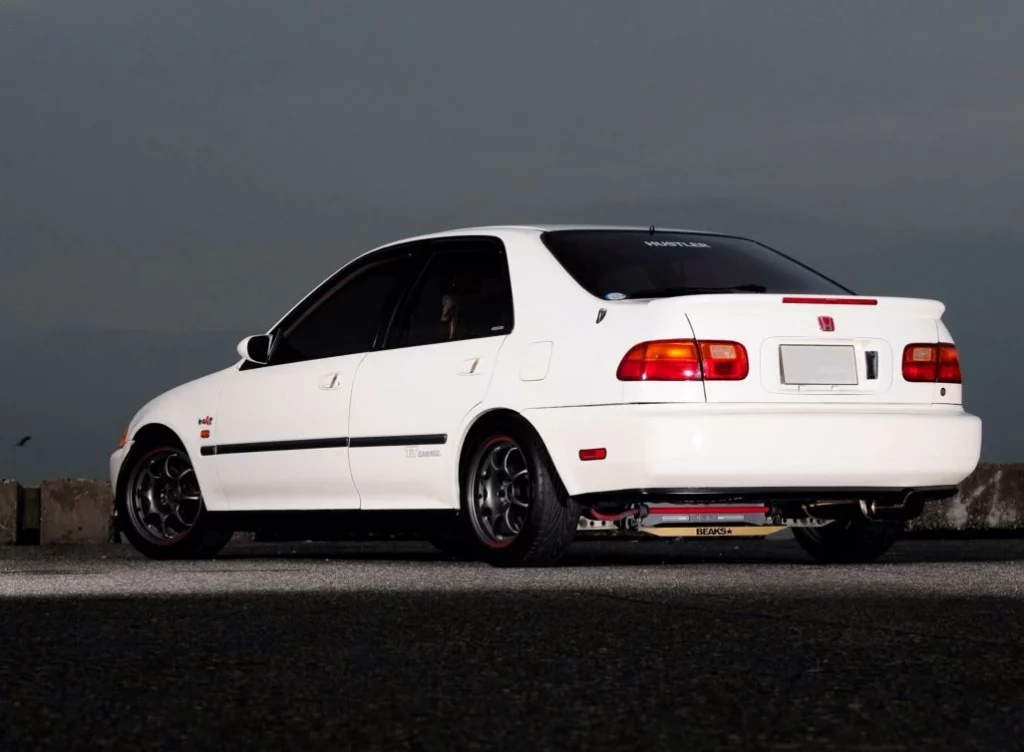
The name “Ferio” comes from the Italian word for “holiday” or “free time” — a deliberate contrast to the Type R’s aggression. From 1992 to 2006, every Civic sedan sold in Japan wore the Ferio badge, whether it was a base-model commuter or a B16A-powered SiR with a 8,000-rpm redline. Americans never saw it — the USDM Civic sedan was simply called “Civic” with a trim level — but the Ferio line included configurations the US market never received: a B16A DOHC VTEC sedan, a RealTime 4WD sedan with a rear wiper, and a continuously variable transmission years before CVTs became common in Honda’s global lineup.
What “Ferio” Actually Means
“Ferio” is not a trim package, a special edition, or an unofficial nickname. It was the official sub-name Honda assigned to the Civic sedan in the Japanese domestic market, sold through Honda Primo dealerships. The name appeared on the Trunk Lid and in Honda’s catalog materials. A more upscale variant of the same platform, the Honda Domani, was sold through Honda Clio dealerships (source: Wikipedia fifth-generation Civic; Honda Primo/Clio dealer network history).
The Ferio name was used across three full Civic generations — fifth (EG), sixth (EK), and seventh (ES) — before being retired after the 2006 model year, when the eighth-generation Civic sedan dropped the sub-name globally. A hybrid-only variant (FD3) carried the Ferio badge briefly in 2005–2006 during the transition.
Ferio Generations — What Was Offered
5th Generation (1991–1995) — EG Ferio
The Ferio name debuted with the fifth-generation Civic sedan in 1992. Chassis codes for the Ferio line included EG7 (D13B base), EG8 (D15B), EJ3 (EXi with D16B VTEC), EH1 (ZC 4WD), and EG9 — the SiR with the B16A DOHC VTEC engine producing 170 PS (168 hp) at 7,800 rpm and 157 Nm (116 lb-ft) at 7,300 rpm (source: Honda fifth-gen Civic Wikipedia; greeco-channel EG9 SiR specs).
The EG9 SiR Ferio was the sedan equivalent of the EG6 SiR hatchback. It shared the same B16A engine, the same 5-speed manual transmission, and the same double-wishbone suspension, but in a four-door body that was 4,395 mm long versus the hatchback’s 4,070 mm. Curb weight was 1,090 kg (2,403 lbs) — nearly identical to the hatchback’s weight. Pricing in Japan was approximately ¥1,648,000 (~$10,300 USD AT 1993 exchange rates).
6th Generation (1995–2000) — EK Ferio
The sixth-generation Ferio rode on the EK platform with sedan chassis codes EK2 (D13B base), EK3 (D15B, available with CVT), EK4 (B16A SiR), EK5 (D16A RealTime 4WD), and EK8 (D16A LEV). The Ferio received the sharper, more angular design language of the sixth-generation Civic, with a longer Wheelbase (2,620 mm) and more interior space (source: Wikipedia sixth-generation Civic; cars-japan.net EK Ferio grade list).
The EK4 Ferio SiR used a second-generation B16A engine producing 170 PS (168 hp) — the same engine found in the JDM EK4 SiR hatchback and similar to the B16A2 found in the USDM 1999–2000 Civic Si coupe (EM1), which was rated at 160 hp. The USDM Si received a slightly detuned version with a smaller throttle body and different intake manifold (source: Honda Newsroom 1999 Si specs). The Ferio SiR also received standard rear headrests, an Integra Type R-style shift knob, unique seat fabric, and the same 15-inch 5-lug alloy wheels that appeared on the USDM Si coupe.
The EK3 Ferio Vi-RS offered a 1.5L D15B SOHC VTEC-E engine with 130 PS (128 hp) at 7,000 rpm and 139 Nm (102 lb-ft) at 5,300 rpm, available with either a 5-speed manual or a CVT — one of the first Honda applications of a continuously variable transmission outside of the Civic Hybrid. The CVT-equipped Vi-RS achieved 16.4 km/L (38.6 mpg) on Japan’s 10・15 mode cycle (source: greeco-channel EK3 Vi-RS specs). A RealTime 4WD option was available on the EK5, featuring a rear wiper on the sedan — something never offered on a USDM Civic sedan.
| Chassis | Engine | Output | Transmissions | Drivetrain | Notes |
|---|---|---|---|---|---|
| EG9 | B16A 1.6L DOHC VTEC | 170 PS / 157 Nm | 5MT only | FWD | 5th gen SiR — sedan equivalent of EG6 hatch, 1,090 kg, double wishbone |
| EG8 | D15B 1.5L SOHC | ~130 PS / ~135 Nm | 5MT / 4AT | FWD | Base Ferio sold alongside EG9 SiR |
| EK4 | B16A 1.6L DOHC VTEC | 170 PS / 160 Nm | 5MT / 4AT | FWD | 6th gen SiR — USDM Si coupe’s B16A2 sedan equivalent, Integra Type R shift knob |
| EK3 | D15B 1.5L SOHC VTEC-E | 130 PS / 139 Nm | 5MT / CVT | FWD | CVT option from 1997 — early Honda CVT application, 38.6 mpg |
| EK5 | D16A 1.6L SOHC | ~120 PS / ~140 Nm | 5MT / 4AT | RealTime 4WD | 4WD Ferio with rear wiper — feature never offered on USDM Civic sedan |
| EK8 | D16A 1.6L SOHC LEV | ~120 PS / ~140 Nm | 5MT / 4AT | FWD | Low-emission vehicle variant — Japan market LEV compliance |
| ES1/ES9 | D17A / LDA (hybrid) | ~117 hp / ~94 PS (hybrid) | 5MT / CVT / 5AT | FWD | 7th gen Ferio — Civic Hybrid introduced (ES9), final generation with Ferio badge |
Sources: Cars-japan.net EK Ferio grade data, Wikipedia fifth/sixth/seventh-generation Civic, greeco-channel EG9/EK3/ES1 spec pages, Honda-tech.com EG/EK Chassis Code reference, cars-directory.net Honda Civic Ferio chassis listing.
7th Generation (2000–2005) — ES Ferio
The seventh-generation Ferio (ES chassis) moved to a taller, more rounded sedan body. The flat rear floor — made possible by moving the fuel tank under the front seats — was a notable feature that improved rear seat comfort. Chassis codes ES1 (D17A base), ES2, and ES3 covered the standard models, while the ES9 introduced the Civic Hybrid to the Ferio line in 2004, using Honda’s Integrated Motor Assist (IMA) system with a 1.3L LDA engine and an electric motor (source: Wikipedia seventh-generation Civic).
The seventh-generation Ferio was also the last to carry the name. When the eighth-generation Civic launched for 2006, Honda dropped the Ferio sub-name globally — the sedan was simply called “Civic” in all markets.
What Americans Missed
The USDM Civic sedan is the same basic platform as the Ferio across all three generations, but the Japanese market received several configurations that were never offered in the US:
- B16A DOHC VTEC sedan (EG9 and EK4). The US never received a Civic sedan with the B16A engine. The closest was the 1999–2000 Civic Si coupe (EM1), which used the B16A2. A B16A-powered four-door Civic was never sold through official US channels.
- RealTime 4WD on a sedan (EK5). Honda’s hydromechanical RealTime 4WD system was available on the Ferio sedan — a feature the US market only received on the Civic Wagon and CR-V.
- CVT in a non-hybrid Civic (EK3). The Ferio Vi-RS with the D15B engine and a CVT appeared in 1997 — years before CVTs became standard on modern Civics. The USDM didn’t get a CVT Civic until the 2014 model year.
- Rear wiper on a sedan. The EK5 4WD Ferio included a rear window wiper — something no USDM Civic sedan has ever had.
- Civic Hybrid sedan a year early. The Ferio ES9 Hybrid launched in Japan for 2004, while the USDM Civic Hybrid arrived for the 2005 model year.
The EG9 SiR Ferio vs the USDM Civic Si (EM1)
The closest apples-to-apples comparison is between the EG9 SiR Ferio and the USDM 1999–2000 Civic Si coupe (EM1). Both use a 1.6L DOHC VTEC B-Series engine, a 5-speed manual, and double-wishbone suspension, but the differences are meaningful:
| Specification | EG9 SiR Ferio (JDM) | EM1 Si Coupe (USDM) |
|---|---|---|
| Engine | B16A (Gen 2) | B16A2 |
| Output | 170 PS (168 hp) at 7,800 rpm | 160 hp at 8,000 rpm |
| Torque | 157 Nm (116 lb-ft) at 7,300 rpm | 111 lb-ft at 7,000 rpm |
| Body style | 4-door sedan | 2-door coupe |
| Curb weight | 1,090 kg (2,403 lbs) | ~2,600 lbs |
| Transmission | 5-speed manual | 5-speed manual |
| LSD | None (SiR) | None |
| Suspension | Double wishbone F/R | Double wishbone F/R |
| Original MSRP (JPY) | ~¥1,648,000 (~$10,300) | ~$17,000 USD |
The EG9 SiR makes 8 more horsepower in a 200-lb lighter sedan body, but lacks the EM1’s stronger connecting rods, counterweighted Crankshaft, and larger throttle body — the USDM engine was built for durability at the cost of peak power. Neither had a limited-slip differential; that was reserved for the EK9 Type R.
Current Market — Ferio Values
The Ferio nameplate does not command the same premium as the EK9 Type R or even the EM1 Si. Most Ferios were economy sedans with D-Series engines, and they were produced in much higher volumes than the Type R. Current pricing depends heavily on the variant:
- Base Ferio (EG8/EK3/ES1): $1,500–$5,000 in Japan export condition. Economy cars with limited collector interest unless exceptionally clean.
- SiR Ferio (EG9/EK4): $4,000–$10,000 depending on condition, mileage, and originality. The B16A sedan carries a premium but not at the level of the Type R or even the EM1 coupe.
- 4WD Ferio (EK5): $2,000–$5,000. Niche interest — mostly for enthusiasts who want the rear wiper and winter capability.
- CVT Ferio (EK3 Vi-RS): $2,000–$4,000. Historical curiosity more than a performance buy.
The 25-year import rule makes 1997–2000 EK Ferios eligible for US import (the EK4 SiR became legal in 2022–2025 depending on production date). The EG9 remains eligible as a 1991–1995 model. Import costs, including shipping, customs duty, and compliance, typically add $2,000–$4,000 to the purchase price.
Reliability and Parts
The Ferio shares its mechanical architecture with the global Civic of the same generation, which means:
- B16A and D15B engines are well-documented and parts are widely available through aftermarket suppliers and Honda Japan. The B16A uses a timing belt (Interference Engine) — replacement interval is 90,000 km (55,000 miles).
- The CVT in the EK3 is a Honda Multimatic unit from the late 1990s. These are less durable than Honda’s later CVT designs and can be difficult to service outside Japan.
- The RealTime 4WD system on the EK5 is hydraulic and uses a viscous coupling. It requires Honda-specific fluid and is generally reliable if maintained.
- Body panels and glass are Ferio-specific for the sedan. Front doors and some interior parts are shared with the hatchback, but the trunk lid, rear quarters, and taillights are unique to each generation.
- Rust at the rear Trailing Arm mounts is the same concern as on any EG/EK-generation Civic. Japanese-market cars from regions with winter road salt are less common, but import cars from coastal Japan may have corrosion.
Why the Ferio Matters
The Ferio is not a Type R. It does not have the B16B, the Helical LSD, the Recaro seats, or the $30,000+ price tag. What it does represent is the full breadth of what Honda offered in the Civic sedan during the 1990s — a lineup that included a DOHC VTEC SiR, a fuel-sipping VTEC-E with CVT, and a RealTime 4WD version with a rear wiper. The USDM Civic sedan never had any of these configurations. Every Ferio import is proof that Honda’s home market got a wider, more interesting Civic lineup than the US did.
☐ “Ferio” was Honda’s official JDM name for Civic sedans from 1992 to 2006
☐ Three Ferio generations: EG (5th gen, 1992–1995), EK (6th gen, 1995–2000), ES (7th gen, 2000–2005)
☐ EG9 and EK4 SiR Ferios had B16A DOHC VTEC with 170 PS (168 hp) — no USDM Civic sedan ever had a B16A
☐ EK5 Ferio had RealTime 4WD with a rear wiper — feature never offered on USDM Civic sedan
☐ EK3 Ferio Vi-RS had a CVT option from 1997 — USDM didn’t get Civic CVT until 2014
☐ EG9 SiR was 2,403 lbs with 168 HP — lighter than EM1 Si coupe but same B-series engine family
☐ 7th gen Ferio (ES) introduced the Civic Hybrid to Japan in 2004 (ES9)
☐ Ferio name retired after 2006 — 8th gen Civic sedan dropped the sub-name globally
☐ EK Ferios became US-import-eligible from 2022 onward under the 25-year rule
☐ SiR Ferio values typically $4k–$10k — affordable compared to EK9 Type R ($30k+)
☐ Mechanical parts widely available through B/D-series aftermarket — body panels are Ferio-specific