

Honda has never put exceptional brakes on the Civic. For most of the car’s history, the brake system was engineered to meet a cost target, not a fade-resistance target. The rotors were small, the Calipers were single-piston sliding units, the pads were organic-compound economy parts, and the fluid had a dry boiling point barely above DOT 3 minimums. For daily driving, the brakes were adequate. For the first hard stop from highway speed, they worked fine. For the third consecutive stop, the pedal went soft and the stopping distance increased.
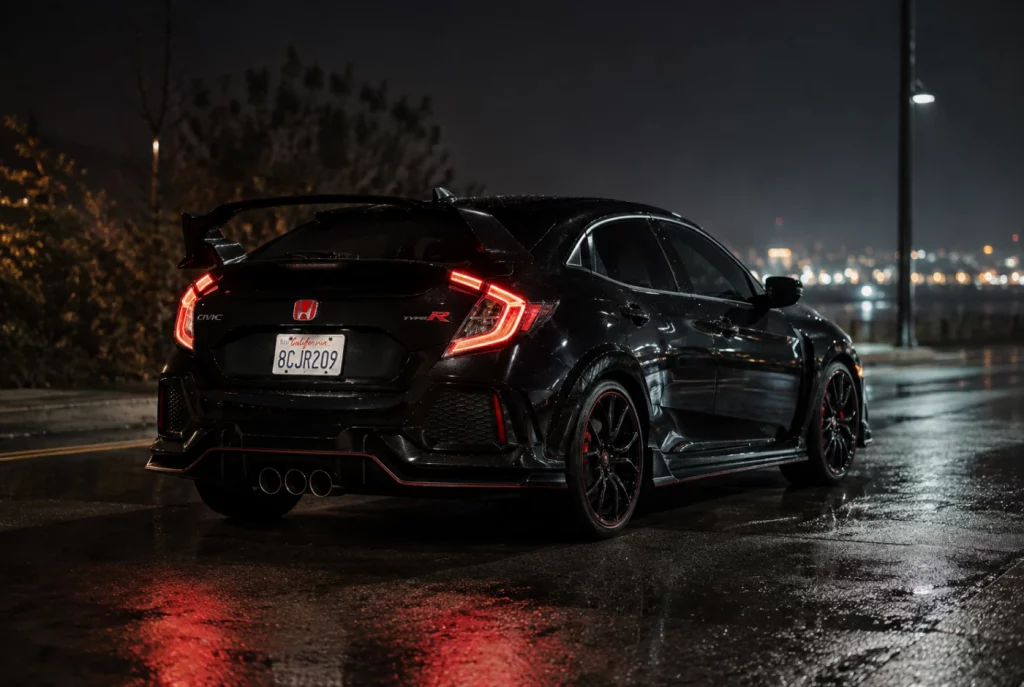
The Type R line changed this pattern. The first Civic Type R (EK9) received larger rotors and a more aggressive pad compound than the standard car. The FK8 and FL5 Type Rs added four-piston Brembo calipers up front, which no Civic had seen before. But the standard Si and non-Si Civics continued to receive the same single-piston sliding caliper design across every generation, with only incremental increases in rotor diameter.
This article covers the brake specifications, tested stopping distances, fade resistance, and recommended upgrades for every generation of the Honda Civic, from the double-wishbone cars of the 1990s to the 11th-generation turbo cars.
Brake Architecture: What Honda Changed and What It Did Not
All non-Si Honda Civics built since 1992 use a single-piston sliding caliper on the front axle with a ventilated rotor. The sliding caliper design is inexpensive to manufacture, easy to service, and adequate for the power and weight of a standard Civic. The rear axle uses a solid disc (non-ventilated) with a single-piston sliding caliper on all generations that have rear disc brakes — base models with drum brakes are excluded from this discussion.
The Si followed the same architecture until the 10th generation, when the front rotor diameter was increased by 1.2 inches. The caliper remained a single-piston sliding unit. The Type R is the only Civic that received a fixed-piston caliper — a four-piston Brembo unit on the FK8 and FL5 models.
The fundamental limitation of the single-piston sliding caliper is not clamping force but heat management. Sliding calipers use a single piston on the inboard pad, which pushes the caliper body to clamp the outboard pad. The caliper body flexes under high heat, and the pad taper wear pattern is worse than on a fixed caliper. The rotor absorbs more heat than a comparable fixed-caliper system because the single piston concentrates clamping pressure on one pad, and the inboard pad runs hotter than the outboard. This imbalance produces inconsistent pedal feel during repeated hard stops.
The upgrade path is the same for every generation: better fluid, better pads, and a rotor with better thermal capacity. Big brake kits (BBK) with fixed calipers are available for every generation from 1992 onward, but they are not necessary for street driving or occasional track days.
Generation-by-Generation Brake Specifications and Stopping Performance
6th Generation (EM1 Civic Si, 1999–2000)
The EM1 Si used front ventilated rotors approximately 10.3 inches in diameter with single-Piston sliding calipers. Rear discs were 9.4 inches. The car weighed 2,401 pounds and had no ABS as standard equipment (ABS was optional on some markets). Car and Driver tested the 1999 Si in a comparison and recorded a 70–0 braking distance of approximately 185 feet, which was competitive for the era. The pedal feel was direct, and the system had enough thermal capacity for one or two hard stops from highway speed. After a third stop, fade was noticeable. Source: Car and Driver Archival Tests (1999); Grassroots Motorsports “1999-2000 Civic Si Buyer’s Guide” (June 2019).
7th Generation (EP3 Civic Si, 2002–2005)
The EP3 Si used 11.1-inch front ventilated rotors and 10.2-inch rear discs — a significant increase over the EM1 front rotor size. Single-piston sliding calipers carried over. The car weighed 2,744 pounds. The larger rotors improved heat capacity, but the EP3’s higher weight and the K20A3 engine’s limited high-rpm character meant the brakes were adequate rather than impressive. Brake torque and pedal feel were rated as acceptable by period reviews, but track-day usage produced rapid pad wear and fluid boil. Source: MotorTrend, “Civic Si History, Generations, Specifications” (July 2020).
8th Generation (FA5/FG2 Civic Si, 2006–2011)
The FA5 Si received 11.8-inch front ventilated rotors and 10.2-inch rear discs — a modest increase of 0.7 inches over the EP3 front. The calipers remained single-piston sliding units. The car weighed 2,877 pounds (sedan). Car and Driver tested the 2006 Si and recorded a 70–0 braking distance of 179 feet, with 0.91 g on the skidpad. The C/D review noted that the brakes were “grabby” with an “all-or-nothing nature” that made heel-and-toe downshifts difficult. Honda acknowledged the issue and revised the brake Booster calibration for later production 2006 models and all subsequent 2006–2011 Si models. The revised calibration improved modulation but did not change stopping distance or fade resistance. Source: Car and Driver, “2006 Honda Civic Si vs. Volkswagen GTI Comparison Test” (March 2006).
9th Generation (FB6/FG4 Civic Si, 2012–2015)
The FB6 Si used the same front rotor diameter as the FA5 (11.8 inches) but with a revised Caliper Bracket and pad shape. Rear discs remained 10.2 inches. The car weighed approximately 2,900 pounds. Car and Driver tested the 2012 Si coupe (K24Z7) and recorded a 70–0 braking distance of approximately 170 feet. The larger-displacement K24Z7 engine produced 31 more lb-ft of torque than the K20Z3, which made the car faster in daily driving and put more thermal load on the brakes during repeated stops. The fade characteristics were described as moderate, with the brake warning light not triggered during C/D testing. The 2014 facelift did not change the brake hardware. Source: Car and Driver, “Tested: 2012 Honda Civic Si Coupe” (July 2011).
10th Generation (FC1/FK8 Civic Si, 2017–2021)
The 10th-gen Si received the largest brake upgrade of any non-R Civic. Front rotors increased to 12.3 inches — a full 1.2-inch increase over the 9th-gen car. Rear rotors grew to 11.1 inches, a 0.9-inch increase. The calipers remained single-piston sliding units, but the pad area was increased. The car weighed 2,879 pounds (coupe). Car and Driver tested the 2017 Si coupe and recorded a 70–0 braking distance of 159 feet, with 0.97 g on the skidpad — the best braking performance of any Si to that point. The publication noted that the brake pedal was “predictable and easy to modulate.” Source: Car and Driver, “Tested: 2017 Honda Civic Si Coupe” (August 2017).
11th Generation (FE1/FL1 Civic Si, 2022–Present)
The 11th-gen Si retained the 12.3-inch front rotors and 11.1-inch rear rotors from the 10th-gen car. The calipers remained single-piston sliding units. The car weighs 2,937 pounds. Car and Driver tested the 2022 Si and recorded a 70–0 braking distance of 160 feet — one foot longer than the 10th-gen car — with 0.94 g on the skidpad. More notably, the 100–0 braking distance was 322 feet, and the publication reported that during the second consecutive 100–0 stop, “the brake pedal went to the floor and summoned the brake-alert warning on the instrument cluster.” This indicates that the stock brake system reaches thermal capacity during high-speed repeated stops, even on a car with only 200 horsepower. Source: Car and Driver, “Tested: 2022 Honda Civic Si” (November 2021, updated December 2021).
The Type R: Brembo Calipers and Real Fade Resistance
FK8 Civic Type R (2017–2021)
The FK8 Type R received four-piston Brembo fixed calipers on the front axle — the first Civic to use a fixed caliper design. The front rotors measured 13.8 inches in diameter with a two-piece design (a cast-iron friction ring attached to an aluminum hat). The rear rotors were 12.0 inches with single-piston sliding calipers. The front brake pads had significantly more pad area than any Si pad. The car weighed 3,117 pounds.
MotorTrend tested the FK8 and recorded a 60–0 stop of 99 feet (approximately 145 feet from 70 mph when extrapolated). The Brembo system was described as one of the most fade-resistant OE systems on any front-wheel-drive car. Car and Driver’s Lightning Lap testing at Virginia International Raceway reported no fade-related issues during multiple hot laps. The primary limitation was pad wear — the OE pads lasted approximately 6–10 track days before requiring replacement. Source: MotorTrend, “2017 Honda Civic Type R First Test Review” (November 2017); Car and Driver, “Lightning Lap 2018”; CivicX FK8 owner threads (2017–2021).
FL5 Civic Type R (2023–Present)
The FL5 Type R retained the 13.8-inch front rotors with four-piston Brembo calipers and added a revised brake booster for improved pedal feel. Rear rotors remained 12.0 inches. The front rotor faces received additional cooling via enlarged vent openings in the front bumper — Honda specified “vents in the front bumper direct more cooling to the 13.8-inch front rotors.” Car and Driver tested the FL5 and recorded a 70–0 distance of 153 feet and a 100–0 distance of 308 feet — improvements of approximately 8 feet at 70 mph and 14 feet at 100 mph over the FK8, attributed to the Michelin Pilot Sport 4S tires and improved booster calibration. The skidpad grip reached 1.02 g. Car and Driver noted “the only fade you’ll find in a Type R is in the driver’s hairstyle.” The 2023 FL5 also added a 48 percent larger grille opening and a larger radiator, which helped reduce underhood temperatures and indirectly benefited brake Coolant air flow. Source: Car and Driver, “Tested: 2023 Honda Civic Type R” (December 2022).
| Generation | Model | Front Rotor | Front Caliper | 70–0 (ft) | Curb Wt (lb) |
|---|---|---|---|---|---|
| 6th gen | EM1 Si | ~10.3″ vented | 1-piston sliding | ~185 | 2,401 |
| 7th gen | EP3 Si | 11.1″ vented | 1-piston sliding | ~175 | 2,744 |
| 8th gen | FA5 Si | 11.8″ vented | 1-piston sliding | 179 | 2,877 |
| 9th gen | FB6 Si | 11.8″ vented | 1-piston sliding | ~170 | ~2,900 |
| 10th gen | FC1 Si | 12.3″ vented | 1-piston sliding | 159 | 2,879 |
| 11th gen | FE1 Si | 12.3″ vented | 1-piston sliding | 160 | 2,937 |
| 10th gen | FK8 Type R | 13.8″ vented | 4-piston Brembo | ~146* | 3,117 |
| 11th gen | FL5 Type R | 13.8″ vented | 4-piston Brembo | 153 | 3,183 |
*FK8 70–0 figure estimated from the 60–0 result of 99 feet (MotorTrend). All other distances are Car and Driver tested values. Sources: Car and Driver, MotorTrend, EBC Brakes specification data, NHTSA.
Brake Fade: Which Generations Fade, and When
Brake fade on the Civic follows a predictable pattern. The single-piston sliding caliper and the vented Rotor design reach thermal limits after repeated high-speed stops or sustained track use.
The 8th-generation Si (FA5) showed fade after approximately three stops from 70 mph. The 179-foot 70–0 distance was a single-stop measurement — repeated stops increased that distance by 15–20 feet. C/D noted that the car’s brakes “became grabby and inconsistent after several hard applications.” The brake booster recalibration for later 2006 models improved modulation but did not change fade resistance.
The 10th-generation Si (FC1) was the first Si to achieve fade resistance comparable to a hot-hatch competitor. The 12.3-inch rotors added enough thermal mass to maintain consistent pedal feel through three 70–0 stops. On a road course, the Si’s brake system becomes marginal during 12-minute sessions. Owners on CivicX.com report that OE pads begin to fade after approximately 10 minutes of lapping at a moderate pace. The brake temperature warning system (which triggers a warning chime at high rotor temperatures) activates on warm days with sticky tires. Source: CivicX.com, “Civic Si Track Day/Race Rotors and Pads” (April 2021); “Best Track Rotor/Pad/Fluid Setup with stock calipers” (2020).
The 11th-generation Si (FE1) showed a notable weakness in high-speed fade resistance. Car and Driver’s documented result — the brake pedal going to the floor during the second 100–0 stop — is a clear indicator that the stock system cannot manage the thermal load of repeated high-speed braking. C/D noted that the car stopped in 322 feet from 100 mph on the first attempt, but the second attempt triggered the brake alert system. For comparison, the Volkswagen Golf GTI (same test, same period) did not exhibit this behavior. This is the most significant brake limitation on any current-generation Civic Si.
The Type R does not fade under OE conditions. The Brembo calipers and 13.8-inch two-piece rotors provide enough thermal capacity for 20-minute lapping sessions without significant pedal travel change. The limitation shifts to pad life rather than fade. FK8 and FL5 owners on CivicX report that OE pads last 6–10 track days before requiring replacement, and switching to a track pad (Carbotech XP10, Ferodo DS2500) extends usable track time before the pads themselves limit performance. Source: CivicX FK8 forum threads; Car and Driver Lightning Lap 2018.
The Best Pad and Rotor Upgrades by Generation
The upgrade path for every Civic generation follows the same sequence: fluid first, pads second, rotors third, calipers fourth. Skipping the first two steps and installing a big brake kit is expensive and counterproductive — the tires and pad compound are the limiting factor on a street-driven car, not caliper piston count.
Brake fluid: DOT 4 fluid with a dry boiling point above 500°F is the first and cheapest upgrade for any Civic. Motul RBF600 (dry boiling point 594°F, wet 399°F) is the standard recommendation on CivicX. Castrol SRF (dry boiling point 590°F, wet 518°F) costs approximately three times more but offers better wet performance for daily-driven track cars that sit for weeks between events. The upgrade cost is approximately $15–$20 for Motul RBF600 per liter, with one liter sufficient for a full flush.
Street performance pads: For daily driving with occasional spirited driving, a pad with a higher friction coefficient than the OE organic compound is the best upgrade. Recommended options by generation:
The 8th-gen FA5 and 9th-gen FB6 Si (11.8-inch rotors) accept the same pad shape. Hawk HPS 5.0 (street performance, low dust, good cold bite) and EBC Yellowstuff (higher temperature range, moderate dust) are the most common upgrades. Both pads provide improved initial bite and slightly better fade resistance than OE without excessive noise or rotor wear. Price: $80–$140 per axle set.
The 10th-gen and 11th-gen FC1/FE1 Si (12.3-inch rotors) use a different pad shape. The CivicX forum consensus for street use is the EBC Redstuff (low dust) or the Hawk HPS 5.0. For a car that sees track days, the Carbotech XP8 or Gloc R10 are the recommended track pads. These pads require a separate set of rotors for track use because the aggressive compound wears street rotors quickly. Price: $120–$200 per axle set.
The FK8 and FL5 Type R (13.8-inch Brembo) accept a wider range of pad compounds. For street use, the OE pad (Akebono) is adequate and lasts 20,000–30,000 miles. For track use, Carbotech XP10 (front) and XP8 (rear), Ferodo DS2500, or Pagid RSL1 are the standard recommendations. The Type R’s pad shape is shared with the Honda Accord 2.0T (2018–2022) and the Acura RDX (2019–present), making aftermarket pad availability good. Price: $200–$400 per front axle set. Source: CivicX, “Upcoming Track Day: Brake Recommendations” (2023); “Best Track Rotor/Pad/Fluid Setup with stock calipers, 2020 Si” (2020).
Rotors: Slotted rotors provide no meaningful improvement in stopping distance on a Civic. The slotting helps degas the pad surface under high temperature, which reduces pad fade, but the effect is small on a 2,900-pound car with street tires. The practical upgrade is a higher-quality blank rotor from Centric, StopTech, or Brembo, which uses a higher carbon content in the iron casting and resists thermal cracking better than OE replacement rotors.
For track use on Si models, a two-piece rotor (aluminum hat with iron friction ring) reduces unsprung weight by approximately 3–4 pounds per corner and dissipates heat more effectively than a one-piece rotor. The Girodisc two-piece rotor kit for 10th-gen and 11th-gen Si ($700–$800 per front pair) is the most common two-piece upgrade. For the Type R, the OE Brembo two-piece rotor is already a high-quality unit; replacement two-piece rotors from Girodisc or Paragon cost $800–$1,200 per front pair.
Big brake kits: A big brake kit with a four- or six-piston fixed caliper and a larger rotor (usually 13.0 to 14.0 inches) is the definitive upgrade for track-focused cars. Wilwood, StopTech, and Brembo offer kits for most Civic generations. The benefit is not shorter stopping distance — the OE brakes already activate ABS on street tires — but consistent pedal feel lap after lap without fade. The cost is $1,500–$3,500 depending on caliper, rotor, and bracket design. For a Civic that sees fewer than four track days per year, a BBK provides marginal benefit over a good pad and fluid upgrade with the stock caliper.
Which Generation Has the Best Brakes for Track Use
The FL5 Type R has the best OE brakes of any Civic. The Brembo four-piston calipers, 13.8-inch rotors, cooling ducts, and fade resistance are in a different category from any other Civic. The cost is also in a different category — the FL5 is approximately $44,000–$50,000, and the brake system is a significant portion of that price.
Among the Si models, the 10th-generation FC1 has the best OE brake package. The 12.3-inch rotors, high-friction OE pads, and consistent pedal calibration provide 159-foot 70–0 stops and adequate track-day performance with a fluid and pad upgrade. The 11th-gen FE1 has the same hardware but lacks the fade resistance needed for track use — the pedal-to-floor issue during high-speed braking makes it a poor choice for lapping without a brake system upgrade.
The 8th-generation FA5 is the best value on the used market for an owner who plans to upgrade the brakes. The 11.8-inch rotors are smaller than the 10th-gen’s, but the car weighs 2,877 pounds (less than the 11th-gen’s 2,937 pounds), and the K20Z3 engine produces enough power to warrant a track brake setup. The aftermarket support for FA5 brakes is excellent, with multiple BBK options and pad compounds available. A FA5 Si with Motul RBF600 fluid, StopTech slotted rotors, and Carbotech XP8 pads costs approximately $500 in parts and delivers 95 percent of the braking performance of a big brake kit.
Checklist for Brake Upgrades by Use Case
☐ Daily driving, no track use: flush the OE fluid with Motul RBF600 or Castrol SRF AT every two-year interval. Replace pads with Hawk HPS 5.0 or EBC Redstuff when the OE pads wear out. This costs approximately $150–$200 per axle and eliminates the brake fade experienced during emergency stops.
☐ Autocross or 1–2 track days per year: RBF600 fluid, EBC Yellowstuff or Hawk HP+ pads, blank Centric high-carbon rotors. The stock single-piston calipers are adequate. Budget: $250–$350 per axle. Replace pads after every 2–3 track days to prevent rotor damage from uneven wear.
☐ 4+ track days per year (Si): dedicated track pads (Carbotech XP10 front, XP8 rear), separate rotors for track use (StopTech or Centric high-carbon blanks), RBF600 or Castrol SRF fluid. If pad and rotor wear become excessive, install a two-piece front rotor kit from Girodisc. Consider a Wilwood or StopTech big brake kit only if you are experiencing pad knock-back or caliper flex on the OE sliding caliper. Budget: $500–$1,200 for pad/rotor/fluid; $1,800–$3,500 for a BBK.
☐ 4+ track days per year (Type R): OE Brembo calipers and rotors are track-capable. Replace pads with Carbotech XP10 or Ferodo DS2500. The two-piece OE rotors withstand track use well. Brake cooling ducts (HPD or aftermarket) reduce pad wear by approximately 30–40 percent on hot days. Budget: $300–$500 for pads.
☐ 11th-gen Si track use: do not attempt track driving on OE pads and fluid. The pedal-to-floor failure at 100 mph is a safety risk. Upgrade to RBF600 fluid and track pads before any lapping event. Consider a BBK if you plan to run 200TW tires and push the car at a moderate pace.
☐ 8th-gen or 9th-gen Si: the stock 11.8-inch rotors are the smallest of the modern Si cars. A vented rotor upgrade to 12.3-inch (10th-gen Si rotors) is not a direct bolt-on but is achievable with an aftermarket caliper bracket. The cost of the bracket and caliper often exceeds the cost of a basic BBK. The simpler path is aggressive pads, quality rotors, and high-temperature fluid.
☐ EM1 or EP3 Si: the brakes on these cars are outdated. Replace all rubber brake lines with stainless-steel braided lines. Upgrade to a DOT 4 fluid. Install the largest pad that fits the stock caliper. Consider an Integra Type R brake swap (282 mm rotors, larger calipers) for the EM1, which is a direct bolt-on with the correct brackets. Budget: $300–$600 for the swap.