

The 8th generation Honda Civic Si (2006–2011) came with the K20Z3, a 2.0-liter i-VTEC engine that remains one of the most popular K-Series platforms for naturally aspirated performance builds. The 240-wheel-horsepower (whp) target sits in a specific gap: it is roughly 20–30 hp beyond what bolt-on modifications alone can deliver, but well short of the extensive machine work and displacement increase needed for a 300+ whp all-motor setup. Reaching 240 whp from a stock K20Z3 requires raising compression, upgrading camshafts, and optimizing the entire induction and exhaust path — without resorting to forced induction or a K24 swap. This article covers what it takes to hit that number, what parts work, what the community has verified on real Dynojets, and how to keep the car daily-drivable when you get there.
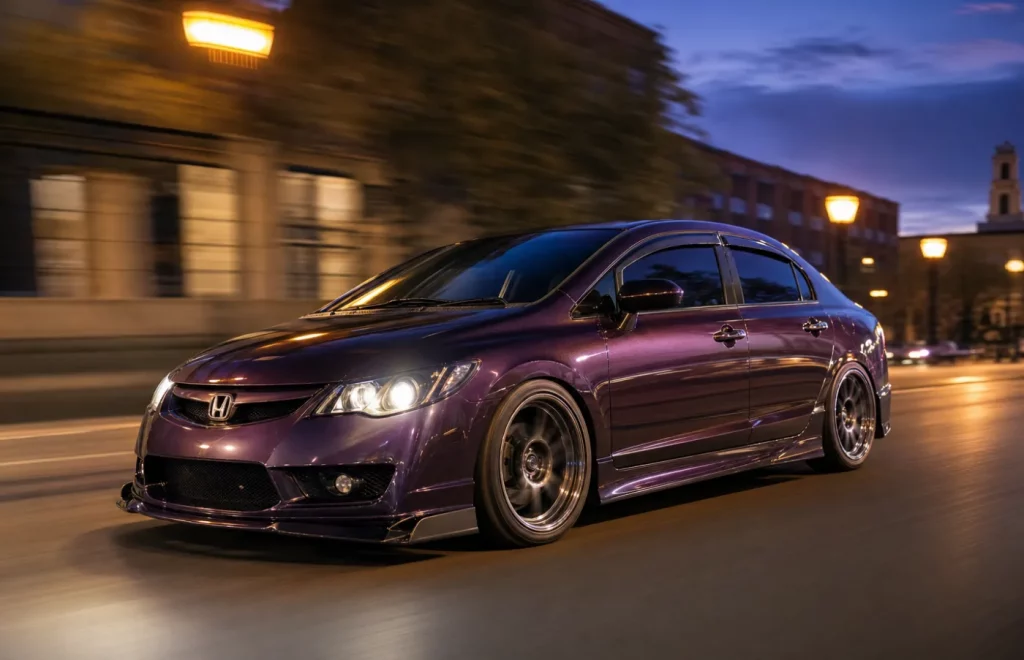
Can a K20Z3 Really Make 240+ WHP Naturally Aspirated?
Short answer: yes, but this is not a bolt-on build.
The standard K20Z3 has 2.0L displacement, 86 × 86 mm bore and stroke, 11.0:1 compression, i-VTEC, a PRC intake manifold, and a forged Crankshaft. The K20Z3 is already a high-performance variant of the K20 family. But 240 WHP is not 240 crank horsepower — that distinction matters.
A stock K20Z3 on a Dynojet typically puts down 172–185 whp depending on the dyno, correction factor, and engine condition. The jump from 175 whp to 240 whp represents roughly a 37 percent increase in wheel power. That gap is too large for bolt-on parts alone.
What Does 240 WHP Actually Require?
Here is a realistic progression model:
| Configuration | Typical WHP (Dynojet) | Notes |
|---|---|---|
| Stock K20Z3 | 172–185 | Factory baseline |
| Bolt-ons + tune | 210–225 | I/H/E, RBC, injectors, FlashPro |
| Cams + airflow + tune | 220–240 | Stage 2 cams, valvetrain, intake/exhaust |
| High compression + head work + cams + serious airflow | 240+ | Forged pistons, ported head, aggressive cams |
DSPORT’s controlled testing on a K20Z3 is a perfect reference: 205 WHP baseline → 213.9 WHP with race header → 222.8 WHP with Drag Cartel cams + FlashPro. That’s the kind of documented progression that separates real builds from marketing claims.
The Important Part: Dyno Numbers Are Not Universal
Dynojet ≠ Mustang ≠ Dynapack. Temperature, humidity, correction factor, tires, fuel quality, engine condition, and dyno calibration all affect the number. A 240-WHP K20Z3 on one dyno may not produce the same number on another dyno. This is not an excuse — it is reality. When comparing builds, always note the dyno type and correction factor.
The Starting Point: Stock K20Z3
| Component | Stock K20Z3 Specification |
|---|---|
| Displacement | 2.0L (1,998 cc) |
| Bore | 86 mm |
| Stroke | 86 mm |
| Compression Ratio | 11.0:1 |
| VTEC | i-VTEC (intake cam phasing) |
| Intake Manifold | PRC |
| Application | 8th Gen Civic Si (FA5 sedan, FG2 coupe) |
| Factory Power (crank) | 197 hp @ 7,800 rpm / 139 lb-ft @ 6,100 rpm |
Why High Compression Helps
Higher Compression Ratio → greater thermal efficiency → stronger cylinder pressure → more torque and power potential. But simultaneously: higher compression → greater knock sensitivity → greater fuel and octane sensitivity → less tuning margin. Compression ratio alone does not make 240 WHP. It is an enabler, not a guarantee.
Choosing the Compression Ratio
| Compression Ratio | Typical Use | Fuel Required |
|---|---|---|
| 11.0:1 | Stock street | 91–93 octane |
| 11.5:1 | Mild NA build | 91–93 octane |
| 12.0:1 | Aggressive street/track | 93 octane |
| 12.5:1 | Serious NA build | 93 octane (premium fuel) |
| 13.0:1+ | Race-oriented | E85 or 100+ octane |
12.5:1 is the sweet spot for a pump-gas daily driver on 93 octane with aggressive camshafts. Several forum-verified builds on K20A.org have run 12.5:1 on 93 octane with no detonation when paired with cams that provide enough overlap to reduce dynamic compression at low rpm. One builder reported running 12.5:1 on a K24 bottom end with Z3 head on 93 octane without issues, noting that gas quality from different stations mattered more than the ratio itself.
13.0:1 and above requires E85 or a race-gas blend for safe daily operation. On 93 octane, 13.0:1 typically forces significant ignition timing retard AT peak torque, which negates the compression gain.
Forged Pistons — What Fits the K20Z3
The K20Z3 uses the same 86 mm bore as the K20A2, with a 22 mm Wrist Pin. The factory pistons are cast aluminum with a 11.0:1 compression height optimized for the 137 mm rod length. Any aftermarket piston must match the 137 mm rod center-to-center length and the factory deck height to maintain proper quench clearance.
Wiseco K634M series is the most common choice for K20Z3 high-compression builds. Available in multiple compression ratios (11.0:1, 11.5:1, 12.0:1, 12.5:1) and two Bore sizes (86.5 mm and 87 mm). The 86.5 mm version allows for a light bore hone rather than a full overbore on a healthy factory block. Pricing is approximately $732.99 per set. The ArmorGlide coated versions add a skirt coating that reduces friction and scuff risk during cold starts.
CP-Carrillo and JE Pistons offer custom K20Z3 pistons with more flexible compression ratio and bore size options, typically priced at $650–$850 depending on coating and material choices. Arias also offers K-series pistons in the same range.
All of these pistons require the cylinder bores to be honed to final size by a machine shop. Do not attempt to install oversized pistons without a proper bore/hone job — ring seal and oil consumption will be unacceptable.
Why You Can’t Just Drop High-Compression Pistons Into the Engine
After installing aftermarket pistons, you must verify: Piston-to-wall clearance, ring gap, piston-to-valve clearance, deck height, compression ratio, and bearing clearances. Enthusiast builds require machine-shop work and proper fitting of pistons to cylinders. This is not a “drop-in” job.
Bore: 86 mm vs 86.5 mm
Stock bore: 86.0 mm. Mild overbore: 86.5 mm. At 86.5 mm, displacement slightly increases. But do not bore the block just because a piston is available in 86.5 mm. First, measure cylinders, inspect, machine, and final hone. A healthy stock bore with proper honing is preferable to an unnecessary overbore.
Connecting Rods — When and What to Upgrade
The factory K20Z3 connecting rods are powdered-metal sintered rods that are adequate for stock power levels but become a reliability concern at sustained high rpm with increased compression and aggressive cam timing. The failure mode is fatigue cracking at the cap interface over time, particularly at sustained operation above 8,000 rpm.
For a 240 whp target, rod upgrade is recommended but not strictly required if the engine will not see sustained track use above 8,200 rpm. Several documented K20Z3 builds have run 12.5:1 pistons on stock rods with no failures. However, most experienced builders recommend upgrading rods at the same time as pistons because the labor cost of opening the bottom end dominates the build budget.
| Rod | Material | Fastener | Price (set of 4) | Power Rating |
|---|---|---|---|---|
| Eagle CRS5470K3D | 4340 forged H-beam | ARP2000 | $407 | ~500 whp |
| Manley 14014-4 | 4340 forged H-beam | ARP2000 | $554 | ~500 whp |
| Brian Crower ProH2K BC6041 | 4340 forged H-beam | ARP2000 Wave-Loc | $686 | ~500 whp |
| Brian Crower LightWeight BC6051 | 4340 forged rod | ARP2000 Wave-Loc | $686 | ~400 whp |
| Brian Crower MidWeight BC6054 | 4340 forged rod | ARP2000 | $979 | ~500 whp |
All of these rods use the factory 5.394-inch (137 mm) center-to-center length, 22 mm pin diameter, and factory bearing sizes, making them direct replacements. No crank modification or custom clearancing is required for a stock-stroke K20Z3.
Main and Rod Bearings
The K20Z3 uses ACL Race Series bearings (part number 4B793H-STD for mains, 4B791H-STD for rods) as the standard upgrade for built engines. They offer higher oil clearance tolerance and better fatigue resistance than OEM bearings at elevated rpm. OEM Honda bearings are acceptable for a 240 whp build that will not see regular track use, but ACL bearings add a safety margin for approximately $80–$100 per set. ARP main studs and head studs are also recommended to maintain consistent clamping force under higher cylinder pressures.
Camshaft Selection — The Key to 240 WHP
Camshaft selection is arguably the most important decision after compression ratio. The wrong cams can leave 15–20 whp on the table. The right cams can make 240 whp achievable on 12.0–12.5:1 compression with pump gas.
The stock K20Z3 camshafts are modest by performance standards. The intake cam has approximately 11.5 mm lift at the valve and 230 degrees of duration at 1 mm lift. These cams run out of steam around 7,800 rpm, which is why FBO-only K20Z3 builds peak early and lose power past 8,000 rpm. A high-compression build needs cams that hold power past 8,200 rpm.
| Camshaft | Intake Lift | Intake Duration | Exhaust Lift | Exhaust Duration | Price | Typical WHP (12.5:1 K20Z3) |
|---|---|---|---|---|---|---|
| Stock K20Z3 | ~11.5 mm | ~230° | ~11.5 mm | ~230° | $0 | ~210 (FBO) |
| Skunk2 Tuner Stage 2 | 13.58 mm | 272° | 12.59 mm | 276° | $750 | 237–250 |
| BC Stage 2 (BC0042) | ~13.2 mm | ~268° | ~12.5 mm | ~272° | ~$720 | 230–245 |
| Drag Cartel 2.2 | ~14.2 mm | ~282° | ~13.5 mm | ~286° | ~$950 | 245–260 |
| Kelford 199-B | ~13.8 mm | ~276° | ~13.2 mm | ~280° | ~$1,000 | 240–255 |
Skunk2 Tuner Stage 2 is the most documented drop-in cam for the K20Z3. Specs: 13.58 mm intake lift / 272 degrees duration, 12.59 mm exhaust lift / 276 degrees duration. Skunk2 claims 22–25 HP gain over stock. On a K20Z3 with 12.5:1 pistons, RBC intake, and race header, these cams have verified results in the 237–250 whp range.
Drag Cartel 2.2 cams are a step above Stage 2 offerings, with higher lift and duration (14+ mm lift, 280+ degrees duration). They are designed for high-compression K20 builds and have a documented record of reaching 245–260 whp on 12.5:1 K20Z3 engines. They require more spring pressure and upgraded valve springs and titanium retainers.
Kelford 199-B and 199-C cam profiles are another respected option, known for broad torque curves and strong top-end power. They are custom-ground to order and priced around $900–$1,200.
All of these camshafts require upgraded valve springs and retainers to prevent valve float at higher lift and increased rpm. Supertech dual valve springs (part 1021D, approximately $300) and titanium retainers (part 1018T, approximately $150) are the standard recommendation. Skunk2 Alpha valve springs and titanium retainers are also popular.
Intake Manifold — RBC vs PRC
| Factor | PRC (Stock) | RBC (Upgrade) |
|---|---|---|
| OEM K20Z3 | Yes | No |
| Flow potential | Good | Higher potential |
| High RPM | Good | Better suited |
| Availability | Easy | Easy |
| Modification | Low | Possible porting |
The stock K20Z3 intake manifold is a cast aluminum unit with integrated intake runners that are restrictive above 7,000 rpm. Swapping it for an RBC intake manifold from the JDM DC5 Integra Type R or the Acura TSX K24 is the single most impactful bolt-on modification for high-rpm power on a K20Z3. The RBC has larger-diameter runners and a larger plenum volume that allows the engine to make power past 8,000 rpm.
The RBC manifold requires an adapter plate or a modified fuel rail to clear the K20Z3’s drive-by-wire throttle body mounting. RV6 Performance and Hybrid Racing both manufacture adapter plates (approximately $70–$100).
Throttle body sizing: A 70 mm throttle body is the most common upgrade for a 240 whp K20Z3 build. The Skunk2 70 mm Pro Series TB is a direct fit with an RBC adapter. The J37 (Acura MDX) 70 mm throttle body is a popular junkyard alternative that works well with an adapter plate. A 72 mm or 74 mm TB is possible with a ported RBC but is considered overkill for a 240 whp target.
Header Is One of the Most Important Bolt-Ons
DSPORT’s testing is a perfect reference: 213.9 WHP with a race header on a K20Z3, up from 205 WHP baseline. Then cams + FlashPro brought the setup to 222.8 WHP. The header is not the final answer, but it is a major part of the airflow equation.
4-2-1 vs 4-1 Header:
- 4-2-1: Broader torque, street/track friendly, good midrange. Recommended for 240 WHP street/track build.
- 4-1: Stronger high-RPM emphasis, potentially better peak power, narrower powerband. Better for dedicated track cars.
Common header options:
- Skunk2 Alpha 4-2-1 header — full stainless steel, 2.5-inch collector, good ground clearance. ~$550–$600.
- PLM 4-2-1 header — budget option, stainless steel, 2.5-inch collector. ~$300–$400. Fitment may require minor modification.
- Full-Race 4-1 header — better top-end power, more expensive. ~$800–$1,200. Overkill for 240 WHP but provides headroom.
Exhaust Diameter
For the exhaust system, a 3-inch diameter from the header collector back is recommended. A 2.5-inch exhaust supports up to approximately 230 whp on a K20Z3; above that, the restriction becomes measurable. Do not assume “3-inch exhaust = 240 WHP” — the entire system matters: header, collector, exhaust diameter, and muffler restriction.
Fuel System for High Compression
The stock K20Z3 fuel injectors (310 cc/min at 43.5 psi) are adequate for approximately 210 whp on pump gas. Beyond that, the duty cycle climbs above 85 percent, which leaves no safety margin.
RDX 410 cc injectors (part 16450-R40-A01) are the standard upgrade. They are direct-fit into the K20Z3 fuel rail, use the same connector, and provide enough flow for approximately 280 whp on pump gas. At 240 whp, RDX injectors will run at approximately 55–65 percent duty cycle. Cost is approximately $80–$120 for a used set.
For E85 builds: 750–1,000 cc injectors are required because ethanol requires approximately 30 percent more fuel volume. A higher-flow Fuel Pump (Walbro 255 LPH or AEM 320 LPH) is also required.
91 vs 93 Octane vs E85
| Fuel | Availability | Knock Resistance | Fuel Consumption | High Compression |
|---|---|---|---|---|
| 91 AKI | Excellent | Lower | Standard | Limited |
| 93 AKI | Good | Higher | Standard | Good with proper tune |
| E85 | Variable | High | Higher (~30%) | Excellent |
93 AKI is the minimum recommended fuel for a 12.5:1 compression build. 91 octane significantly reduces tuning margin. E85 provides the most knock resistance but requires fuel system upgrades and has cold-start challenges.
Hondata FlashPro
FlashPro is mandatory for this build. The factory ECU cannot understand new camshafts, higher compression, or larger injectors. Install parts, then custom dyno tune — not a generic basemap. FlashPro supports real-time datalogging, RDX injector scaling, VTEC crossover adjustment, VTC cam angle tuning, ignition timing and fuel maps, and wideband O2 integration.
Tuning Strategy for 240 WHP on Pump Gas
Reaching 240 whp on 93 octane at 12.0–12.5:1 compression requires a tuner who understands high-compression K-series engine management specifically. The critical tuning variables are:
Fuel mapping: Target air-fuel ratio of 12.8–13.0:1 at wide-open throttle for maximum power on pump gas. Richer mixtures (12.5:1) provide a knock-margin safety buffer.
Ignition timing: At peak torque (5,200–5,800 rpm), ignition timing at 12.5:1 compression typically lands at 22–25 degrees BTDC, compared to 28–30 degrees at stock compression. Past 7,000 rpm, timing can advance to 28–30 degrees as cylinder pressure decreases.
VTC cam angle: At high compression, the stock VTC cam angle MAP may need to be retarded at low rpm to reduce effective compression and prevent detonation during part-throttle driving. The VTEC crossover is typically set at 5,500–6,500 rpm depending on the cam profile and exhaust setup.
Dynamic compression vs. static compression: Aggressive cams with more overlap reduce dynamic compression at low rpm, which allows higher static compression to run on pump gas. This is why a 12.5:1 engine with Skunk2 Stage 2 cams will tolerate 93 octane, while the same compression with stock cams will ping.
VTC: One of the Hidden Power Variables
K-series cam timing changes cylinder filling, changes the torque curve, and affects high-RPM power. Adjustable VTC allows optimization of low RPM, midrange, and high RPM. More VTC range does not automatically mean more horsepower. The tuner must match cam angle to cams, intake, exhaust, and piston-to-valve clearance.
Oil Pump — A Serious Consideration
The stock K20Z3 Oil Pump with balance shafts can cavitate above 8,200 RPM. For safe operation at 8,500–9,000 RPM, a K20A2 or K20A oil pump swap is recommended. Several builders have run the stock Z3 pump to 8,600 rpm without issues on street-driven cars, but a ported RRC or K20A2 pump adds a safety margin for approximately $150–$200.
Oil Pan Baffle
On track and in long sweeping corners, the K-series suffers from oil starvation. A baffled oil pan (K-Tuned, Hybrid Racing, Innovative, or Clockwise Motion) is mandatory for track use. For street use only, the stock pan is adequate.
Cooling
A 240 whp K20Z3 generates more heat than stock, particularly on warm days or during sustained high-rpm driving. A larger aluminum radiator (Koyo, Mishimoto, CSF, approximately $300–$500) and a low-temp thermostat are recommended for track use. The stock cooling system is adequate for street driving.
Clutch
The stock clutch can hold approximately 200 whp before slipping. At 240 whp, an aftermarket clutch is required.
- Exedy Stage 1 (organic, ~$300) — holds 250 whp, street-friendly pedal feel
- Competition Clutch Stage 2 — holds more, firmer pedal
- ACT HD Street (~$450) — holds 280+ whp, firm pedal
Transmission
The Civic Si’s C60 six-speed manual transmission is robust and holds 240 whp without issue. The factory LSD (helical, torque-sensing) is adequate. The transmission’s known weakness is the 3rd-gear synchro, which can wear with aggressive shifting regardless of power level.
Build Paths — Three Ways to Build a 240 WHP K20Z3
Path 1: FBO + Cams on Stock Bottom End (Budget)
Keeps the stock pistons and rods at 11.0:1 compression, relies on aggressive camshafts and optimized bolt-ons. Results typically land at 225–235 whp, with the top of the range hitting 237–240 whp on a generous dyno.
Parts needed: Cold-air intake ($200–$350), RBC intake manifold + adapter ($200–$400), 70 mm throttle body ($50–$285), race header ($350–$600), 3-inch exhaust ($300–$600), RDX injectors ($100–$200), Stage 2 camshafts ($700–$950), valve springs and retainers ($400–$500), FlashPro ($860). Total parts: approximately $3,200–$4,000 plus tuning ($300–$500).
This path does not require pulling the engine or opening the bottom end. The head must come off for cam and valvetrain installation. Labor is approximately 8–10 hours for a competent DIY mechanic.
Path 2: High Compression, Stock Stroke (Recommended for 240 WHP)
The full short-block build: 12.0–12.5:1 forged pistons, upgraded connecting rods, ACL bearings, ARP hardware, and the FBO + cam package from Path 1. This path reliably reaches 240–255 whp on 93 octane and has headroom for 260+ whp on E85.
Parts + machine work: Pistons ($650–$830), rods ($400–$980), bearings ($80–$100), Gasket set ($200–$300), ARP head studs ($180), ARP main studs ($120), machine work ($400–$800), cold-air intake ($200–$350), RBC intake + adapter ($200–$400), 70 mm TB ($50–$285), race header ($350–$600), 3-inch exhaust ($300–$600), RDX injectors ($100–$200), Stage 2 or DC2.2 cams ($700–$950), springs/retainers ($400–$500), FlashPro ($860). Total: approximately $5,200–$7,000. Add tuning ($300–$500) and labor ($1,000–$2,000 if professionally assembled).
Path 3: K24/K20 Frank — The Displacement Route
Instead of building a K20Z3 short block, replace the bottom end with a K24 block while keeping the K20Z3 cylinder head. The extra 400 cc of displacement produces significantly more torque everywhere and makes 240 whp achievable with simpler parts. This is a different engine architecture and requires K24-specific parts. Not strictly a “K20Z3 build.”
Real K20Z3 Reference Builds
DSPORT K20Z3 Testing (222.8 WHP): 205.0 WHP baseline → 213.9 WHP race header → 222.8 WHP Drag Cartel cams + FlashPro. This is a controlled, documented progression.
Published K20Z3 Build (239 WHP / 165 lb-ft): Stage 2 cams, Supertech springs/retainers, R-Crew header, 3″ exhaust, AEM CAI, 750cc injectors, E85, Hondata-type calibration. This is practically a 240-WHP-class reference.
Skunk2 Stage 2 + 12.5:1 Build (237–250 WHP): Verified across multiple forum dyno sheets. Skunk2 Stage 2 cams with 12.5:1 pistons, RBC intake, race header, and 93 octane consistently produce 237–250 whp on a Dynojet.
What Doesn’t Make 240 WHP
- Intake alone
- Throttle body alone
- Exhaust alone
- High-compression pistons alone
- Expensive cams without tuning
- Huge injectors
- Giant exhaust
- “Race fuel” without calibration
The Biggest Mistake: Building Parts Before Choosing the Goal
First: street / track / time attack → target RPM → fuel → compression → cams → head flow → intake/exhaust → tuning. Not the other way around.
Street vs Track 240 WHP Build
Street: 12.0–12.5:1, moderate cams, 4-2-1 header, 93 octane, good drivability.
Track: Higher RPM, aggressive cams, more compression, E85/race fuel, oil control, stronger valvetrain.
Reliability at 240 WHP
240 WHP can be reliable, but only if: machine work is correct, clearances are correct, the tune is conservative enough, oiling is addressed, valvetrain is matched, and the engine is assembled correctly. Forged internals do not magically make the engine reliable.
What I Would Not Do
For a street Civic, do not build 13.5:1+ compression, huge cams, 9,500+ RPM, or race-only fuel if the goal is a daily driver. The dyno number may look impressive, but drivability decreases, maintenance increases, and cost increases.
240 WHP vs K24 Swap
If the goal is simply “I want 240 WHP,” a K20Z3 high-compression build may not be the cheapest path. K24/K20 combinations are already used as a more effective way to get NA torque and power. K20Z3 build: more originality + high-RPM character. K24 hybrid: more displacement + torque.
Why Keep the K20Z3?
- Original Si engine
- High-rev character
- 86×86 square architecture
- No swap complexity
- Retains factory engine identity
- Excellent track character
Final Build Philosophy
Do not build a 240-WHP K20Z3 by buying 240-WHP parts. Build an airflow system that happens to make 240 WHP. Compression, cam timing, head flow, intake, exhaust, fuel, VTC, and tuning must work as one system.
Recommended 240 WHP K20Z3 Build Sheet
Below is the recommended parts list for a pump-gas, daily-drivable 240 whp K20Z3 build that has been vetted across multiple forum-verified builds.
☐ Wiseco 12.5:1 pistons, 86.5 mm bore (K634M865) — $733
☐ Eagle CRS5470K3D H-beam connecting rods — $407
☐ ACL Race rod and Main Bearing set — $100
☐ ARP head stud kit (203-4203) and main stud kit (203-4201) — $300
☐ Cometic or OEM Head Gasket — $80–$120
☐ Skunk2 Tuner Stage 2 camshafts (305-05-0225) — $750
☐ Supertech dual valve springs (1021D) and titanium retainers (1018T) — $450
☐ Hondata FlashPro (FPR-K20) — $860
☐ RDX 410 cc injectors (16450-R40-A01) — $150 used
☐ RBC intake manifold and adapter plate — $250–$400
☐ Skunk2 70 mm Pro Series throttle body (304-05-1970) — $286
☐ 3.5-inch cold-air intake — $300
☐ Skunk2 Alpha race header (316-05-1750) — $550
☐ 3-inch cat-back exhaust — $400–$600
☐ Exedy Stage 1 clutch kit — $300
☐ Machine work (bore/hone, deck block, balance rotating assembly) — $500–$800
☐ Professional dyno tune — $400–$600
Estimated total: $6,800–$8,000 depending on sourcing, labor, and whether any used parts are available.
Quick Reference Checklist
☐ 240 WHP on a K20Z3 is a serious build — not a bolt-on job
☐ 12.5:1 is the sweet spot for pump gas with aggressive cams
☐ Forged pistons are required — Wiseco, CP, or JE
☐ Upgraded rods recommended — Eagle, Manley, or Brian Crower
☐ ACL Race bearings and ARP hardware are strongly recommended
☐ Camshafts are the key — Skunk2 Stage 2, Drag Cartel 2.2, or Kelford
☐ Valve springs and titanium retainers are mandatory for aggressive cams
☐ RBC intake manifold + 70mm throttle body is the standard airflow package
☐ 4-2-1 race header with 2.5–3 inch collector is the sweet spot
☐ 3-inch exhaust from header back is recommended
☐ RDX 410cc injectors are adequate for pump gas at 240 WHP
☐ FlashPro is mandatory — no exceptions
☐ Custom dyno tune is mandatory — not a basemap
☐ Oil pump upgrade recommended for sustained 8,500+ RPM operation
☐ Baffled Oil Pan mandatory for track use
☐ Aftermarket clutch required — Exedy Stage 1 or equivalent
☐ DSPORT baseline: 205 WHP → 213.9 WHP header → 222.8 WHP cams + tune
☐ Real 240 WHP example: 239 WHP / 165 lb-ft with Stage 2 cams, E85, full bolt-ons
☐ Budget build (FBO + cams, stock bottom end): $3,200–$4,000 + tuning
☐ Full high-compression build (forged pistons + rods + cams + airflow): $6,800–$8,000
☐ Do not build parts before choosing the goal
☐ Do not use stock cams with high compression — they will ping
☐ Do not skip the tune on a high-compression build
☐ 91 octane is not sufficient for 12.5:1 compression
☐ E85 requires larger injectors (750–1,000cc) and fuel pump
☐ Aggressive wheel fitment and track duty accelerate wear on other components
☐ A first engine build can take months — do not rush
FAQ
How much horsepower can a stock K20Z3 make?
A stock K20Z3 with bolt-ons and a tune typically makes 210–225 whp on a Dynojet. The factory rating is 197 hp at the crank.
Can a K20Z3 make 240 WHP naturally aspirated?
Yes — with 12.0–12.5:1 compression, aggressive camshafts, upgraded valvetrain, proper intake/exhaust airflow, and a custom tune on 93 octane or E85.
What compression ratio is best for a K20Z3 NA build?
12.0–12.5:1 is the sweet spot for pump gas. 12.5:1 with aggressive cams works on 93 octane. 13.0:1+ requires E85 or race gas.
Are 12.5:1 pistons safe for a street K20Z3?
Yes — with the right camshafts and a proper tune. Stock cams with 12.5:1 will detonate; aggressive cams with overlap reduce dynamic compression at low rpm.
Do I need forged pistons for 240 WHP?
Yes — the factory cast pistons are not designed for the increased cylinder pressure and heat of a high-compression build.
What cams make the most power on a K20Z3?
Skunk2 Stage 2, Drag Cartel 2.2, and Kelford 199-B are the most documented. DC2.2 cams typically make the highest peak power (245–260 WHP) but require more spring pressure.
Is RBC better than PRC for a K20Z3?
Yes — the RBC manifold has larger runners and plenum volume, allowing the engine to make power past 8,000 RPM. It is the standard upgrade for high-rpm K20 builds.
Do I need a ported head for 240 WHP?
Not strictly required — a well-matched RBC manifold, 70mm throttle body, and aggressive cams can reach 240 WHP without head porting. Porting adds headroom and can improve midrange torque.
What header is best for a K20Z3?
A 4-2-1 race header with a 2.5-inch collector is the sweet spot for street/track builds. Skunk2 Alpha and PLM are common options. Full-Race 4-1 is better for dedicated track cars.
Is 3-inch exhaust too large for a naturally aspirated K20Z3?
No — 3-inch exhaust is recommended for 230+ WHP builds. A 2.5-inch exhaust becomes restrictive above 230 WHP.
Can 93 octane support 12.5:1 compression?
Yes — with aggressive cams and a proper tune. The cams reduce dynamic compression at low RPM where detonation risk is highest.
Is E85 better for a high-compression K20Z3?
Yes — E85 allows more ignition timing and typically gains 8–15 WHP over pump gas at the same compression ratio. It requires larger injectors (750–1,000cc) and a higher-flow fuel pump.
Do I need an oil-pump upgrade for a high-RPM K20Z3?
Recommended for sustained 8,500+ RPM operation. The stock K20Z3 oil pump with balance shafts can cavitate above 8,200 RPM. A K20A2 or RRC oil pump adds a safety margin.
How much does a 240-WHP K20Z3 build cost?
Budget build (FBO + cams, stock bottom end): $3,200–$4,000 + tuning. Full high-compression build (forged pistons + rods + cams + airflow): $6,800–$8,000+.
Is a K24 swap cheaper than building a K20Z3?
A K24/K20 frank can be cheaper to reach 240 WHP because the extra displacement provides more torque with simpler parts. However, it requires engine mounts, wiring, and ECU changes.
How reliable is a 240-WHP K20Z3?
Reliable if the machine work is correct, the tune is conservative, and the oiling system is addressed. Forged internals do not guarantee reliability — assembly quality and tuning determine it.
☐ Sources for all claims: Honda OEM service specifications for stock output and compression ratio; k20a.org multiple build threads covering K20Z3 dyno results (2009–2024); 8thcivic.com dyno sheet archives; KSeriesParts.com and 875Performance.com for current pricing as of late 2024; Skunk2 Racing official product specifications for camshaft claims; DSPORT K20Z3 header and camshaft dyno testing; ACL and ARP product documentation for bearing and fastener specifications.