

The Touring trim sat at the top of the 10th generation Civic lineup for its entire production run from 2016 to 2021, across sedan, coupe, and hatchback body styles. It added equipment that the EX-L left out — LED headlights, a premium audio system, navigation, and larger wheels — but carried a price that pushed it into territory where buyers could cross-shop near-luxury compact cars. For used buyers in 2026, the Touring represents the highest-spec 10th gen Civic available, but the premium features come with their own set of aging-related problems that lower trims avoid. This article covers what the Touring offered, how it changed year to year, what commonly fails, and whether the used price premium is worth paying.
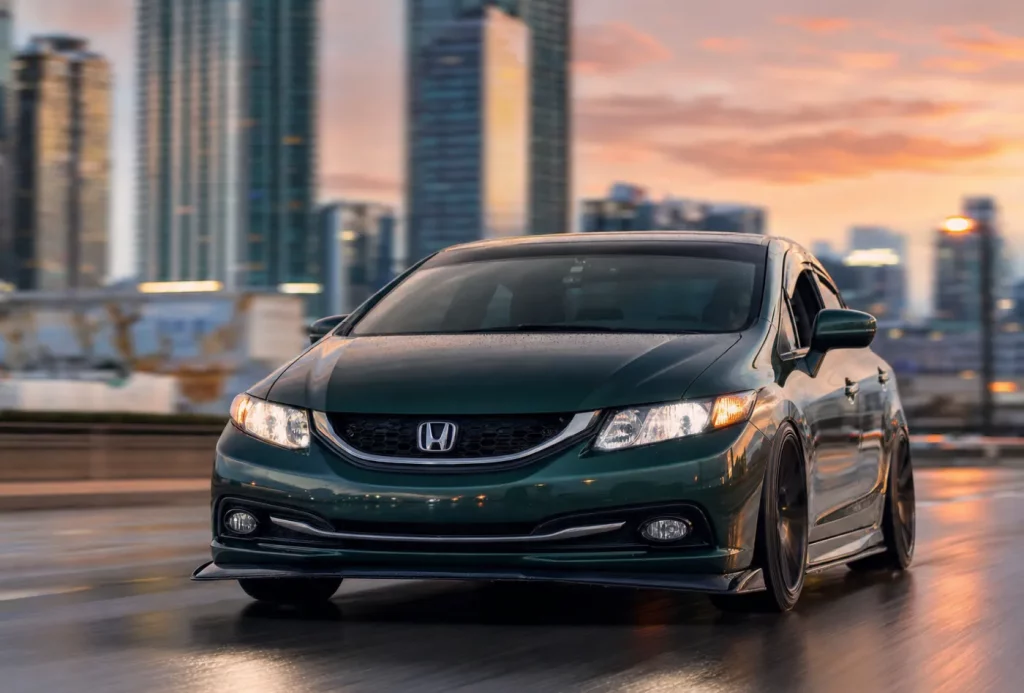
Touring in the 10th Gen Trim Hierarchy
The 10th generation Civic sedan launched in late 2015 with five trim levels, with Touring at the top. The coupe followed the same structure, and the hatchback (introduced for 2017) added a Sport Touring trim above the regular Touring for hatchback buyers. By 2019, the trim structure shifted — the EX-T was dropped, and the turbo engine became available in the new Sport trim and standard in EX-L and Touring.
The MSRP progression for the Touring sedan across its production run was:
| Model Year | Touring MSRP (sedan) | Premium over EX-L | Premium over LX | Notes |
|---|---|---|---|---|
| 2016 | $26,655 | $2,700 | $7,200 | Launch year, no hatchback |
| 2017 | $26,655 | $2,700 | $7,200 | Hatchback Sport Touring introduced |
| 2018 | $27,155 | $2,500 | $7,500 | Minor price increase, volume knob added |
| 2019 | $28,455 | $1,900 | $7,400 | Facelift year, Honda Sensing standard, 18-inch wheels |
| 2020 | $28,455 | $1,900 | $7,400 | Carryover |
| 2021 | $28,655 | $1,900 | $7,500 | Final year, limited production |
Sources: American Honda Motor Co. press releases and model year specifications, 2015-2020.
The hatchback Sport Touring trim followed a slightly different pricing track. It launched at $28,300 for 2017 and climbed to $29,655 by 2021. The hatchback was discontinued after 2021 alongside the coupe as Honda consolidated production for the 11th generation.
What the Touring Added Over the EX-L
The EX-L was already well-equipped: leather seating, power front seats, heated front and rear seats, dual-zone automatic climate control, 7-inch Display Audio with navigation available, and the 1.5-liter turbo engine. The Touring added specific upgrades that targeted buyers who wanted the premium compact experience without stepping up to an Acura ILX or a German competitor.
Exclusive Touring features (not available on any lower trim):
- LED headlights with auto-on/off for both low and high beams — the EX-L and below used projector-beam halogen headlights. IIHS headlight ratings for the 10th generation Civic varied by trim: the Touring’s LED headlights were rated Acceptable to Good depending on model year, while the halogen units on lower trims were consistently rated Poor (IIHS headlight evaluations, 2016-2021).
- 450-watt premium audio system with 10 speakers including a subwoofer — badged as a premium system but branded as Honda, not Bose, with the Bose branding appearing only on 11th generation models. The system was developed in partnership with Bose but carries Honda branding in the 10th generation.
- Rain-sensing windshield wipers with variable intermittent control
- Chrome-plated body-colored door handles (EX-L had body-colored handles without chrome)
- Automatic-dimming rearview mirror with HomeLink (on models with the feature) — EX-L had a manual dimming mirror
- Honda Satellite-Linked Navigation System standard with Honda HD Digital Traffic and voice recognition — EX-L had navigation as an option
- 17-inch alloy wheels for 2016-2018 (unique design), upgraded to 18-inch 10-spoke alloy wheels for the 2019 facelift
- Larger front stabilizer bar (26.5 mm vs. 25.5 mm on EX-T and EX-L) and 17 mm rear stabilizer bar (vs. 16.5 mm)
The Touring also received unique interior trim: the leather-wrapped steering wheel had contrast stitching, and the shift knob was leather-wrapped with a different pattern than the EX-L.
Source: 2016 Honda Civic Sedan Model Comparison and Model Specifications (American Honda Motor Co., 2015); 2019 Civic Sedan press release (American Honda Motor Co., August 2018).
Year-by-Year Changes (2016-2021)
2016: The Touring debuted with all the features described above. Early 2016 models had a high rate of infotainment glitches — screen freezes, slow boot times, and Bluetooth connectivity drops. The touch-only volume slider (no physical knob) was a persistent complaint. Honda released multiple infotainment firmware updates during the 2016 model year, but the hardware was the limiting factor. The subwoofer in the rear deck was prone to rattling at moderate volume levels, and some owners reported amplifier failure within the first year (NHTSA complaints, 2016-2017 Civic).
2017: Minor changes. Honda added acoustic noise-damping materials (laminated front glass, additional sound insulation) to address cabin noise complaints from 2016 models. The infotainment system received a periodic software update but the hardware remained unchanged. The hatchback Sport Touring joined the lineup with a unique rear-end design, a 1.5-liter turbo engine, and the same Touring feature set adapted for the hatchback body style. The Sport Touring hatchback used a different exhaust routing and included a center-exit dual exhaust.
2018: The most important update for the Touring was the addition of a physical volume knob to the 7-inch Display Audio unit — the same update applied to all trims with the 7-inch screen. This addressed the single most common complaint from 2016-2017 owners about the touch slider. Honda also revised the CVT calibration for smoother operation at low speeds. The Touring sedan received a slight MSRP increase to $27,155.
2019 (facelift): The mid-cycle refresh brought visible changes to the Touring:
- Revised front fascia with a new piano black upper wing element, restyled lower grille, and a full-width front splitter
- Updated LED headlight housings with a new internal reflector design
- Updated LED taillight design with a chrome accent on the lower rear bumper
- Larger 18-inch 10-spoke alloy wheels (replacing the 17-inch wheels on 2016-2018 Touring models)
- Honda Sensing became standard across all trims — it was standard on the Touring from launch, but the 2019 model included revised camera and radar calibration
- The sedan Touring continued as the top sedan trim. The hatchback Sport Touring received similar front-end updates with the hatchback-specific rear styling
- Dual chrome exhaust finishers for the sedan
The 2019 refresh also addressed some interior quality complaints. The seat material was revised for better wear resistance, and the leather on the steering wheel used a slightly different grain.
2020: Carryover year with no significant changes. The Civic line continued with the same specifications as the 2019 model year.
2021: The final year of the 10th generation. Honda limited production of the Touring sedan and discontinued the coupe entirely. The hatchback Sport Touring was also discontinued after 2021. The 2021 Touring was the lowest-volume production year of the trim. Honda focused dealer allocations on LX, EX, and Sport trims leading up to the 11th generation launch.
Hatchback Sport Touring vs. Sedan Touring Differences
The hatchback Sport Touring shared the same feature set as the sedan Touring but had specific differences worth noting for used buyers:
The hatchback’s rear cargo area offered 25.7 cubic feet of space with the rear seats up and 46.2 cubic feet with the seats folded — significantly more than the sedan’s 15.1 cubic feet. However, the hatchback Sport Touring had slightly different rear suspension tuning to accommodate the cargo area packaging, and rear visibility was more restricted due to the larger C-pillars and the rear spoiler.
The hatchback also offered a 6-speed manual transmission on lower trims, but the Sport Touring trim was CVT-only. The sedan Touring was also CVT-only. The hatchback Honda Sensing system on the Sport Touring used the same calibration as the sedan.
Weight differences: the 2017 hatchback Sport Touring with CVT weighed approximately 2,994 lbs compared to the 2017 sedan Touring AT approximately 2,923 lbs (Honda technical specifications, 2017 model year).
Known Problems Specific to the Touring Trim
The Touring shares the same L15B7 engine and LL-CVT transmission issues as other 1.5-liter turbo models — fuel dilution, CVT maintenance requirements, and AC Condenser failure — but the premium features add their own failure points.
Premium 450-watt amplifier failure: The 10-speaker premium audio system uses an amplifier mounted in the rear of the vehicle (behind the rear seat on the sedan, in the rear cargo area on the hatchback). The amplifier is known to fail, producing no audio output or intermittent cutting out. This was reported on Cars.com owner reviews and in forum threads (CivicX, 10thCivicForum) with owners documenting dealer replacement costs of $600-$1,200 for the amplifier module alone. Some owners have reported success with used replacement units from salvage vehicles. The amplifier part number changed across model years, so verify compatibility before purchasing a used unit.
Subwoofer rattle (2016-2018): The rear deck subwoofer on the sedan Touring is prone to rattling at moderate volume levels. The issue is mechanical — the plastic rear deck mounting points flex and contact the rear window glass. Honda issued a dealer fix involving foam padding and reinforced mounting brackets, but some owners report the fix only partially resolves the issue (CivicX forum, multiple threads 2016-2020). The hatchback Sport Touring has the subwoofer mounted differently and does not share this specific issue.
LED headlight replacement cost: The Touring’s LED headlights are sealed units that require full housing replacement when individual LEDs fail. Replacement cost at a Honda dealer is approximately $1,200-$2,000 per side depending on the model year and labor, based on owner-reported figures from CivicX forum posts (2020-2025). Unlike halogen housings where a bulb costs $15-$30, the Touring’s LED assembly has no serviceable components. Some owners have reported moisture ingress in early 2016 LED housings.
Moonroof frame failure and drainage blockage: The moonroof on the Touring (standard on EX and above) shares the same design as lower trims, but the Touring’s additional weight from sound deadening and the glass panel means the moonroof frame is under slightly more stress. Drainage tubes can clog, leading to water entry into the headliner. A moonroof repair (frame replacement, not just drain cleaning) can cost $1,300-$1,800 (CivicX forum, 2018 thread documenting $1,365 repair). This affects all trims with moonroofs, but the severity is comparable across EX, EX-L, and Touring.
Rain-sensing wiper sensor failure: The rain-sensing wiper module is mounted on the windshield behind the rearview mirror. The sensor can fail or lose calibration, causing erratic wiper behavior — wiping too fast on light mist or not activating during moderate rain. Replacement cost is approximately $300-$500 for the sensor plus calibration at a dealer. This is a Touring-specific failure point; no other trim has rain-sensing wipers.
Automatic-dimming mirror delamination (2016-2018): The electrochromatic element in the automatic-dimming rearview mirror can develop bubbles or discoloration at the edges, particularly in hot climates. Replacement cost at a dealer is $250-$500. Aftermarket mirrors that retain the HomeLink functionality cost approximately $150-$300.
Navigation system map updates: The Honda Satellite-Linked Navigation System in the Touring uses MAP data that Honda updates approximately once per year. After the first year, map update subscriptions cost approximately $99-$149 per update. Many used Touring models on the market in 2026 are running maps that are 3-6 years out of date. The system still provides routing, but points of interest and road changes will be missing. Apple CarPlay and Android Auto (available on all trims with the 7-inch display) provide real-time navigation through the phone, making the built-in navigation less critical for most buyers.
CVT maintenance at higher mileage: While this affects all 10th gen CVT models, the Touring’s additional weight (heavier sound deadening, 18-inch wheels and tires on 2019-2021, moonroof, power seats) places slightly more load on the LL-CVT. The CVT fluid should be changed every 30,000-40,000 miles under severe driving conditions. On Touring models approaching 80,000-100,000 miles with no documented CVT fluid changes, the risk of valve body wear and belt slip is elevated. Replacement cost at a dealer is $3,800-$5,500.
2019+ 18-inch wheel and tire costs: The facelift Touring’s 18-inch wheels use 235/40R18 tires, which are more expensive than the 215/50R17 tires on lower trims. A set of four quality all-season tires for the 18-inch wheels costs approximately $700-$1,000 vs. $500-$700 for the 17-inch size. Replacement wheels from Honda cost $400-$600 each.
Used Market Pricing for 2016-2021 Touring Models (2026)
The Touring commands a premium on the used market because it is the highest spec available. However, the depreciation curve is steeper than the EX and EX-L because the premium features lose value faster than the base platform.
| Model Year | Typical Used Price (2026) | Typical Mileage | Premium over EX-L | Best Model Year Value |
|---|---|---|---|---|
| 2016 | $13,500-$16,500 | 80k-100k | $1,000-$2,000 | Weak — infotainment, no volume knob, highest problem rate |
| 2017 | $14,500-$17,500 | 70k-90k | $1,000-$2,000 | Middle ground, better NVH than 2016 |
| 2018 | $16,000-$19,000 | 60k-80k | $1,500-$2,500 | Strong — volume knob, most refined pre-facelift model |
| 2019 | $18,000-$21,500 | 50k-70k | $2,000-$3,000 | Good — facelift, 18-inch wheels, updated styling, standard Honda Sensing |
| 2020 | $19,500-$23,000 | 40k-60k | $2,500-$3,500 | Best value — lowest depreciation of any year, same car as 2019 |
| 2021 | $22,000-$26,000 | 25k-45k | $3,000-$4,000 | Premium — final year, lowest volume, still under factory warranty |
Sources: Kelley Blue Book Fair Purchase Price estimates, 2026 market data; listing aggregation from Cars.com and Autotrader, 2026.
The 2018 Touring represents the best value in the pre-facelift range for the volume knob fix and Honda Sensing standard availability. The 2020 Touring is the strongest buy in the facelift range because it has the same specifications as the 2019 and 2021 at a lower price than the 2021, and it avoids the limited-production premium of the final year.
Should a Used Buyer Pay the Touring Premium?
The Touring’s used premium over an equivalent EX-L typically ranges from $1,500 to $3,500 depending on the model year. In exchange, the buyer gets LED headlights, a premium audio system, rain-sensing wipers, navigation, and 18-inch wheels (2019+). The question is whether those features hold value.
LED headlights: The most compelling argument for the Touring. The LX/EX halogen units were rated Poor by IIHS, and the Touring’s LED units were rated Acceptable to Good. This is a meaningful safety upgrade, not just a cosmetic one. However, the repair cost ($1,200-$2,000 per housing if an LED fails) is a risk to factor in.
Premium audio: The 450-watt system sounds better than the 180-watt system in lower trims, but the amplifier failure rate and subwoofer rattle suggest the system’s reliability is below average. A buyer who values audio quality should budget for potential amplifier replacement.
Navigation: Redundant with Apple CarPlay and Android Auto, which work on the same screen in lower trims. This feature alone should not justify the Touring premium.
Rain-sensing wipers, auto-dimming mirror, and chrome handles: Convenience features that add livability but do not significantly affect resale value or safety.
The Touring makes the most sense for a buyer who plans to keep the car for 5+ years, prioritizes LED headlight performance, and can absorb the higher maintenance costs of the premium features. For a buyer looking for the most reliable long-term 10th gen Civic experience, an EX-L with aftermarket LED upgrades and aftermarket sound deadening will cost significantly less and avoid the Touring-specific failure points.
Touring vs. Competitors in the Same Price Range
A 2018-2020 Civic Touring at $16,000-$23,000 competes with several near-luxury and fully loaded compact options:
2018-2020 Mazda3 2.5L Premium ($16,000-$21,000): The Mazda3’s top trim includes a 12-speaker Bose system, LED headlights (standard on all 2019+ trims), a head-up display, and a more upscale interior with soft-touch materials throughout. The Skyactiv-G 2.5L engine (186 HP, 186 lb-ft) produces more torque than the Civic Touring and avoids the fuel dilution issue entirely. The rear seat is tighter, and the infotainment system lacks touchscreen functionality, but the interior quality and reliability record are strong arguments for the Mazda.
2018-2020 Toyota Corolla XSE ($15,000-$19,000): The 2019+ Corolla XSE includes LED headlights, a 8-speaker JBL audio system on the higher trims, a digital instrument cluster, and the Toyota Safety Sense 2.0 suite standard. The 2.0L Dynamic Force engine (169 hp, 151 lb-ft) is naturally aspirated and reliable, and the Corolla’s CVT has a physical first gear for smoother launches. The interior is not as premium as the Touring, and the infotainment system does not support Android Auto until 2020.
2017-2019 Acura ILX Premium ($15,000-$20,000): The ILX is mechanically similar to the Civic (same Civic-based platform, same K24Z7 engine producing 201 hp from the 9th gen Si), but includes Acura’s premium interior, LED headlights, ELS audio on higher trims, and a dual-clutch automatic transmission. The ILX has more rear seat room than the Civic Touring and a better reliability record than the Civic’s 1.5T. The ILX uses the older 9th generation platform, so the chassis is less rigid than the 10th gen Civic.
2018-2020 Honda Civic Si ($18,000-$22,000): The Si offers the L15B7 engine with a larger turbo, a 6-speed manual with rev-matching, an LSD, and sport-tuned suspension — more driver engagement than the Touring but with a harsher ride and no premium audio or LED headlights. The Si retains the halogen headlights and 8-speaker audio system of the EX.
Quick-Reference Checklist
☐ The Touring was the top 10th gen trim from 2016-2021; the coupe was discontinued after 2020, the hatchback after 2021
☐ Exclusive Touring features: LED headlights (full LED low/high), 450W 10-speaker audio, rain-sensing wipers, 17-inch (2016-2018) or 18-inch (2019-2021) wheels, navigation standard, auto-dimming mirror
☐ The Touring does NOT have Bose-branded audio in the 10th generation — the premium system uses Honda-branded amplifier and speakers (Bose branding arrived with the 11th gen)
☐ The 2016 Touring has the worst infotainment experience (no volume knob, slow screen, amplifier failures) — avoid unless priced accordingly
☐ The 2018 Touring is the best pre-facelift year: volume knob added, Honda Sensing standard, revised CVT calibration
☐ The 2019 facelift brought new front/rear styling, 18-inch wheels, updated LED headlights, and revised interior materials
☐ The 2020 Touring is the best value in the facelift range — same car as 2019 and 2021 at a lower price, no last-year premium
☐ LED headlight replacement costs $1,200-$2,000 per side — the most expensive single repair on a used Touring
☐ Premium audio amplifier failure is documented across all model years — budget $600-$1,200 for replacement
☐ Subwoofer rattle on the rear deck is a known issue on sedan Touring models (2016-2021) — verify before purchase
☐ Moonroof drain blockages can cause interior water damage — check for headliner stains
☐ The Touring shares the L15B7 fuel dilution issue and LL-CVT maintenance requirements with all 1.5T models
☐ 235/40R18 tires (2019+) cost $200-$250 more per set than the 215/50R17 tires on lower trims
☐ Typical used price range: $13,500 (2016, 80k-100k miles) to $26,000 (2021, 25k-45k miles)
☐ The Touring premium over an equivalent EX-L is $1,500-$3,500 — the value depends on how much LED headlights matter to the buyer