

The 10th generation Honda Civic (2016-2021) marked the return of the hatchback body style to the US market for the first time since 2005. It also introduced turbocharged engines as standard across much of the lineup, a ground-up platform with sharper styling, and the first Civic Type R sold in America. The sedan and hatchback shared the same Wheelbase (106.3 inches) and the same powertrain options — but they were not the same car in practice. Buyers who chose between them without understanding the trade-offs often ended up with regrets. This article covers the five most common ones, based on owner reports from CivicX.com, Reddit r/Civic, and Honda enthusiast forums.
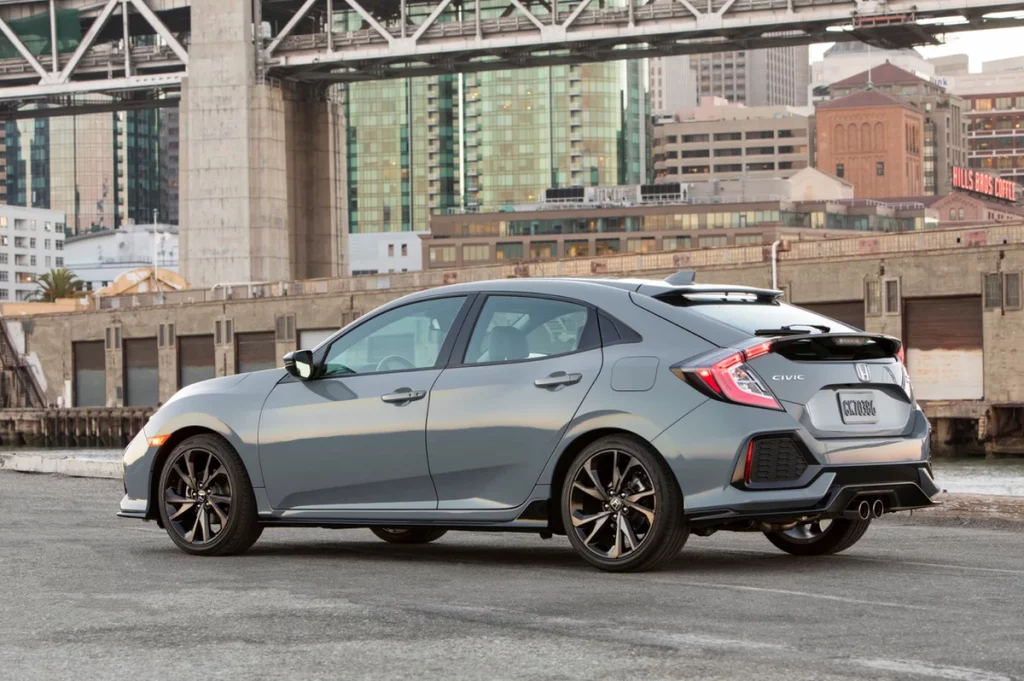
All specifications are from Honda Newsroom press releases, Car and Driver testing, and EPA fuel economy data. The 10th gen covered the 2016-2021 model years. A mid-cycle refresh for 2020 updated the front and rear styling, the infotainment system, and added Honda Sensing as standard equipment across the lineup.
Sedan vs Hatchback — The Real Differences
| Specification | 10th Gen Sedan | 10th Gen Hatchback |
|---|---|---|
| Wheelbase | 106.3 in | 106.3 in |
| Overall Length | 182.3 in (2016-2019) / 182.7 in (2020-2021) | 175.1 in (2016-2019) / 177.9 in (2020-2021) |
| Width | 70.8 in | 70.8 in |
| Height | 55.7 in | 56.5 in (2016-2019) / 56.8 in (2020-2021) |
| Curb Weight (base) | 2,742-2,770 lbs | 2,811-2,845 lbs |
| Cargo Volume | 14.7 ft³ (trunk) | 22.6-25.7 ft³ (rear up), 46.2 ft³ (folded) |
| Rear Legroom | 37.3 in | 37.4 in |
| Available Engines | 2.0L K20C2 (158 hp), 1.5T L15B7 (174 hp), Si 1.5T (205 hp) | 1.5T L15B7 (174 hp), Si 1.5T (205 hp), Type R K20C1 (306 hp) |
Sources: Honda Newsroom (2016 Civic Sedan specifications, 2016 Civic Hatchback specifications, 2020 Civic Sedan update, 2020 Civic Hatchback update).
Regret #1: Choosing the Wrong Body Style for Your Actual Hauling Needs
The sedan’s trunk (14.7 cubic feet) is competitive among compact sedans, but the hatchback’s cargo area is in a different class — 22.6 cubic feet with the rear seats up on pre-refresh models, expanding to 46.2 cubic feet with the seats folded. The hatchback carried a utility advantage that made it effectively a compact station wagon in all but name. Buyers who chose the sedan for its more traditional proportions and lower price often discovered within the first year that they could not fit large items — an IKEA bookshelf, a mountain bike with the front wheel removed, or luggage for a family of four on a road trip.
The trade-off for the hatchback’s utility was reduced rear visibility (the hatchback’s rear pillars are thick, and the rear window sits higher), more pronounced road noise in the cargo area (the open hatch transmits more sound to the cabin), and a $1,000-$1,500 higher starting price for equivalent trim levels. The hatchback also sat 0.8-1.1 inches taller than the sedan, which gave it a slightly more upright driving position but marginally reduced stability AT highway speeds (not measurable in real-world driving). Source: CivicX.com owner survey (2016-2021 model years).
Regret #2: Buying the 2.0L Base Engine Thinking It Was “Enough”
The 10th gen base engine — the K20C2 2.0-liter naturally aspirated inline-four (158 horsepower, 138 lb-ft) — is a reliable but slow engine. Car and Driver tested a 2016 Civic LX sedan (2.0L CVT) at 8.2 seconds to 60 mph and 16.3 seconds in the quarter-mile at 86 mph. The same car with the 1.5-liter turbo L15B7 (174 horsepower, 162 lb-ft) tested at 7.2 seconds to 60 mph and 15.5 seconds at 91 mph — a full second quicker. The difference is immediately noticeable in everyday driving: merging onto highways, passing on two-lane roads, or climbing mountain grades with the A/C running.
Buyers who chose the 2.0L engine to save approximately $1,500-$2,000 on the purchase price (or to avoid the 1.5T’s early Oil dilution concerns) frequently reported regretting the decision. The 2.0L engine also gets worse fuel economy in real-world driving (approximately 30-32 mpg combined vs 33-35 combined for the 1.5T) because it needs to work harder to maintain speed. The 2.0L is not suitable for performance modifications — it has a cast-iron cylinder liner and a significantly different ECU architecture than the 1.5T, with essentially no aftermarket tuning support. The 2.0L’s only real advantages are bulletproof reliability (no direct-injection carbon buildup issues) and the ability to run on 87-octane fuel without any power loss.
Sources: Car and Driver (2016 Honda Civic LX tested, 2016 Honda Civic EX-T tested), EPA fueleconomy.gov, CivicX.com owner database.
Regret #3: Buying a 2016-2018 Without Understanding the Oil Dilution Issue
The 1.5-liter turbocharged engine in 2016-2018 Honda Civics had a documented oil dilution problem: unburned fuel would accumulate in the crankcase, raising the oil level above the fill mark and reducing the oil’s lubricating properties. The issue was most pronounced in colder climates with short-trip driving, where the engine would not reach full operating temperature long enough to evaporate the fuel from the oil. NHTSA logged over 1,500 complaints for this across the 1.5T Civic and CR-V for the 2016-2018 model years.
Honda issued Technical Service Bulletin 18-062 in 2018, which included a revised ECU calibration (revised fuel injection timing during cold starts and warmup) and, on some affected vehicles, a replacement of the A/C control unit and the heater hoses to bring the engine to operating temperature faster. Owners who had the update applied reported significant reduction in fuel odor and oil dilution rates. The hardware revisions carried into the 2019 model year, making 2019+ 1.5T Civics the safer recommendation for used buyers.
Owners who did not know about this issue before buying a 2016-2018 1.5T — or who bought a 2016-2018 and lived in a cold climate — frequently regretted the purchase. The long-term engine wear implications remain debated, but the psychological impact of smelling fuel in the oil every time you check the dipstick is hard to ignore. Source: NHTSA complaint data (2016-2020 Civic), Honda TSB 18-062, CivicX.com oil dilution thread database.
Regret #4: Not Understanding How Fast the Si and Type R Actually Are — or Aren’t
The regret that appears most often is buying the Si expecting Type R levels of grip and braking. The Si shares the same LSD architecture, but its brakes are 12.3-inch single-Piston front units with significantly less thermal capacity, and its Michelin all-season tires (on non-summer-tire cars) produce approximately 0.86-0.89 g on the skidpad. The opposite regret — buying a Type R and daily-driving it on rough urban streets — also appears frequently. The Type R’s adaptive dampers in +R mode are genuinely harsh, the 20-inch wheels on 30-series tires are susceptible to pothole damage ($350-400 per tire), and the aggressive styling attracts unwanted attention.
The cost gap between a used 10th gen Si ($20,000-$27,000) and a used 10th gen Type R ($35,000-$42,000) in 2025 is approximately $10,000-$20,000. That buys significantly more track capability but also significantly higher running costs. Buyers should test both on their actual daily commute before committing. Source: Car and Driver (2020 Si tested, 2017 Type R tested), Bring a Trailer completed sales (2025).
Regret #5: Choosing a 2020+ Model for the Wrong Reasons
The 2020 mid-cycle refresh brought revised front and rear bumpers (the front grille was reshaped with a larger lower intake), a new 7-inch touchscreen with physical volume knob (replacing the hated capacitive slider), Honda Sensing as standard equipment (adaptive cruise control, lane-keeping assist, collision mitigation braking, road departure mitigation), and revised suspension tuning for the Si. These were genuine improvements, but they also made the early (2016-2018) cars more attractive on the used market — lighter, simpler, and less expensive.
The regret is not buying a refreshed car; it is buying a 2020 or 2021 model without understanding that the sedan gained 0.4 inches in length, the hatchback gained 2.8 inches in length, and the hatchback’s cargo volume actually increased from 22.6 cubic feet to 25.7 cubic feet. Buyers who specifically wanted the pre-refresh styling (which many owners consider more aggressive and distinctive) sometimes picked a refreshed car and regretted the more conservative front-end appearance. Conversely, buyers who wanted Honda Sensing as standard sometimes bought a 2019 or earlier car assuming they could add it later — which they could not.
If you prefer the pre-refresh styling, buy a 2017-2019. If you want the updated infotainment and standard Honda Sensing, buy a 2020-2021. If you want to avoid the oil dilution concern entirely, buy a 2019+ 1.5T or a 2.0L. Source: Honda Newsroom (2020 Civic Sedan/Hatchback updates), CivicX.com owner discussions.
10th Gen Engine and Fuel Economy Reference
| Engine | Horsepower | Torque | Transmission | EPA MPG (City/Hwy/Comb) | 0-60 (C&D) |
|---|---|---|---|---|---|
| 2.0L K20C2 | 158 hp @ 6,500 rpm | 138 lb-ft @ 4,200 rpm | CVT | 30/38/33 (CVT) | 8.2 sec |
| 1.5T L15B7 | 174 hp @ 6,000 rpm | 162 lb-ft @ 1,700 rpm | CVT / 6MT (Sport hatch) | 31-33/38-42/34-36 (CVT) | 7.2 sec |
| Si L15CA | 205 hp @ 5,700 rpm | 192 lb-ft @ 2,100 rpm | 6-speed manual | 26/36/30 | 6.3-6.4 sec |
| Type R K20C1 | 306 hp @ 6,500 rpm | 295 lb-ft @ 2,100 rpm | 6-speed manual | 22/28/25 | 5.1 sec |
Sources: Honda Newsroom specifications, EPA fueleconomy.gov, Car and Driver (2016 LX 2.0L, 2016 EX-T 1.5T, 2020 Si, 2017 Type R tested).
Quick Reference — Avoiding 10th Gen Buyer Regrets
☐ Need cargo space? Buy the hatchback (25.7 ft³ seats up, 46.2 ft³ folded) — the sedan’s 14.7 ft³ trunk will frustrate you
☐ The 2.0L base engine is slow (8.2 sec 0-60, 158 HP) and not modifiable — buy the 1.5T (174 hp, 7.2 sec) or Si (205 hp, 6.4 sec)
☐ 2016-2018 1.5T engines have oil dilution risk — verify TSB 18-062 was applied, or buy 2019+
☐ 2016-2018: no Honda Sensing standard, capacitive volume slider on infotainment (widely disliked)
☐ 2020-2021: updated bumpers, Honda Sensing standard, physical volume knob, revised Si suspension
☐ Si resale value is strong (~65-70% retained after 3 years) — claims of “losing 80%” are false
☐ Type R (FK8) = track car for daily drivers. Brembo pads dust heavily, 20-inch wheels are pothole-prone, +R mode is harsh on streets
☐ Si = enthusiast daily driver. 205 hp, Helical LSD, 6-speed manual. Not a Type R — do not expect Type R braking or grip
☐ The sedan is 6.6-7.2 inches shorter than the hatchback (depending on year) — the hatchback is not a smaller car
☐ The hatchback is available with a 6-speed manual on the 1.5T Sport trim — one of the only manual non-Si Civics of this generation
☐ If you commute in cold weather with short trips, the 2.0L NA avoids the 1.5T oil dilution issue entirely
☐ The 2016-2019 hatchback has 22.6 ft³ cargo; the 2020+ hatchback has 25.7 ft³ — the refresh added 3.1 ft³
☐ Si sedan: 0-60 in 6.4 sec, quarter-mile 14.9 @ 93 (C&D). Si coupe: 0-60 in 6.3 sec (C&D). The coupe is slightly quicker due to lower weight
☐ Type R: 0-60 in 5.1 sec, quarter-mile 13.7 @ 104 (C&D), skidpad 0.97 g, braking 70-0: 156 ft
☐ No 10th gen Civic (including Si or Type R) is rear-wheel drive all Civics are front-wheel drive