

I bought my first Civic in 2008. I was twenty years old, the economy was collapsing, gas prices were climbing past $4 a gallon, and I needed a car that would start every morning and not ask questions. I found a Galaxy Gray 2006 Civic LX sedan on a used lot in Texas. It had 62,000 miles on it. The previous owner was a sales rep who spent his life on I-35 between Austin and Dallas. The car looked tired but honest. I paid $11,500 and drove it home.
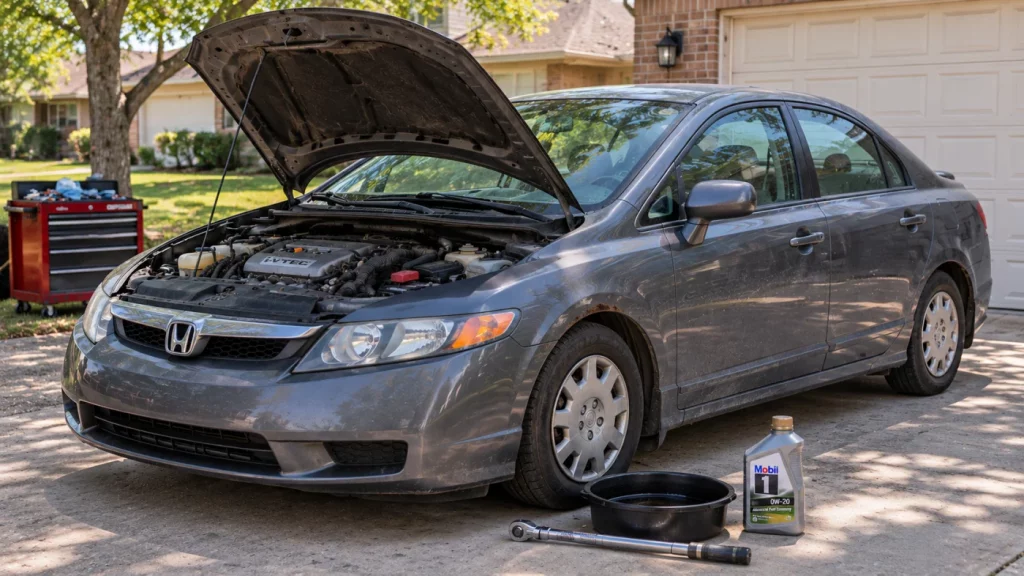
Ten years later, I sold that same car with 180,000 miles on the odometer. It was still running. It was still starting every morning. And in those ten years, I learned more about the R18 engine than I ever expected to — not from forums, not from YouTube, but from my own driveway, my own tools, and my own mistakes.
This is not a review of the R18. This is not a reliability ranking. This is what actually happened to one 2006 Civic LX over 118,000 miles of my ownership — what broke, what didn’t, what I got wrong, and what I would do differently if I were buying the same car today.
The R18A1 in the 8th-gen Civic (2006–2011) is a reliable but not indestructible engine. It uses a Timing Chain, not a belt, which reduces major service intervals. Common issues after 100,000 miles include oil consumption, coolant leaks from porous engine blocks (covered by an extended warranty in some cases), failing engine mounts, and worn suspension components. The engine itself is simple, cheap to maintain, and forgiving of minor neglect — but it is not immune to age. At 180,000 miles, the car is only as reliable as the maintenance history behind it. Prioritize cooling system condition, oil consumption history, and mount condition when buying used.
1. Why I Bought an LX and Not an EX or Si
In 2008, I had three choices in front of me. The EX had a sunroof, alloy wheels, and a better stereo. The Si had a 197-horsepower K20 and a six-speed manual. The LX had steel wheels, hubcaps, and a 140-horsepower R18.
I chose the LX because I was twenty years old and insurance on an Si would have cost me more per month than the car payment. I chose the LX because I wanted a commuter, not a project. I chose the LX because the R18 had a timing chain instead of a Timing Belt — and at that point in my life, I did not want to think about a $600 service every 90,000 miles.
What I did not know then was that the LX would teach me more about Honda ownership than any Si ever could. Because the LX is not exciting. It is not fast. It does not reward you for pushing it. It just runs. And because it just runs, you stop paying attention. And when you stop paying attention, things wear out quietly.
That is the trap of a reliable car. It does not ask for attention until it is too late.
| Specification | 2006 Civic LX | 2006 Civic EX | 2006 Civic Si |
|---|---|---|---|
| Engine | R18A1 1.8L SOHC i-VTEC | R18A1 1.8L SOHC i-VTEC | K20Z3 2.0L DOHC i-VTEC |
| Horsepower | 140 hp | 140 hp | 197 hp |
| Torque | 128 lb-ft | 128 lb-ft | 139 lb-ft |
| Transmission | 5-speed manual or 5-speed automatic | 5-speed manual or 5-speed automatic | 6-speed manual |
| Timing | Chain | Chain | Chain |
| Fuel economy (combined) | 29–33 mpg | 29–33 mpg | 22–26 mpg |
| Insurance cost (2008, 20-year-old driver) | Lowest | Moderate | Highest |
The R18A1 is a 1.8-liter single-overhead-cam engine with i-VTEC. But unlike the performance VTEC engines that Honda built its reputation on, the R18’s VTEC system is designed for fuel economy, not power. It runs on a low-lift cam profile at low RPM and switches to a high-lift profile at higher RPM for efficiency. It is not a performance engine. It was never meant to be.
What it was meant to be was a simple, durable, efficient commuter engine. And for the most part, it was.
2. Day-One Spec Check — What I Should Have Looked At
When I bought the car in 2008, I did what most twenty-year-olds do. I checked the oil. I checked the Coolant. I took it for a test drive. I looked at the Carfax. I asked for service records. The seller had some. I bought the car.
What I did not check was the thermostat. I did not check the water pump. I did not check the PCV valve. I did not check the engine mounts. I did not check the condition of the coolant itself — just the level. I did not know that the 2006 Civic had a known issue with porous engine blocks that could develop coolant leaks. I did not know that the R18 was prone to oil consumption as it aged. I did not know that the passenger-side hydraulic Engine Mount was a wear item that would fail before 100,000 miles.
None of those things mattered AT 62,000 miles. But they mattered later.
If you are buying an 8th-gen Civic today, here is what I would check before you hand over money:
Coolant Condition and Level
Look at the coolant in the reservoir. It should be blue (Honda Type 2). If it is brown or low, there may be a leak. Check for the sweet smell of coolant around the engine bay.
Oil Consumption History
Ask the seller how much oil the car uses between changes. If they do not know, that is a red flag. The R18 can consume oil after 100,000 miles.
Engine Mount Condition
With the car idling in Drive, feel for excessive vibration. A failed passenger-side mount is common and causes a rough idle.
Suspension Noise
Drive over bumps and listen for clunks or rattles. Struts, Sway Bar links, and strut mounts are all wear items on this generation.
Timing Chain Noise
Listen for a rattle on cold start. The R18 uses a chain, but the tensioner can wear. A rattling chain is a warning sign.
Valve Cover Leaks
Check for oil seepage around the valve cover Gasket and the VTEC solenoid. These are common leak points.
3. The Routine That Kept It Alive
I am not going to pretend I was a perfect owner. I was not. I skipped things. I procrastinated. I learned lessons the hard way. But the things I did right kept the car on the road for 180,000 miles.
Oil changes: I changed the oil every 5,000 miles with 0W-20 synthetic. Honda specifies 0W-20 for the R18, and I stuck with it. I used whatever name-brand synthetic was on sale at AutoZone or Advance Auto Parts. I did not use mineral oil. I did not stretch intervals. This is the single most important thing you can do for an R18.
Valve adjustments: The R18 uses solid lifters, which means valve clearance needs to be checked and adjusted periodically. Honda recommends checking every 110,000 miles. I did mine at 120,000. The exhaust valves were tight. I adjusted them back to spec. The engine idled smoother afterward. Most owners never do this. Most owners are fine. But if you want the engine to last, do it.
Spark plugs: I replaced them at 100,000 miles with NGK iridium plugs. The old ones looked fine. The new ones made no noticeable difference. But it is cheap insurance.
Coolant: I replaced the coolant at 100,000 miles with Honda Type 2. I should have done it earlier. The old coolant was dark. The new coolant was blue. The difference mattered when I started chasing leaks.
Transmission fluid: My car had the five-speed automatic. I drained and filled the transmission fluid every 30,000 miles with Honda ATF-Z1. This is not a flush. It is a simple drain and fill. It takes about three quarts. It costs about $30. It is the easiest thing you can do to extend the life of a Honda automatic.
What I skipped: I skipped the Brake Fluid flush. I skipped the power steering fluid flush. I skipped the cabin air filter more than once. None of these caused a catastrophic failure, but they are all things I would do differently now.
Pro tip: The R18 is forgiving, but it is not maintenance-free. The owners who get 200,000+ miles out of these engines are the ones who change the oil on time, check the coolant, and do not ignore small noises. The ones who treat it like an appliance and never open the Hood are the ones who end up with a cracked block at 130,000 miles.
4. Timeline of What Broke — The Real Story
This is the part that matters. Not the spec sheet. Not the marketing. The actual breakdowns, the actual repairs, and the actual lessons.
78,000 Miles — The Thermostat
It was January 2010. I was driving to work on a cold morning. The heater was blowing cold air. The temperature gauge was climbing. I pulled over, popped the hood, and saw that the coolant reservoir was full. The upper radiator hose was hot. The lower hose was cold. That told me the thermostat was stuck closed.
I drove home with the heater on full blast to keep the engine cool. I ordered a new thermostat and gasket from AutoZone for $30. I drained the coolant, replaced the thermostat, refilled with Honda Type 2, and bled the system. It took about an hour. The problem was solved.
If I had taken it to a shop, it would have cost $250–$300. If I had ignored it, the engine would have overheated and I would have been looking at a Head Gasket job.
Lesson: The cooling system is the first weak point on the R18. The thermostat is a $30 part. Replace it every 60,000–80,000 miles as preventive maintenance. Do not wait for it to fail.
95,000 Miles — The Water Pump
A few months later, I started hearing a whine from the engine bay. It was subtle at first. It got louder over a few weeks. Then I noticed a small puddle of coolant under the car. I looked at the Water Pump and saw coolant seeping from the weep hole.
The water pump on the R18 is driven by the timing chain. It is not an easy job, but it is not impossible. I ordered a new water pump and tensioner from RockAuto for $120. I spent four hours in my driveway replacing it. The hardest part was getting the timing chain back on correctly. I used a service manual and took my time.
If I had taken it to a shop, it would have cost $400–$500. If I had ignored it, the pump would have seized, the timing chain would have jumped, and the engine would have been destroyed.
Lesson: The water pump on the R18 is a known wear item. Replace it preventively at 90,000–100,000 miles. Do it at the same time as the timing chain inspection. Do not wait for it to fail.
120,000 Miles — The Struts
By 2013, the car was floating over bumps. It was bouncy. It was vague. It was eating tires. I knew the struts were original. I knew they were done.
I ordered a set of KYB Excel-G struts and mounts from Amazon for $400. I replaced all four corners in my driveway over a weekend. It took about four hours per corner because I was learning as I went. The difference was night and day. The car felt planted again. The bounciness was gone.
If I had taken it to a shop, it would have cost $900–$1,000. If I had ignored it, I would have worn out a set of tires every year.
Lesson: Suspension is not a lifetime component. Struts, shocks, and mounts wear out. On the 8th-gen Civic, plan on replacing them every 100,000–120,000 miles.
130,000 Miles — Oil Consumption
I noticed the oil level was dropping between changes. Not a lot. About a quart every 1,500 miles. There was no smoke. There was no leak. The engine ran fine. But it was using oil.
I replaced the PCV valve for $30. It helped a little. I switched from 0W-20 to 5W-30. It helped a little more. I started checking the oil every 1,000 miles and topping it off as needed. The consumption stabilized at about a quart every 2,000 miles.
I did not rebuild the engine. I did not replace the rings. I just managed it. And the car kept running.
Lesson: Oil consumption after 120,000 miles is common on the R18. It is not necessarily a death sentence. Check the PCV valve first. Switch to a thicker oil if needed. Monitor the level and top it off. If consumption gets worse, then you are looking at rings or valve seals.
155,000 Miles — The VTEC Solenoid
One day the check engine light came on. The code was P1259 — VTEC system malfunction. The car lost power above 4,000 RPM. It felt like the VTEC system was not engaging.
I removed the VTEC solenoid, cleaned the screen, and replaced the gasket. The screen was clogged with sludge. After cleaning, the code cleared and the power returned. The whole job took an hour and cost $40 in parts.
Lesson: The VTEC solenoid screen on the R18 can clog over time. Clean it every 100,000 miles. It takes 30 minutes and costs almost nothing. If you ignore it, you will lose VTEC engagement and power.
165,000 Miles — Suspension Refresh
The car was clunking over bumps again. The steering felt vague. The tires were wearing unevenly. I knew what it was. The sway bar links, Tie Rod ends, and ball joints were all original. They were done.
I replaced all of them — sway bar links, tie rod ends, ball joints — for about $300 in parts. It took me six hours in the driveway. The car felt tight again. The clunks were gone. The steering was sharp.
Lesson: After 150,000 miles, plan on a full suspension refresh. Bushings, links, ball joints, tie rod ends — they all wear out. Doing them all at once is easier than doing them one at a time.
| Mileage | What Broke | DIY Cost | Shop Cost | Time |
|---|---|---|---|---|
| 78,000 | Thermostat | $30 | $250–$300 | 1 hour |
| 95,000 | Water pump | $120 | $400–$500 | 4 hours |
| 120,000 | Struts (all four) | $400 | $900–$1,000 | 8 hours |
| 130,000 | Oil consumption | $30 (PCV) | N/A | 30 minutes |
| 155,000 | VTEC solenoid | $40 | $150–$200 | 1 hour |
| 165,000 | Suspension refresh | $300 | $800–$1,000 | 6 hours |
5. The Myth of the Bulletproof R18
There is a myth in the Honda community that the R18 is unkillable. That it will run forever. That you can neglect it and it will still start every morning.
That myth is partly true. The R18 is a simple, durable engine. It is forgiving. It tolerates neglect better than most. But it is not indestructible. And the 8th-gen Civic has some specific weaknesses that every owner should know about.
What is true: The R18 is cheap to maintain, easy to work on, and has a timing chain instead of a belt. It does not have the oil sludge problems of some other engines. It does not have the head gasket issues of the D-Series. It is a fundamentally sound design.
What is a myth: The idea that the R18 never needs attention. It does. The cooling system is a weak point. The engine mounts fail. The suspension wears out. Oil consumption is common after 120,000 miles. The VTEC solenoid screen clogs. None of these are catastrophic, but they are all things that require attention.
The porous block issue: Some 2006–2008 R18 engines developed coolant leaks from porous castings in the engine block. Honda extended the warranty on affected cars. If you are buying an 8th-gen Civic, check the VIN for open recalls and warranty extensions. If the block is leaking, it needs to be addressed. If it is not leaking, it may never leak. But it is something to be aware of.
Important: The R18 is not bulletproof. It is reliable. There is a difference. A reliable engine will give you warning signs before it fails. A bulletproof engine never fails. The R18 gives you warning signs — coolant leaks, oil consumption, noises, vibrations. If you pay attention to those signs, the engine will last a long time. If you ignore them, it will fail just like any other engine.
6. What Did NOT Break — The Surprises
At 180,000 miles, some things on my Civic were still original. That surprised me. I expected more things to fail.
The alternator: Original. Still charging at 14.2 volts when I sold the car.
The starter: Original. Still cranking strong.
The radiator: Original. No leaks. No cracks. Still cooling the engine properly.
The fuel pump: Original. No issues. No noise. No hesitation.
The ignition coils: Original. No misfires. No codes.
The exhaust system: Original. No rust-through. No leaks. The muffler was still solid.
The manual transmission (on cars equipped with it): I had the automatic, but the five-speed manual in these cars is known to be durable. The automatic, with regular fluid changes, is also capable of high mileage.
That is the thing about Hondas. The major components are overbuilt. The Alternator, the starter, the radiator, the fuel pump — they last a long time. It is the wear items — the mounts, the struts, the bushings, the thermostat, the water pump — that fail.
If you are buying a used 8th-gen Civic, pay attention to the wear items. The major components are usually fine.
7. What I Would Do Differently in 2008
If I could go back and buy that same car again, here is what I would do differently.
I would check the coolant more carefully. I would look at the color, the level, and the condition of the hoses. I would check for the sweet smell of coolant around the engine bay. I would check the VIN for the porous block warranty extension.
I would check the oil consumption history. I would ask the seller how much oil the car uses between changes. If they did not know, I would assume the worst.
I would check the engine mounts. I would feel for vibration at idle in Drive. I would look at the passenger-side mount for cracking or separation.
I would check the suspension. I would drive over bumps and listen for clunks. I would check the Strut mounts for play. I would look at the tires for uneven wear.
I would check the VTEC solenoid screen. I would remove it and look for sludge. If it was clogged, I would clean it before it caused problems.
I would replace the thermostat and water pump preventively. Not because they were broken, but because they are known wear items and it is easier to do them on my schedule than on the side of the road.
I would change the coolant every 60,000 miles instead of every 100,000. Fresh coolant keeps the cooling system healthy. Old coolant becomes acidic and can cause leaks.
I would not ignore small noises. The whine from the water pump. The clunk from the sway bar links. The rattle from the VTEC solenoid. Small noises become big problems if you ignore them.
8. Would I Buy Another R18 Civic Today?
Yes. But I would not buy it blindly.
The R18 is a good engine. It is simple. It is cheap to maintain. It is forgiving. But at 180,000 miles, the engine is only part of the story. The car around it — the suspension, the cooling system, the mounts, the bushings — is also 180,000 miles old. And those things matter just as much as the engine.
If I were buying a used 8th-gen Civic today, here is what I would look for:
- Maintenance records. Oil changes, coolant changes, transmission fluid changes. If the owner kept records, that is a good sign. If they did not, assume the worst.
- Cooling system condition. Check the coolant color, the radiator, the hoses, the water pump, and the thermostat housing. Look for leaks. Look for the sweet smell of coolant.
- Oil consumption history. Ask the seller how much oil the car uses. If they do not know, check the oil level and look for signs of consumption.
- Engine mounts. Feel for vibration at idle. Look at the passenger-side mount. If it is collapsed or leaking, it needs to be replaced.
- Suspension condition. Drive over bumps. Listen for clunks. Check the struts, the sway bar links, the tie rod ends, and the ball joints.
- VTEC solenoid screen. Remove it and check for sludge. Clean it if needed.
- Recalls and warranty extensions. Check the VIN for open recalls. Check for the porous block warranty extension. If the block is leaking, it needs to be addressed.
- Test drive. Drive it cold. Drive it hot. Drive it on the highway. Listen for noises. Feel for vibrations. Check for hesitation. Check for smoke.
If the car passes all of those checks, it is probably a good buy. If it fails any of them, negotiate accordingly or walk away.
9. What 180,000 Miles Really Taught Me About the R18
I sold the car in 2018. I got $3,200 for it. The buyer was a college student who needed a cheap commuter. I told him everything I knew about the car — the oil consumption, the suspension refresh, the water pump replacement, the thermostat. I told him what to watch for. I told him what I would do if I were keeping it.
He drove it away. I do not know if it is still on the road. But I hope it is.
What I learned from that car is that reliability is not a binary thing. It is not “this engine is reliable” or “this engine is not reliable.” It is “this engine is reliable if you do these things, and it is not reliable if you do not.”
The R18 is reliable. It is forgiving. It tolerates neglect better than most. But it is not immortal. It is a machine. Machines wear out. Parts fail. Fluids degrade. Noises develop. If you pay attention, you can catch those things early. If you ignore them, they become expensive.
That is the real lesson of 180,000 miles. Not that the R18 is bulletproof. But that it gives you a chance to notice problems before they become catastrophes. And that chance is worth taking.
FAQ — 2006 Civic LX and the R18 Engine
How long does an R18 engine last?
The R18 can last well beyond 200,000 miles with regular maintenance. The key factors are oil change intervals, cooling system condition, and attention to oil consumption. Engines that are neglected may fail earlier, particularly if the cooling system is not maintained.
Is a 2006 Civic LX worth buying today?
Yes, if the car has been maintained. The 8th-gen Civic is cheap to buy, cheap to insure, and cheap to repair. The R18 is a simple engine with a timing chain and no major design flaws. But at this age, the car around the engine matters just as much. Check the cooling system, suspension, mounts, and oil consumption history before buying.
What are the most common problems with the 8th-gen Civic?
Common issues include oil consumption after 120,000 miles, coolant leaks from porous engine blocks (covered by a warranty extension in some cases), failing engine mounts, worn suspension components, and clogged VTEC solenoid screens. The thermostat and water pump are also known wear items.
Does the R18 have a timing belt or a timing chain?
The R18 uses a timing chain, not a timing belt. This reduces major service intervals compared to engines with belts. However, the chain tensioner can wear over time, and the chain should be inspected if you hear rattling on cold start.
Why does my R18 consume oil?
Oil consumption after 120,000 miles is common on the R18. It is usually caused by worn Piston rings or valve seals. Start by replacing the PCV valve and switching to a thicker oil. If consumption continues, the engine may need more extensive work.
What is the porous block issue on the 2006–2008 Civic?
Some 2006–2008 R18 engines developed coolant leaks from porous castings in the engine block. Honda extended the warranty on affected vehicles. Check your VIN with a dealer to see if your car is covered. If the block is leaking, it needs to be replaced.
How often should I change the oil in an R18?
Every 5,000 miles with 0W-20 synthetic oil is a safe interval. Honda’s Maintenance Minder may suggest longer intervals, but 5,000 miles is cheap insurance for a high-mileage engine.
What is the VTEC solenoid screen and why does it clog?
The VTEC solenoid screen filters oil before it reaches the VTEC system. Over time, it can clog with sludge and debris. A clogged screen can cause loss of power above 4,000 RPM and trigger a P1259 code. Clean it every 100,000 miles.
Should I replace the water pump preventively?
Yes. The water pump on the R18 is driven by the timing chain and is a known wear item. Replacing it preventively at 90,000–100,000 miles is cheaper than replacing it after it fails and damages the engine.
What should I check before buying a high-mileage 8th-gen Civic?
Check the cooling system for leaks and coolant condition. Check the oil consumption history. Check the engine mounts for vibration. Check the suspension for clunks and uneven tire wear. Check the VTEC solenoid screen for sludge. Check the VIN for open recalls and warranty extensions.