

The Honda Civic has been tested under the National Highway Traffic Safety Administration’s (NHTSA) New Car Assessment Program (NCAP) continuously since the 8th generation launched in 2006. Over the four generations covered here — 8th (2006–2011), 9th (2012–2015), 10th (2016–2021), and 11th (2022–present) — the raw star counts have shifted substantially, but not always because the car got safer. NHTSA revised its side impact test in 2011, added rollover resistance ratings, and later introduced a side pole test. The result is a Civic safety story where a 2011 sedan scoring 3 out of 5 in frontal and side crash tests is structurally similar to a 2006 sedan that scored 5 out of 5 in those same categories under a different protocol. This guide compares NHTSA scores across all four generations, body style by body style, with the methodology context that makes those scores interpretable. Sources: NHTSA NCAP database (2006–2025 via CarComplaints.com and CarProblemZoo aggregated NHTSA data), TheWeeklyDriver NHTSA ratings compilation (2022–2025 model years), NHTSA official 5-Star Safety Ratings page.
8th Generation (2006–2011) — Two Protocols, Two Very Different Scores
The 8th gen Civic spans a NHTSA methodology change that makes the same car look dramatically better or worse depending on the test year.
2006–2010 models (pre-2011 NCAP protocol): The front crash test (35 mph full frontal into a rigid barrier) and side impact test (moving barrier AT 38 mph) were less demanding than what followed. Rollover resistance was not yet part of NCAP — those model years have no NHTSA rollover rating at all. The 2-door coupe and 4-door sedan both earned 5 out of 5 for front driver, front passenger, and side passenger protection. Side driver protection was 4 out of 5 on both body styles — the side curtain airbags provided adequate head protection but torso coverage from the seat-mounted side airbag was less comprehensive. The 2007 GX (CNG) and Hybrid followed the same pattern.
2011 model (post-2011 NCAP protocol): NHTSA introduced a tougher side impact barrier with more stringent chest deflection criteria and added the rollover resistance rating. The 2011 Civic 4-door sedan, tested under this new protocol, scored 4 out of 5 overall with 3 out of 5 frontal, 3 out of 5 side, and 3 out of 5 rollover. The 2-door coupe (with side airbags) was not assigned overall/frontal/side ratings — only rollover at 4 out of 5. The Hybrid and CNG matched the sedan’s 4/3/3/3.
The key comparison: A 2006 Civic sedan looks like a top-rated car next to a 2011 Civic’s 3 out of 5 side score. But the 2006 car was tested at lower impact severity. If both cars were tested under today’s protocol, they would likely score similarly — the 8th gen structure did not meaningfully change between 2006 and 2011. The drop is a measurement artifact, not a safety regression. Sources: CarComplaints NHTSA data for 2006–2007 Civic, CarProblemZoo NHTSA data for 2011 Civic.
9th Generation (2012–2015) — First 5 out of 5 Overall Civic Under the New Rules
The 9th gen debuted in 2012 with a redesigned body structure and stiffer occupant cell. Under the same post-2011 NCAP protocol that made the 2011 car look weak, the 2012 sedan scored a clean 5 out of 5 overall — a direct improvement over the 2011 model year.
2012 Civic sedan: 5 out of 5 overall, 5 out of 5 frontal, 5 out of 5 side, 4 out of 5 rollover. This was the first Civic to earn the top overall score under the current (at the time) NCAP standards. The 4 out of 5 rollover score was driven by the Civic’s narrow track and relatively high center of gravity compared to larger sedans. The 2012 Hybrid matched these numbers.
2012 Civic coupe: 4 out of 5 overall, 4 out of 5 frontal, 4 out of 5 side, 4 out of 5 rollover. The coupe’s shorter body and different door structure limited side impact performance relative to the sedan. Rollover resistance was also lower due to the narrower track.
2013–2015 sedan: 5 out of 5 overall, 5 out of 5 frontal, 4 out of 5 side, 4 out of 5 rollover. Side protection dropped from 5 to 4 out of 5 compared to 2012. This appears to reflect NHTSA recalibrating its injury criteria rather than Honda removing structure — the 2013 refresh was a minor cosmetic update with no body structure changes.
2013–2015 coupe: 5 out of 5 overall, 4 out of 5 frontal, 4 out of 5 side, 4 out of 5 rollover. Coupe frontal improved from 4 to 5 in 2013, but side and rollover held at 4.
The key comparison vs 8th gen: The 9th gen sedan scores 1–2 points higher across every category than the 2011 model year of the 8th gen under the same protocol. That is a real improvement. The 9th gen’s stiffer body structure and improved side impact protection delivered measurable gains. The 4 out of 5 rollover score, however, was a limitation that would not be fully addressed until the 10th gen. Sources: CarProblemZoo NHTSA safety ratings database.
10th Generation (2016–2021) — The Clean Sweep Generation
The 10th gen Civic, built on Honda’s new global compact platform, achieved the first perfect 5 out of 5 sweep across all four NHTSA categories — but only for the sedan and hatchback body styles.
Sedan and hatchback: 5 out of 5 overall, 5 out of 5 frontal, 5 out of 5 side, 5 out of 5 rollover. Every subcategory at maximum. The rollover score was the headline improvement over the 9th gen — the 10th gen’s wider track and lower roof structure pushed the static stability factor into the top tier. The hatchback matched the sedan despite a different rear structure.
Coupe: 5 out of 5 overall, 5 out of 5 frontal, 5 out of 5 side, 4 out of 5 rollover. The coupe pattern persisted into the 10th gen — the same 4 out of 5 rollover limitation seen on the 9th gen coupe and 8th gen coupe. The shorter Wheelbase and narrower track are structural constraints that side curtain airbags and stability control cannot fully compensate for in the rollover resistance calculation.
Si sedan: 5 out of 5 in every category. The Si‘s stiffer suspension and lower ride height did not degrade rollover resistance — it matched the base sedan. Si coupe: 5/5/5/4.
Type R: NHTSA did not assign overall or frontal ratings. Side: 5 out of 5. Rollover: 5 out of 5. The Type R‘s unique front structure and powertrain layout required separate certification that was not completed.
The key comparison vs 9th gen: The 10th gen sedan closed the rollover gap (5 vs 4 out of 5) and held the perfect frontal score. The 10th gen sedan is the first Civic where NHTSA found no category weakness. The coupe, however, remained a 4 out of 5 rollover car — the same limitation as the 9th gen. Sources: CarProblemZoo NHTSA ratings database, CarComplaints 10th gen safety pages.
11th Generation (2022–Present) — Maintaining the Ceiling
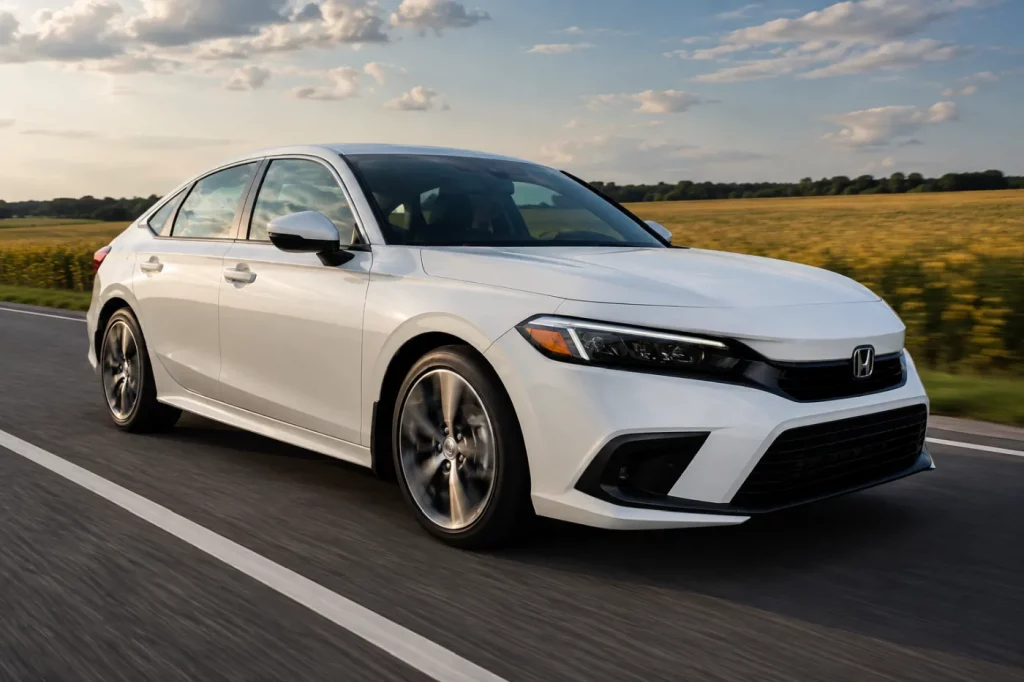
The 11th gen Civic carried forward the 10th gen’s 5 out of 5 overall performance with incremental improvements in subcategory scores. NHTSA data for 2022–2025 shows the sedan, hatchback, and Si sedan all achieving 5 out of 5 overall with 29 out of 30 possible points.
Each variant scored 5 out of 5 in 5 of the 6 sub-categories (driver front, passenger front, driver side, passenger side, side pole, rollover) with one category at 4 out of 5. The specific sub-category that dropped to 4 is not individually published in the accessible NHTSA dataset, but the 29 out of 30 ceiling means the 11th gen Civic is at the very top of the small car class under the current NCAP protocol. Rollover resistance held at 5 out of 5 across sedan and hatchback, matching the 10th gen’s best result.
The 5-door hatchback and the Si sedan score identically to the 4-door sedan. The Type R has not been separately rated for the 11th generation as of the 2025 model year.
The key comparison vs 10th gen: The 11th gen essentially matches the 10th gen’s best scores. There is no meaningful NHTSA improvement between the two generations, which is not surprising — the platform architecture shares its fundamental crash structure with the late 10th gen cars. The 11th gen’s advantage shows up in IIHS testing (updated moderate overlap and side tests), not in NHTSA scores. Sources: TheWeeklyDriver NHTSA ratings for 2022–2025 Civic, CarComplaints 2022 Civic safety page.
Side-by-Side Comparison — Scores Across All Four Generations
| Gen | Body Style | Overall | Frontal | Side | Rollover | Notes |
|---|---|---|---|---|---|---|
| 8th | 4DR (2006–07) | NR | 5/5 | 5/5 Pass / 4/5 DR | Not tested | Pre-2011 protocol |
| 8th | 4DR (2011) | 4/5 | 3/5 | 3/5 | 3/5 | Tougher 2011 protocol |
| 9th | 4DR (2012) | 5/5 | 5/5 | 5/5 | 4/5 | First 5/5 overall Civic |
| 9th | 4DR (2013–15) | 5/5 | 5/5 | 4/5 | 4/5 | Side dropped from 2012 |
| 10th | 4DR / 5HB (2016–21) | 5/5 | 5/5 | 5/5 | 5/5 | Perfect 5/5 sweep |
| 10th | 2DR Coupe (2016–20) | 5/5 | 5/5 | 5/5 | 4/5 | Coupe rollover limitation |
| 11th | 4DR / 5HB (2022–25) | 5/5 | 5/5 | 5/5 | 5/5 | 29/30 points |
What the Scores Actually Mean for Buyers
The biggest trap in NHTSA comparisons is treating scores as absolute safety measures across different test protocols. A 2006 Civic’s 5 out of 5 frontal rating and a 2022 Civic’s 5 out of 5 frontal rating are not equivalent achievements — the 2022 car was tested against a more severe impact profile with tighter injury metrics. The 10th and 11th gen Civics earning 5 out of 5 across every category under the modern protocol is the genuine achievement, not the 8th gen’s top scores under the older test.
For used-car buyers comparing within a generation, NHTSA scores are directly useful. For cross-generation comparisons, the practical ranking is: 11th gen (similar to) 10th gen > 9th gen > 8th gen (2011) > 8th gen (2006–2010), with the caveat that the gap between 10th and 11th gen is negligible, the 9th gen sedan is within one point of the 10th gen in frontal and side, and the 2006–2010 cars’ lack of a rollover rating does not mean they roll over more easily — it means NHTSA was not yet measuring it.
Quick Reference: NHTSA Scores by Generation
☐ 8th gen (2006–2010): 5/5 front, 4/5 side driver / 5/5 side passenger. No rollover rating. Pre-2011 protocol — do not compare scores directly to later generations.
☐ 8th gen (2011): 4/5 overall, 3/5 frontal, 3/5 side, 3/5 rollover. Tested under the 2011 NCAP protocol. Lowest absolute scores of any generation under a single consistent protocol.
☐ 9th gen (2012): 5/5 overall sedan. 5/5 front, 5/5 side, 4/5 rollover. First 5/5 overall Civic. Coupe 4/5 overall.
☐ 9th gen (2013–2015): 5/5 overall sedan. Side dropped to 4/5. Rollover held at 4/5. Coupe improved to 5/5 overall with 4/5 front/side/rollover.
☐ 10th gen sedan/hatchback (2016–2021): 5/5 across all four categories. First perfect sweep. Best NHTSA scores of any generation.
☐ 10th gen coupe (2016–2020): 5/5 overall but 4/5 rollover — same limitation as 9th gen coupe.
☐ 10th gen Si sedan (2017–2020): 5/5 across all categories. Matches base sedan.
☐ 10th gen Type R (2017–2020): Side and rollover rated 5/5. No overall or frontal rating from NHTSA.
☐ 11th gen (2022–2025): 5/5 overall, 29/30 points. Matches 10th gen in every practical category.
☐ The 2011 protocol change makes 8th gen (2006–2010) and 8th gen (2011) look like different safety classes. They are the same car structure tested differently.
☐ The 10th gen sedan/hatchback is the only Civic family to score 5/5 rollover resistance — the 9th gen’s 4/5 rollover and the 8th gen’s unrated rollover are the main NHTSA weaknesses.
☐ Coupe variants score 4/5 rollover in every generation tested. This is a structural limitation of the shorter body, not a safety defect.