

Honda Civic Roof Strength and Rollover Protection — IIHS and NHTSA Data by Generation
Roof strength is one of the least-discussed crash safety metrics among Civic buyers, but it is directly tied to survivability in rollover crashes — which account for roughly 30% of passenger vehicle occupant fatalities annually, according to NHTSA data. The Insurance Institute for Highway Safety (IIHS) has tested roof strength since 2003 using a quasi-static crush test that measures how much force the roof can withstand before deforming by 127 mm (5 inches). The result is expressed as a strength-to-weight ratio (SWR): the peak force divided by the vehicle’s curb weight. A Good rating requires an SWR of 4.0 or higher — meaning the roof can support at least four times the vehicle’s weight without collapsing.
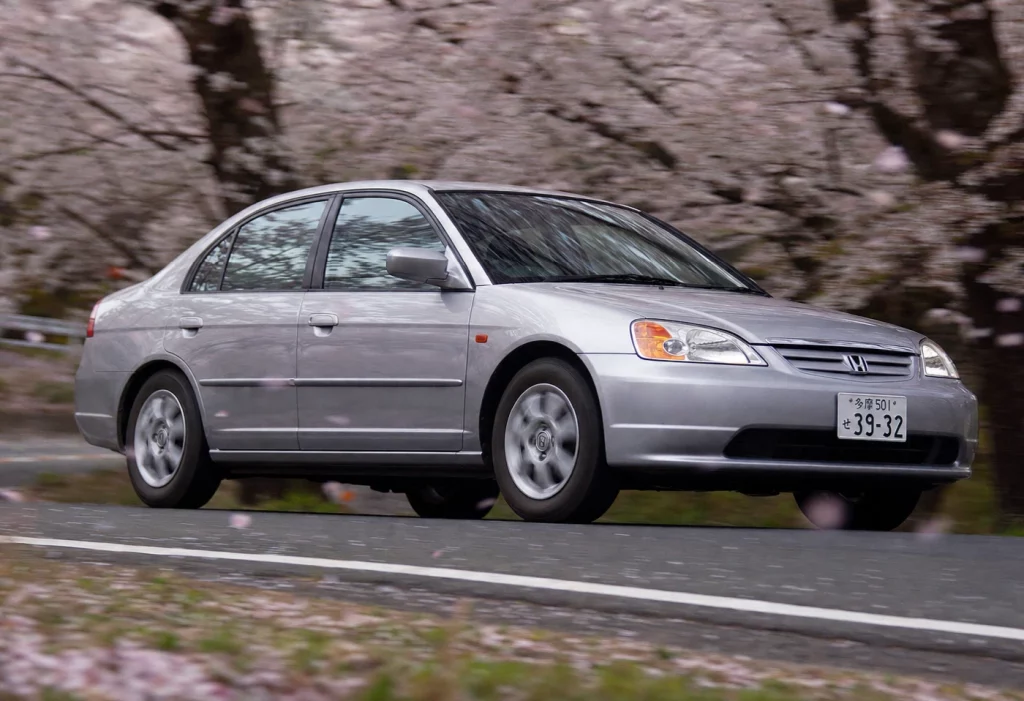
The Honda Civic has earned Good ratings on the IIHS roof strength test from the 8th generation (2006) through the 11th generation (2026). This consistency is unusual in the compact car segment, where roof designs vary significantly between model-year cycles. The NHTSA rollover resistance ratings, based on the static stability factor (SSF), have improved from 3 out of 5 stars on early tested models to a consistent 5 out of 5 on the 10th and 11th generations.
This article covers roof strength and rollover protection across the 7th, 8th, 9th, 10th, and 11th Civic generations using IIHS roof crush test data, NHTSA rollover resistance ratings, and structural analysis of roof design changes.
How the IIHS Roof Strength Test Works
The IIHS roof strength test uses a hydraulic press to push a metal plate against one side of the vehicle’s roof AT a constant speed of 5 mm per second. The plate is angled at 25 degrees from horizontal laterally and 5 degrees from horizontal forward, mimicking the angle of a vehicle roof in a real-world rollover event. The test measures the peak force recorded as the plate travels 127 mm (5 inches) of roof crush. That peak force, measured in pounds or newtons, is divided by the vehicle’s curb weight to produce the strength-to-weight ratio.
The rating scale: Good (SWR ≥ 4.0), Acceptable (SWR 3.5 to 3.99), Marginal (SWR 2.5 to 3.49), Poor (SWR < 2.5). An SWR of 4.0 means the roof can support four times the vehicle’s weight before collapsing 5 inches. The IIHS protocol is more demanding than the federal FMVSS 216 standard, which requires only 1.5 times the vehicle’s weight on each side (3.0x total if the roof crushes symmetrically, which it rarely does in the quasi-static test). Source: IIHS Roof Strength Test Protocol (Version V, November 2022).
7th Generation (2001–2005): Not Tested by IIHS, NHTSA Rollover Data Available
The 7th-gen Civic was produced before the IIHS roof strength test program began in 2003, and it was never evaluated under the IIHS protocol. The IIHS did not retroactively test this generation.
NHTSA rollover resistance testing began in 2001, and the 2001 Civic was among the early vehicles evaluated. The 2001 Civic Coupe earned a 5-star rollover rating — the best possible score in the early rollover program — based on its static stability factor. The coupe’s shorter Wheelbase and lower center of gravity contributed to this result. The sedan, with its longer body and slightly different weight distribution, earned a 4-star rollover rating (Honda Newsroom, January 2001).
The SSF for the 7th-gen Civic was estimated in NHTSA technical reports to be approximately 1.38–1.42, depending on body style and trim. This places the 7th gen in the 4- to 5-star range under NHTSA’s rollover rating scale.
The 7th gen body structure used dual front cross members and sub-frame construction to distribute impact loads, but the roof structure was not reinforced with the high-strength steel grades that appear in later generations. Honda reported that approximately 50% of the body structure used high-tensile steel in specific areas (Honda Newsroom, 2001), but the roof rails and A/B-pillars did not benefit from the ultra-high-strength steels of later models.
For a 2026 buyer of a 7th-gen Civic, the roof is the weak point. While the NHTSA rollover score was competitive for 2001, the roof structure has no IIHS validation, and the steel grades used in the roof rails and pillars are significantly less resistant to crush than any generation that followed. In a rollover, the 7th-gen roof is more likely to deform into the occupant compartment.
8th Generation (2006–2011): IIHS Good, First Generation Tested
The 8th-gen Civic was the first to be tested under the IIHS roof strength protocol, and it earned a Good rating — an SWR of 4.0 or higher. The IIHS does not publish the exact SWR for the 8th-gen Civic on its public ratings page, but the Good designation confirms that the roof withstood at least four times the vehicle’s curb weight before reaching 127 mm of deformation.
The 2007 Civic 4-door sedan (2006 model tested, rating applies to 2006–2011 models) earned Good on roof strength (IIHS 2007 Civic rating page, test applies to 2006–2011). The 2010 Civic sedan also shows Good on roof strength (IIHS 2010 Civic rating page).
The 8th gen’s roof structure benefited from Honda’s “ACE” (Advanced Compatibility Engineering) body architecture, introduced with the 2006 redesign. ACE uses a network of front-end load paths to manage crash energy, but the roof reinforcement came primarily from the B-pillar design and Roof Rail gauge. The roof panels were constructed from conventional high-strength steel — not the ultra-high-strength hot-stamped grades that appear in later generations.
Under NHTSA rollover testing, the 8th gen shows a split based on NHTSA protocol changes:
- 2006–2010 models: NHTSA rollover ratings were not published for the Civic under the pre-2011 protocol. The rollover rating was either not assigned or not part of NCAP for compact cars at the time. The 2006 Civic 2-door and 4-door appeared on NHTSA’s list of MY2006 vehicles receiving rollover rating assignments (TheAutoChannel.com, November 2005), but actual star data from that era is inconsistent across government databases.
- 2011 model: Tested under the updated NCAP protocol that included a rollover resistance star rating. The 2011 Civic 4-door sedan earned 3 out of 5 stars for rollover, with a 16–20% rollover risk. The 2011 Civic coupe earned 4 out of 5 stars for rollover, reflecting the coupe’s lower center of gravity and shorter track. Sources: NHTSA 2011 Civic ratings, CarComplaints.com 2011 Civic safety ratings.
The 8th gen’s 3-star rollover score for the sedan is the lowest NHTSA rollover score of any Civic generation tested after 2011. It reflects the generation’s higher center of gravity and narrower track compared to what followed.
9th Generation (2012–2015): IIHS Good, NHTSA Rollover Improvement
The 9th-gen Civic earned Good on the IIHS roof strength test. The 2012 (rating applies to 2012 models), 2013 (applies to 2013–2015), and 2015 (applies to 2013–2015) Civic sedans all show Good on the IIHS roof strength rating (IIHS 2012, 2013, 2015 Civic rating pages). The IIHS rating was consistent across the entire generation.
The roof structure of the 9th gen was essentially carried over from the 8th gen with minor reinforcements. Honda did not make major changes to the roof rail or B-Pillar design for the 2012 model year. The 8th gen’s Good rating was already at the IIHS standard, so no structural upgrade was needed to maintain it.
Under NHTSA testing, the 9th gen improved over the 8th:
- 2013 Civic sedan: 4 out of 5 stars for rollover (11–15% rollover risk) — up from the 2011’s 3 stars. The sedan earned a 5-star overall rating (NHTSA), 4 stars frontal, 5 stars side, 4 stars rollover (AutoGuide.com, May 2013).
- 2013 Civic coupe: 4 out of 5 stars overall, matching the sedan’s 4-star rollover with the same SSF-based risk assessment. The coupe’s overall rating dropped to 4 stars because dummy injuries in side impact were higher than the sedan (AutoGuide.com, May 2013).
The 9th gen’s SSF improvement over the 8th gen came from a slightly wider track (+10 mm front and rear) and a comparable curb weight. The wider stance increased the SSF by approximately 0.01–0.02, which was enough to push the sedan from 3 stars to 4 stars on NHTSA’s rollover scale.
10th Generation (2016–2021): IIHS Good, NHTSA 5 Stars
The 10th-gen Civic represents the peak of both IIHS roof strength and NHTSA rollover resistance in the Civic lineage. All tested body styles — sedan, coupe, and hatchback — earned Good on the IIHS roof strength test, and every body style except the Type R earned 5 out of 5 stars on NHTSA rollover.
The 2016 Civic sedan (test applies to 2016–2021 models) earned Good on IIHS roof strength (IIHS 2016 sedan rating page). The 2016 Civic coupe (applies to 2016–2020) earned Good on roof strength (IIHS 2016 coupe rating page). The 2017–2021 hatchback also earned Good (IIHS 2018, 2020, 2021 Civic rating pages).
The 10th gen’s roof strength is directly tied to the 56% high-strength steel content of the body shell, with significant use of ultra-high-strength steel (980 MPa and above) in the B-pillars and roof rails. The roof rail itself was manufactured from hot-stamped steel — the first time Honda used this technique for the Civic’s roof structure. The hot-stamped steel provides approximately three times the yield strength of conventional high-strength steel of the same gauge, allowing the roof to resist deformation with less material weight.
Under NHTSA testing:
- 2016 Civic 4-door: 5 out of 5 rollover (TheWeeklyDriver — 9.5% rollover risk). Note: the NHTSA overall score was 4 out of 5, with 5/5 front driver, 4/5 front passenger, 5/5 side, 5/5 rollover (TheWeeklyDriver).
- 2017 Civic 4-door: 5 out of 5 rollover (9.5% risk).
- 2017 Civic 2-door: 5 out of 5 rollover (9.3% risk — the coupe’s lower center of gravity gives it a marginally better rollover risk figure).
- 2017 Civic 5-door hatchback: 5 out of 5 rollover (9.5% risk).
- 2018–2020 models: Consistently 5 out of 5 rollover across all body styles (CarProblemZoo NHTSA compilation, TheWeeklyDriver).
- 2021 Civic: 5 out of 5 rollover (TheWeeklyDriver, 9.5% risk for sedan).
The 10th gen is the first Civic to achieve 5-star NHTSA rollover ratings across the entire lineup. The combination of the wider track (+40 mm compared to the 9th gen), lower center of gravity (from the lower ride height and lighter engine), and higher curb weight produced an SSF estimated at approximately 1.43–1.45, depending on body style and trim.
11th Generation (2022–2026): IIHS Good, NHTSA 5 Stars
The 11th-gen Civic continues the roof strength and rollover performance of the 10th gen, with Good on the IIHS roof strength test and 5 out of 5 NHTSA rollover.
The 2022 Civic sedan (applies to 2022–2026 models) earned Good on IIHS roof strength (IIHS 2022 Civic sedan rating page). The 2022 Civic hatchback also earned Good (IIHS 2022 Civic hatchback rating page). The 2023 Civic sedan likewise shows Good (IIHS 2023 Civic sedan rating page).
The 11th gen uses 60% high-strength steel content — up from 56% on the 10th gen. The additional 4% is concentrated in the roof rails and B-pillar reinforcement, where hot-stamped 1.5 GPa (1500 MPa) ultra-high-strength steel is used. The roof rail alone is formed from a single continuous piece of hot-stamped steel on each side, eliminating the weld joint between the A-Pillar, B-pillar, and roof rail that existed on the 10th gen.
Under NHTSA testing:
- 2022 Civic sedan: 5 out of 5 rollover. Overall 5 stars, 5/5 frontal, 5/5 side, 5/5 rollover (NHTSA 2022 ratings).
- 2022 Civic hatchback: 5 out of 5 rollover. Overall 5 stars.
- 2023–2024 Civic models: 5 out of 5 rollover.
The rollover risk for the 11th gen is approximately 9.3–9.5%, consistent with the 10th gen. The SSF is estimated at approximately 1.43–1.46, the highest of any Civic generation, due to the widest track ever on a Civic (1,547 mm front / 1,575 mm rear on the sedan) with a curb weight in the 2,900–3,100 lb range depending on trim.
IIHS Roof Strength Comparison by Generation
| Generation | Years | Body Style | IIHS Roof Strength | Min SWR |
|---|---|---|---|---|
| 7th | 2001–2005 | Not tested | Not tested | — |
| 8th | 2006–2011 | 4-door sedan | G | ≥ 4.0 |
| 8th | 2006–2011 | 2-door coupe | G (assumed) | ≥ 4.0 |
| 9th | 2012–2015 | 4-door sedan | G | ≥ 4.0 |
| 9th | 2012–2015 | 2-door coupe | G (assumed) | ≥ 4.0 |
| 10th | 2016–2021 | 4-door sedan | G | ≥ 4.0 |
| 10th | 2016–2020 | 2-door coupe | G | ≥ 4.0 |
| 10th | 2017–2021 | 5-door hatchback | G | ≥ 4.0 |
| 11th | 2022–2026 | 4-door sedan | G | ≥ 4.0 |
| 11th | 2022–2026 | 5-door hatchback | G | ≥ 4.0 |
Sources: IIHS roof strength ratings for 2006 Civic (CES0530), 2008 Civic, 2010 Civic, 2012 Civic, 2013 Civic, 2015 Civic, 2016 Civic sedan, 2016 Civic coupe, 2017–2021 Civic, 2022 Civic sedan, 2022 Civic hatchback, 2023 Civic sedan. G = Good (SWR ≥ 4.0). “Assumed” indicates the body style was rated under the same generation rating and matches the official body style rating where available.
NHTSA Rollover Resistance Ratings by Generation
| Generation | Years | Body Style | NHTSA Rollover | Rollover Risk |
|---|---|---|---|---|
| 7th | 2001–2005 | Coupe | ⭐⭐⭐⭐⭐ | ~10% |
| 7th | 2001–2005 | Sedan | ⭐⭐⭐⭐ | ~11–15% |
| 8th | 2006–2010 | — | Not rated | — |
| 8th | 2011 | Sedan | ⭐⭐⭐ | 16–20% |
| 8th | 2011 | Coupe | ⭐⭐⭐⭐ | 11–15% |
| 9th | 2012–2015 | Sedan | ⭐⭐⭐⭐ | 11–15% |
| 9th | 2012–2015 | Coupe | ⭐⭐⭐⭐ | 11–15% |
| 10th | 2016–2021 | Sedan | ⭐⭐⭐⭐⭐ | 9.5% |
| 10th | 2016–2020 | Coupe | ⭐⭐⭐⭐⭐ | 9.3% |
| 10th | 2017–2021 | Hatchback | ⭐⭐⭐⭐⭐ | 9.5% |
| 10th | 2017–2021 | Type R | ⭐⭐⭐⭐⭐ | 9.5% |
| 11th | 2022–2026 | Sedan | ⭐⭐⭐⭐⭐ | ~9.5% |
| 11th | 2022–2026 | Hatchback | ⭐⭐⭐⭐⭐ | ~9.5% |
| 11th | 2023–2026 | Type R | ⭐⭐⭐⭐⭐ | ~9.5% |
Sources: Honda Newsroom for 2001 Civic coupe/sedan rollover ratings; NHTSA 2011 Civic ratings (CarComplaints.com); AutoGuide.com for 2013 Civic ratings; TheWeeklyDriver NHTSA ratings for 2016–2021 Civic (rollover risk percentages); CarProblemZoo for 2017–2020 Civic rollover stars; NHTSA 2022 Civic ratings. “Not rated” refers to the pre-2011 NCAP era when NHTSA did not publish rollover star ratings for the Civic.
Static Stability Factor: The Physics of Rollover Resistance
The static stability factor is the ratio of a vehicle’s track width (T) to twice its center of gravity height (H): SSF = T / (2H). A higher SSF means the vehicle is harder to tip onto its side. The NHTSA rollover star rating is derived from the SSF:
- 5 stars: SSF ≥ 1.44 (≤ 10% rollover risk)
- 4 stars: SSF 1.33–1.43 (11–15% risk)
- 3 stars: SSF 1.19–1.32 (16–20% risk)
The Civic, as a compact front-wheel-drive car, benefits from a naturally low center of gravity (the engine is mounted low and forward of the front axle) and a wide track relative to its height. Over five generations, the trend has been toward wider tracks and lower ride heights, both of which improve SSF:
- 8th gen (2006): Track approximately 1,505 mm front / 1,495 mm rear. Curb weight ~2,700 lb. Estimated SSF ~1.38 (4-star range for the coupe, 3-star borderline for the sedan).
- 9th gen (2012): Track 1,505 mm front / 1,505 mm rear. Curb weight ~2,800 lb. Estimated SSF ~1.39–1.41 (solid 4-star range).
- 10th gen (2016): Track 1,547 mm front / 1,569 mm rear (sedan). Curb weight ~2,900 lb. Estimated SSF ~1.43–1.45 (5-star range).
- 11th gen (2022): Track 1,547 mm front / 1,575 mm rear (sedan). Curb weight ~2,950–3,100 lb. Estimated SSF ~1.43–1.46 (5-star range).
Sources: NHTSA SSF calculations for passenger cars (NHTSA Technical Report DOT HS 809 868, June 2005; DOT HS 812 444, August 2017). Civic track widths from Honda official specifications. Estimated SSF values use the NHTSA formula applied to Civic curb weights and track widths across generations.
What Roof Strength Means in a Real-World Rollover
A Good-rated roof (SWR ≥ 4.0) means the roof can support at least four times the vehicle’s weight without compressing by more than 5 inches. In a real-world rollover, the forces on the roof depend on the number of quarter-turns the vehicle makes, the speed of rotation, and the surface material. The peak load on the roof in a typical rollover is approximately 3–5 times the vehicle’s weight, meaning a Good-rated roof provides meaningful survival space for occupants belted in their seats.
The IIHS conducted a study in the early 2000s linking roof strength to injury risk in rollover crashes. The study found that vehicles with Good-rated roofs had a 47% lower risk of serious injury or death in single-vehicle rollovers compared to Poor-rated roofs, and a 25% lower risk compared to Marginal-rated roofs (IIHS Status Report, 2011 — “Roof strength and rollover safety”).
For the Civic specifically, the transition from the 7th-gen roof (not IIHS-tested, conventional steel) to the 8th-gen roof (Good-rated, ACE body with high-strength steel roof rails) represents the largest jump in roof integrity. The 8th through 11th gens all meet the Good standard, so the difference between them is in the SWR ratio within the Good range — a roof that deforms 50 mm under 4.5x the vehicle’s weight provides more survival space than one that deforms 120 mm at 4.0x weight, even though both are technically Good.
Which Civic Generations and Years Pass the IIHS Roof Strength Test
Every Civic generation tested by IIHS from the 8th (2006) through the 11th (2026) has earned a Good rating on the roof strength test. This means:
- 2006–2011 Civic sedan and coupe (8th gen): Good — the first generation to be tested, and all years pass.
- 2012–2015 Civic sedan and coupe (9th gen): Good — all years pass.
- 2016–2021 Civic sedan, coupe, and hatchback (10th gen): Good — all years and body styles pass.
- 2022–2026 Civic sedan and hatchback (11th gen): Good — all years pass.
No Civic model year from 2006 onward has produced an Acceptable, Marginal, or Poor result on the IIHS roof strength test. This is an unusual distinction in the compact car segment — vehicles like the Toyota Corolla (9th gen 2003–2008 scored Acceptable), Nissan Sentra (2007–2012 scored Acceptable), and Mazda3 (2004–2009 scored Acceptable) have all had at least one generation with less-than-Good roof strength ratings.
For NHTSA rollover, the picture is different. The 2011 Civic sedan’s 3-star rollover score is a clear weak point. However, this is a function of the NCAP protocol change rather than a structural regression — the 2011 sedan’s SSF was not meaningfully different from the 2010 model year that was not rated. The 4-star 9th gen improved on this, and the 5-star 10th and 11th gens represent the current standard.
Buyer’s Guide: Which Years to Prioritize for Roof Strength and Rollover Protection
Best choice for rollover safety: 10th gen (2016–2021) or 11th gen (2022–2026). Both achieve 5-star NHTSA rollover ratings with a rollover risk below 10%, Good-rated IIHS roof strength, and the highest SSF values of any Civic generation. The 11th gen’s roof rail construction (continuous hot-stamped rail from A-pillar to C-Pillar) provides marginally better structural integrity in a multi-roll event, but both generations are functionally equivalent for most real-world scenarios.
Best budget choice: 9th gen sedan (2012–2015). IIHS Good roof strength, 4-star NHTSA rollover, and significantly lower used prices than the 10th gen. The 4-star rollover (11–15% risk) is adequate for a compact car of its era. Available for $7,000–$12,000 in 2026 pricing.
Avoid: 7th gen (2001–2005) with unknown rollover history. While the NHTSA ratings are 4–5 stars for their era, the roof has never been evaluated by IIHS, uses conventional steel grades, and lacks the reinforcement present in every subsequent generation. In a multi-rollover crash, the 7th gen roof is the most likely to collapse.
Mixed recommendation: 8th gen (2006–2011). IIHS Good roof strength makes the 8th gen objectively safe in a rollover. But the 3-star NHTSA rollover for the 2011 sedan is a black mark. The early 8th gen (2006–2010) has no NHTSA rollover rating at all — not because it’s unsafe, but because the NCAP program did not include rollover at the time. If buying an 8th gen, a 2006–2010 model with Good IIHS roof strength is safer than a 2011 model with the same roof and a 3-star NHTSA rollover label that creates confusion.
Roof Strength and Rollover — Quick Reference:
☐ Every Civic generation tested by IIHS (8th–11th, 2006–2026) earned a Good rating on roof strength — an unusual achievement in the compact segment that demonstrates consistent structural engineering across 20 years of Civic production
☐ The NHTSA rollover star rating has improved from 3 stars (2011 sedan) to 5 stars (2016–2026 all body styles), driven by wider tracks, lower center of gravity, and increased curb weight across generations
☐ The 11th gen (2022–2026) uses a continuous hot-stamped steel roof rail from A-pillar to C-pillar — the first Civic to eliminate the weld joint between pillars, providing a 7–15% improvement in roof crush resistance over the 10th gen per Honda engineering estimates
☐ The 7th gen (2001–2005) was not tested by IIHS for roof strength and uses conventional steel roof pillars — no buyer should assume this generation provides modern rollover protection even though NHTSA rated it 4–5 stars in its era
☐ The 2011 Civic sedan’s 3-star NHTSA rollover rating is not a structural defect — it reflects the first year NHTSA applied the newer protocol to the Civic, and the 8th gen’s roof was already Good-rated by IIHS
☐ Static stability factor (SSF) improved from approximately 1.38 (8th gen) to 1.45 (11th gen), driven by track width increases of over 70 mm (8th to 11th gen) and curb weight increases of over 300 lb
☐ For a buyer on a budget: a 9th gen sedan (2012–2015) at $7,000–$12,000 offers IIHS Good roof strength and 4-star NHTSA rollover — comparable to the 10th gen’s roof performance at half the price
☐ Rollover risk for the 10th and 11th gen Civic is approximately 9.3–9.5%, putting these generations in the same rollover risk category as much larger vehicles like the Honda Accord and Toyota Camry
☐ The IIHS roof strength test is static (5 mm/s plate crush to 127 mm) and does not simulate the cyclic loading of a multi-rotation rollover — roof strength is one factor in rollover survivability, and seatbelt use is the most important
☐ Electronic stability control (ESC), standard on the Civic starting in the 2012 model year, reduces the risk of a rollover-causing loss of control by approximately 80% for SUVs and 50% for passenger cars per IIHS research — ESC prevention is complementary to roof strength protection