

Why Safety Ratings Differ Across These Three Compact Cars
The Honda Civic, Toyota Corolla, and Mazda3 have competed in the compact car segment for decades. All three have improved substantially in crash protection over time, but they have not moved in lockstep. Differences in platform timing, structural design priorities, and headlight and crash-avoidance technology mean that a used buyer looking at a 2014 model year faces very different safety outcomes depending on which badge is on the hood. This article compares IIHS and NHTSA ratings across every generation of these three models, sourced directly from the Insurance Institute for Highway Safety and the National Highway Traffic Safety Administration.
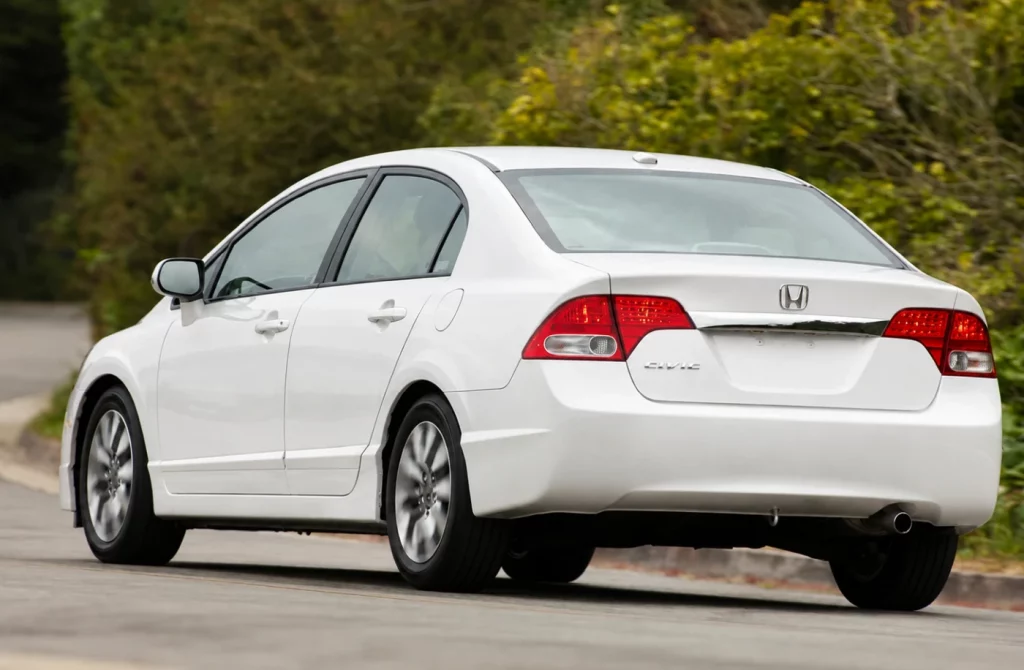
Mid-2000s Generation (2006–2013): Before Small Overlap Testing
The IIHS introduced the driver-side small overlap front test in 2012, so vehicles designed before that date were not engineered to pass it. In the moderate overlap front, side, roof strength, and head restraint tests that were in use during this period, all three models performed well — but there are meaningful differences in how they handled the side test, particularly the coupe versus sedan body styles.
| Model | Years | Moderate Front | Side (Sedan) | Side (Coupe) | Roof Strength |
|---|---|---|---|---|---|
| Honda Civic (8th gen) | 2006–2011 | G | G | A | G |
| Toyota Corolla (10th gen) | 2009–2013 | G | G | N/A | G |
| Mazda3 (2nd gen) | 2010–2013 | G | G | G | G |
Sources: IIHS ratings for 2007–2011 Honda Civic 4-door sedan; 2009–2013 Toyota Corolla 4-door sedan; 2010–2013 Mazda 3 4-door sedan/hatchback.
All three earned IIHS Top Safety Pick awards for this period when they were tested under the criteria then in effect. The Civic sedan’s side structure was rated Good, but the coupe scored Acceptable — a meaningful difference for two-door buyers. The Corolla never offered a coupe body style, so only sedan data exists. The Mazda3’s roof strength was not rated for 2010 hatchback models (IIHS began roof testing in 2010 but not all vehicles were evaluated immediately), but 2011 and later models scored Good across the board.
NHTSA ratings for this period: the 2008–2011 Civic earned 5 stars overall with 5/5 frontal and 5/5 side. The 2009–2013 Corolla earned 4 stars overall (4/5 frontal, 5/5 side). The 2010–2013 Mazda3 earned 4 stars overall (4/5 frontal, 5/5 side). Sources: NHTSA 5-Star Safety Ratings database for respective model years.
Small Overlap Era (2014–2018): Where the Gap Opened
The IIHS driver-side small overlap front test, introduced in 2012, exposed structural weaknesses that moderate overlap testing had not caught. How each manufacturer responded — or failed to respond — created the first major safety gap between these three cars.
| Model / Gen | Years | Small Overlap Driver | Small Overlap Passenger | Moderate Front | Side | IIHS Award |
|---|---|---|---|---|---|---|
| Honda Civic (9th gen) | 2013–2015 | G | Not tested | G | G | TSP+ (2013) |
| Toyota Corolla (11th gen) | 2014–2016 | M | Not tested | G | G | TSP (2014) |
| Toyota Corolla (11th gen) | 2017–2018 | G | Not tested | G | G | TSP+ (2017) |
| Mazda3 (3rd gen) | 2014–2018 | G | Not tested | G | G | TSP+ (2014–2017) |
Sources: IIHS ratings for 2013 Honda Civic sedan; 2014–2016 Toyota Corolla sedan (Marginal small overlap); 2017 Toyota Corolla sedan (Good small overlap); 2014–2018 Mazda 3 sedan/hatchback.
The 2014 Corolla was a new design (11th generation) that launched just as the small overlap test was fully rolling out. Toyota did not reinforce the driver-side structure adequately, and the 2014–2016 Corolla earned a Marginal rating — the worst small overlap result of any of these three cars in any generation. The driver-side intrusion allowed the steering column to move upward and inward excessively, and the dummy’s head barely contacted the front airbag before sliding off to the left.
The 2013 Civic (9th generation, mid-cycle refresh of a design that originally launched for 2012) earned a Good small overlap rating because Honda had reinforced the front structure ahead of the test’s introduction. The 2014 Mazda3 (3rd generation, all-new Skyactiv platform) also earned Good, making it and the Civic the only compact cars in 2014 to ace the driver-side small overlap test.
Toyota did not address the Corolla’s small overlap weakness until a structural revision for the 2017 model year, which brought the rating up to Good. The passenger-side small overlap test was not yet administered by IIHS during this period, so neither the 9th-gen Civic nor the 3rd-gen Mazda3 was evaluated on that side.
NHTSA ratings: The 2013–2015 Civic earned 5/5 overall. The 2014–2016 Corolla earned 5/5 overall (despite its IIHS small overlap Marginal rating — NHTSA’s frontal test is a full-width barrier, not a small overlap). The 2014–2018 Mazda3 earned 5/5 overall. Sources: NHTSA 5-Star Safety Ratings database.
Passenger-Side Small Overlap and Updated Side Test Era (2019–2026)
IIHS added the passenger-side small overlap test in 2017–2018 and introduced an updated, more severe side-impact test in 2020–2021 (using a heavier 4,200-pound barrier traveling AT 37 mph instead of the original 3,300-pound barrier at 31 mph). A new moderate overlap front test with a rear-seat dummy was also introduced in 2023. This is the most challenging testing regime small cars have ever faced, and it separates the three models clearly.
| Test | 2025–2026 Civic Sedan | 2025–2026 Civic Hatchback | 2025–2026 Corolla Sedan | 2024–2026 Mazda3 Sedan/Hatch |
|---|---|---|---|---|
| Small Overlap Front | G | G | G | G |
| Moderate Front (Updated) | A | G | M | G |
| Side (Updated) | G | G | G | G |
| Headlights | G | G | G | G (premium trim) / A (base) |
| FCP Vehicle-to-Vehicle | A | G | G | A |
| FCP Pedestrian | A | A | G | G |
| IIHS Award | TSP (not +) | TSP+ | TSP (not +) | TSP+ |
Sources: IIHS ratings as of June 2026 for 2025 Honda Civic sedan and hatchback, 2025–2026 Toyota Corolla sedan, 2024–2026 Mazda 3 sedan and hatchback.
Why the Civic Sedan and Hatchback Score Differently
IIHS data shows a clear structural split between the 11th-generation Civic sedan and hatchback on the updated moderate overlap front test. The hatchback earned Good across all crashworthiness tests and qualifies for the Top Safety Pick+ award. The sedan earned Acceptable on the updated moderate overlap test — IIHS noted issues with rear passenger restraints and dummy kinematics — which limits it to the standard Top Safety Pick award. Sources: IIHS 2025 Civic 4-door sedan and 4-door hatchback ratings.
This means a used buyer looking at an 11th-gen Civic should be aware that the hatchback body has demonstrated better overall crashworthiness scores. The Civic sedan remains a safe car — Acceptable on the updated moderate test is not a safety concern in the way Marginal or Poor would be — but the hatchback is the stronger performer in the current generation.
The Corolla’s Moderate Overlap Weakness
The 12th-generation Corolla (2019–present) addressed the driver-side small overlap weakness of the 11th generation, earning a Good rating on both driver and passenger small overlap. However, when IIHS introduced the updated moderate overlap front test with the rear-seat dummy in 2023, the Corolla earned a Marginal rating — the worst result among all three current-generation models on any crashworthiness test. The rear passenger dummy showed excessive head and neck injury measures because the rear seatbelt did not adequately restrain the dummy, and the rear structure allowed excessive forward movement. Sources: IIHS 2023–2026 Toyota Corolla 4-door sedan ratings.
This matters for families or anyone who regularly carries rear-seat passengers in a Corolla. The IIHS updated test was designed specifically to address rear-seat occupant protection, which had been a blind spot in previous test protocols.
Crash Avoidance and Headlight Comparison
Beyond crashworthiness, IIHS evaluates headlights and front crash prevention (FCP) systems. These matter because avoiding a crash altogether is better than surviving one.
The 2025–2026 Civic (both sedan and hatchback) earns Good headlights across all trims — a significant improvement over the 10th generation, where headlight quality varied from Good (Touring and Si post-November 2019) to Poor (all halogen-equipped trims). The Civic sedan’s vehicle-to-vehicle FCP rates Acceptable, and pedestrian FCP rates Acceptable — not class-leading but solid. Sources: IIHS 2025 Civic sedan and hatchback ratings.
The 2025–2026 Corolla earns Good headlights across all trims. Its vehicle-to-vehicle FCP earns Good — IIHS reported the Corolla avoided a collision at all tested speeds, which neither the Civic nor the Mazda3 accomplished. Pedestrian FCP also earns Good. The Corolla leads in crash prevention, even if its crashworthiness scores lag in the updated moderate overlap test. Sources: IIHS 2025–2026 Toyota Corolla sedan ratings.
The 2024–2026 Mazda3’s headlight rating depends on trim. The premium-level trims (higher trims with LED projector headlights) earn Good. The base trim headlights earn Acceptable — meaning a buyer who wants the best IIHS headlight score needs to spend up on the option list. FCP vehicle-to-vehicle rates Acceptable, but pedestrian FCP rates Good. Sources: IIHS 2024–2026 Mazda 3 sedan and hatchback ratings.
| Category | Best Performer | Notes |
|---|---|---|
| Crashworthiness (all tests) | Mazda3 | Only compact with Good on all current-generation tests — small overlap, moderate overlap updated, side updated |
| Rear-seat protection | Mazda3 / Civic Hatch | Corolla Marginal on updated moderate (rear occupant); Civic sedan Acceptable |
| Headlights (all trims) | Civic / Corolla | Both earn Good across all trims. Mazda3 base trim Acceptable. |
| Front crash prevention (vehicle) | Corolla | Only one to avoid collision at all tested speeds — Good rating |
| Front crash prevention (pedestrian) | Corolla / Mazda3 | Both earn Good. Civic earns Acceptable. |
| NHTSA overall rating (current gen) | All three | All three earn 5/5 stars overall on current model years. NHTSA does not test small overlap or rear-seat moderate overlap. |
NHTSA 5-Star Ratings — Less Discriminating, But Still Useful
NHTSA’s 5-Star Safety Ratings use a full-width frontal barrier test (35 mph), a side barrier test (38 mph for current protocol), and a rollover resistance measurement. These tests have not changed as dramatically as IIHS protocols over the past 15 years, so NHTSA ratings tend to show less variation between models.
All three current-generation models earn 5 stars overall. Going back to earlier generations: the 8th-gen Civic (2006–2011) earned 5 stars overall. The 10th-gen Corolla (2009–2013) earned 4 stars overall. The 2nd-gen Mazda3 (2010–2013) earned 4 stars. By the 2014 model year, all three had reached 5 stars overall and have maintained that rating through the present. Sources: NHTSA 5-Star Safety Ratings database, historical queries by model year.
Used Buyer Guidance by Generation
2006–2011 (8th-gen Civic / 10th-gen Corolla / 2nd-gen Mazda3): The Civic is the strongest pick here. It earned IIHS Top Safety Pick for its era, Good across all available tests, and 5-star NHTSA overall. The Corolla earned 4-star NHTSA overall, slightly behind. The Mazda3 earned 4-star NHTSA overall and its roof strength was not initially rated on hatchbacks. None of these three were designed for small overlap protection, so a 2012 or later model is a meaningful safety upgrade.
2013–2015 (9th-gen Civic / 11th-gen Corolla / 3rd-gen Mazda3): The Civic and Mazda3 both earned Good on the driver-side small overlap test. The 2014–2015 Corolla earned Marginal — avoid these model years on the used market unless you can confirm the car was never in a front-corner crash. The Civic earned IIHS Top Safety Pick+ for 2013, and the Mazda3 earned Top Safety Pick+ from 2014 onward. NHTSA is 5 stars across all three.
2016–2021 (10th-gen Civic / 11th-gen refreshed Corolla / 3rd-gen Mazda3 continued): The 2017+ Corolla fixed the small overlap weakness and earned Top Safety Pick+. The 10th-gen Civic (2016–2021) earned Good on both driver and passenger small overlap once IIHS added that test, but headlight quality was a major weak point — only post-November 2019 Touring and Si trims earned Good headlights; all halogen-trunk models rated Poor. The Mazda3 continued earning top crashworthiness scores through the end of the 3rd generation.
2022–present (11th-gen Civic / 12th-gen Corolla / 4th-gen Mazda3): The Mazda3 is the objectively safest choice by IIHS criteria — the only compact car earning Good across all current crashworthiness tests (small overlap, updated moderate overlap, updated side). The Civic hatchback is essentially tied, with Good across all tests but with Acceptable on pedestrian FCP. The Civic sedan drops to Acceptable on updated moderate overlap. The Corolla earns Good small overlap and side but Marginal on updated moderate overlap, which specifically penalizes rear-seat protection.
Quick Reference
☐ For the current generation overall safety, the Mazda3 leads with Good across all IIHS crashworthiness tests and a Top Safety Pick+ award. The Civic hatchback is essentially tied; the Civic sedan and Corolla trail on the updated moderate overlap test.
☐ For crash avoidance, the Corolla leads with Good ratings on both vehicle-to-vehicle and pedestrian front crash prevention. It was the only one of the three to avoid a collision at all tested speeds.
☐ The 2014–2016 Corolla (11th generation) earned a Marginal rating on the IIHS driver-side small overlap test. Used buyers should prioritize 2017 or newer Corollas, which fixed this structural deficiency.
☐ The 2025–2026 Corolla earns a Marginal rating on the updated moderate overlap front test — the rear-seat protection weakness is a real consideration for families who carry rear passengers.
☐ The 2025 Civic sedan earns Acceptable on the updated moderate overlap front test. The Civic hatchback earns Good. Used buyers looking at 11th-gen Civics should prioritize the hatchback for the stronger crashworthiness package.
☐ The Mazda3’s base trim headlights (Acceptable) are not as good as the premium trim headlights (Good). Buyers who want maximum IIHS headlight scores need to avoid base trims.
☐ All three current models earn 5/5 stars from NHTSA. For buying decisions, IIHS ratings are more discriminating because NHTSA does not test small overlap or rear-seat kinematics.
☐ None of the three cars has meaningful differences in NHTSA ratings for 2014 and newer model years — all earn 5 stars overall, so NHTSA alone should not be the deciding factor in a modern used car choice.