

Honda’s Pedestrian Safety Philosophy and the Early Years
Honda began researching pedestrian crash protection in earnest during the early 1990s, and the company’s first production pedestrian countermeasures appeared on the HR-V in 1998 with the Pedestrian Injury Reduction Body. This system used impact-absorbing structures in the engine Hood, hood hinges, wiper pivots, front fenders, and bumpers — all designed to reduce head injury risk. In 2000, Honda added leg protection measures to the Civic (7th generation at that time) based on research from its POLAR II crash test dummy, which was the world’s first pedestrian dummy capable of measuring knee and lower-leg injury data. Sources: Honda Global Newsroom, September 4, 2008; Honda POLAR II announcement, May 10, 2000; Honda Pop-up Hood System technology page.
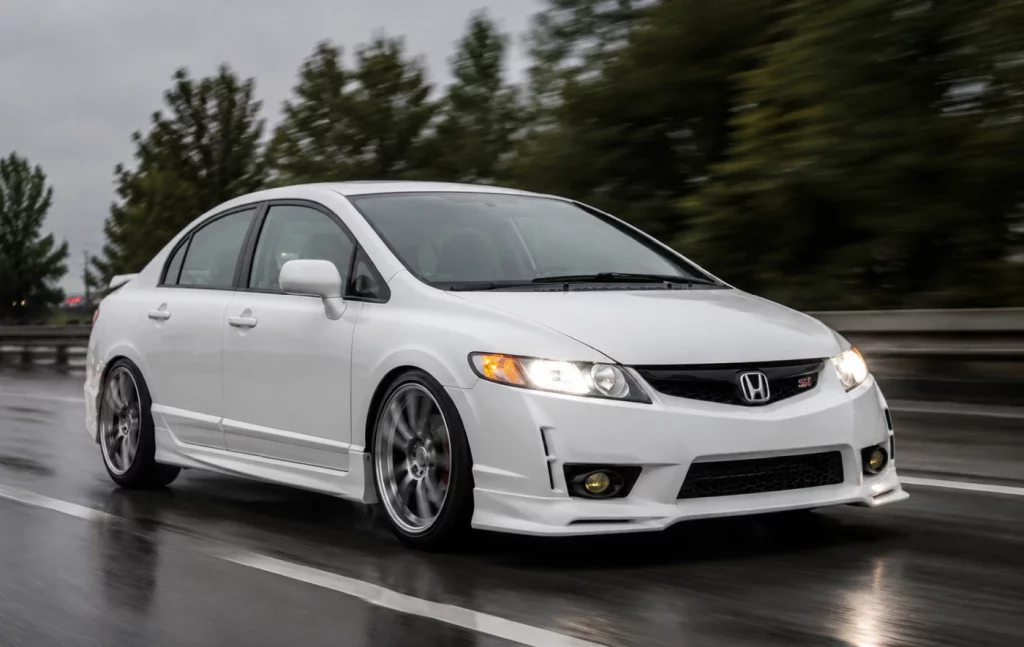
The Civic’s approach to pedestrian protection has evolved across four distinct vehicle architectures (8th through 11th generations), each incorporating a growing list of passive deformation features and, starting in 2022, an active pop-up hood system. The front-end geometry — bumper height, hood leading edge position, hood angle, and windshield base location — has shifted measurably across generations as regulatory and consumer testing programs (Euro NCAP, Japanese JNCAP, and the U.S. NCAP pedestrian proposal) pushed manufacturers to address pedestrian head, pelvis, and leg protection simultaneously.
8th Generation (2006–2011): ACE Body Structure Debuts with Passive Pedestrian Measures
The 8th-generation Civic was the first to use Honda’s Advanced Compatibility Engineering (ACE) body structure, which debuted on the 2005 Odyssey and was applied to the redesigned Civic for 2006. ACE uses a network of load-bearing front-frame members to distribute crash energy across a wider area, improving compatibility with larger vehicles and reducing concentrated impact forces. Sources: Honda Newsroom, August 30, 2005; Honda ACE body structure press release, November 2024.
For pedestrian protection, the 8th-gen Civic incorporated what Honda described as deformable hood and Fender areas designed to reduce injury if contacted by a pedestrian’s head. The specific passive features included:
- Energy-absorbing collapsible hood supports: Brackets designed to buckle under vertical load rather than resisting the impact
- Breakaway wiper arm pivots: The wiper pivot bases were designed to shear or collapse when struck from above
- Deformable fender mounts: The fender attachment brackets allowed the fender panel to deflect inward on impact
- Clearance beneath the hood: The hood-to-engine clearance was designed to allow the hood panel to deform without bottoming out on hard components underneath
The 8th-gen’s front-end geometry used a relatively low hood leading edge and short hood length compared to later generations. Research from Honda’s POLAR program had shown that bumper height, hood edge height, and hood length all affect the kinetic behavior of a struck pedestrian — lower hood edges tend to produce more leg rotation before head contact, while higher hood edges can reduce femur bending but increase pelvis loading. Sources: Honda Newsroom, August 30, 2005; Honda Pedestrian Safety Remarks, August 7, 2003; Wikipedia ANCAP pedestrian data for 2007 Civic (pedestrian protection: Adequate).
The 8th-gen Civic was tested under the ANCAP protocol (Australia), which rated its pedestrian protection as “Adequate” — a level consistent with vehicles of that era. The Euro NCAP pedestrian rating for this generation was not published for the Civic specifically, though Honda’s overall pedestrian technology at the time was among the more developed in the compact segment. The National Highway Traffic Safety Administration (NHTSA) did not evaluate pedestrian protection in the United States until the early 2020s, so no federal pedestrian score exists for this generation.
9th Generation (2012–2015): Refined Passive Design and Euro NCAP 5-Star Achievement
The 9th-generation Civic carried over the ACE body structure foundation from the 8th generation but incorporated a revised front-end structure that improved small overlap front crashworthiness and pedestrian protection together. When tested by Euro NCAP in 2012, the 9th-gen Civic earned a five-star overall rating with a pedestrian protection score that met the then-current Euro NCAP criteria (60% pedestrian threshold for five stars). Sources: Euro NCAP Honda Civic 2012 test results; Honda Global Newsroom, February 22, 2012.
The pedestrian protection features on the 9th gen matched the 8th gen in concept but were refined in execution:
- Windscreen wiper pivots designed to break away on impact — specifically called out in Honda’s press materials for the 9th gen as an improvement
- Energy-absorbing front wing (fender) mounts and bonnet hinges — the hinge design was revised for more predictable collapse behavior
- Unobstructed area beneath the bonnet — the engine layout was optimized to provide greater clearance between the hood inner panel and hard engine components across a wider area of the hood surface
The Euro NCAP assessment for the 9th-gen Civic noted that the bonnet provided “predominantly good or adequate” head protection, with weak and poor results concentrated only along the base of the windscreen and the stiff windscreen pillars — a pattern common to nearly all vehicles in this segment. The bumper scored maximum points for leg protection at all test locations, and pelvis protection was rated good. The AEB system (optional CMBS) was capable of detecting pedestrians and performed well in test scenarios. Sources: Euro NCAP Honda Civic 2017 assessment (0677 — tested on 10th gen but protocol consistent).
10th Generation (2016–2021): Comprehensive Passive System and Engineering Simulation Optimization
The 10th-generation Civic represented a substantial step forward in pedestrian protection design, driven by Euro NCAP requirements that had grown more stringent since the 2012 assessment. Honda’s Torque News announcement for the 2016 Civic explicitly stated that the car was engineered to “set a new segment benchmark for pedestrian safety.” Sources: Torque News, October 25, 2015.
The specific pedestrian injury mitigation features on the 10th-gen Civic included:
- Deformable hood with clearance to engine parts: The hood inner panel was designed with optimized embossing patterns to manage head impact energy, with sufficient clearance to hard components underneath across a wider area of the hood than the 9th generation
- Deformable hood hinges: The hinge structure was redesigned to collapse under vertical load in a controlled sequence, reducing peak head acceleration
- Impact energy-absorbing windshield base: The Cowl area beneath the windshield base received a unique section structure specifically tuned for pedestrian head impact energy absorption
- Breakaway windshield wiper pivots: The wiper pivot mechanisms were designed to detach or collapse on impact
- Impact energy-absorbing fender mounts and supports
- Aluminum hood on higher trims: Honda used an aluminum hood on certain 10th-gen Civic trims, achieving approximately 40% weight reduction compared to steel. However, aluminum’s lower energy absorption required optimized clearances and structural design. Honda used modeFRONTIER optimization software to refine the aluminum hood’s inner embossed pattern across 15 design parameters for nine Euro NCAP head impact points, reducing crash deformation by 6% compared to a conventional aluminum hood while meeting Head Injury Criterion (HIC) targets
When tested by Euro NCAP in 2017, the 10th-gen Civic scored 75% in Vulnerable Road Users (VRU) — a significant improvement over the 9th generation’s performance. The specific impact protection breakdown was:
- Head (pedestrian and cyclist): 15.0 out of 36 points
- Pelvis: 6 out of 6 points (maximum — improved from mixed results on earlier designs)
- Knee and tibia: 6 out of 6 points (maximum — bumper design fully optimized for leg protection)
- AEB pedestrian: 4.6 out of 6 points (Good)
Euro NCAP noted that the bonnet provided “predominantly good or adequate” head protection with weak results only along the windscreen base and pillars, which remained the consistent weak point for all Civic pedestrian designs. Sources: Euro NCAP Honda Civic 2017 assessment (0677), VRU impact protection scores; ESTECO modeFRONTIER case study, Honda R&D — Osamu Ito.
11th Generation (2022–Present): Active Bonnet and ACE 2.0
The 11th-generation Civic, introduced for the 2022 model year, marked the most significant change in Civic pedestrian protection: an active (pop-up) bonnet system, the first on a Civic sold in major markets. The system uses pressure sensors and speed sensors inside the front bumper to detect a pedestrian collision. When impact is detected (AT speeds above approximately 25 km/h / 15 mph), actuators raise the rear edge of the bonnet by approximately 100 mm (about 4 inches), creating additional clearance between the hood inner surface and hard engine components before the pedestrian’s head contacts the hood. Sources: Honda Global Pop-up Hood System technology page; Euro NCAP Honda Civic 2022 assessment (0945); Repairer Driven News, April 30, 2021 (quoting Honda).
Honda combined the active bonnet with a redesigned front-end structure as part of the next-generation ACE body architecture (ACE 2.0), introduced on the 11th-gen Civic. The 2022 Civic’s pedestrian-specific features included:
- Active pop-up bonnet with bumper-mounted pressure sensors — the system was validated by Honda for different pedestrian statures and across a range of impact speeds
- New front bumper beam safety plate designed specifically to decrease leg injuries — a structural plate integrated into the bumper beam to manage lower-leg impact loads
- Embossed hood inner structure designed to improve head protection performance — the hood inner panel geometry was optimized to provide consistent energy absorption across the hood surface
- Enhanced ACE body structure with a new upper A-Pillar structure, side frame, and lower firewall designed to route crash energy around the cabin, indirectly improving pedestrian protection by allowing more forgiving front-end deformation zones
- All-new, lighter aluminum front subframe with an efficient truss and rib structure, providing rigidity while reducing weight at the front of the vehicle
- Next-generation Honda Sensing with a single-camera system providing a wider field of view, capable of more quickly and accurately identifying pedestrians, bicyclists, and other vulnerable road users. Sources: Honda Newsroom, Civic 2022 technical specifications; Repairer Driven News, April 30, 2021.
Euro NCAP tested the 11th-gen Civic in 2022 with the active bonnet in the deployed position (as required by protocol) and awarded an 82% VRU score — the highest ever for a Civic at the time. The breakdown:
- VRU Impact Protection: 28.4 out of 36 points
- Head: 18.2 out of 36 points — “almost entirely good or adequate” per Euro NCAP, a substantial improvement from the 10th generation’s 15.0 points
- Pelvis: 4.2 out of 6 points — mixed, a slight regression from the 10th gen’s perfect pelvis score, likely due to the active bonnet deployment mechanism affecting fender and cowl stiffness
- Knee and tibia: 6 out of 6 points (maximum)
- AEB Pedestrian: 7 out of 9 points (Good), with avoided collisions in daytime crossing scenarios for both child and adult, and avoided impacts or significant speed reductions at night
- AEB Cyclist: 9 out of 9 points (Good — maximum score)
Sources: Euro NCAP Honda Civic 2022 assessment (0945), VRU scores.
| Generation | Model Years | Active Bonnet? | Key Pedestrian Features | Euro NCAP VRU Score | Hood Material |
|---|---|---|---|---|---|
| 8th gen | 2006–2011 | No | Collapsible hood supports, breakaway wiper pivots, deformable fenders, ACE body | Adequate (ANCAP) | Steel |
| 9th gen | 2012–2015 | No | Breakaway wipers, energy-absorbing wing mounts, optimized bonnet hinges, unobstructed bonnet clearance | Passed 60% threshold | Steel |
| 10th gen | 2016–2021 | No | Deformable hood with clearance, energy-absorbing windshield base, breakaway wipers, fender mounts, aluminum hood opt. | 75% | Steel / Aluminum (select trims) |
| 11th gen | 2022–present | Yes | Active pop-up bonnet, bumper beam leg safety plate, embossed hood inner, ACE 2.0, aluminum front subframe | 82% | Aluminum |
Front-End Geometry Changes Across Generations
The physical dimensions of the Civic’s front end changed measurably across generations, driven by pedestrian protection requirements alongside styling, aerodynamics, and crashworthiness needs. Research on passenger car front shapes from the GIDAS accident database (published in Accident Analysis & Prevention, 2018) shows that vehicles produced after 2005 have flatter and wider bumpers, higher bonnet leading edges, shorter and steeper bonnets, and shallower windscreens than vehicles produced before 2000. Source: ScienceDirect / Accident Analysis & Prevention, “Have pedestrian subsystem tests improved passenger car front shape?” June 2018.
The Civic follows this industry-wide trend. The 8th generation (2006) had a relatively low hood leading edge with a long, gently sloping hood profile. By the 11th generation (2022), the hood leading edge had risen substantially, the hood slope had steepened, and the bumper had widened and flattened. These changes reflect the need to manage pedestrian leg kinematics (a flatter bumper reduces knee bending and tibia acceleration) and head impact timing (a higher hood leading edge changes the pedestrian’s rotation trajectory, affecting where and how the head contacts the hood or windshield). Sources: GIDAS corridor analysis; comparison of Civic front-end photos across generations (Honda Newsroom).
Active Bonnet: How It Works and What It Costs
The active bonnet on the 11th-gen Civic uses three pressure sensors embedded in the front bumper (left, center, right) plus a vehicle speed sensor. When the system detects impact forces consistent with a pedestrian collision at speeds above approximately 25 km/h, actuators at the rear of the hood fire to raise it roughly 100 mm (4 inches) in a fraction of a second — before the pedestrian’s head would contact the hood surface. The system is designed to work for different pedestrian statures (adult and child) and across a range of impact angles. Sources: Honda Global Pop-up Hood System technology page; Euro NCAP Civic 2022 assessment.
The active bonnet deploys once per activation and then requires reset by a Honda dealer or qualified technician, which involves replacing the actuators and resetting the system. This is a repair cost consideration for owners, though pedestrian collisions that trigger the system are rare relative to overall accident types. Honda’s validation testing for the 11th-gen Civic demonstrated that the system deployed reliably for pedestrian impacts across the specified speed and stature ranges. Euro NCAP tested the Civic with the bonnet in the deployed position and noted that the system worked robustly. Sources: Euro NCAP Civic 2022 assessment; Honda Pop-up Hood technology page.
AEB Pedestrian Detection Across Generations
Pedestrian safety is not limited to passive impact protection. The Civic’s ability to avoid a pedestrian collision altogether has improved steadily across generations. The 9th-gen Civic offered Collision Mitigation Braking System (CMBS) as an option, which could detect pedestrians but was radar-based and had limited nighttime capability. The 10th-gen Civic made CMBS standard on EX and higher trims from 2016, and standard across all trims from 2019. The 10th-gen’s radar-and-camera system performed well in Euro NCAP’s daytime pedestrian tests but had no formal nighttime pedestrian rating. Sources: Euro NCAP Civic 2017 assessment; IIHS FCP pedestrian Civic ratings.
The 11th-gen Civic moved to a single-camera Honda Sensing system with a wider field of view and more powerful processor, capable of more quickly identifying pedestrians and cyclists. IIHS rated the 11th-gen Civic’s FCP pedestrian system as Superior for daytime and Advanced for nighttime (including high-beam assist credit). Euro NCAP’s AEB pedestrian score was 7 out of 9 points (Good), and the AEB cyclist score was the maximum 9 out of 9. Sources: IIHS Civic 2022–26 FCP pedestrian ratings; Euro NCAP Civic 2022 assessment.
| Generation | Model Years | AEB Pedestrian Standard? | IIHS FCP Pedestrian Rating | Euro NCAP AEB Pedestrian | Nighttime Pedestrian Capability |
|---|---|---|---|---|---|
| 9th gen | 2012–2015 | No (optional CMBS) | Not rated | CMBS option (not main rating) | No (radar-based, limited) |
| 10th gen | 2016–2021 | Option EX+ (2016–18), Standard all trims (2019+) | Superior (day) | 4.6/6 points (Good) | Limited (daytime only in protocols) |
| 11th gen | 2022–present | Standard all trims | Superior (day) / Advanced (night) | 7/9 points (Good) | Yes — IIHS Advanced with high-beam assist |
The Persistent Weak Point: Windscreen Base and Pillars
Across all Civic generations tested by Euro NCAP, one weak point has remained consistent: the base of the windscreen and the A-pillars. The windscreen base is structurally stiff because it supports the windshield and forms the boundary between the hood and the cabin structure. The A-pillars are designed to maintain cabin integrity during frontal and rollover crashes, which makes them inherently stiff in a vertical direction — the same direction a pedestrian’s head would impact after rotating over the hood. Sources: Euro NCAP Civic 2017 and 2022 assessments.
The active bonnet on the 11th-gen Civic reduces head impact forces at the rear of the hood by providing clearance to hard components, but the windscreen base and pillars remain a structural challenge that cannot be fully solved with hood-based countermeasures. The 11th gen’s head protection score improved to 18.2 points from the 10th gen’s 15.0 points, driven largely by the active bonnet, but the windscreen area continued to produce weak and poor results. This is not a Civic-specific limitation — it affects virtually every production vehicle.
U.S. Regulatory Landscape and What It Means for Civic Buyers
The United States has not historically regulated pedestrian protection for passenger vehicles, unlike Europe (Euro NCAP) and Japan (JNCAP). NHTSA issued a Notice of Proposed Rulemaking in September 2024 to adopt Global Technical Regulation No. 9 (GTR 9) on pedestrian head protection, which would establish the first U.S. federal standard for pedestrian head impact performance. The proposed standard would test head-to-hood impacts using child and adult headforms and require vehicles to meet a Head Injury Criterion (HIC) limit. Sources: Federal Register, September 19, 2024 — FMVSS Pedestrian Head Protection GTR No. 9 NPRM.
For Civic buyers in the U.S., the practical implication is that only the 11th generation (2022+) meets the most advanced pedestrian protection standards that would be required under a GTR 9-based regulation. Earlier Civic generations were not designed to meet the same level of pedestrian head protection that became the norm in European and Japanese markets. However, all Civic generations from the 8th gen onward include some form of Honda’s Pedestrian Injury Reduction Body, and the 10th and 11th generations achieve the highest levels of passive and active pedestrian protection in the Civic’s history.
Quick Reference
☐ The 8th-generation Civic (2006–2011) introduced ACE body structure with passive pedestrian measures (collapsible hood supports, breakaway wipers, deformable fenders). ANCAP pedestrian rating: Adequate. Steel hood.
☐ The 9th-generation Civic (2012–2015) refined the passive system with optimized hinge and wing mount design and unobstructed hood clearance. First Civic generation to achieve Euro NCAP five-star rating with pedestrian threshold met. Steel hood.
☐ The 10th-generation Civic (2016–2021) added energy-absorbing windshield base structure and optional aluminum hood on higher trims with modeFRONTIER-optimized inner embossing. Euro NCAP VRU: 75%. Pelvis and leg protection scored maximum points.
☐ The 11th-generation Civic (2022+) is the first Civic with an active pop-up bonnet, which raised the rear of the hood 100 mm on pedestrian impact. It also added a bumper beam safety plate for leg protection. Euro NCAP VRU: 82% — the highest Civic score. Head protection improved substantially to 18.2 points.
☐ The windscreen base and A-pillars are the persistent weak points across all Civic generations — not a Civic-specific problem, but a structural limitation of all production vehicles.
☐ AEB pedestrian detection improved from optional CMBS on the 9th gen to standard single-camera Honda Sensing on the 11th gen. The 11th gen achieves IIHS Superior (day) and Advanced (night) ratings, plus 9/9 on Euro NCAP cyclist detection.
☐ The 11th-gen Civic’s active bonnet increases repair complexity if deployed — the actuators must be replaced and the system reset by a dealer. This is a post-collision cost consideration for owners.
☐ Honda developed the world’s first pedestrian crash test dummy (POLAR I, 1998) and has been iterating pedestrian protection design since the 1998 HR-V. The Civic has carried pedestrian protection features since the 2000 model year (7th generation), making it one of the longest-running production vehicles with intentional pedestrian injury mitigation design.