

The Honda Civic Si and Civic Type R share the same front-wheel-drive platform, the same manual transmission, and the same fundamental engineering philosophy. But the price difference between them is roughly $17,000, and that gap raises an obvious question: is the Type R worth it, or is the Si the smarter buy?
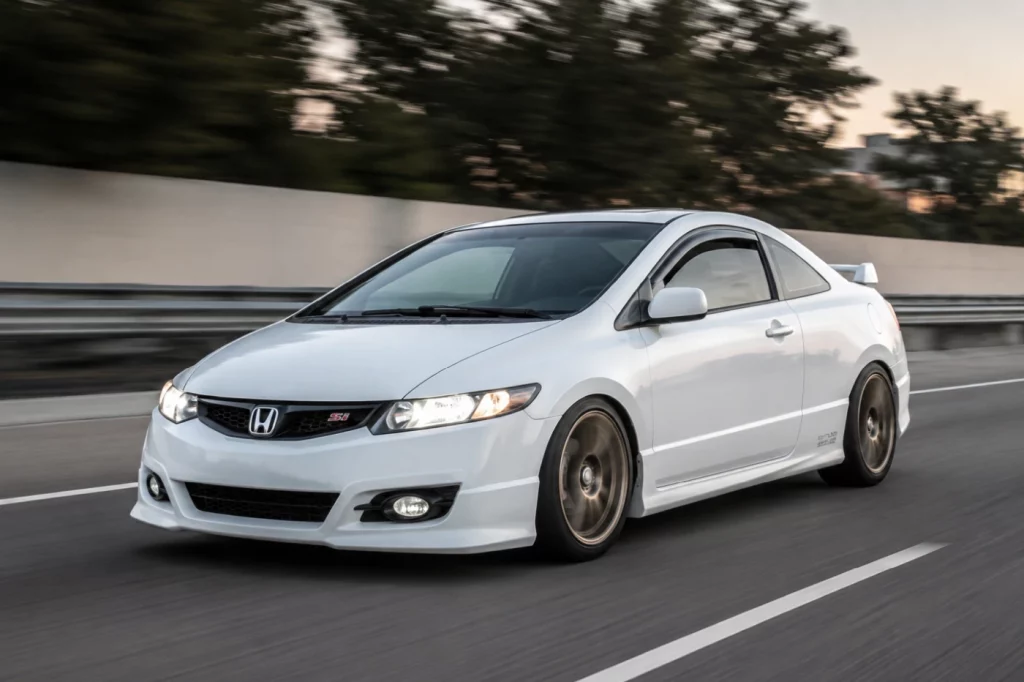
The answer depends on how you define worth. On paper, the Type R has 58 percent more horsepower, a track-tuned chassis, and hardware that the Si cannot match at any price. In daily driving, the gap is narrower than the spec sheet suggests. This article breaks down where the money goes and whether it matters for the way you drive.
Powertrain: Two Different Turbocharged Approaches
The Si uses a 1.5-liter turbocharged four-cylinder (L15CA) rated at 200 horsepower and 192 lb-ft of torque. Peak torque arrives at 1,800 rpm and holds to 5,000 rpm, which gives the Si strong mid-range response for a four-cylinder engine. The official 0–60 mph time from Honda is not published, but tested results from Car and Driver place it at approximately 6.6 seconds. The quarter-mile is in the low 15-second range.
The Type R uses a 2.0-liter turbocharged four-cylinder (K20C1) rated at 315 horsepower and 310 lb-ft of torque. The engine is fundamentally different — it uses a larger Turbocharger, a more aggressive cam profile, a higher-flow intake and exhaust system, and a dedicated cooling package with an additional radiator and an engine-oil cooler. The Type R reaches 60 mph in approximately 4.9 seconds and runs the quarter-mile in the low 13-second range at 104–107 mph, depending on conditions and tire temperature. Source: Honda Newsroom, 2025 Civic Type R specifications; MotorMatchup, 2025 Civic Type R performance data.
The real-world difference is not subtle. The Si requires gear changes to stay in the powerband during aggressive driving. The Type R has enough torque breadth to pull hard from 3,000 rpm to redline in a single gear, and the top-end pull is significantly stronger.
| Specification | Civic Si (2025) | Civic Type R (2025) |
|---|---|---|
| Engine | 1.5L turbo L15CA | 2.0L turbo K20C1 |
| Horsepower | 200 hp @ 6,000 rpm | 315 hp @ 6,500 rpm |
| Torque | 192 lb-ft @ 1,800–5,000 rpm | 310 lb-ft @ 2,600 rpm |
| Transmission | 6-speed manual | 6-speed manual |
| Curb weight | 2,952 lbs | 3,188 lbs |
| 0–60 mph | ~6.6 seconds | ~4.9 seconds |
| Quarter-mile | ~15.4 sec @ 91 mph | ~13.7 sec @ 104 mph |
| EPA combined MPG | 31 mpg | 24 mpg |
| MSRP (2025) | $31,445 | $47,090 |
Handling and Chassis: LSD vs. Adaptive Dampers
Both cars are front-wheel drive with a limited-slip differential, but the hardware is different in meaningful ways. The Si uses a helical limited-slip differential that passively transfers torque across the front axle when wheel slip is detected. It is the same type of LSD used in earlier Si generations, and it works well — Car and Driver rated the 11th-gen Si a 10/10 and noted that it has “impressive front-drive grip for the price.” Source: Car and Driver, 2023 Honda Civic Si Review.
The Type R uses a more aggressive Helical LSD combined with a dual-axis front suspension that reduces torque steer. The dual-axis design moves the pivot point of the front control arms to cancel the leverage effect that pulls the steering wheel under hard acceleration. On the Si, torque steer is present under full throttle in lower gears. On the Type R, it is nearly absent.
The suspension is where the gap widens significantly. The Si has a fixed-rate spring and damper setup tuned for sporty driving but designed for daily comfort. The Type R has adaptive dampers with three selectable modes (Comfort, Sport, and R), stiffer springs, larger sway bars, and additional chassis bracing throughout the body. In Comfort mode, the Type R’s ride is surprisingly compliant — one owner who upgraded from a 2022 Si to a 2023 Type R described Comfort mode as feeling “a bit softer than the stock Si,” with Sport dialing the firmness past the Si and R mode going even further. The same owner described R mode suspension as “comically bouncy but adds to the experience.” Source: CivicXI.com, “2022 Si upgraded to 2023 Type R — owner comparison review” (November 2022).
The Si’s advantage in handling is weight. At 2,952 pounds, the Si is approximately 236 pounds lighter than the Type R. In tight corners and during direction changes, the Si feels more nimble and eager. The Type R’s extra weight is noticeable during initial turn-in, but its superior tire grip (265/30R19 Michelin Pilot Sport 4S vs. the Si’s 235/40R18 all-season or summer tires), stiffer chassis, and adaptive dampers allow it to carry more speed through any corner once the suspension loads up.
On a track, the Type R is in a different class. MotorTrend’s long-term FK8 Type R completed a full 20,100-mile test period with no mechanical issues and consistently delivered lap times competitive with cars costing twice as much. The FL5 generation is even faster, with a Nürburgring lap time of approximately 7:44. The Si is not a track car in stock form — it is a capable back-road car that will overheat its front brakes and CVT-equipped models (if one existed — the Si is manual-only) within a few hot laps.
Daily Comfort and Livability
The Si is a genuinely comfortable daily driver. The ride is firm but not punishing, the seats are supportive without being aggressive, and the fuel economy (31 mpg combined) makes it practical for commuting. The rear seats fold down, but the sedan trunk opening limits cargo capacity compared to the Type R’s hatchback layout.
The Type R is louder, firmer, and more demanding as a daily driver — even in Comfort mode. The adaptive dampers help, and the suspension is more compliant than the outgoing FK8 generation, but the Type R still transmits more road noise into the cabin than the Si. The Type R has a more aggressive clutch engagement, a notchtier shifter feel (one Si-to-Type R owner reported that the Si’s shifter felt smoother, rating the Si a 10 and the Type R a 9.5), and the exhaust note is present at all times, even in Comfort mode. The tradeoff is that the Type R’s seats are dramatically better — one owner at 6’1″ and 200 pounds reported that the seats were “fantastic” and that the additional headroom from the lack of a sunroof was a welcome upgrade. Source: CivicXI.com, owner comparison review.
The Si has a sunroof, which reduces headroom for taller drivers. The Type R has no sunroof, which provides approximately one inch of additional headroom and lowers the car’s center of gravity by keeping mass lower in the body structure.
The Type R is a hatchback with fold-flat rear seats and a large cargo opening. The Si is a sedan with a traditional trunk. For anyone who transports bicycles, luggage, or bulky items, the Type R’s hatchback layout is materially more practical. That said, the Si’s trunk is still usable for most daily needs.
Long-term reliability: The Si uses the same L15 engine family found in many 10th- and 11th-gen Civics. The engine has a documented history of carbon buildup on intake valves (direct injection, no port injection), and some earlier examples experienced Oil dilution issues. The Type R’s K20C1 engine has been more robust in owner surveys and long-term tests. MotorTrend’s one-year, 20,100-mile test of an FK8 Type R returned zero mechanical issues and no unscheduled repairs. Source: MotorTrend, “2018 Honda Civic Type R Long-Term Verdict” (October 2019). The FL5 generation has been similarly reliable in owner reporting.
The Price Gap and What It Buys
The 2025 Civic Si starts at $31,445. The 2025 Civic Type R starts at $47,090. The difference is $15,645 before taxes, dealer markup, or optional accessories. And dealer markup on the Type R has been significant — many buyers in 2022–2024 reported paying $5,000 to $15,000 over MSRP. The Si has also seen markups, but less consistently.
For that price difference, the Type R buyer gets:
– 115 additional horsepower and 118 additional lb-ft of torque
– Adaptive dampers with three distinct modes
– Dual-axis front suspension (reduced torque steer)
– Larger brakes with two-piece front rotors
– 265-section Michelin Pilot Sport 4S tires on 19-inch forged wheels
– A hatchback body with significantly more cargo space
– Alcantara-wrapped steering wheel and shifter
– Digital gauge cluster with track-focused displays
– Additional engine and transmission cooling hardware
– A limited-slip differential with more aggressive tuning
– Stiffer chassis with additional bracing
The Si buyer gets a car that shares the same platform, the same transmission (with a smoother shifter feel according to owners), the same infotainment system, similar interior quality with less premium trim, and an engine that delivers approximately 63 percent of the Type R’s power output.
The Si is a more practical daily driver for most people. It gets better fuel economy, rides more comfortably on rough roads, attracts less attention, and costs significantly less to insure. The Type R is a car that requires compromise — the ride is firmer, the fuel consumption is higher, the insurance premiums are steeper, and the car attracts attention from enthusiasts and law enforcement alike.
Which One Should You Buy?
Buy the Civic Si if: you want a fun, practical, manual-transmission daily driver that handles well, gets 31 mpg, and costs under $32,000. The Si is one of the best values in the new-car market. Car and Driver has rated it 10/10 and included it on its 10Best list. It is engaging enough for back-road driving, comfortable enough for a commute, and reliable enough for long-term ownership. The only real compromise is that the Si will never be a track car without significant modification.
Buy the Civic Type R if: you plan to attend track days, you want a car that can compete with vehicles costing twice as much, and you are willing to accept a firmer ride, higher running costs, and additional attention. The Type R is one of the most capable front-wheel-drive cars ever built. It is also daily-drivable in Comfort mode, but that is a secondary capability — the car was designed to excel on a circuit, and it excels there.
The middle ground: for buyers who want more than the Si but cannot justify the Type R’s price or compromises, the used market offers a clear path. A 10th-generation Civic Si (2017–2021) with low miles can be found for $20,000–$25,000. Adding a downpipe, intercooler, and a Hondata tune to a 10th-gen Si brings power to approximately 230–240 horsepower for roughly $2,500 in parts, which closes much of the gap to the Type R’s acceleration without the Type R’s track-focused chassis hardware. The tradeoff is that no amount of modification to an Si will replicate the Type R’s adaptive suspension, dual-axis front geometry, or cooling capacity.
Quick-Reference Checklist
☐ Si (2025) — $31,445 MSRP, 200 hp, 192 lb-ft, 31 mpg combined, 2,952 lbs curb weight. Helical LSD, fixed-rate suspension. Manual only. 10/10 Car and Driver rating.
☐ Type R (2025) — $47,090 MSRP, 315 hp, 310 lb-ft, 24 mpg combined, 3,188 lbs curb weight. Aggressive helical LSD with dual-axis front suspension. Adaptive dampers with Comfort/Sport/R modes. Hatchback body. Manual only.
☐ Si is more comfortable as a daily driver — better ride quality on rough roads, quieter cabin, lower insurance costs, better fuel economy.
☐ Type R is a genuine track car that can also be daily-driven. The adaptive dampers in Comfort mode are softer than the Si’s fixed suspension, but road noise and exhaust noise are higher.
☐ The Shifter: Si shifter is smoother according to owner reports. Type R shifter is notchier but the clutch engagement is superior.
☐ The Si’s 200 hp is adequate for spirited daily driving. The Type R’s 315 hp is transformative, particularly above 5,000 rpm where the K20C1 pulls like a larger-displacement engine.
☐ Dealer markup on the Type R has been significant. Budget for $5,000–$15,000 over MSRP depending on your region. The Si is easier to find AT or near MSRP in most markets.
☐ The Type R hatchback is more practical for cargo. The Si sedan trunk is adequate for daily use but cannot carry large items.
☐ Si aftermarket is mature and affordable. A tuned 10th-gen Si with bolt-ons delivers approximately 85 percent of a stock Type R’s acceleration for a fraction of the cost. The Type R aftermarket is more expensive, but the car responds well to tuning (approaching 350–400 HP with bolt-ons and ethanol).
☐ Resale value on both cars is strong, but the Type R holds value exceptionally well. A 2023 FL5 Type R with 10,000 miles still sells for near its original MSRP in private-party transactions, while the Si depreciates more like a standard Civic with a slight premium.