

The 2025 Honda Civic Hybrid is not the first hybrid Civic, but it is the first one worth recommending without disclaimers about reliability, driving feel, or real-world fuel economy. The previous Civic Hybrid, sold from 2003 through 2015, used Honda’s Integrated Motor Assist (IMA) system — a mild hybrid setup that added roughly 13 to 20 horsepower to a 1.3L or 1.5L gasoline engine and struggled to deliver EPA numbers in real driving. The IMA system was also prone to premature battery failure, with Consumer Reports finding that nearly 20 percent of 2009 Civic Hybrid owners needed battery replacements within a 12-month survey period and out-of-warranty costs ranging from $2,000 to $4,000. Honda issued a TSB (12-077) extending the IMA battery warranty by 12 months and 12,000 miles, but the damage to owner confidence was done. Source: Consumer Reports, April 2013; AA1Car.com, “Honda Civic Hybrid Battery Failure”; TSB 12-077.
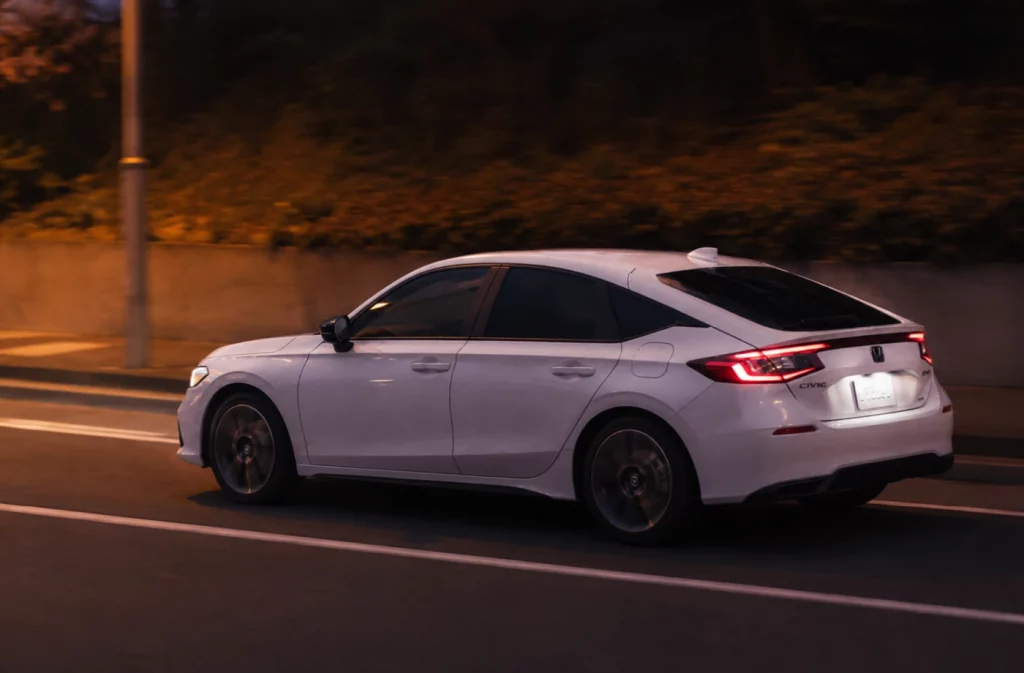
The 2025 Civic Hybrid is a fundamentally different architecture. It uses Honda’s two-motor hybrid system — the same powertrain found in the Accord Hybrid and CR-V Hybrid — with a 2.0L Atkinson-cycle four-cylinder engine, two electric motors, and an e-CVT that eliminates the conventional transmission’s belt-and-pulley design. The result is 200 combined horsepower, 232 lb-ft of torque, a 0-60 MPH time of 6.2 seconds (faster than any non-Type R Civic ever offered), and EPA fuel economy of 50 city / 47 highway / 49 combined in sedan form. The 2025 gas-only Civic LX and Sport use a 2.0L naturally aspirated K20C2 engine producing 150 hp and 133 lb-ft, with EPA combined ratings of 36 MPG (LX) and 34 MPG (Sport).
The question is not whether the hybrid is more efficient — it is. The question is whether the fuel savings and performance upgrade justify the higher purchase price for a given buyer’s driving pattern.
2025 Price Comparison: Hybrid vs. Gas by Trim
Honda simplified the 2025 Civic lineup by removing the EX and EX-L trims and replacing them with hybrid models that slot near the same price points. The gas models now cover just the LX and Sport trims; everything from Sport Hybrid upward uses the hybrid powertrain.
| Trim | Engine | MSRP (sedan) | MSRP (hatch) | EPA Combined |
|---|---|---|---|---|
| LX | 2.0L gas (150 hp) | $24,250 | — | 36 MPG |
| Sport | 2.0L gas (150 hp) | $26,250 | $27,450 | 34 MPG |
| Sport Hybrid | 2.0L hybrid (200 hp) | $28,750 | $29,950 | 49 MPG |
| Si | 1.5T gas (200 hp) | $29,950 | — | 31 MPG |
| Sport Touring Hybrid | 2.0L hybrid (200 hp) | $31,750 | $32,950 | 48 MPG |
Source: Honda official MSRP (incl. destination), Edmunds.com, MotorTrend “2025 Honda Civic Hybrid Price” (September 2024). EPA figures from fueleconomy.gov.
The premium for the Sport Hybrid over the Sport is approximately $2,500 for the sedan. That gap buys the hybrid powertrain, a sunroof, heated front seats, and dual-zone automatic climate control. The Sport Touring Hybrid is roughly $1,800 more than a 2024 Touring was, but adds the hybrid system and Google Built-In infotainment. Source: MotorTrend, “The New Honda Civic Hybrid Is More Powerful, Efficient, for Not Much More Money” (September 2024).
Real-World Fuel Economy: What Owners Are Reporting
The EPA numbers tell one story. The crowd-sourced data from Fuelly and controlled real-world tests tell another — and for the 2025 Civic Hybrid, the story is even better than the sticker.
Fuelly data from 159 2025 Civic owners across all trims shows a combined average of 41.88 MPG, but that number includes the non-hybrid 2.0L, Si, and Type R vehicles in the same sample. Isolating the hybrids reveals the real picture:
The 2025 Civic Sport Hybrid averages 49.1 MPG on Fuelly over 256 logged fuel-ups. One owner in Westborough, MA has tracked 46 consecutive fuel-ups, averaging 48.6 MPG with recent consecutive tanks of 52.5, 52.3, and 52.3 MPG. A Sport Touring Hybrid owner averaged 47.0 MPG over 22 fuel-ups with a best tank of 58.3 MPG. Source: Fuelly.com, users LilSlugga2002 and Tailwagger.
Cars.com conducted a controlled 200-mile mixed-driving test on the same route used for the Corolla Hybrid and Elantra Hybrid. The Civic Hybrid returned 52.0 MPG at the pump, 8 percent above its EPA combined rating of 48 MPG. The test was run in 45-50 degree Fahrenheit weather with climate control on Auto, no cruise control, and normal driving. Source: Cars.com, “What Real-World MPG Does the 2025 Honda Civic Hybrid Get?” (January 2025).
The Drive ran a two-month, 1,830-mile test with no hypermiling and no driving-behavior changes. The Civic Hybrid returned 51.2 MPG combined, above the EPA 49 combined rating. City-only driving on a full tank produced 53 MPG. Fill-ups averaged $38 in the Midwest. Source: The Drive, “I Drove a 2025 Honda Civic Hybrid for Two Months” (August 2025).
MotorTrend’s year-long loan produced a cross-country average of 38 MPG over 3,090 miles of highway driving at 75+ MPH across 14 states and mountain elevations. A MotorTrend single-tank highway hypermiling test at 70 MPH cruise control returned 44.7 MPG. The adjusted real-world average across the first month was 39.25 MPG. The hybrid’s smaller 10.6-gallon fuel tank (down from 12.4 gallons in the gas model) meant more frequent stops on the road trip, though each fill-up cost roughly $22–$35 depending on location. Source: MotorTrend, “2025 Honda Civic Hybrid Yearlong Review: Cross-Country Road Trip” (July 2025).
For comparison, the gas 2.0L Civic in real-world driving typically returns 32–37 MPG combined. Daily Motor’s highway fuel economy test of the 2025 Civic Sport (2.0L) at a steady 70 MPH returned 41 MPG, slightly above the EPA highway rating of 39 MPG. Owners on 11thGenForum with the 2022 LX 2.0L report 36–38 MPG in mixed driving and 40–42 MPG on highway trips. The gas models are efficient — the hybrid is simply operating in a different class.
| Metric | 2025 Civic Gas 2.0L | 2025 Civic Hybrid | Hybrid Advantage |
|---|---|---|---|
| EPA Combined | 34–36 MPG | 48–49 MPG | +13–15 MPG |
| Fuelly Real-World Avg | ~32–36 MPG | 47–51 MPG | +13–15 MPG |
| Highway at 70 MPH | 39–41 MPG | 45–47 MPG | +5–6 MPG |
| City Driving | 27–32 MPG | 50–53 MPG | +20+ MPG |
| Fuel Tank Capacity | 12.4 gallons | 10.6 gallons | Gas +1.8 gal |
| Range (mixed) | ~410–440 miles | ~480–520 miles | Hybrid +40–80 mi |
Sources: Fuelly.com, Cars.com real-world test (January 2025), Daily Motor highway test, 11thGenForum owner reports, MotorTrend year-long review (July 2025), The Drive long-term test (August 2025). Range calculated AT real-world averages on a full tank.
Fuel Cost Analysis: How Many Miles to Break Even
The hybrid premium of approximately $2,500 over the Sport gas model must be recovered through fuel savings, lower maintenance for certain components (the hybrid system uses regenerative braking that extends pad life), and potentially higher resale value. Here is the calculation based on current US average gas prices.
Assumptions: $3.50 per gallon of regular 87 octane (both vehicles use regular fuel). Real-world combined MPG of 34 for the gas 2.0L and 49 for the hybrid, based on Fuelly averages. The hybrid gets a 15 MPG combined advantage in real-world driving.
At 10,000 miles per year: The gas Civic consumes 294 gallons at $3.50/gallon = $1,029 per year. The hybrid consumes 204 gallons at $3.50/gallon = $714 per year. Annual fuel savings: $315. Break-even on the $2,500 premium: 7.9 years.
At 15,000 miles per year: Gas Civic consumes 441 gallons = $1,544/year. Hybrid consumes 306 gallons = $1,071/year. Annual savings: $473. Break-even: 5.3 years.
At 20,000 miles per year: Gas Civic consumes 588 gallons = $2,058/year. Hybrid consumes 408 gallons = $1,428/year. Annual savings: $630. Break-even: 4.0 years.
At 25,000 miles per year: Gas Civic consumes 735 gallons = $2,573/year. Hybrid consumes 510 gallons = $1,785/year. Annual savings: $788. Break-even: 3.2 years.
These are calculations with stated assumptions, not predictions. The break-even point shifts with gas prices at $4.00/gallon — the 15,000-mile break-even drops to 4.5 years. At $3.00/gallon, it extends to 6.2 years. The hybrid’s real-world advantage is greatest in city driving, so buyers whose commute consists primarily of stop-and-go traffic will reach break-even significantly faster than the mixed-driving calculation suggests.
The hybrid also comes with equipment that the gas Sport does not: a sunroof, heated front seats, and dual-zone automatic climate control. If those features have standalone value, the effective premium for the hybrid powertrain alone is smaller than $2,500.
Beyond Fuel Economy: Performance, Drivetrain Feel, and Ownership
The 2025 Civic Hybrid is not merely a fuel-economy play. The two-motor system provides instant torque from 0 RPM — 232 lb-ft of peak torque is available from a standstill, compared to the gas model’s 133 lb-ft at 4,000 RPM. The 0-60 MPH time of 6.2 seconds is 2.7 seconds quicker than the gas Sport’s approximately 8.9 seconds, and it is faster than any previous Civic Si with the exception of the current-generation model. The hybrid accelerates with a single-gear EV feel — no CVT drone, no gear hunting, no waiting for the torque band.
The e-CVT is mechanically different from the belt-driven CVT used in the gas models. It uses two electric motors and a fixed gearset to blend power from the engine and the battery. There are no belts or pulleys to wear out, and the system has proven reliable in the Accord Hybrid and CR-V Hybrid over hundreds of thousands of cumulative miles. Honda has been selling two-motor hybrids since the 2014 Accord Hybrid, and the architecture has not required major recalls or service campaigns.
The smaller fuel tank (10.6 gallons vs. 12.4 gallons) is a real trade-off. On a long highway trip at 75+ MPH, the hybrid’s range is approximately 400–420 miles — comparable to the gas model’s 420–440 miles because of the efficiency difference, but the hybrid needs fuel more frequently on a per-tank basis because of the smaller tank capacity. The MotorTrend cross-country trip confirmed that the car needed to stop for fuel more often than the driver wanted.
Historical Context: Why 2025 Is Different From Earlier Civic Hybrids
The earlier Civic Hybrid generations (2003–2015) used Honda’s IMA system, which placed a thin electric motor between the engine and transmission. It could not drive the wheels on electric power alone, produced only marginal efficiency gains over the gas model, and suffered from a well-documented battery failure issue. The 2009 Civic Hybrid had a nearly 20 percent battery replacement rate in a 12-month Consumer Reports survey period, and the repair cost ran $2,000–$4,000 for owners outside the warranty window. Honda extended the warranty through TSB 12-077 but never fully resolved the root cause of the undercharging problem that Honda attributed to “frequent stop-and-go city driving with the A/C on, especially during warm weather.”
The 2025 two-motor system is a completely different architecture. The e-CVT has no belt or pulley wear items. The battery is air-cooled but sits in a protected location behind the rear seat, and the system can drive the wheels on electric power alone at low speeds, which the IMA system could never do. The Atkinson-cycle engine runs in a narrower, more efficient RPM range, with the electric motor filling torque gaps. The reliability data from the Accord Hybrid and CR-V Hybrid — which use the same basic system — shows no pattern of premature battery failure or expensive component wear.
Resale Value and Total Cost of Ownership
Kelley Blue Book projects the 2025 Civic Hybrid’s 5-year cost-to-own at $51,771 with a Residual Value of $14,744 after 5 years and $15,356 in depreciation. KBB notes that resale values for the hybrid “may be better than those of the combustion-only Civic, which have topped the class quite comfortably.” The standard Honda Civic depreciates 22.7 percent over five years, according to iSeeCars data — significantly better than the compact car category average of 29.6 percent and the sedan average of 38.9 percent. The hybrid is expected to track at least as well as the gas model in resale, and possibly better, given market demand for fuel-efficient vehicles.
The hybrid’s regenerative braking system extends brake pad life — owners can expect 60,000–80,000 miles between front brake replacements compared to 40,000–50,000 on the gas model. There is no separate starter motor or alternator to fail (the hybrid system handles both functions), and the e-CVT eliminates the CVT belt replacement that some owners budget for at high mileage.
The trade-off: the hybrid’s added weight (approximately 220–250 pounds more than the equivalent gas model) affects handling feel, and the battery pack marginally reduces rear cargo capacity in the sedan (14.4 cubic feet vs. 14.8 in the gas sedan). Repair costs for hybrid-specific components are higher than for a conventional gas powertrain, though these failures are uncommon based on the broader Honda hybrid fleet data.
Which One to Buy
Buy the Civic Hybrid if:
☐ You drive 12,000 miles or more per year — the fuel savings will offset the price premium within 3–5 years.
☐ Your commute is primarily city or stop-and-go traffic — the hybrid advantage is largest in city driving, where it more than doubles the gas model’s MPG.
☐ You want the most responsive, quickest non-Type R Civic available — 0-60 in 6.2 seconds with instant torque is a real driving experience upgrade, not just an efficiency play.
☐ You plan to keep the car for 5+ years — the longer ownership window maximizes fuel savings and captures the hybrid’s better-than-gas resale trajectory.
☐ You want the additional equipment (sunroof, heated seats, dual-zone climate) that comes standard on the Sport Hybrid.
Buy the Civic Gas if:
☐ You drive under 10,000 miles per year — the break-even point extends past 7 years, which is longer than most original owners keep a new car.
☐ You want the lowest possible upfront price — the LX sedan starts at $24,250, which is $4,500 less than the cheapest hybrid trim.
☐ You prefer a simpler, lighter powertrain with no hybrid battery to consider at the 150,000-mile mark — the 2.0L K20C2 is a proven, naturally aspirated engine with no turbo, no hybrid components, and a reliable CVT.
☐ You take frequent long-distance highway trips at high speed — the hybrid’s highway MPG advantage narrows to 5–6 MPG, and the smaller fuel tank means more frequent stops.
☐ You live in a cold climate — the hybrid’s MPG advantage drops in winter (cold batteries reduce regen efficiency, and cabin heating runs the engine more often), though it remains more efficient than the gas model.