

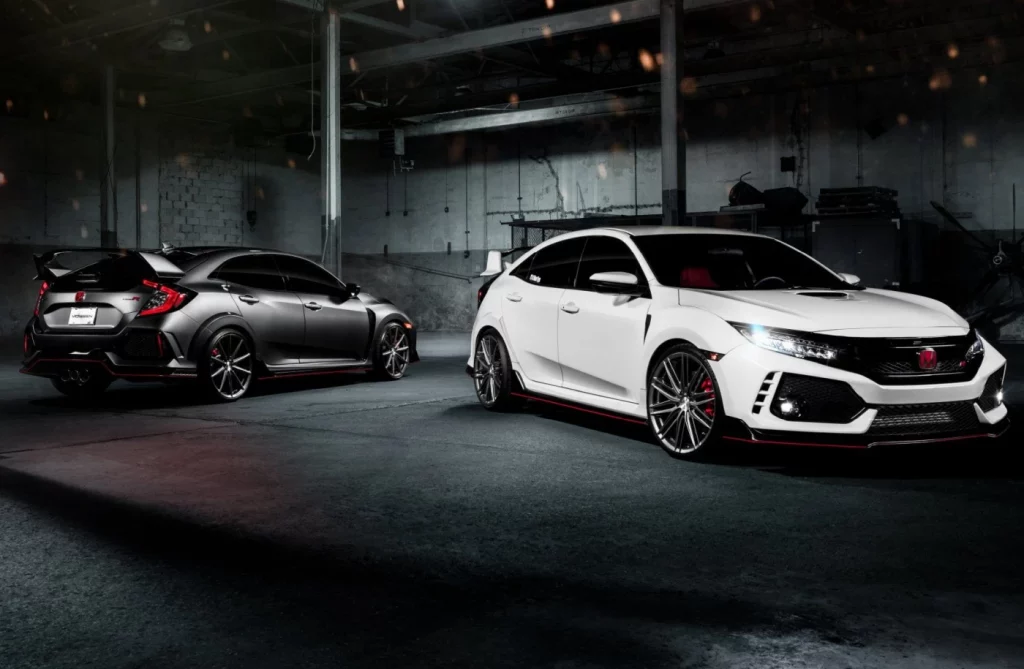
The FK8 (2017-2021) and FL5 (2023+) Civic Type R share the same K20C engine platform and attract a heavily documented owner community. Forum surveys, dyno threads, and build journals on CivicX, CivicXI, and the FL5 owners groups reveal clear patterns in what owners actually buy, in what order, and with what real-world results. This article covers the most common modifications by category, with supporting data from the community.
Tuning Platform: Hondata Is the Standard
Hondata FlashPro is the most widely used tuning platform across both generations (Edge Autosport, best first mods guide, 2024). The FlashPro unit costs $795, and the FK8 ECU requires a $250 instant jailbreak before it can be programmed. 2020-2021 US FK8 models also need a CAN gateway jailbreaker module ($75). The FL5 cannot use the instant jailbreak method and requires ECU removal for bench unlocking or a COBB AccessPort with a different unlock procedure.
COBB Tuning released an AccessPort solution for the Type R in December 2023 and has gained traction among FL5 owners, but Hondata remains the dominant choice due to earlier market entry and broader basemap support. KTuner is available for the FK8 but is significantly less popular among Type R owners compared to the 1.5T community (Edge Autosport).
Phearable.net is the most commonly recommended off-the-shelf calibration provider. Their Stage 2 tune for the FK8 produces:
– 362 hp / 371 lb-ft on a stock vehicle with 93 octane (Phearable, Stage 2 product page)
– 373 hp / 383 lb-ft with PRL intake, intercooler, and exhaust on 91 octane
– 386 hp / 393 lb-ft with PRL intake, intercooler, downpipe, and exhaust on 93 octane
That represents 50-57 hp over a stock tune on a stock car and 80 hp over stock with bolt-ons. The Phearable Stage 2 is compatible with stock turbos and intakes that use a stock-size MAF housing. It also features raised rev limit to 7,200 rpm, launch limiter at 4,000 rpm, and optional pops-and-bangs on deceleration.
The FL5 Phearable guide shows similar scaling: Stage 2 tune only produces 381 hp and 397 lb-ct (90 hp over stock). Adding bolt-ons (PRL intercooler, downpipe, front pipe, intake, inlet pipe, exhaust, charge piping) reaches 390 hp and 402 lb-ft on 93 octane (Phearable, FL5/DE5 modification guide).
Intake: PRL HVI Dominates, MAF Scaling Matters
The PRL High Volume Intake (HVI) is the most commonly reported intake on both FK8 and FL5 build threads. The 27WON intake and Eventuri carbon intake are also popular but less frequently seen than PRL.
The FK8 uses a voltage-based MAF sensor that can reach its 5-volt ceiling with increased boost, even on a stock intake (Edge Autosport). This means the FK8 benefits from an intake with a larger-diameter MAF housing earlier in the modification timeline. The FL5 uses a frequency-output MAF sensor that extends the usable range and reduces the urgency of this upgrade (Hondata, bolt-ons dyno test, 2024).
Intakes with stock-size MAF housings (PRL Street, 27WON, most drop-in designs) do not require tuning. Intakes with larger MAF housings (PRL Race, COBB Redline) require immediate MAF scaling calibration through Hondata or COBB (SBX Performance, FL5 mod order guide, 2026).
A common community observation is that the FK8 intake system benefits more noticeably from an early upgrade than the FL5, because the FL5’s factory airbox flows better from the factory.
Intercooler: Heat Management Is the First Real Limiter
The stock intercooler on both cars reaches heat-soak relatively quickly under sustained load. PRL Motorsports tested the FL5 intercooler on a 59-degree day and found the factory unit produced 0.6 psi of pressure drop and reached heat-soak after 8 consecutive power pulls, at which point Coolant temps reached 240 degrees (PRL, FL5 intercooler testing data, 2023).
The PRL intercooler upgrade produced 0.4 psi of pressure drop (less restriction), reached heat-soak 66% later, and settled at an equilibrium temperature 26 degrees cooler than stock. The dyno gains were modest (310 whp vs 302 whp stock, both untuned), but the consistency benefit on track is the real value. PRL’s intercooler achieved 15 back-to-back pulls before heat-soak vs. 8 on the stock unit.
Hondata’s bolt-on dyno test on the FL5 showed similar results: the intercooler alone produces a small peak power gain on the dyno but delivers much greater real-world benefit during sustained driving (Hondata, FL5 bolt-ons dyno test, 2024).
Popular intercooler choices in the community: PRL (most common), MDR (strong IAT drops and good fitment), COBB, HKS, and PWR (SBX Performance). The general recommendation is to do the intercooler before tuning, since reducing IAT2 keeps knock control low and allows the tune to deliver full timing.
Downpipe and Exhaust
Turbo Upgrades: Drop-In Options at Three Tiers
The stock MHI TD04 Turbocharger on the K20C runs out of steam around 380-400 whp on pump gas and falls off above 6,000 rpm. The community has settled on three tiers of drop-in replacements:
Entry upgrade (stock fuel, ~380-420 whp): The 27WON Kuro uses a TD04 CHRA with a ball-bearing center section, a point-milled billet compressor wheel (~50mm inducer / 67mm exducer), and a 9-blade Inconel turbine wheel. Owner reviews on CivicX report a linear power curve to 7,600 rpm with no dead spots, near-stock spool characteristics, and zero reliability issues over 20,000 km of mixed daily, track, and road-trip use. The Kuro retains all factory oil and coolant lines. Priced approximately $2,000.
Mid-range (supporting mods + fuel, ~420-520 whp): The MHI Stage 2 drop-in and the PRL P600 ($2,649) both target this range. The P600 uses a dual ceramic ball bearing CHRA, a 54mm inducer / 67mm exducer billet compressor wheel, and a 54mm inducer / 49mm exducer Inconel 713C turbine wheel. It retains factory oil and coolant lines and the factory bypass valve and wastegate actuator.
Top-end (fuel system required, 500-600 whp): The RV6 R660 moves to a full TD05 bearing housing with 8mm dual ceramic ball bearings, -10AN coolant lines, a MAR-M super-alloy turbine wheel, and a 0.81 A/R turbine housing. It produces approximately 501 whp AT only 26 psi on E30 and lives in the 520-570 whp range with proper fueling. The VTT GC turbocharger supports 500-550 whp using a G25-660 wheel combo. Both require upgraded fuel systems above 430 whp.
| Turbo | CHRA Type | WHP Range (pump gas) | WHP Range (ethanol + fuel system) | Price |
|---|---|---|---|---|
| 27WON Kuro | TD04 ball bearing | 380-420 | ~480 | ~$2,000 |
| 27WON Kuro+ | TD04 ball bearing | 400-430 | 520-580 | ~$2,200 |
| PRL P600 | Dual ceramic ball bearing | 400-450 | 500-600 | $2,649 |
| VTT GC | Journal bearing, enlarged | 400-450 | 500-550 | ~$2,200 |
| RV6 R660 | TD05 dual ceramic ball bearing | 430-450 | 520-570 | ~$3,000 |
Clutch: Stock Holds Longer Than Expected
The stock clutch on both FK8 and FL5 holds surprisingly well. One CivicX owner with a 556 whp / 440 lb-ft FK8 on the factory clutch reported the key was smooth torque delivery in the tune — bringing full torque in at 4,800 rpm instead of 4,200 rpm prevented slip (CivicX, Type R upgraded clutch options thread, 2023). Multiple owners report the stock clutch holding at 400-435 lb-ft with proper tuning.
Once the clutch does need replacement, the community’s most common choices are:
– Exedy Stage 1: Feels like stock, holds moderate power increases. Recommended by DRob at IMW for daily-driven cars making up to 450 lb-ft.
– ACT Heavy Duty 6-puck: Rated at 527 lb-ft (71% over OE), moderate pedal effort, aggressive engagement. Includes Streetlite flywheel. $1,341 for the full kit.
– Clutchmasters FX400: Full-face ceramic Disc, holds 700+ whp, daily-drivable. The most common choice for owners with upgraded turbos and fueling.
Wheels and Tires: 18-Inch Downsize Is the Norm
Downsizing to 18-inch wheels is the single most common handling modification across both generations. The FK8 ships on 20×8.5 +60 wheels with 245/30/20 tires. The FL5 improved this to 19×9.5 +60 with 265/30/19 tires. Most track-focused owners still downsize to 18-inch for better tire selection, lower tire costs, reduced rotational mass, and more sidewall for track abuse.
The most common track setup is 18×9.5 with 265/35/18 tires. The proven offset range is +38 to +45, with +38 being the most common for the RPF1 and +40 to +45 for the TE37 (System Motorsports, FL5 wheel fitment thread, 2023).
Enkei RPF1 (18×9.5 +38, 17-18 lbs, $1,000-1,200/set) is the most common track wheel in the Type R community. It clears the Brembo brakes with room to spare and is widely considered the best value option.
Volk TE37 (18×9.5 +40 to +45, ~15 lbs, $2,500-3,200/set) is the premium choice. The TE37SL in 18×9.5 +45 has been confirmed by multiple FL5 owners as a 100% bolt-on fit with 265/35/18 tires — no rubbing, no modifications required (System Motorsports).
Recommended tires: Michelin Pilot Sport 4S or Cup 2 for street/track use, Yokohama Advan A052 for competition.
Suspension and Chassis
The adaptive dampers on both FK8 and FL5 limit aftermarket shock options. Coilover choices that retain or delete the adaptive system are both common.
KW V3 is the most popular high-end coilover for both generations. Independent rebound and compression adjustment (12 clicks each), inox-line stainless steel construction, and a proven track record. The V3 allows lowering within a safe range without sacrificing suspension travel.
Öhlins Road & Track (~$3,000) is the premium option, commonly paired with Swift springs. Less common than KW due to price but highly regarded by owners who track their cars.
HKS HyperMax S offers 30-step damping adjustment with camber-adjustable front pillow upper mounts. Spring rates are 8.0 kg/mm front and 6.0 kg/mm rear.
Swift Spec-R lowering springs are the most common budget option for owners keeping the factory adaptive dampers. They lower approximately 1 inch while maintaining reasonable ride quality. Eibach Pro Kit is the second most common spring choice.
Rear motor mounts: Hasport 62A (street) is the most common upgrade. It reduces engine movement without adding significant cabin vibration. Owners consistently report improved shift feel and more predictable power delivery (Edge Autosport). The FK8 and FL5 rear mounts are interchangeable.
Fuel System and Flex Fuel
The stock fuel system on the K20C supports approximately 410-430 whp on ethanol blends and 430-450 whp on pump gas before the high-pressure Fuel Pump and injectors run out of capacity (Phearable, FL5 modification guide).
Hondata CANFlex ($550-700) is the most common flex fuel solution for both FK8 and FL5. It adds an ethanol content sensor and allows the ECU to read ethanol content in real time, adjusting timing and boost accordingly. CANFlex calibrations add approximately 70 hp and spool the turbo 200-400 rpm earlier on E85.
The Hondata fuel system (1530cc injectors, upgraded HPFP, high-flow lines) delivers 24% more fuel flow and supports power levels from 375 to 550 HP. It is required above 430 whp on pump gas or 410 whp on ethanol.
Phearable’s Stage 3 Flex Fuel calibration produces 401 hp / 402 lb-ft on the FL5 with bolt-ons and CANFlex, and 421 hp / 428 lb-ft with the upgraded fuel system.
Other Common Modifications
Catch cans: Radium Engineering catch cans are the most common. Owners running only one can install the PCV-side can. Owners who track their cars install both PCV and CCV cans (Edge Autosport).
Short shifter and bushings: Acuity instruments shifter Bushings and the Acuity short shifter are widely used. The FK8 and FL5 share the same shifter assembly.
Zestek CANbus steering hub: A popular interior modification that replaces the factory steering wheel with an aftermarket wheel (Sparco, Momo, OMP) while retaining factory controls through a CANbus interface. Priced at approximately $1,400.
Carbon fiber: The Type R community has an unusually high rate of carbon fiber upgrades compared to other platforms (Edge Autosport). Common items include duckbill spoilers (Carbon Sixth Element), EVS Tuning 5-piece body kits, hoods, mirror caps, interior trim, and engine covers.
Common Build Path
Based on forum surveys, build threads, and community guides (Edge Autosport, SBX Performance, Phearable), the most common modification order is:
1. ECU tuning (Hondata FlashPro + jailbreak + Phearable Stage 2)
2. Intake (PRL HVI Street or similar, no tune required)
3. Catch can (Radium PCV)
4. Rear motor mount (Hasport 62A)
5. Catback exhaust (AWE Touring or HKS Legamax — sound/weight, not power)
6. Downpipe and front pipe (PRL or 27WON catted)
7. Intercooler (PRL, MDR, or COBB)
8. Flex fuel (Hondata CANFlex)
9. Wheels and tires (18×9.5 + 265/35/18)
10. Coilovers (KW V3 or Öhlins)
11. Turbo upgrade (27WON Kuro or PRL P600)
12. Clutch (ACT 6-puck or Clutchmasters FX400)
13. Fuel system (Hondata kit with 1530cc injectors)
☐ Hondata FlashPro + jailbreak is the universal first mod — $795 + $250 + $75 (2020-2021)
☐ Phearable Stage 2: 362 hp stock / 386 hp with bolt-ons on 93 octane
☐ PRL HVI intake is the most common; FK8 needs intake earlier than FL5 due to MAF limits
☐ PRL intercooler: 0.4 psi drop vs 0.6 psi stock, 15 pulls vs 8 to heat-soak
☐ Downpipe + front pipe add the most power after tuning; catted preferred for street use
☐ 18×9.5 with 265/35/18 is the standard track wheel setup; RPF1 most common, TE37 premium
☐ Stock clutch holds 400+ lb-ft with smooth torque delivery tuning
☐ Turbo upgrades range from 27WON Kuro (380-420 whp) to RV6 R660 (520-570 whp)
☐ Hondata CANFlex adds ~70 hp on E85; fuel system needed above 430 whp on pump gas
☐ Radium catch can (PCV) is a common preventative mod
☐ Hasport 62A rear motor mount improves shift feel and power delivery
☐ Carbon fiber aero is disproportionately popular in the Type R community
☐ FK8 and FL5 share many parts (mounts, shifter, turbo drop-in fitment, intercooler sizing)