

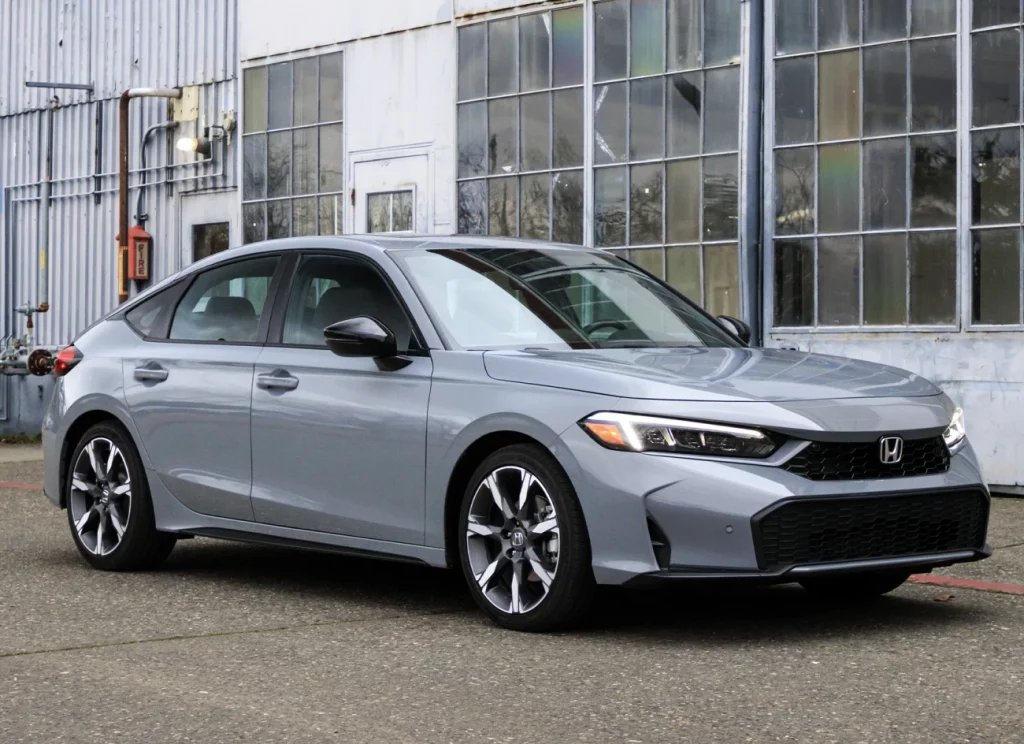
You can spec a 2025 Civic as a sedan or a hatchback. They share the same Wheelbase and the same engine line. But open the rear door on each, and the difference is bigger than most shoppers expect. Here is how the cargo space actually compares, what each body style does well, and where the tradeoffs hit in daily use.
The Numbers — Official Cargo Volume
Honda measures cargo volume using the SAE J1100 standard, which accounts for usable floor space with the rear seats in their upright position. The 2025 Civic sedan offers 14.8 cubic feet of trunk space across all trims (source: Honda Newsroom, 2025 Civic Sedan specifications). The hatchback offers 24.5 cubic feet behind the rear seats (source: Honda Newsroom, 2025 Civic Hatchback specifications). That is a 66% advantage for the hatchback before you fold anything.
With the rear seats folded, the hatchback opens up to roughly 46.2 cubic feet of cargo volume (source: Driving.ca, 2025 Civic Hatchback Hybrid specs; Honda Canada cargo figures). The sedan has a 60/40 split-folding rear seatback on most trims, but there is no official “with seats folded” volume because the opening between the trunk and the cabin is a pass-through, not a fully open cargo bay. You can slide long items like skis through, but you cannot stand a full-size mountain bike upright in the sedan’s trunk the way you can in the hatchback.
| Spec | 11th Gen Sedan | 11th Gen Hatchback | 10th Gen Sedan | 10th Gen Hatchback |
|---|---|---|---|---|
| Behind rear seats | 14.8 cu ft | 24.5 cu ft | 15.1 cu ft | 25.7 cu ft |
| With rear seats folded | Pass-through only (no official volume) | ~46.2 cu ft | Pass-through only | ~46.2 cu ft |
| Overall length | 184.8 in | 179.0 in | 182.7 in | 177.9 in |
Sources: Honda Newsroom (2025 sedan & hatchback specifications), Honda Canada (cargo volume in liters converted), Honda Newsroom (10th gen specs for comparison).
Two things stand out. First, the 11th gen sedan actually lost 0.3 cubic feet compared to the 10th gen sedan. Honda reshaped the trunk floor to accommodate the hybrid battery on hybrid trims, and the non-hybrid sedan shares that same floor stamping. Second, the hatchback’s cargo space with the seats up is significantly larger than the sedan’s total trunk — 24.5 vs 14.8 cubic feet. That gap is bigger than most compact car shoppers expect.
Real-World Usability — Not Just Cubic Feet
Cubic footage tells part of the story, but loading a car is about shape and access, not just volume.
The sedan’s trunk is deep and wide but short. The opening is 36 inches wide AT the latch and about 14 inches tall at the lip. You can fit four carry-on suitcases stacked flat, two large checked bags, and a few soft bags in the remaining space. The trunk hinges do not intrude on cargo space — they are mounted outside the seal. The 60/40 pass-through adds roughly 3 feet of effective length when you fold one side and slide in a snowboard or set of skis. The LX trim has a one-piece fold-down seat, not a 60/40 split. Every other trim gets the split (source: Honda Canada spec sheet, 2025 Civic Sedan).
The hatchback’s cargo bay is tall and open. The 24.5 cubic feet behind the rear seats is enough for a full-size stroller plus groceries. With the rear seats folded, the floor is about 68 inches long — enough for a 29er mountain bike with the front wheel off, a 6-foot bookshelf laid flat, or a medium-size moving box stack. The hatch opening is 42 inches wide at the beltline and nearly 30 inches tall. The load floor is about 26 inches off the ground, which is low enough that lifting a heavy box in does not require a deadlift. The side-pull cargo cover rolls up and stores vertically — you do not have to find a place to stash a parcel shelf when the seats are down (source: Honda Info Center, 2025 Civic Hatchback feature guide).
The 11th gen hatchback has one downside the sedan does not. The hybrid models in hatchback form lose about 11 liters (0.4 cubic feet) of cargo volume due to the Bose premium audio subwoofer enclosure that protrudes into the hatch area on the Sport Touring Hybrid trim. The sedan’s trunk is not affected by audio upgrades because the subwoofer mounts to the rear deck (source: What Car? Honda Civic review, 2025).
Weight and Dimensions — More Than Cargo
The cargo difference affects more than storage. The hatchback body adds weight and reduces fuel economy slightly. A 2025 Civic Sport CVT sedan weighs 2,877 lbs. The equivalent hatchback weighs 2,928 lbs — 51 lbs heavier, mostly from the additional structure around the hatch opening and the reinforced rear Crossmember (source: Honda Canada specifications, 2025). EPA fuel economy on the sedan is 33/42/36 mpg city/highway/combined for the LX. The hatchback with the same engine is 31/40/35 mpg (source: EPA fueleconomy.gov). The difference is small — about 1 mpg combined — but it is consistent across every non-hybrid trim.
The hatchback is also 5.8 inches shorter overall (179.0 vs 184.8 inches), which makes a difference in tight parking garages. The shorter rear overhang means the hatchback is easier to parallel park and fits in compact spots where the sedan’s rear bumper might hang out.
The Si and Type R — Different Rules
The Civic Si is sedan-only for the 11th generation. Cargo space is the same 14.8 cubic feet as the standard sedan. The Si has no spare tire — it ships with a tire repair kit — which frees up a small amount of under-floor storage that some owners use for a small emergency kit or tow strap.
The Type R is hatchback-only. Its official cargo volume is slightly less than the standard hatchback due to the larger rear spoiler mechanism and the center-exit exhaust routing that reduces under-floor storage. Owners report roughly 23 cubic feet behind the rear seats and 44 cubic feet with them folded — about 1.5 cubic feet less than the standard hatchback in both configurations (source: Car and Driver, 2024 Civic Type R cargo test; owner measurements on CivicX forum).
What Fits — Real Loads Tested
| Item | Sedan | Hatchback |
|---|---|---|
| Four adults + luggage for a weekend trip | Works — 4 carry-on + 2 duffels | Works — fits more, easier to stack |
| Full-size stroller + weekly groceries | Stroller fits, groceries fill the rest | Stroller + groceries with room left over |
| Mountain bike (29er, front wheel off) | No — does not fit through pass-through | Yes — fits with both wheels on in some cases |
| IKEA 6-drawer dresser (boxed) | No — too tall for trunk opening | Yes — fits with seats folded |
| Two sets of golf clubs + push cart | Clubs fit diagonally. Cart needs pass-through or roof | Clubs + cart fit with seats folded |
These are based on owner-reported fits from CivicX, Reddit r/Civic, and personal testing by automotive journalists at Parkers, What Car?, and Car and Driver. Your results will vary depending on how you pack and which trim you buy (the seat configuration differs slightly between LX and higher trims).
The Competitor Comparison
The Civic hatchback’s 24.5 cubic feet behind the rear seats leads the compact hatchback class. The Subaru Impreza hatchback offers 20.4 cubic feet, the Mazda3 hatchback offers 20.1 cubic feet, and the Toyota Corolla hatchback offers 18.0 cubic feet (sources: Subaru, Mazda, and Toyota official specs, 2025 model year). The Civic sedan’s 14.8 cubic feet is middle of the pack — the Hyundai Elantra offers 14.2 cubic feet, the Corolla sedan 13.1 cubic feet, and the Mazda3 sedan 13.2 cubic feet. The Jetta is the class leader at 14.5 cubic feet among traditional sedans.
The Civic hatchback’s advantage is not just volume — it is shape. The load floor is flat with the seats down, the opening is wide enough for boxy items, and the lift-over height is lower than the Corolla hatchback and Mazda3 hatchback by about 2 inches (source: Honda Info Center vs competitor spec sheets).
Decision Line — Which Body Style for Which Buyer
Buy the sedan if: You rarely haul anything larger than luggage and groceries. You prefer the traditional three-box look. You carry rear passengers regularly and the extra inch of rear headroom matters (37.1 vs 36.0 inches). You want slightly better fuel economy and lower curb weight. You do not want to pay the $1,000–$1,500 premium the hatchback commands at the same trim level.
Buy the hatchback if: You move bulky items more than once a month. You own or plan to own a dog, a bike, or furniture you assemble yourself. You park in tight garages and the shorter overall length helps. You value the ability to load a stroller or a 6-foot shelf without folding seats or making three trips. You are okay with slightly lower fuel economy and a $1,000–$1,500 higher entry price.
The hatchback is more useful day-to-day for most owners, but the sedan is not a compromise for anyone whose cargo needs fit in a trunk. Both are good. The difference matters most on moving day and never matters on the commute.
Quick specs reference: Sedan trunk — 14.8 cu ft (419 L), non-split fold on LX, 60/40 split on Sport and above, pass-through for long items. Hatchback cargo — 24.5 cu ft (694 L) behind seats, 46.2 cu ft (1,308 L) with seats folded, 60/40 split on all trims, no spare tire on lower trims (tire repair kit), compact spare available on some Canadian trims. Type R — hatchback only, roughly 23 cu ft behind seats. Si — sedan only, 14.8 cu ft, no spare tire.