

What Can You Actually Haul? Honda Civic Payload Limits Explained
The Honda Civic is not a truck and does not pretend to be one. But for a compact car, it can carry a surprising amount of weight — provided you understand where the limits are and what happens when you push past them.
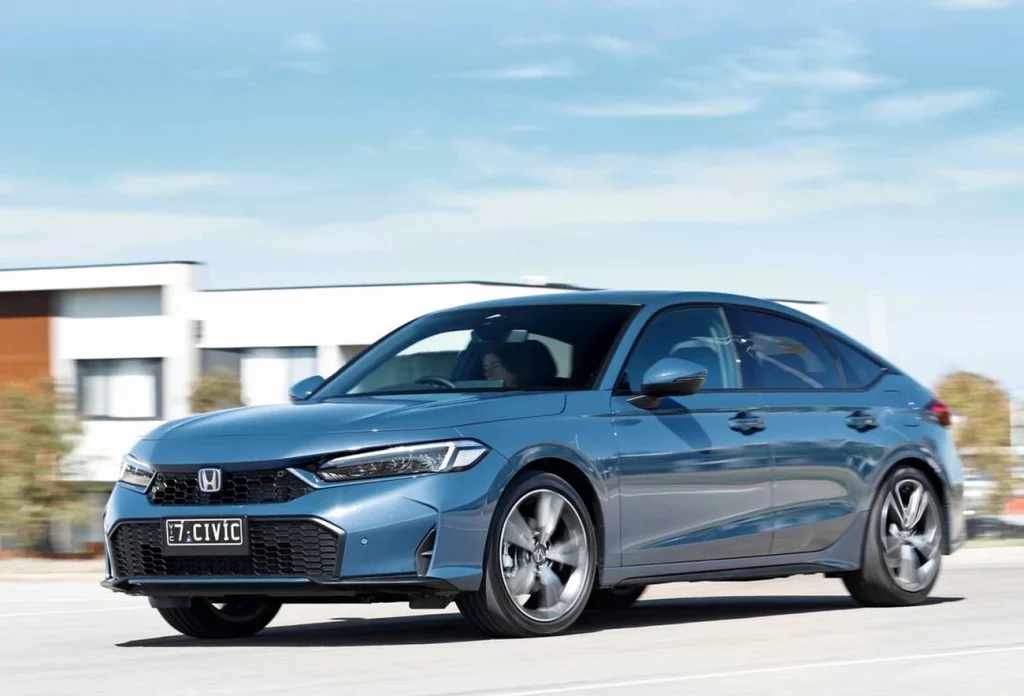
The official payload for the 11th generation Civic sedan is 850 lbs (385 kg), as printed on the Tire and Loading Information label inside the driver’s doorjamb (source: Honda 2023 Civic Sedan Owner’s Manual). That number includes the driver, every passenger, everything in the trunk, anything on the roof, and the tongue weight of a trailer if you are towing one.
Here is where most articles get it wrong: payload is not “how much stuff you can throw in the trunk.” It is the total weight added to the empty car. A Civic with five average-sized adults (say 160 lbs each) is already AT 800 lbs — leaving 50 lbs for cargo. That is one checked suitcase and a backpack. A family of four at 180 lbs each plus a driver at 200 lbs is already over the limit before the trunk opens.
Payload by Generation and Body Style
The 850 lbs figure applies to the 11th gen Civic sedan. Other generations and body styles have slightly different limits based on their Gross Vehicle Weight Rating (GVWR) and curb weight. The payload is the difference between GVWR and curb weight — so heavier trims (hybrid, Sport Touring) have less payload capacity even though the GVWR is the same.
| Generation | Body Style | Curb Weight | Payload | GVWR |
|---|---|---|---|---|
| 11th Gen (2022–present) | Sedan LX/Sport | 2,875–2,935 lbs | ~850 lbs | ~3,725 lbs |
| 11th Gen | Hatchback Sport | 2,976 lbs | ~750–800 lbs | ~3,725 lbs |
| 11th Gen | Sport Touring Hybrid | 3,252 lbs | ~470–500 lbs | ~3,725 lbs |
| 11th Gen Si | Sedan | 2,952 lbs | ~770 lbs | ~3,725 lbs |
| 10th Gen (2016–2021) | Sedan LX/Sport | 2,770–2,877 lbs | ~850 lbs | ~3,620–3,725 lbs |
Payload varies by trim more than most buyers expect. A base LX sedan can carry roughly 850 lbs. A fully loaded Sport Touring Hybrid sedan, with its heavier battery and electric motors, drops to about 470–500 lbs — nearly half. That means a hybrid owner with two passengers is already at the limit without any cargo. The GVWR itself does not change between trims; the heavier the car is empty, the less it can carry.
What 850 Pounds Looks Like in Real Life
Numbers on a doorjamb label do not mean much until you translate them into actual loads. Here is what 850 lbs of payload covers in a Civic sedan versus a hatchback:
| Scenario | Occupants | Cargo Allowed | Verdict |
|---|---|---|---|
| Solo commute + weekly groceries | 1 × 180 lb driver | 670 lbs | No issue — trunk holds ~150 lbs max of groceries |
| Weekend trip, two people | 2 × 170 lbs | 510 lbs | Fine — four fully packed suitcases run ~200 lbs |
| Family of four, Costco run | 2 × 180 lbs + 2 × 60 lbs | 370 lbs | Manageable — but fill the trunk carefully |
| Five adults to the airport | 5 × 170 lbs | 0 lbs | At the limit with only passengers — zero cargo |
| Hybrid with four adults | 4 × 170 lbs (680 lbs) | Over limit (GVWR ~3,725, Hybrid ~3,252 + 680 = 3,932) | Overloaded — heavier curb weight leaves no room |
The fifth row is the one most Civic owners miss. A Sport Touring Hybrid weighs 3,252 lbs empty. With four 170 lb adults, the car weighs 3,932 lbs — exceeding a typical 3,725 lb GVWR by over 200 lbs. The car drives, handles, and brakes differently at that weight. The suspension compresses further into the bump stops. Braking distance increases. The transmission runs hotter.
Can You Tow With a Honda Civic?
Honda USA says no. The official towing capacity for the Civic, across every trim and every model year of the 11th generation, is zero pounds. The Civic has no transmission cooler provision, its braking system is not engineered for trailer loads, and the unibody structure is not reinforced for hitch stress (source: Honda Civic Owner’s Manual).
The aftermarket tells a different story. Brands like Curt and Draw-Tite sell 1.25-inch receiver hitches for the Civic, and thousands of owners install them for bike racks and cargo carriers. A two-bike e-bike rack with bikes weighs roughly 100–130 lbs on the hitch. That is not towing — the weight sits on the hitch as tongue load, with no trailer dragging behind. The car does not pull anything; it just carries the weight on the rear chassis.
Most CivicX forum consensus treats a hitch-mounted bike rack as acceptable for occasional use, provided total hitch load stays under 200 lbs, the driver accounts for that weight within the payload limit, and rear lighting clearance is maintained (source: CivicX forum, Curt Manufacturing hitch documentation). This is not Honda-approved. If something breaks — rear Subframe damage, differential housing crack, electrical failure — Honda will not cover it.
For anything with wheels — pop-up camper, jet ski trailer, utility trailer — the Civic is the wrong vehicle. Buy a small truck or a utility trailer rental.
Cargo Volume: Sedan vs Hatchback
Payload is about weight. Cargo volume is about space. The two are independent: you can fill a hatchback to the roof with packing peanuts and stay within payload, or you can put a single engine block in the trunk and exceed it.
The 11th gen Civic sedan offers 14.8 cubic feet in the trunk. The hatchback offers 24.5 cubic feet behind the rear seats — roughly 65% more volume. Folding the rear seats opens up significantly more space in the hatchback, while the sedan has a fixed cargo-pass-through behind the rear armrest (source: Honda 2025 Civic specifications, Car and Driver).
| Item | Sedan (14.8 cu ft) | Hatchback (24.5 cu ft) | Difference |
|---|---|---|---|
| Grocery bags (1 cu ft each) | Up to 14 | Up to 24 | +10 bags |
| Carry-on suitcases (1.6 cu ft) | Up to 9 | Up to 15 | +6 carry-ons |
| Large checked suitcase (3.4 cu ft) | Up to 4 | Up to 7 | +3 suitcases |
| 48-qt cooler (1.6 cu ft) | Up to 9 | Up to 15 | +6 coolers |
What Happens When You Exceed the Payload Limit
Overloading a unibody compact car is not the same as overloading a body-on-frame truck. The consequences are less forgiving. Here is what actually happens, in order of severity:
Suspension bottoming. The rear springs on the Civic are calibrated for a specific load range. Exceeding GVWR by even 100–200 lbs pushes the rear suspension into its bump stops on moderate bumps. That transfers impact force directly into the unibody rather than dissipating it through the springs.
Brake fade under load. The Civic uses front Disc brakes sized for a 2,900–3,200 lb car. At 3,800 lbs, the same brakes generate more heat per stop. On a downhill grade with a loaded car, brake fade arrives sooner. The pedal stays firm, but stopping distance grows noticeably.
Transmission heat. The Civic CVT relies on an air-to-oil cooler. Under continuous heavy load — mountain grades, sustained highway speeds at max payload — transmission fluid temperatures climb above the normal 180–200°F range. Honda does not publish a hard thermal limit, but extended operation above 230°F accelerates CVT belt wear (source: CivicX transmission failure data, Honda service manual references).
Tire overload. The Civic’s stock tires are rated for specific load indexes. A 235/40R18 tire on a Civic Si typically carries a 91 load index (1,356 lbs per tire at max pressure). Four tires at max pressure can support 5,424 lbs, which is well above GVWR — so tires are rarely the limiting factor unless they are underinflated.
Insurance and liability. If you crash while overloaded — meaning the car’s actual weight exceeded GVWR — and the insurance adjuster finds the Tire and Loading Information label photo from the scene, the claim can be denied or reduced. This is rare but documented in overweight vehicle accident claims.
Payload by Trim — The Heavier the Trim, the Less It Carries
The GVWR on the 11th gen Civic is approximately 3,725 lbs across all trims. That means the payload is simply the GVWR minus the curb weight of the specific trim. Hybrid and Touring trims sacrifice 150–380 lbs of payload versus the base LX because the car is already heavier before anyone sits in it.
| Trim | Curb Weight | Payload (Approx.) | Payload Loss vs LX |
|---|---|---|---|
| LX Sedan | 2,875 lbs | ~850 lbs | — |
| Sport Sedan | 2,935 lbs | ~790 lbs | -60 lbs |
| Si Sedan | 2,952 lbs | ~773 lbs | -77 lbs |
| Sport Hatchback | 2,976 lbs | ~749 lbs | -101 lbs |
| Sport Hybrid | 3,142 lbs | ~583 lbs | -267 lbs |
| Sport Touring Hybrid | 3,252 lbs | ~473 lbs | -377 lbs |
The Sport Touring Hybrid loses 377 lbs of payload versus the base LX — roughly the weight of two adult passengers. If you regularly carry four people and cargo, the base LX is functionally more useful than the top-trim hybrid, even though it has less equipment.
Quick Reference Checklist
Find the payload label: Open the driver’s door and look for the Tire and Loading Information sticker on the doorjamb. That is the official number for your specific car — not a generic internet figure.
Account for every occupant: Payload includes all people, not just cargo. A family of four burns through 500–700 lbs before the trunk opens.
Hybrid trims carry less: The Sport Touring Hybrid has roughly 473 lbs of payload — that is two average adults and nothing else.
Do not tow with a Civic: Honda rates the Civic at 0 lbs towing capacity. Hitch-mounted bike racks are a gray area — keep total load under 200 lbs.
Hatchback holds more volume, not more weight: 24.5 cu ft versus 14.8 cu ft, but the same GVWR applies. You can fill a hatchback with lightweight items. Heavy items still count against payload.
Overloading affects braking and transmission heat first: Suspension bottoming is noticeable. Brake fade and CVT overheating happen gradually and are easy to miss.
Check tire pressure when loaded: Max-sidewall pressure (usually 44–51 psi) is safe for full loads. Do not run door-sticker pressure (32–35 psi) when the car is near GVWR.
The 850 lbs figure is for the base LX sedan only: Every other trim has lower payload. Verify your specific trim before loading up.