

If you’re shopping for a used Civic in the US, understanding Honda’s automatic braking and forward collision warning (FCW) setups is critical. One model year you get a passive system that just beeps AT you angrily while you’re about to rear-end a box truck. The next year, you get a full autonomous robot that slams the brakes for you.
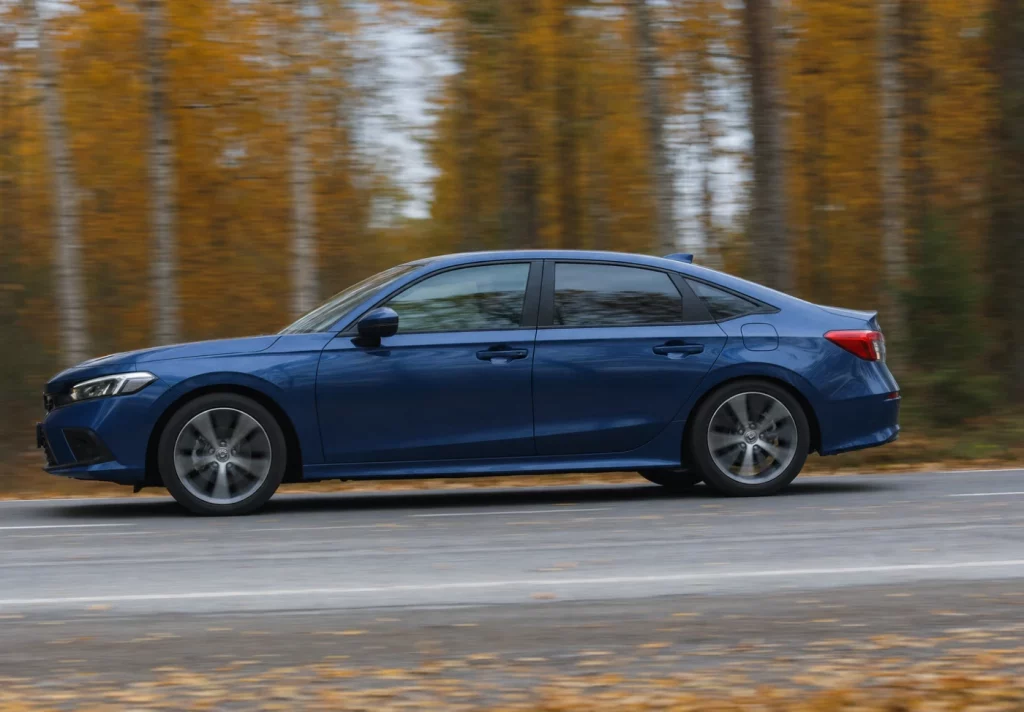
Let’s cut through the corporate brochures. Here’s the raw, garage-tested chronological breakdown of how the Civic’s front crash protection evolved, why some generations suffer from terrifying phantom braking, and which years are the safest bets for your daily driver.
9th Gen (2013–2015) — The Useless Hybrid-Only Beeper
The 9th Gen (FB6/FG4) was mostly a dark age for active safety tech. Honda essentially ignored gasoline models and locked forward collision warnings behind the expensive Hybrid trim starting in 2013.
The Hardware: A single camera glued behind the rearview mirror. No radar. No sonar. Just a cheap camera and hope.
How it Worked: This was a warning-only setup. If a car brake-checked you on the highway, the dashboard would flash a warning light and emit a cheap chime. That’s it. No brakes. No assist. Just a beep.
The Critical Flaw: It had ZERO automatic braking (CMBS). If you fainted or stared at your phone, the car would happily crash into the bumper ahead while beeping all the way down. Like a sad, screaming robot watching you die.
IIHS Verdict: Rated a pathetic Basic. Gasoline Si, EX, and LX models got absolutely nothing — just old-school brake pads and human reflexes. The Hybrid buyers got the beeper. Everyone else got a middle finger from Honda.
10th Gen (2016–2021) — The Radar + Camera Fusion Era (With a Phantom Tax)
The 10th Gen (FC1/FC3/FK7) completely flipped the script with the debut of Honda Sensing. This wasn’t a cheap beeper — it was a true automated braking setup that could actually save your bumper.
The Hardware (Sensor Fusion): A millimeter-wave radar unit hidden right behind the shiny Honda grille emblem combined with a windshield-mounted camera. Two eyes. Two brains. One mission: don’t let you crash.
How it Worked: The radar measured raw distance and speed, while the camera classified objects (cars vs. pedestrians). If the system detected an imminent hit, it flashed “BRAKE” on the gauge cluster, pre-charged the brake lines, and slammed the Calipers shut if you didn’t react. It was the first Civic that could actually save your ass without your help.
IIHS Verdict: Jumped straight to a flawless Superior rating, avoiding collisions completely at both 12 mph and 25 mph tests. Finally, Honda was serious.
The Real-World Nightmare — Phantom Braking: 10th Gen forums are packed with complaints about phantom braking. The grille radar is notorious for getting confused by overhead steel bridge expansions, road signs, or shadows inside parking garages, slamming on the brakes at 70 mph with nobody in front of you. Nothing quite like your car panic-stopping on the highway because it thought a bridge shadow was a truck.
The Stealer Calibration Tax: If a parallel parker taps your front grille emblem and tweaks the radar bracket by just 0.5 degrees, the whole system shuts down. Getting a dealer to dynamically recalibrate that radar grid will run you anywhere from $200 to $400. A minor parking lot bump just turned into a four-figure repair bill.
The Performance Omission: Honda didn’t offer Sensing standard on most models until 2019–2020. And the track-focused 2017–2021 FK8 Type R? It has ZERO forward collision tech. No FCW. No CMBS. No ACC. Nothing. Track boys had to rely on pure driver skill and good luck. A $40,000 performance car with less safety tech than a base 2019 LX.
Availability Rollout:
- 2016–2018: Optional on most trims. Standard only on Touring. Si and Type R got nothing.
- 2019: Standard on all sedan/coupe trims. Hatchback still optional. Si and Type R still nothing.
- 2020–2021: Standard on everything except the Type R. Even the Si got it. Type R? Still nothing. Honda just didn’t care about Type R buyers having modern safety.
11th Gen (2022–Present) — The Clean Wide-Angle Camera Fort
For the 11th Gen (FE1/FL1/FL5), Honda engineers completely lost patience with the finicky grille radar modules. They ripped them out entirely, shifting to a single wide-angle monocular camera architecture.
How it Works: The new camera uses an ultra-fast digital processor with a massive field of view that can detect cars, lane markings, cyclists, and pedestrians even at night. It’s the same tech philosophy as Tesla — all camera, no radar. Whether that’s a good thing depends on where you live.
The Good News: Because there is no radar module hanging behind the front bumper cover, you can take a minor front-end hit without paying a $400 recalibration bill to a body shop. ACC braking is significantly smoother, and phantom braking events dropped drastically. Plus, even the brutal FL5 Type R finally got standard automated braking. Honda finally stopped screwing performance buyers.
The Weather Trap: Ripping out the radar removed any system redundancy. If you hit a blinding downpour on a highway or heavy morning fog, the camera goes blind, throws a “Driver Support System Reduced” error, and shuts off entirely until the glass clears up. The 10th Gen’s radar could see right through rain. The 11th Gen camera cannot. You’re trading phantom braking for weather blindness.
IIHS Verdict: Solid Superior vehicle-to-vehicle rating, with an added Superior for daytime pedestrian detection. Nighttime pedestrian safety steps down slightly to Advanced. It’s the safest Civic ever built — until it rains.
| Metric / Feature | 9th Gen (2013–15) | 10th Gen (2016–21) | 11th Gen (2022+) |
|---|---|---|---|
| Primary Sensors | Windshield Camera Only | Windshield Camera + Grille Radar | Wide-Angle Windshield Camera Only |
| Autobrake (AEB)? | NO (Warning Only) | YES (Full Autonomous Grab) | YES (Smoother Digital Grab) |
| IIHS Rating | Basic (Hybrid Only) | Superior (with Sensing) | Superior (Standard Fleet-Wide) |
| Pedestrian Night Eye | Blind | Daylight Only (Untested) | Advanced (Best with High Beams) |
| Radar Calibration Tax | N/A | $200–$400 | $0 (No Radar) |
| Works in Heavy Rain? | No (Camera Blind) | Yes (Radar Sees Through) | No (Camera Blind) |
| Phantom Braking Issues | N/A (No Braking) | Common (Bridge Shadows, Signs) | Rare (Software Fixed It) |
The Type R Problem — Performance vs Safety
Here’s the wildest part of the Civic safety timeline:
- 2017–2021 FK8 Type R: ZERO Honda Sensing. No FCW. No CMBS. No ACC. No lane keeping. Nothing. A base 2019 LX with the Sensing option is objectively safer in daily traffic than a $45,000 Type R. Honda assumed performance buyers wanted raw, unassisted driving. They were spectacularly wrong.
- 2023+ FL5 Type R: Full Sensing suite included. Honda finally fixed the gap. The FL5 gets the same automatic braking and adaptive cruise as the base LX. No more safety tax for buying the fun car.
Used Buyer Cheat Sheet — Who To Avoid
9th Gen (2012–2015): Completely useless for crash avoidance. Skip gasoline trims if you want automated assistance, and treat the Hybrid’s passive beeping as a historic relic. It’s a museum piece, not a safety system.
2016–2018 (10th Gen Early Launch): Unless you are buying a top-tier Touring or find a lower trim where the original buyer manually checked the option package box, the car likely has zero automatic braking. Look for the radar box under the front emblem and adaptive buttons on the right side of the steering wheel to confirm it’s there. No buttons? No braking.
2019–2021 (10th Gen Refresh): The sweet spot for radar redundancy. Sensing is standard across all sedan and coupe models. It might phantom-brake occasionally under highway bridge signs, but it will see right through a severe thunderstorm when a camera-only system fails. Avoid 2017–2021 Type R models if safety nannies matter to you — they have regular mirrors and regular manual brakes. No nannies. No mercy.
2022+ (11th Gen): Total standard safety lock. Even base trims get the advanced wide camera setup. It is by far the smoothest commuter system for stop-and-go highway traffic, but make sure your windshield stays crystal clean — a single splatted bug on the glass can throw a system error code and disable your nannies mid-drive.
The Calibration Nightmare — Who Pays What
| Repair Scenario | 10th Gen Cost | 11th Gen Cost |
|---|---|---|
| Minor front-end bump (grille area) | $200–$400 (Radar Recalibration) | $0 (No Radar) |
| Windshield replacement | $150–$300 (Camera Recalibration) | $150–$300 (Camera Recalibration) |
| Total for moderate front-end hit | $350–$700 | $150–$300 |
The math is simple: The 11th Gen saves you $200–$400 on every front-end repair. But you lose radar redundancy in bad weather. Pick your poison.
Quick Reference Checklist
☐ 9th Gen (2013–2015): FCW only on Hybrid. No autobrake. IIHS Basic. Gasoline models have nothing.
☐ 10th Gen (2016–2018): CMBS optional on most trims. Standard only on Touring. Radar + camera fusion. IIHS Superior if equipped.
☐ 10th Gen (2019): CMBS standard on sedan/coupe. Hatchback still optional. Radar + camera. IIHS Superior.
☐ 10th Gen (2020–2021): CMBS standard on all Civic trims except Type R. Even the Si got it.
☐ 10th Gen Type R (2017–2021): ZERO Sensing. No FCW. No CMBS. No ACC. Nothing. A 2019 LX is safer in traffic.
☐ 11th Gen (2022+): CMBS standard on all trims including FL5 Type R. Single wide-angle camera. No radar. IIHS Superior V2V, Superior pedestrian day, Advanced pedestrian night.
☐ Phantom Braking: 10th Gen suffers from it (bridge shadows, road signs). 11th Gen mostly fixed it.
☐ Weather Weakness: 10th Gen sees through rain (radar). 11th Gen goes blind in heavy rain/fog (camera only).
☐ Radar Calibration Tax: 10th Gen $200–$400 after any front-end hit. 11th Gen $0 — no radar to calibrate.
☐ Windshield Replacement: Both 10th and 11th Gen need $150–$300 camera recalibration.
☐ Used Buyer Rule (10th Gen): Look for radar behind grille and ACC buttons on steering wheel. No buttons = no braking.
☐ Used Buyer Rule (11th Gen): All trims have it. But keep that windshield spotless or the system will disable itself.
☐ The FL5 Type R (2023+): First Type R with any automated braking. Honda finally stopped screwing performance buyers.