

Adaptive Cruise Control (ACC) on the Honda Civic went through three distinct phases across two generations: zero availability on the 9th generation, a radar-and-camera fusion system on the 10th generation, and a camera-only architecture on the 11th generation. Each phase changed how ACC behaves on the road, which trims get it, and what it costs to repair. This article covers every Civic generation that has ACC — and the one that does not — with detailed comparisons of hardware, performance, trim availability, known issues, and used-buying implications. Sources: Honda 2016–2021 Civic Sedan ACC owner’s manuals (owners.honda.com), Honda 2022–2026 Civic Sensing owner’s manuals (techinfo.honda.com), Honda Newsroom press releases (2015–2022), Honda Global ACC technology page (global.honda/en/tech), Repairer Driven News — “Honda offers ADAS on all models, eliminates radar unit on new Civic” (February 2022), CivicXI.com and CivicX.com forum threads, Honda Parts Now OEM pricing.
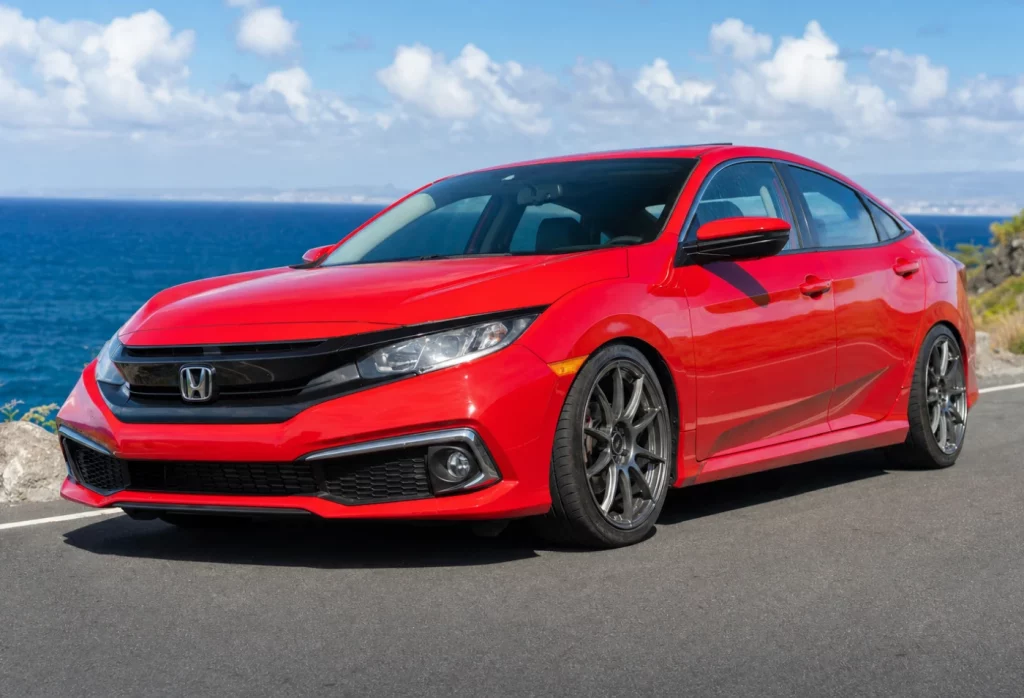
The 9th Generation (2012–2015): No Adaptive Cruise Control
The 9th generation Civic, across all trims — LX, EX, EX-L, Si, and Hybrid — offered only conventional cruise control. There was no radar, no camera-based distance sensing, and no speed-adjusting capability based on traffic ahead. The cruise control system maintained a set speed using the throttle actuator alone. When the driver approached slower traffic, the system did not reduce speed — the driver had to cancel cruise or brake manually. This was not unusual for the compact car segment in 2012–2015. The Toyota Corolla, Mazda3, and Hyundai Elantra of the same years also lacked ACC. Honda’s first ACC system on a mainstream vehicle was the 2015 CR-V Touring, and it arrived on the Civic with the next-generation redesign in 2016. Source: Honda 2012–2015 Civic owner’s manuals (carmanualsonline.info), Honda Newsroom Honda Sensing history press release (February 7, 2022).
10th Generation (2016–2021): Radar + Camera Fusion ACC
The 10th generation Civic introduced ACC as part of the Honda Sensing suite. The system used a millimeter-wave radar unit mounted behind the Honda emblem in the front grille, paired with a monocular camera AT the top of the windshield. The radar measured distance and relative speed of vehicles ahead up to approximately 330 feet. The camera classified objects and detected lane markings. The fusion of both sensors enabled two modes: standard ACC (maintain set speed with following distance) and Low-Speed Follow (decelerate to a full stop behind a stopped vehicle, then resume from a stop when traffic moves). The system could operate from 0 mph up to the car’s top speed, making it a true stop-and-go ACC. Source: Honda 2016 Civic Sedan specifications and highlights (Honda Newsroom, January 2016), 2019 Civic Sedan Honda Sensing owner’s guide (owners.honda.com).
Following interval settings. The 10th gen ACC offered four following interval settings, selected by a button on the steering wheel: Short (approximately 1.0 seconds), Medium (approximately 1.5 seconds), Long (approximately 2.0 seconds), and Extra Long (approximately 2.4 seconds). The intervals were calibrated for the combined radar-camera detection range. Source: 2020 Civic Sedan ACC owner’s manual (owners.honda.com).
Trim and model year availability. ACC availability on the 10th gen Civic changed significantly over its production run. From 2016 through 2018, ACC was optional on LX, EX, EX-T, and EX-L trims and standard only on the top Touring trim. The Si and Type R did not offer ACC at all during the 10th generation. In 2019, Honda made Sensing — including ACC with Low-Speed Follow — standard on every sedan and coupe trim, including the new Sport trim. The hatchback followed in 2020, making ACC standard across the entire hatchback lineup. The 2020 Si became the first Si to include ACC as standard equipment. The 10th gen Type R (2017–2021) never received ACC. Source: Honda Newsroom press releases — August 2018 (2019 Civic sedan/coupe), August 2019 (2020 Civic hatchback and Si), PR Newswire May 2017 (Civic Si on-sale release).
| Model Year | Sedan / Coupe | Hatchback | Si | Type R |
|---|---|---|---|---|
| 2016 | Optional LX–EX-L; Std Touring | — | Not available | — |
| 2017 | Optional LX–EX-L; Std Touring | Optional LX–EX-L; Std Sport Touring | Not available | Not available |
| 2018 | Optional LX–EX-L; Std Touring | Optional LX–EX-L; Std Sport Touring | Not available | Not available |
| 2019 | Standard — all trims | Optional LX–EX-L; Std Sport Touring | Not available | Not available |
| 2020 | Standard — all trims | Standard — all trims | Standard | Not available |
| 2021 | Standard — all trims | Standard — all trims | Standard | Not available |
Source: Honda Newsroom official press releases for each model year and trim update.
11th Generation (2022–Present): Single-Camera ACC
The 11th generation Civic launched for the 2022 model year with a fundamentally different ACC architecture. Honda eliminated the millimeter-wave radar unit entirely and moved to a single wide-angle monocular camera mounted behind the windshield. The camera has a wider field of view and a faster processor than the 10th gen camera, allowing it to perform the distance measurement, object classification, and lane detection that previously required two separate sensors. Source: Honda Newsroom April 2021 11th gen Civic reveal release, Repairer Driven News February 2022 — “Honda offers ADAS on all models, eliminates radar unit on new Civic.”
New features with the 11th gen. The single-camera ACC on the 11th gen added Traffic Sign Recognition as a standard feature — the system reads speed limit signs and can adjust the ACC set speed automatically (driver-selectable). It also added a Driver Attention Monitor that uses steering input patterns to detect driver fatigue. The following interval settings remain at four levels. ACC with Low-Speed Follow continues to operate from 0 mph to top speed. Source: 2022 Civic Sedan ACC owner’s manual (techinfo.honda.com), 2022 Civic Sedan Honda Sensing owner’s manual.
Standard on every trim, every model year. Unlike the 10th generation’s phased rollout, the 11th gen Civic made ACC with Low-Speed Follow standard on every trim from day one — LX, Sport, EX, Touring, and Si. The 2023 Civic Type R (FL5) received the full single-camera ACC system as standard equipment for the first time in Type R history. Source: Honda Newsroom 2022 Civic sedan reveal (April 2021), 2023 Civic Type R reveal press release (July 2022).
ACC Behavior Differences Between Generations
Owner reports on CivicXI.com and CivicX.com provide real-world comparisons between the 10th gen radar+camera ACC and the 11th gen camera-only ACC. The most frequently cited difference is braking smoothness. Multiple owners who owned both generations report that the 10th gen system would decelerate abruptly — “lurch” is the word used repeatedly — particularly when a detected vehicle changed lanes or when the system re-acquired a target at highway speed. The 11th gen camera-only system delivers noticeably smoother deceleration and acceleration profiles. This improvement is attributed to the faster camera processing and the elimination of the radar’s lower-resolution distance data that could cause stepped braking responses. Source: CivicXI.com — “ACC 11th gen vs 10th gen” thread (January 2022), owner comments from hondacm450e, wilbur_the_goose, kanav; CivicX.com — “Is Honda Sensing reliable?” thread (September 2018).
Target acquisition. The 10th gen system could sometimes lose track of the target vehicle on gentle curves where the radar beam would lose line-of-sight and the camera was still processing lane geometry. The 11th gen single-camera system, with its wider field of view and faster processor, picks up new lead vehicles in adjacent lanes more quickly, according to CivicXI owner reports. The camera also handles lane-change scenarios better — when the lead vehicle turns off the road, the system transitions to a new target with less delay. Source: CivicXI.com ACC comparison thread.
Low-speed follow and traffic jam assist. Both generations provide stop-and-go ACC that brings the vehicle to a complete stop and resumes when traffic moves. The 11th gen system, however, integrates more smoothly with the updated Lane Keeping Assist System, which now operates at speeds as low as 0 mph (Traffic Jam Assist). The 10th gen LKAS activated only above approximately 45 mph. The combination of smoother ACC and low-speed LKAS makes the 11th gen significantly more capable in stop-and-go highway congestion. Source: 2022 Civic Sensing owner’s manual, CivicXI.com forum owner reports.
Sensor Hardware Comparison
| Specification | 10th Gen (2016–2021) | 11th Gen (2022–Present) |
|---|---|---|
| Sensor type | mm-wave radar + monocular camera | Single wide-angle monocular camera |
| Radar location | Behind front grille emblem | None — eliminated |
| Camera location | Top of windshield, behind rearview mirror | Top of windshield, wider field of view |
| ACC operating range | 0 mph – top speed (Low-Speed Follow) | 0 mph – top speed (Low-Speed Follow) |
| Following intervals | 4 settings: Short/Med/Long/Extra Long | 4 settings (same intervals) |
| Traffic Sign Recognition | Not available | Standard |
| Driver Attention Monitor | Not available | Standard (steering input based) |
| LKAS low-speed operation | ~45 mph minimum | 0 mph (Traffic Jam Assist) |
| Braking smoothness | Occasional abrupt deceleration reported | Smoother profile per owner reports |
| Bad weather performance | Radar functional when camera obscured; radar can be blocked by snow/slush on grille | Camera behind windshield — no external blockage; reduced performance in dense fog/heavy rain |
| Calibration after repair | Radar aiming required after front-end or windshield replacement | No radar aiming; camera calibration simpler |
Sources: Honda 2019 Civic Sedan Honda Sensing owner’s guide, 2022 Civic Sedan Sensing owner’s manual, Repairer Driven News February 2022, CivicXI.com ACC comparison thread.
Known Issues by Generation
10th gen — radar blockage. The millimeter-wave radar behind the front grille emblem was vulnerable to snow, slush, and ice buildup, particularly in northern climate winters. Once the radar was blocked, the system displayed a “Radar Obstruction” warning and disabled ACC, CMBS, and LKAS until the grille was cleared. Owners on CivicX.com reported that even light slush or road salt accumulation could trigger the warning, sometimes persisting for entire drives in winter conditions. The camera at the windshield was unaffected, but without radar data, the system would not re-engage ACC. Source: CivicX.com — “Radar sensor blocked by snow” threads, CivicXI.com ACC comparison thread (owner kanav, May 2022).
10th gen — abrupt ACC braking. The most consistent owner complaint about 10th gen ACC is abrupt deceleration. The system would sometimes brake harder than necessary when approaching a slower vehicle, particularly if the radar detected a closing speed that the camera had not yet classified. Multiple owners on CivicX.com described the system as “nervous” or “jerky” in moderate traffic. This was a software behavior characteristic of the sensor fusion logic at that generation, not a hardware failure. Source: CivicX.com — “Is Honda Sensing reliable?” thread (September 2018), CivicXI.com ACC comparison thread.
10th gen — ACC disabled after windshield replacement. Replacing the windshield on a 10th gen Civic with Honda Sensing required recalibration of both the camera and the radar. If the camera alignment shifted even slightly, the ACC would remain disabled until recalibrated. Independent glass shops sometimes did not perform the calibration, leaving owners with a non-functional ACC after a routine windshield replacement. Source: Repairer Driven News ADAS calibration guidance, Honda Service Job Aid AJA15434 — “Aiming Driving Support Systems” (June 2021, Version 9).
11th gen — reduced redundancy. The single-camera architecture eliminates the radar entirely, meaning the ACC has no fallback sensor if the camera cannot see. In dense fog, heavy rain, or direct sun glare — conditions where a camera’s visibility is reduced — the system is more likely to display a “Reduced Performance” warning and disengage than the 10th gen’s radar+camera system would have been. Owners on CivicX reports that the system handles moderate rain without issue, but disables itself in heavy downpours. Source: 2022 Civic Sensing owner’s manual — system limitations section, CivicXI.com ACC comparison thread (owner hondacm450e, May 2022).
11th gen — occasional false targets. Some 11th gen owners on Civic11Forum.com report that the ACC occasionally responds to vehicles in adjacent lanes rather than the vehicle directly ahead, causing unwanted deceleration on curved highways. This is characteristic of camera-based systems that interpret lane geometry less precisely than radar+camera fusion on sweeping curves. Source: Civic11Forum.com — “Adaptive Cruise Control (ACC)” thread (April 2025).
Repair Cost Comparison: ACC Sensor Calibration
| Repair Scenario | 10th Gen (2016–2021) | 11th Gen (2022+) |
|---|---|---|
| Windshield replacement + recalibration | $200–$400 extra for camera + radar aiming | $150–$250 extra for camera calibration only |
| Front grille / emblem replacement | Radar aiming required — $150–$300 | No radar — no additional cost |
| Front bumper repair / replacement | Radar bracket misalignment risk — $150–$300 | No radar — no additional cost |
| Radar module failure | $500–$800 part + labor + aiming | Not applicable — no radar module |
The 11th gen’s elimination of the radar unit reduces post-collision repair costs and simplifies windshield replacement. The camera-only system requires calibration after a windshield replacement, but the procedure is less involved than the two-sensor aiming process on the 10th gen. Sources: Repairer Driven News — ADAS calibration cost analysis, Honda Service Job Aid AJA15434, independent glass shop estimates.
Which Generation Has Better ACC for Daily Driving?
The 11th generation’s single-camera ACC delivers a noticeably smoother driving experience than the 10th generation’s radar+camera system, based on consensus owner feedback. The smoother braking, better target acquisition on curves, and Traffic Sign Recognition make it the more refined system for highway and traffic jam use. The elimination of the radar also reduces repair costs after front-end damage and eliminates the frequent radar-blockage-in-winter issue that 10th gen owners in northern climates experienced.
The 10th generation’s radar+camera system has one theoretical advantage: sensor redundancy. The radar can detect objects when the camera cannot — in dense fog, direct sun glare, or heavy rain where the camera’s visibility is reduced. In practice, both systems disengage in truly poor weather (the 10th gen when radar is blocked or camera can’t see; the 11th gen when camera alone can’t see), so the redundancy advantage is marginal for most drivers. The 10th gen’s radar blockage from snow and slush on the grille is a more common real-world nuisance than any weather limitation of the 11th gen’s camera, since the camera is protected behind the windshield.
The 10th gen system also suffers from notably worse braking behavior. The abrupt deceleration that multiple owners describe as “lurching” makes the ACC feel less refined than the 11th gen system. For a driver who uses ACC daily on the highway, the 11th gen system is the clear upgrade.
Used Buyer Recommendations
For buyers considering a 10th gen Civic (2016–2021) with ACC, the key variable is trim level and model year. A 2016–2018 LX or EX without the optional Sensing package will not have ACC. A 2019 sedan or coupe will have ACC standard regardless of trim. A 2020 hatchback or Si will have it standard. Pre-purchase testing for ACC function is straightforward: on a test drive, press the MAIN button on the steering wheel, set a speed with the SET/- button, and verify that the system detects vehicles ahead and adjusts speed accordingly. If the “Radar Obstruction” warning appears, the grille-mounted radar may have an issue beyond simple snow buildup.
For buyers considering an 11th gen Civic (2022+), ACC is standard on every trim. The system should function without issue on any car. The main pre-purchase check is verifying that the windshield camera area is clean and unobstructed — the system will display a warning if the camera view is blocked.
For buyers considering a Civic Type R: the 10th gen (2017–2021) has no ACC at all. Only the 11th gen (2023+) Type R has ACC with Low-Speed Follow. If adaptive cruise control matters, the 10th gen Type R cannot provide it, and aftermarket retrofitting is not feasible.
Summary
Adaptive Cruise Control on the Honda Civic evolved from nonexistent (9th gen) to functional but occasionally abrupt (10th gen radar+camera) to refined and standard on every car (11th gen single-camera). The 10th gen system introduced stop-and-go ACC to the Civic and made it broadly available by 2020, but its radar sensor was vulnerable to winter weather and its braking behavior drew consistent owner criticism. The 11th gen system solved the radar blockage issue by eliminating the radar entirely, delivered noticeably smoother ACC behavior, added Traffic Sign Recognition, and made the feature standard on every trim — including the Type R for the first time. The trade-off is reduced sensor redundancy in extreme weather, but for the vast majority of driving conditions, the 11th gen system is the better ACC.
Adaptive Cruise Control — Quick Reference:
☐ 9th gen Civic (2012–2015): No Adaptive Cruise Control. Conventional cruise control only.
☐ 10th gen Civic (2016–2021): ACC with Low-Speed Follow (0 mph capable). Uses millimeter-wave radar + monocular camera fusion. Available as option 2016–2018 on lower trims, standard on Touring. Standard on all sedan/coupe trims from 2019. Standard on all hatchback trims and Si from 2020. 10th gen Type R — no ACC.
☐ 11th gen Civic (2022+): ACC with Low-Speed Follow. Single wide-angle camera — no radar. Standard on every trim including Si (2022+) and Type R (2023+). Traffic Sign Recognition added.
☐ 10th gen ACC behavior: occasionally abrupt braking (lurching). Radar can be blocked by snow/slush on front grille. Target acquisition can lag on curves.
☐ 11th gen ACC behavior: smoother braking profile. Better target acquisition. 0-mph LKAS integration (Traffic Jam Assist). Reduced performance in dense fog/heavy rain (camera-only limitation).
☐ 10th gen repair cost after collision: radar aiming adds $150–$300 to front-end repairs and windshield replacement.
☐ 11th gen repair cost after collision: no radar aiming needed. Camera calibration after windshield replacement is simpler and less expensive.
☐ Following intervals: both generations offer 4 settings — Short, Medium, Long, and Extra Long.
☐ Used buyer check: 10th gen LX (2016–2018) without camera housing behind windshield = no ACC. All 11th gen trims have it standard. Verify ACC engages on test drive.
☐ The 10th gen radar+camera system has a theoretical redundancy advantage in low visibility. The 11th gen camera-only system has a real-world advantage in winter (no radar to block) and delivers smoother daily performance.
☐ Neither generation’s ACC can be retrofitted. If a 10th gen Civic was built without Sensing, the full Wiring Harness, sensor modules, and steering wheel controls are required — cost-prohibitive on a used car.