

Insurance Costs Across Civic Generations and Trims
Insurance costs across the Honda Civic lineup span a wider range than most buyers expect. A base DX Hatchback and a Civic Type R share the same badge, but their annual premiums differ by more than $2,600. This article breaks down insurance costs by generation and trim, comparing LX, EX, Sport, Si, and Type R using data from MoneyGeek, CarEdge, Insurance.com, and the Insurance Information Institute. All figures assume a 40-year-old driver with good credit and a clean record on a full-coverage policy unless otherwise noted.
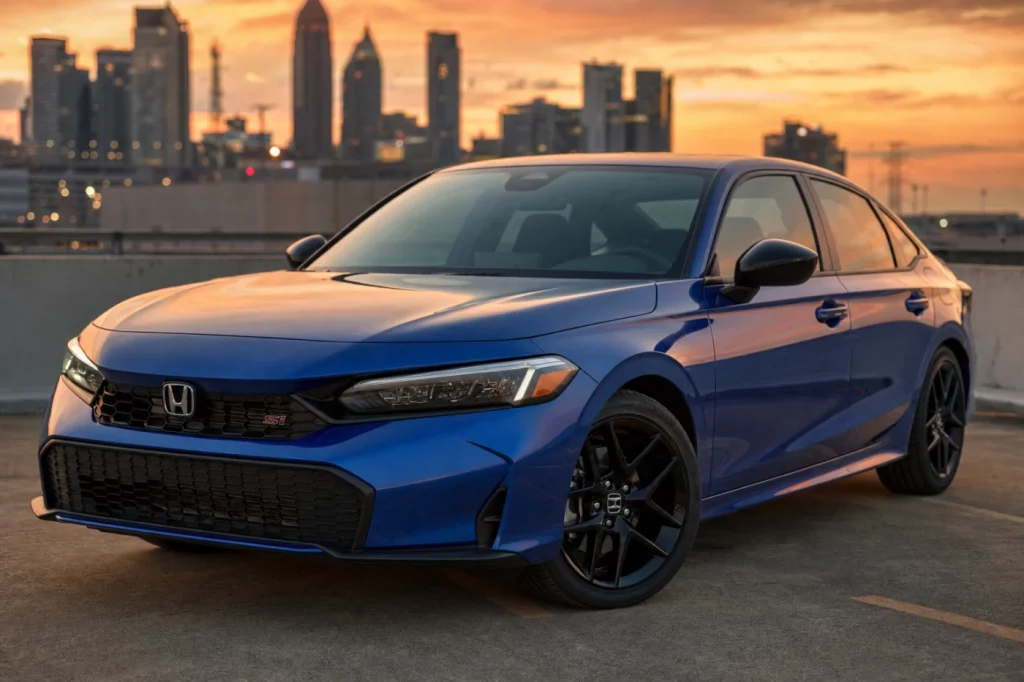
The Civic Is Cheap to Insure — Until You Add Performance
The Honda Civic ranks 174th out of 827 vehicles for insurance affordability, placing it in the top 25% cheapest cars to insure across the U.S. market (MoneyGeek, 2026). Average full-coverage rates for all trims combined come in AT $1,911 per year, or about $159 per month. Minimum coverage averages $990 per year.
That figure, however, masks a wide spread between trims. MoneyGeek’s rate data across all model years and trims shows a progression from $121 per month for the base DX Hatchback to $338 per month for the Type R — a 179% increase driven entirely by trim and performance classification.
| Trim | Monthly Full Coverage | Annual Full Coverage | Premium vs LX |
|---|---|---|---|
| DX Hatchback | $121 | $1,452 | -20% |
| LX Sedan | $152 | $1,824 | baseline |
| EX Sedan | $155 | $1,860 | +2% |
| Sport Sedan | $167 | $2,004 | +10% |
| Touring Sedan | $172 | $2,064 | +13% |
| Si (11th gen) | $224 | $2,688 | +47% |
| Type R (FL5) | $338 | $4,056 | +122% |
Sources: MoneyGeek Honda Civic insurance cost by trim analysis, 2026. Rates for a 40-year-old driver, good credit, full coverage ($100/$300/$100 liability, comp/collision $1,000 deductible).
Does a Civic Si Cost Twice as Much as an LX to Insure?
No — but the gap is larger than most buyers expect. The Si costs roughly 47% more to insure than an LX sedan. That works out to $864 more per year, or $72 per month. On a five-year ownership timeline, the Si adds $4,320 in insurance cost over the LX.
The gap is narrower than the Si‘s performance uplift might suggest. The Si shares the Civic’s basic platform, safety structure, and theft-deterrent systems, which keeps it in the sport compact insurance category rather than sports car. Most insurers classify the Si as a higher-risk version of the standard Civic, not a separate performance vehicle. The difference in horsepower (200 HP vs 158 hp for the LX) and the Si’s younger-skewing owner demographic account for most of the premium gap (Insurance Information Institute, vehicle classification guidelines).
CarEdge’s independent data shows the Civic Si averaging $2,192 per year at a 40-year-old base profile, compared to $2,405 for the standard Civic — a result that initially seems backward. The discrepancy is explained by different methodology: CarEdge’s Civic average includes all trims including the Type R, which pulls the average up, while the Si figure is isolated (CarEdge, Honda Civic Si insurance data, 2026).
The Type R is a different story. At $338 per month ($4,056 per year), it costs 122% more to insure than an LX and 81% more than an Si. The Type R is classified as a high-performance vehicle by most insurers, with a $45,000+ replacement value, higher repair costs, and a statistically higher claim frequency. Progressive rates the FL5 Type R at approximately $3,397 per year in its standard rating tier (Insurance.com, 2025 Si/Type R rate data by company).
Insurance Cost by Generation: How Model Year Changes the Picture
Insurance premiums scale predictably with vehicle age. A 2025 Civic costs nearly twice as much to insure as a 2006 model, because the replacement value drops as the car depreciates. MoneyGeek’s rate data by model year shows a smooth downward curve from newest to oldest.
| Generation | Model Year | Monthly Min Coverage | Monthly Full Coverage | Annual Full Coverage |
|---|---|---|---|---|
| 11th gen | 2025 | $122 | $236 | $2,832 |
| 11th gen | 2022 | $94 | $182 | $2,184 |
| 10th gen | 2021 | $95 | $183 | $2,196 |
| 10th gen | 2016 | $78 | $151 | $1,812 |
| 9th gen | 2012 | $76 | $148 | $1,776 |
| 8th gen | 2008 | $72 | $139 | $1,668 |
| 8th gen | 2006 | $71 | $136 | $1,632 |
Source: MoneyGeek Honda Civic insurance rates by model year, 2026. Based on a 40-year-old driver with good credit and clean record.
The 8th generation (2006-2011) is the cheapest generation to insure, with full coverage rates starting at $1,632 per year. The 11th generation (2022-present) costs 73% more for a brand-new 2025 model, primarily because of the higher insured value. A used 2022 model, now three to four years old, drops to $2,184 per year — within 20% of a 2016 10th generation Civic.
Critically, the safety equipment in newer generations offsets some of the premium increase. The 11th generation’s standard Honda Sensing suite (collision mitigation, adaptive cruise, lane-keeping, traffic sign recognition) qualifies for multi-discount safety credits with most major insurers, reducing rates by 5-10% compared to a 9th generation car with equivalent value (GEICO, State Farm discount schedules).
The Si Premium by Generation
Insurance.com’s model-year-specific data for the Civic Si shows how the Si premium has changed across generations. The 11th generation Si costs approximately 10-15% more to insure than the 10th generation, reflecting higher MSRP and repair costs.
| Model Year | Generation | Annual Full Coverage (Si) | Si vs LX Premium |
|---|---|---|---|
| 2024 | 11th gen | $2,568 | +41% |
| 2023 | 11th gen | $2,646 | +45% |
| 2022 | 11th gen | $2,599 | +43% |
| 2020 | 10th gen | $2,413 | +33% |
| 2019 | 10th gen | $2,383 | +31% |
| 2018 | 10th gen | $2,318 | +27% |
| 2017 | 10th gen | $2,203 | +21% |
Sources: Insurance.com Civic Si rates by model year (GEICO/State Farm/Progressive/Nationwide blended averages). LX baseline estimates per MoneyGeek 2026 data for equivalent model years.
The 10th generation Si saw the premium gap shrink from +21% in 2017 to +33% in 2020 as the model aged and the LX’s value depreciated faster. The 11th generation Si widened the gap to +41-45%, driven by a $29,000+ MSRP (vs $24,000 for the LX) and higher repair costs associated with the 1.5T engine and adaptive damper system.
State Farm offers the cheapest Si rates at approximately $1,918 per year for a 2024 model, followed by GEICO at $1,956 (Insurance.com, 2025 data). Progressive and Allstate are the most expensive major carriers for the Si, with Allstate pricing the 2024 Si at $3,076 — 60% above State Farm’s rate for the same vehicle.
What Actually Drives the Premium Differences
The insurance cost gap between Civic trims comes down to four factors that insurers weigh differently:
Replacement value. The Type R’s $45,000+ replacement cost means the insurer is on the hook for substantially more if the car is totaled. A base LX at $24,000 replacement value carries roughly half the physical damage exposure. Comprehensive and collision premiums scale almost linearly with insured value.
Repair cost. Performance trims use higher-cost components. The Si’s 1.5T engine, limited-slip differential, and 18-inch wheels cost more to repair or replace than the LX’s 2.0L naturally aspirated engine and 16-inch steel wheels. The Type R’s 20-inch wheels, Brembo brakes, and unique body panels push repair costs significantly higher. Insurers price this into the comprehensive and collision portion of the premium.
Claim frequency. Younger drivers are overrepresented in Si and Type R ownership, and claim data bears this out. The Insurance Information Institute’s annual claims study shows that drivers aged 20-30 file claims at roughly 1.8 times the rate of drivers aged 40-50 in the same vehicle class. The Si’s demographic skew means higher pool pricing even for a 40-year-old buyer.
Vehicle classification. Most insurers place the Si in a sport compact subclass that carries a 15-25% premium over standard compact sedans. The Type R is classified as high-performance or sports car depending on the carrier, adding 50-80% to the base compact rate. The LX, EX, and Touring trims remain in the standard compact sedan class.
The 5-Year Insurance Cost: DX vs Si vs Type R
Over a typical five-year ownership period, the insurance cost difference between trims becomes a meaningful part of the total cost of ownership.
A DX Hatchback insured for five years at full coverage will cost approximately $7,260. An LX sedan costs $9,120. An Si costs $13,440. A Type R costs $20,280. The Si adds $4,320 over the LX across five years, while the Type R adds $11,160 — enough to cover a substantial portion of the car’s purchase price difference.
When buying used, the gap narrows because premiums scale with vehicle value. A five-year-old Si (purchased at year 5, held through year 10) would cost roughly 30-40% less to insure than a new Si, bringing the annual premium to approximately $1,500-1,700 depending on the model year and insurer.
Carrier Shopping Matters More Than Trim Choice
The spread between the cheapest and most expensive insurer for the same Civic is wider than the spread between trims. MoneyGeek’s data shows GEICO at $1,452 per year for full coverage on a Civic (all trims blended) versus AIG at $3,396 — a 134% difference. For the Si specifically, Insurance.com found Allstate at $3,076 versus State Farm at $1,918 (2024 model year), a 60% gap driven entirely by carrier pricing strategy.
Practical advice: buy the trim you want, then shop carriers. GEICO and State Farm consistently offer the lowest Civic rates across all trims, while Allstate, Farmers, and AIG are consistently the most expensive. For an Si buyer, the difference between State Farm and Allstate is $1,158 per year — nearly the entire Si-vs-LX premium gap.
Quick-Reference Checklist
☐ The Civic is among the cheapest cars to insure overall, ranking 174th out of 827 vehicles (MoneyGeek 2026)
☐ LX to Si insurance gap is approximately +47% ($864/year), not 2x — the Si stays in sport compact not sports car classification
☐ LX to Type R gap is +122% ($2,232/year) — the Type R is classified as high-performance by most insurers
☐ A 2025 Civic costs 73% more to insure than a 2006 model ($2,832 vs $1,632/year) due to replacement value
☐ Safety tech (Honda Sensing) on 10th/11th gen offsets 5-10% of the premium increase vs older gens
☐ State Farm and GEICO offer the cheapest Si rates (~$1,918-1,956/year); Allstate is 60% higher at $3,076
☐ Carrier shopping matters more than trim choice: the GEICO-to-AIG spread on one Civic is 134%
☐ Over 5 years: DX costs ~$7,260, LX ~$9,120, Si ~$13,440, Type R ~$20,280 in full-coverage insurance
☐ Buying a used Si (5+ years old) cuts insurance by 30-40% vs new
☐ Young drivers (under 25) pay 2-3x these rates regardless of trim; see MoneyGeek age-specific tables