

How IIHS Evaluates LATCH and Why It Matters for Families
The Insurance Institute for Highway Safety began rating LATCH (Lower Anchors and Tethers for Children) ease of use in 2015. The evaluation measures how easily a parent or caregiver can install a child restraint using the vehicle’s built-in anchor hardware without making mistakes. Ratings of Good, Acceptable, Marginal, or Poor are assigned based on three criteria AT each seating position: the force required to attach the lower anchor connectors, the depth of the lower anchors in the seat bight (how far you have to reach), and the accessibility and clarity of the tether anchor location. A vehicle with clearly marked, easily accessible anchors at both outboard rear seats earns a higher score than one where anchors are buried deep in the seat cushion or the tether anchor is confusing to locate. Sources: IIHS LATCH evaluation guidelines, Version III, June 2016; IIHS news release “Simplifying child safety,” June 18, 2015.
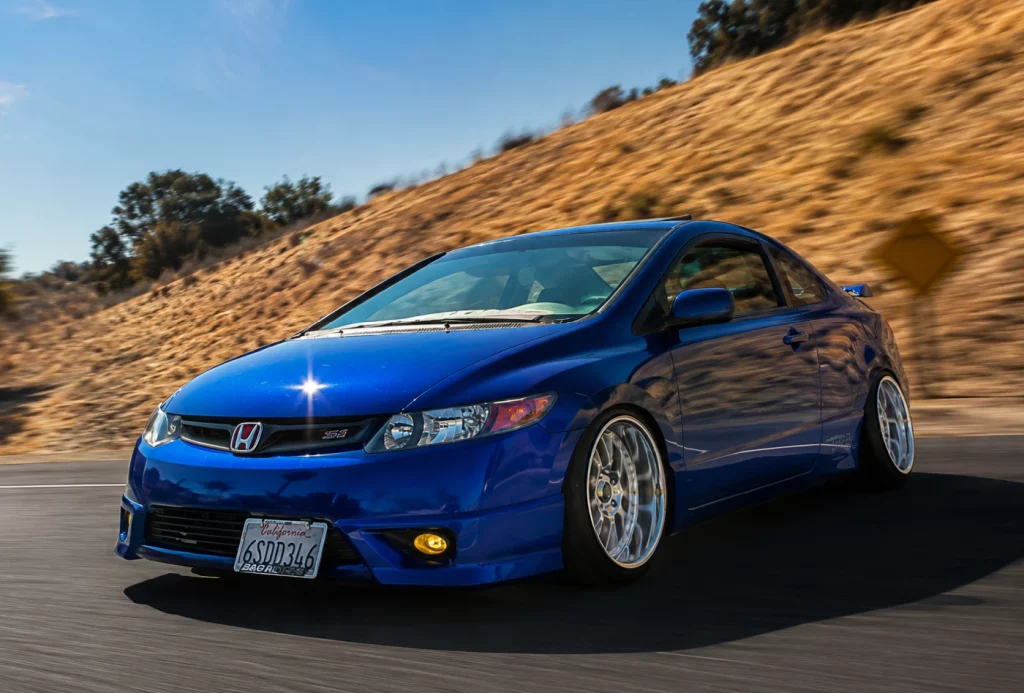
For families considering a Honda Civic as a child-carrying vehicle, the LATCH rating is a practical concern that affects daily use, not just theoretical crash safety. A car with a Poor LATCH rating may still provide excellent crash protection but requires more effort and attention to install a child seat correctly — increasing the risk of improper installation.
8th Generation (2006–2011): Pre-LATCH Rating Era
The IIHS LATCH ease-of-use rating program did not exist when the 8th-generation Civic was sold new. IIHS did not evaluate LATCH for these model years, and the manufacturer-installed LATCH hardware was not subject to any third-party usability scoring. However, some observations from the owner’s manual and service documentation are available. Sources: IIHS 2006–2011 Honda Civic 4-door sedan ratings (no LATCH section); Honda owner’s manual for 2008 Civic (techinfo.honda.com).
All 8th-gen Civics came equipped with lower anchors at the two outboard rear seating positions and a tether anchor at all three rear positions. The lower anchors were located between the seatback and seat cushion, which is the standard location for vehicles of that era. There was no center-seat lower anchor — the middle seat could use a tether-anchored forward-facing seat only, not a lower-anchored seat. The tether anchors were located on the rear deck behind the rear seats, accessible by folding the seatback forward or reaching behind the seat.
The practical experience for a parent installing a child seat in an 8th-gen Civic is that the lower anchors are moderately difficult to access — they sit deep in the seat bight, requiring the caregiver to push the seat cushion down firmly to attach the connectors. This is typical for compact cars of that generation. The 8th-gen Civic’s rear seat is also narrower than later generations, so installing two child seats side by side is tight, and three across is not realistic for most child seat combinations.
9th Generation (2012–2015): Same Hardware, No Score
The 9th-generation Civic (2012–2015) carried over the same basic rear seat structure and LATCH anchor positions from the 8th generation but added a structural reinforcement for the small overlap front test. IIHS did not publish a LATCH ease-of-use rating for the 9th gen — as of the 2013 Civic IIHS page, no child seat anchor evaluation section exists. Sources: IIHS 2013 Honda Civic sedan ratings.
The lower anchor configuration remained two outboard positions only, with tether anchors at all three positions on the rear deck. The center seat had a tether anchor but no lower anchors, meaning a center-seat child seat must be installed with the vehicle seat belt rather than LATCH. This is the same limitation as the 8th gen and is common for compact cars of this era.
10th Generation (2016–2021): IIHS Rated Acceptable
The 10th-generation Civic received IIHS LATCH ease-of-use rating for the first time, and it earned an overall score of Acceptable (A). This rating applies to all 2016–2021 model years, including both sedan and hatchback body styles. Sources: IIHS 2020–2021 Honda Civic 4-door sedan ratings, LATCH section.
IIHS assessed two different child seat anchor configurations on the 10th-gen Civic (trim levels LX and EX were evaluated separately) and both earned Acceptable. The specific scoring details per seating position:
- Outboard rear seats (positions 1 and 3): The tether anchors on the rear deck are easy to find with no confusing hardware that could be mistaken for an anchor. The lower anchors are too deep in the seat cushion (2–4 cm depth measured) — the primary reason the score did not reach Good. The force required to attach the connectors is moderate (11–26 lbs depending on position), and once attached, maneuvering the child seat around the anchors is easy.
- Center rear seat (position 2): Tether anchor is easy to find on the rear deck with no confusing hardware. There are no lower anchors at the center position — the center seat has only a tether anchor. Forward-facing seats in the center position must be installed with the seat belt, not LATCH.
The Acceptable score means the 10th-gen Civic is serviceable for child seat installation but not ideal. The deep lower anchors are the main complaint: caregivers with larger hands may find it difficult to reach and connect the lower anchor clips. The tether anchors are well-designed — clearly visible on the rear deck with contrasting labels — so the top tether strap installation is straightforward.
11th Generation (2022–Present): No Separate LATCH Score Published
IIHS simplified its rating format starting with the 2022 model year, and the LATCH ease-of-use section is no longer displayed as a separate scored category on the main Civic ratings page for the 11th generation. The 2022 and later Civic pages show crashworthiness and crash avoidance ratings but omit the standalone LATCH evaluation. Sources: IIHS 2022, 2023, 2024, 2025 Honda Civic 4-door hatchback and sedan ratings.
This does not mean the 11th gen has worse LATCH hardware. The physical anchor configuration is essentially unchanged from the 10th generation: two outboard lower anchors in the rear seat, tether anchors on the rear deck at all three positions, and no center lower anchor. The rear seat structure was redesigned for the larger 11th-gen platform (the Wheelbase grew 1.4 inches), which provides slightly more rear-seat width for child seat installation compared to the 10th generation. Sources: Honda Newsroom, 2022 Civic technical specifications; comparison of IIHS Civic pages across model years.
LATCH Weight Limits and Changed Rules for Families
The Civic’s lower anchors have a maximum child weight rating that has changed over time. For the 8th and 9th generations (2006–2015), Honda specified a lower anchor weight limit of 40 pounds (child weight) per NHTSA guidance in effect at the time. Starting with the 10th generation (2016–2021), the weight limit increased to 65 pounds per federal regulations that standardized LATCH weight limits across all manufacturers. Sources: NHTSA LATCH weight limit guidance; Honda owner’s manuals for 2008 and 2016 Civic (techinfo.honda.com).
The practical impact: in older Civics (2006–2015), a forward-facing child restraint using LATCH lower anchors must be switched to seat-belt installation once the child exceeds 40 pounds. In 2016 and newer Civics, the 65-pound limit covers most children through Booster seat age, so families can use LATCH for longer. The top tether anchor has no weight limit on any Civic generation — it should always be used for forward-facing seats regardless of how the lower portion is attached.
| Civic Generation | Model Years | IIHS LATCH Score | Lower Anchor Limit | Center Lower Anchors? | Tether Anchor Locations |
|---|---|---|---|---|---|
| 8th gen | 2006–2011 | Not rated | 40 lbs | No | Rear deck, 3 positions |
| 9th gen | 2012–2015 | Not rated | 40 lbs | No | Rear deck, 3 positions |
| 10th gen | 2016–2021 | Acceptable (A) | 65 lbs | No | Rear deck, 3 positions |
| 11th gen | 2022–present | Not separately scored | 65 lbs | No | Rear deck, 3 positions |
How the Civic Compares to Compact Competitors for LATCH
For context on the Civic’s Acceptable rating: the Toyota Corolla (11th generation, 2014–2018) earned a LATCH ease-of-use rating of Acceptable as well, with similar issues of deep lower anchors in the seat bight. The Mazda3 (3rd generation, 2014–2018) also earned Acceptable. No compact car in this segment has ever earned a Good LATCH rating from IIHS — the deep seat bight common to all small cars makes lower anchor access difficult regardless of manufacturer. Sources: IIHS LATCH ratings for Corolla and Mazda3 (3rd gen).
The Civic’s Acceptable score is not a weakness unique to Honda. It reflects the physical constraints of packaging LATCH hardware into a compact rear seat that also has to accommodate adults, provide seat belt geometry, and meet crash structure requirements. Families comparing compact cars will find essentially equivalent LATCH ease of use across the Civic, Corolla, and Mazda3.
Best Civic Years for Families with Young Children
For families specifically prioritizing child seat installation ease, the following recommendations apply:
The 11th generation (2022+) is the best choice overall, not because of LATCH hardware differences but because of the larger rear seat (1.4 inches more wheelbase, translated into slightly more rear legroom) and the standard LED headlights and AEB that improve overall safety. The wider rear seat makes it easier to install two child seats side by side without forcing them to overlap on the seat cushion.
The 10th generation (2016–2021) is the second-best option. The LATCH hardware is functionally identical to the 11th gen, and the Acceptable IIHS rating is well-documented. The 10th-gen rear seat is slightly tighter, but still workable for two child seats. The 2019+ model years add standard AEB, which is a meaningful safety benefit for any family car.
The 9th generation (2012–2015) is adequate but has the 40-pound lower anchor limit, meaning forward-facing seats need to switch to seat-belt installation earlier. The small overlap front crash protection is Good (unlike the 2014–2016 Corolla, which scored Marginal), so crashworthiness is not a concern. But families who plan to use the car for several years with forward-facing seats will find the 65-pound limit of later models more convenient.
The 8th generation (2006–2011) is the least suitable for frequent child seat use. The lower anchor weight limit is lower, the rear seat is narrower, and the lack of standard side curtain airbags on some trims from the earliest years of this generation means reduced side-impact protection. Families should prioritize a 2008 or newer Civic at minimum (when side curtain airbags became standard across all trims).
Quick Reference
☐ The 10th-generation Civic (2016–2021) is the only generation with a formal IIHS LATCH ease-of-use rating — Acceptable. The 11th generation uses the same anchor configuration but IIHS no longer separately scores LATCH in its simplified rating format.
☐ All Civic generations have lower anchors at the two outboard rear seats only. The center seat has a tether anchor but no lower anchors — a center-seat child seat must be installed with the vehicle seat belt.
☐ Tether anchors are on the rear deck behind the rear seats on all Civic generations. IIHS rates them as easy to find with no confusing hardware, which is better than many competitors where tether anchors are hidden under the seat or require folding the seatback.
☐ The lower anchor weight limit increased from 40 lbs (8th–9th gen, 2006–2015) to 65 lbs (10th gen onward, 2016+). Families using forward-facing seats should prioritize 2016 or newer Civics for the higher LATCH weight limit.
☐ The 11th gen (2022+) offers the most rear-seat width of any Civic generation, making it the easiest for installing two child seats side by side. The wider platform is a real practical benefit for families, even though the LATCH hardware itself is unchanged.
☐ The Civic’s LATCH Acceptable rating is on par with the Toyota Corolla and Mazda3 from the same period. No compact car has earned a Good LATCH rating from IIHS due to the physical constraints of small rear seats.
☐ The 8th-gen Civic (2006–2011) lacks side curtain airbags on pre-2008 trims and has the narrowest rear seat — it is the least recommended Civic for regular child seat use. Prioritize 2008 or newer if buying an 8th-gen as a family car.
☐ LATCH should not be confused with crashworthiness. The Civic’s crash test ratings are strong across all generations (Good small overlap on 9th gen and newer, Good side on 10th gen and newer). LATCH ease of use is a convenience factor, not a safety rating — an Acceptable LATCH score means installation requires more effort, not that the vehicle is less safe in a crash.