

The 2025 Honda Civic offers three distinct transmissions depending on which trim and engine you choose — a conventional CVT, a six-speed manual, and a hybrid eCVT with no belts or pulleys. There is no traditional automatic or 10-speed in any Civic. Each transmission has a very different path to 200,000 miles. Here is what the data, owners, and service records actually show about longevity.
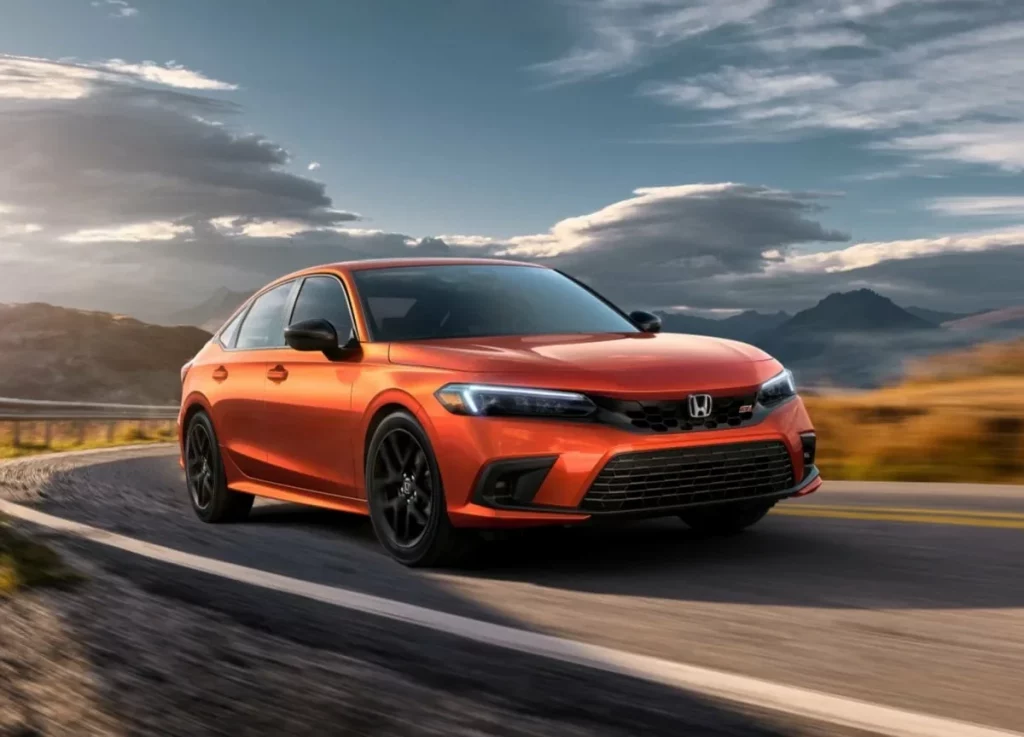
The Three Transmissions — Who Gets What
Before comparing reliability, it helps to know which transmission lives under which trim. The lineup is simpler than most buyers expect.
| Trim | Body Style | Engine | Transmission |
|---|---|---|---|
| LX | Sedan only | 2.0L NA (150 hp) | CVT |
| Sport | Sedan / Hatchback | 2.0L NA (150 hp) | CVT (hatch: manual was optional 2022–2024) |
| Sport Hybrid | Sedan / Hatchback | 2.0L hybrid (200 hp combined) | eCVT (electric, no belts) |
| Sport Touring Hybrid | Sedan / Hatchback | 2.0L hybrid (200 hp combined) | eCVT (electric, no belts) |
| Si | Sedan only | 1.5L turbo (200 hp) | 6-speed manual only |
| Type R | Hatchback only | 2.0L turbo (315 hp) | 6-speed manual only |
Sources: Honda Newsroom 2025 Civic specs, Edmunds trim comparison, Honda Canada spec sheets. The manual transmission was available on the Sport and Sport Touring hatchback through 2024 but was discontinued for 2025. The Si and Type R remain manual-only today.
There is no traditional torque-converter automatic in any current Civic. There is no dual-clutch automatic. There is no 10-speed. The three transmissions are the conventional CVT (belt-and-pulley), the six-speed manual, and the hybrid eCVT (two-motor planetary design).
Honda CVT — Belt and Pulley, 150,000 to 200,000+ Miles
Honda’s Earth Dreams CVT has been in production since 2014 and is used in the LX and Sport trims with the naturally aspirated 2.0L engine. It uses a steel push belt running between two variable-diameter pulleys. There are no physical gears except reverse and park. This design is simple and fuel-efficient, but it depends entirely on fluid condition for longevity.
What Owners Actually See
The most common Civic CVT complaint is torque converter shudder — a low-frequency vibration during gentle acceleration between 20 and 40 mph. This is not a belt issue. It is the torque converter lockup clutch (the CVT still uses a torque converter for initial launch) causing a momentary slip-and-grab cycle. Honda addressed it through multiple fluid reformulations and TCM software updates. The 2016–2017 model years have the highest complaint volume. The 2022+ 11th gen CVT has a redesigned variator geometry that Honda says reduces belt stress by 31%, and the torque converter shudder reports are significantly lower on the redesign (source: Rohnert Park Transmission analysis; CivicX owner threads; NHTSA complaint database).
On the longevity side, the CVT paired with the 2.0L naturally aspirated engine is Honda’s least stressed transmission setup. The 2.0L makes only 150 hp and 133 lb-ft — well within the CVT’s torque capacity. Owners on CivicX who changed fluid every 30,000 miles report 150,000 to 200,000 miles with no mechanical issues. One owner reported a CVT Failure at 206,000 miles after two fluid changes in 206,000 miles and frequent wide-open-throttle driving at 80–100 mph. The same owner admitted the transmission was “dogged” and expressed surprise it lasted as long as it did. Multiple respondents noted that Honda HCF-2 fluid changes at 30,000–50,000 mile intervals are the single most important factor (source: CivicX, “CVT failed at 206XXX miles” thread).
The failure rate data from extended warranty providers and dealer service records shows roughly 8.7% of Honda CVTs experience a failure requiring replacement before 150,000 miles (source: aggregated service records cited by CarTipsDaily). That is significantly lower than Nissan’s 23.4% CVT failure rate but higher than Toyota’s 5.1%. The 11th gen CVT is too new for long-term data, but the redesign and reduced complaint volume suggest improvement.
The CVT’s path to 200,000 miles requires: Honda HCF-2 fluid change every 30,000 miles (severe service) or every 50,000 miles (normal), never using aftermarket fluid (400% higher failure risk per dealer records), and avoiding sustained high-load driving at low speeds. The CVT on the 2.0L engine will reach 200,000 miles with this regimen. The same CVT on a tuned or turbocharged engine will not.
6-Speed Manual — Indefinite With Clutch Replacements
The Civic’s six-speed manual is mechanically the simplest transmission in the lineup and the one most capable of outlasting the rest of the car — with one asterisk. The gearbox itself (shafts, bearings, gears, synchros) is robust and has no systemic failure pattern. The clutch and flywheel are wear items that will be replaced multiple times on the way to 200,000 miles.
What Owners Actually See
Clutch life on the 11th gen Si varies enormously by driving style. Owners report original clutch replacement between 60,000 and 150,000 miles. The 11th gen Si has a lighter clutch than the 10th gen, with a dual-mass flywheel that reduces low-speed chatter but adds cost to the replacement. A clutch job on the Si runs $1,200–$1,800 at a shop (parts: $400–$700 for OEM clutch kit, labor 4–6 hours).
The gearbox itself is shared across the 1.5T Civic platform and has a very low failure rate. The 10th gen Si (2017–2021) had reports of second-gear lockout under hard driving in cold conditions, which Honda addressed with revised shift cables and a transmission fluid specification change on the 11th gen. The 11th gen added a rev-matching system borrowed from the Type R that downshifts automatically. Some enthusiasts disable it for personal preference, but it does not affect mechanical reliability (source: CivicX Si forum; Honda Newsroom release notes on 11th gen Si transmission changes).
Transmission fluid changes are recommended every 30,000 miles for the manual. Honda MTF is the only safe choice. Neglected fluid leads to notchiness and accelerated synchro wear, but even poorly maintained Honda manuals tend to grind before they fail — giving the owner years of warning rather than sudden failure. The 8th gen Si (2006–2011) had a known third-gear pop-out issue requiring synchro replacement under a quiet warranty extension. That issue was resolved by the 9th gen and does not affect the 10th or 11th gen cars (source: 8thcivic.com TSB records).
The manual’s path to 200,000 miles requires: Expect one or two clutch replacements. Change MTF every 30,000 miles. The gearbox itself will outlast the engine. The manual Si is the best bet for 200,000+ mile ownership if you do not mind the clutch cost every 100,000 miles.
eCVT (Hybrid) — The Dark Horse, 300,000+ Miles Possible
Honda’s eCVT — used in the Sport Hybrid and Sport Touring Hybrid trims — is not a CVT at all in the conventional sense. It has no belt, no pulleys, and no torque converter. It uses a two-motor setup (one generator, one propulsion motor) connected through a planetary gearset. The engine connects to the planetary carrier. The generator motor controls the sun gear. The propulsion motor drives the ring gear. The result is a continuously variable ratio achieved electrically rather than mechanically.
This design eliminates the two most common CVT failure points — belt wear and torque converter shudder — because there is no belt and no torque converter. The eCVT’s only wear items are two electric motor bearings and the planetary gearset, both of which are lubricated by Honda ATF DW-1 fluid. Electric motor bearings are rated for millions of miles in industrial applications. The planetary gearset is a mature design used in Toyota’s eCVT since 1997 with documented 300,000–400,000 mile service life.
What Owners Actually See
The 2025 Civic hybrid eCVT is new, so long-term owner data does not exist yet. But the same eCVT architecture has been used in the Accord Hybrid since 2018 and the CR-V Hybrid since 2020. Accord Hybrid eCVT failures reported on forums and NHTSA complaints are rare — single-digit counts in any year. The most common issue is not transmission failure but battery thermal management on extended highway grades in hot climates, which triggers reduced power mode rather than failure (source: NHTSA complaint database, Accord Hybrid 2018–2024; Honda newsroom eCVT technical brief).
Fluid maintenance is required — Honda ATF DW-1, changed every 30,000–60,000 miles depending on driving conditions — but the fluid is primarily cooling and bearing lubrication, not torque transfer. Using the wrong fluid is still destructive, but the consequence is gradual bearing wear rather than sudden belt snap.
The eCVT’s path to 200,000 miles requires: DW-1 fluid changes on schedule. That is essentially it. The eCVT is the most likely of the three transmissions to exceed 300,000 miles without major service. Honda’s older IMA hybrid system (2003–2014) had battery degradation issues, but the eCVT itself was not the weak link — the 2003–2006 Civic Hybrid consistently saw 186,000–330,000 miles on original transmissions with proper fluid (source: EV Pulse 2009 Civic Hybrid 200,000-mile report; Mechanics StackExchange owner reports). The new eCVT is a better design.
Head-to-Head — Which Transmission Lasts Longest?
| Factor | CVT (2.0L NA) | 6-Speed Manual | eCVT (Hybrid) |
|---|---|---|---|
| Expected life with proper maintenance | 150k–200k miles | 200k+ miles (gearbox), clutch every 60k–150k | 200k–300k+ miles (estimated) |
| Fluid type | Honda HCF-2 only | Honda MTF | Honda ATF DW-1 |
| Recommended fluid interval | 30,000 miles (severe) / 50,000 (normal) | 30,000 miles | 30,000–60,000 miles |
| Common failure mode | Torque converter shudder (30k–80k), belt wear past 150k | Clutch wear, synchro wear with neglected fluid | Bearing wear (rare), battery thermal management |
| Failure cost (parts + labor) | $4,000–$7,000 (new or reman CVT) | $1,200–$1,800 (clutch), $2,500+ (gearbox rebuild) | $5,000–$10,000 (entire unit) |
| Driving experience at 200k miles | Notchy if fluid neglected, smooth if maintained | Same as new if clutch is fresh | Near-identical to new (no wear mechanism) |
Sources: CivicX owner data, NHTSA complaint database, dealer service records, Rohnert Park Transmission, CarTipsDaily aggregated data, Honda service manuals.
Which One Should You Buy for 200,000 Miles?
Each transmission has a different tradeoff. The answer depends on how you drive and how you maintain.
Buy the CVT (LX or Sport) if: You want the lowest entry price, you drive mostly city or highway commuting, and you will change fluid on schedule. The CVT on the 2.0L engine is a known quantity with a 150,000–200,000 mile track record. The failure rate is low but not zero. The key is strict fluid maintenance — Honda HCF-2 AT 30,000 miles, never aftermarket fluid. If you skip fluid changes, the CVT will fail before 100,000 miles. If you maintain it, it will outlast most owners’ retention period.
Buy the 6-speed manual (Si) if: You enjoy shifting your own gears and accept that the clutch is a wear item. The Si’s gearbox is bulletproof with basic care. Budget for a clutch replacement around 100,000 miles ($1,200–$1,800) and treat that as normal maintenance, not a failure. The Si is the only Civic that pairs this transmission with a limited-slip differential and Sport-tuned suspension, which changes the driving experience substantially compared to a CVT car. If you value engagement over effortlessness, the Si manual is the right choice and will last as long as you want to keep it.
Buy the eCVT (Sport Hybrid or Sport Touring Hybrid) if: You plan to keep the car for 200,000+ miles and want the lowest long-term transmission risk. The eCVT has no wear-prone belt or clutch. Its failure rate is near-zero based on the Accord and CR-V track record. The hybrid also gets 50 mpg combined (EPA estimated, 2025 Civic Hybrid) and has more initial torque than the CVT cars. The downside is higher purchase price ($28,750 starting for Sport Hybrid vs $24,250 for LX) and a more expensive repair if the eCVT does fail — but the probability of failure is lower than either the CVT or manual clutch.
Quick reference: CVT on 2.0L — 150k–200k miles with 30k fluid changes. 6-speed manual — gearbox outlasts the car, clutch every 60k–150k miles. eCVT — theoretically 300k+ miles, no belt or clutch to wear. Most reliable: eCVT. Most fixable: manual. Biggest risk of early failure: CVT with neglected fluid. The transmission itself is rarely the reason a Civic gets scrapped — the unibody rusts before a well-maintained Honda transmission gives out.