

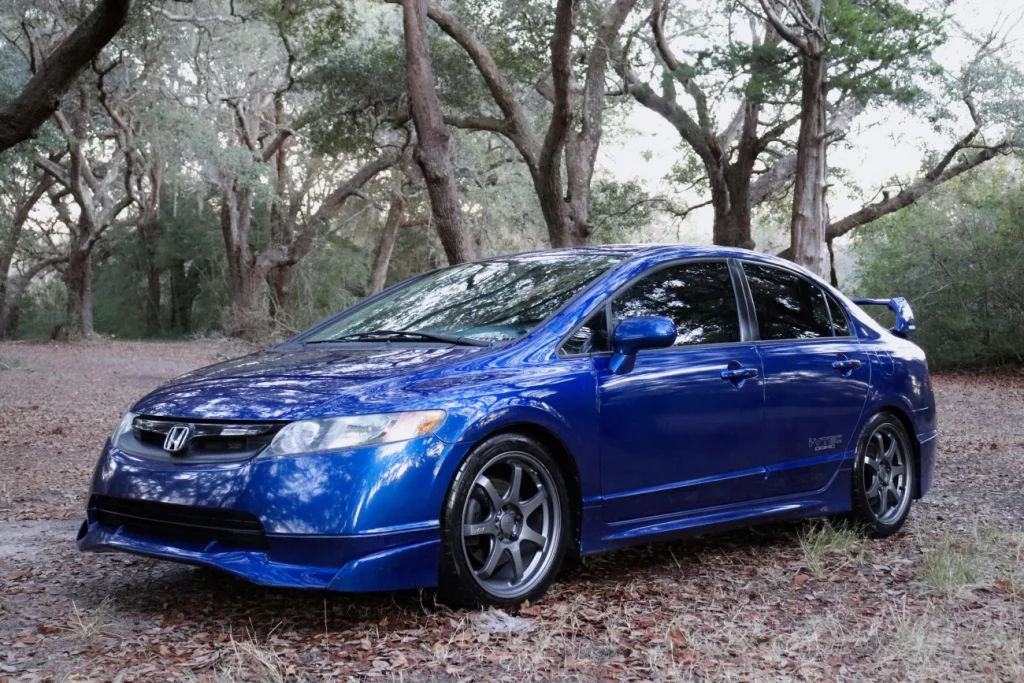
The 2008 Honda Civic Mugen Si is one of the most debated special editions in Honda’s modern history. It carried a $29,500 MSRP plus $595 destination (approximately $30,095 total) — roughly $8,000-$9,000 more than a standard Civic Si sedan that started at $21,310. For that premium, buyers received forged Mugen 18-inch wheels, a Mugen-tuned exhaust, a Mugen-tuned suspension, a unique aero body kit, exclusive Fiji Blue Pearl paint, and one of 1,000 numbered units. The engine and transmission were unchanged from the standard Si. Whether the package was worth its price has been argued since the day it was announced.
This article covers what the Mugen Si actually included, what it did not include, how it compared to the standard Si, and what the package is worth on the used market today. Source data comes from the Honda Newsroom press release of October 23, 2007, period road tests, and Bring a Trailer auction results.
What the Mugen Si Actually Was — and Wasn’t
The Mugen Si was not a high-horsepower factory special. It did not receive a Turbocharger, a supercharger, a displacement increase, different camshafts, a standalone ECU, or any engine calibration changes. The powertrain was identical to the standard 2008 Civic Si: the K20Z3 2.0-liter naturally aspirated inline-four producing 197 horsepower at 7,800 rpm and 139 lb-ft of torque at 6,100 rpm, with an 8,000 rpm redline, a close-ratio 6-speed manual transmission, and a helical limited-slip differential. The only mechanical difference was the exhaust system — a Mugen-tuned sport exhaust that changed the sound character but added no measurable horsepower.
The premium was entirely in chassis, wheels, tires, aero, and exclusivity. Honda and Mugen developed the car as a limited-run appearance and handling package, not a performance upgrade. The press release described the car as “the most track-ready Civic Si ever offered by Honda” but attributed that to the suspension tuning and tires, not to additional power.
Source: Honda Newsroom, October 23, 2007 — “2008 Honda Civic MUGEN Si Sedan Specifications” and “Pricing Set AT $29,500.”
Mugen Si vs Standard Si — What You Actually Got
| Feature | Standard Si Sedan (2008) | Mugen Si Sedan (2008) | Mugen Upgrade Value |
|---|---|---|---|
| Engine | K20Z3 2.0L NA — 197 hp | Same K20Z3 — 197 hp | $0 — no change |
| Exhaust | Standard stainless steel | Mugen-tuned sport exhaust | ~$800-1,200 (sound only) |
| Transmission | 6MT + helical LSD | Same 6MT + helical LSD | $0 — no change |
| Wheels | 17×7J cast alloy | Mugen 18×7.5J forged alloy | ~$2,500-3,500 set |
| Tires | P215/45R17 all-season | BFGoodrich g-Force KDW 215/40ZR18 summer | ~$600-800 set |
| Suspension | MacPherson strut / double wishbone | Mugen-tuned dampers and springs | ~$1,500-2,500 |
| Body Kit | Standard Si bumpers | Mugen front bumper, rear bumper, side skirts, wing | ~$2,000-3,000 (replica) |
| Paint | Standard colors | Fiji Blue Pearl (exclusive Mugen Si color) | Subjective |
| Production | Unlimited | 1,000 numbered units | Scarcity premium |
Sources: Honda Newsroom (2008 Civic MUGEN Si Sedan Specifications, 2008 Civic Si Sedan specifications), Honda Media Site. Aftermarket pricing estimated from period Mugen parts catalogs and current Mugen wheel market value.
The total parts value of Mugen-specific upgrades — if bought individually from aftermarket Mugen parts — was approximately $7,400-$11,000 in 2008 dollars. The package price premium of approximately $8,800 (difference between $29,500 Mugen Si and approximately $20,700 similarly-equipped Si with no options) was roughly in line with the cost of the same Mugen parts purchased separately. The buyer was paying list price for the parts, not a significant markup.
Dimensions and Appearance Differences
The Mugen Si body kit pushed the sedan’s overall length from 176.7 inches (standard Si) to 177.8 inches, an increase of 1.1 inches attributed to the revised front and rear bumpers. The car rode 0.6 inches lower than the standard Si — 55.9 inches in overall height versus 56.5 inches — due to the Mugen-tuned springs and dampers. Width (69.0 inches) and Wheelbase (106.3 inches) were unchanged. Curb weight was 2,945 pounds, identical to the standard Si. Source: Honda Newsroom specification sheet.
The body kit included a unique front bumper fascia with a larger lower intake opening, revised side skirts, a rear bumper with a more pronounced diffuser lip, and a subtle trunk-lip spoiler. The overall effect was modest — less aggressive than the aftermarket Mugen body kits available for the regular Civic, but integrated and factory-finished. The unique Fiji Blue Pearl paint was the only color offered and is the primary visual identifier of a genuine Mugen Si today.
Performance — Identical Powertrain, Different Feel
Because the Mugen Si shared the standard Si’s engine and final drive ratio (4.765), acceleration was effectively identical. Period testing recorded 0-60 mph in approximately 6.5 seconds and the quarter-mile in approximately 15.0-15.2 seconds at 91 mph for both cars. The Mugen-tuned exhaust did not measurably change power output — Honda did not publish a horsepower difference, and no period magazine test recorded one.
The Mugen Si’s performance advantage was in handling. The combination of the forged 18-inch Mugen wheels (saving approximately 3-4 lbs per corner compared to the standard 17-inch cast wheels), the 215/40ZR18 BFGoodrich g-Force KDW summer tires (significantly more grip than the standard all-season rubber), and the Mugen-tuned dampers and springs (reducing ride height by 0.6 inches) resulted in higher cornering speeds and better transient response. Period reviews noted improved steering feel and reduced body roll through the Mugen-tuned front MacPherson Strut and rear double-wishbone suspension.
Braking hardware was unchanged: 11.8-inch front ventilated discs and 10.2-inch rear solid discs. The improved tires would have reduced stopping distances by approximately 5-10 feet from 60 mph, but this is a tire benefit, not a brake system upgrade.
Sources: Motor Matchup period testing (0-60 6.5 sec, quarter-mile 15.2 sec @ 91 mph), ZeroSixtyTimes database (6.5 sec, 15.0 sec quarter-mile). Honda Newsroom (MUGEN Si suspension specifications, brake specifications).
Pricing Breakdown — Then and Now
| Cost Item | Standard Si (2008) | Mugen Si (2008) | Premium |
|---|---|---|---|
| Base MSRP | $21,310 | $29,500 | +$8,190 |
| Destination | $595 | $595 | $0 |
| Total New | $21,905 | $30,095 | +$8,190 |
| Adj. for Inflation (2025) | ~$32,000 | ~$44,000 | +$12,000 |
| BaT Auction Avg (2023-2024) | $8,000-$12,000 | $25,000-$37,000 | +$20,000+ premium |
Sources: Honda Newsroom pricing release (October 23, 2007), Bring a Trailer completed auction results for 2008 Civic Mugen Si (2023-2024), standard 2008 Civic Si listings.
The inflation-adjusted price of the Mugen Si in 2025 dollars is approximately $44,000 — within striking distance of a new 2025 Civic Si ($31,395) or a base Sport Hybrid ($30,100). That comparison makes the Mugen Si look expensive, but that misses the point: the Mugen Si was never a rational value proposition. It was a limited-production collector’s model from the start.
The Verdict — Was It Worth It?
At original MSRP in 2008: No. The Mugen Si was a fair price for the parts installed but offered no performance improvement in a straight line. A buyer who spent $30,095 could have bought a standard Si for $21,905 and used the $8,190 difference on aftermarket coilovers ($1,500), lightweight 18-inch wheels ($2,000), summer tires ($700), a cat-back exhaust ($800), a Hondata ECU reflash ($695), and still had $2,495 left over — and that modified Si would have been faster, handled similarly, and sounded as good. The Mugen Si made sense only for buyers who valued factory warranty coverage on all modifications, factory integration, and the exclusivity of a numbered edition.
On the used market in 2025: Condition-dependent. Low-mileage examples (under 30,000 miles) regularly sell for $25,000-$37,000 on Bring a Trailer, compared to $8,000-$12,000 for a standard 8th gen Si in similar condition. That is a 3x premium, which far exceeds what the original owner paid. As a collector asset, the Mugen Si has appreciated substantially. As a driver’s car, it is still a 197-horsepower, 17-year-old front-drive sedan that a modern Civic Hybrid would gap from a stoplight.
For an enthusiast in 2025: The Mugen Si is worth buying only if you specifically want the collector piece — a numbered factory collaboration between Honda and Mugen with only 1,000 examples. If you want the best-handling 8th generation Civic, you can build one cheaper and faster. If you want a quick Civic that also returns 49 mpg, the 2025 Hybrid costs less adjusted for inflation and is 0.3 seconds quicker to 60 mph.
Competitors at the Time
| Model (2008) | Horsepower | 0-60 | MSRP (2008) | Notes |
|---|---|---|---|---|
| Honda Civic Mugen Si | 197 hp | 6.5 sec | $29,500 | 1,000 units, handling-focused |
| Mazda MX-5 Miata | 170 hp (2.0L MZR) | 6.5 sec | $22,400-$27,700 | RWD, convertible, lighter (2,500 lbs) |
| Mazdaspeed 3 | 263 hp (2.3L turbo) | 5.8 sec | $24,000-$26,000 | Torque steer issues, hatch only |
| Subaru WRX | 224 hp (2.5L turbo) | 5.5 sec | $24,850-$27,850 | AWD, 4-door, significantly quicker |
Sources: Car and Driver (2008 Mazdaspeed 3 tested, 2008 WRX tested, 2008 MX-5 tested), Honda Newsroom. The Mugen Si was dramatically slower than every competitor at its price point except the MX-5, and the MX-5 offered rear-wheel drive and a convertible roof at a lower price. The Mugen Si’s only unique selling proposition was Mugen branding, factory integration, and production scarcity.
Reliability and Ownership Considerations
The Mugen Si shares all mechanical components with the standard 8th generation Civic Si. The K20Z3 engine is chain-driven (no timing belt replacement), has a 100,000-mile no-scheduled-tune-up interval, and is generally reliable when oil changes are maintained. The 6-speed manual transmission has no widespread failure patterns. The Helical LSD is robust in stock form. The only Mugen-specific parts that cannot be replaced with standard Si parts are the wheels, the body kit, the exhaust, and the suspension dampers — and the wheels and body kit are no longer available from Mugen, making cosmetic damage potentially difficult to repair.
The 8th generation Civic Si has two known issues that apply equally to the Mugen Si. The engine is prone to low-RPM knock on 87-octane fuel (premium is required but owners sometimes ignore this). The interior materials — particularly the dashboard and door panels — are lower-grade plastics that can develop rattles and cracking in high-heat environments. Neither issue is systemic or expensive to address.
The Mugen Si’s 18-inch forged wheels (18×7.5J, +45mm offset) are lighter and stronger than the standard 17-inch cast wheels, but the 215/40R18 tire size has fewer options and higher per-tire cost than the standard 215/45R17 size. Replacement summer tires cost approximately $180-$220 per tire. Source: Tire Rack pricing (2025), 8thcivic.com forum owner surveys.
Quick Reference — Mugen Si Facts
☐ Real, factory-built limited edition — not a hypothetical or thought experiment
☐ 1,000 units produced for the US market, all Fiji Blue Pearl
☐ Engine: K20Z3 2.0L NA, 197 hp @ 7,800 rpm, 139 lb-ft @ 6,100 rpm, 8,000 rpm redline
☐ No turbo. No supercharger. No engine calibration changes — identical power to standard Si
☐ 6-speed manual transmission with helical LSD (unchanged from standard Si)
☐ Mugen-specific: 18×7.5J forged wheels, sport exhaust, tuned dampers/springs, aero body kit, exclusive paint
☐ 0-60 mph: ~6.5 seconds (identical to standard Si)
☐ MSRP $29,500 + $595 destination = ~$30,095 total
☐ Premium over standard Si: approximately $8,190-$8,800
☐ Parts value of Mugen upgrades at retail: approximately $7,400-$11,000
☐ Fuel economy: EPA 21 city / 29 highway — premium fuel required
☐ Turning circle: 35.4 ft — tightest of any Civic Si generation
☐ Curb weight: 2,945 lbs — same as standard Si
☐ 2025 BaT auction range: $25,000-$37,000 for low-mileage examples
☐ Adjusted for inflation: ~$44,000 in 2025 dollars — more than a new 2025 Civic Si or Hybrid
☐ Not worth building for performance in 2025 — 2025 Civic Hybrid is quicker and cheaper
☐ Worth buying only as a collector piece with documented provenance and original wheels
☐ Competitors at $30K in 2008 were significantly faster: WRX, Mazdaspeed 3