

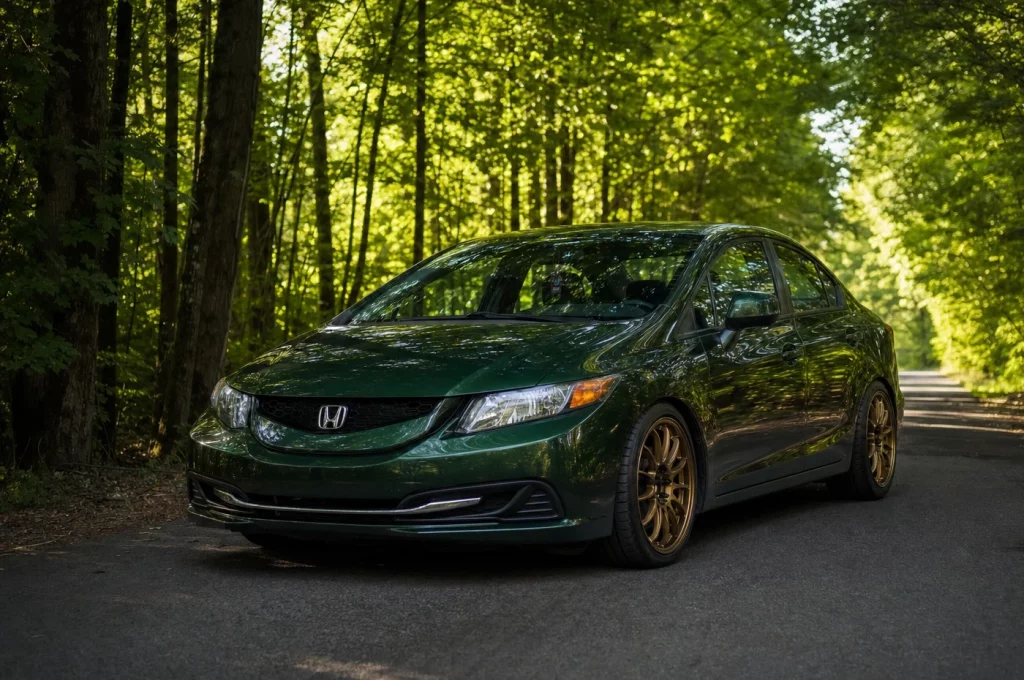
The 9th-generation Honda Civic Si (2012–2015) is one of the most misunderstood cars in the Si lineage. It replaced the beloved 8th-gen K20Z3 with a larger-displacement K24Z7 engine that produced more torque but revved lower, used an integrated exhaust manifold, and traded some of the 8th-gen’s high-RPM character for a broader powerband. The result was a car that earned mixed reviews at launch and still occupies an awkward position among Si enthusiasts. The tuning story for this engine is similarly complex — the K24Z7 responds well to bolt-ons and tuning, but the path to power is different from older K-series engines, and the ceiling is lower than many owners expect from a naturally aspirated K24. This guide covers every bolt-on worth considering, the tuning options available, realistic dyno results, and where the platform runs into limits. Sources: Honda Newsroom official press release, Wikipedia K24Z7 specifications, 9thGenCivic.com and 9thCivic.com forum dyno threads, DSPORT Magazine 10th-gen Si dyno testing, Hondata.com FlashPro documentation, RV6 Performance product pages, ThreePiece.us build guide, VitViper tuning blog and forum threads, Hardmotion product data.
The K24Z7 Engine — What Made It Different
The K24Z7 is a 2.4-liter DOHC i-VTEC inline-four with an 11.0:1 Compression Ratio, 87 mm bore, and 99 mm stroke — making it a long-stroke engine by K-series standards. The long stroke gives it the torque character that Honda intended for the 9th-gen Si: 174 lb-ft at 4,400 rpm (2014–2015) versus the 8th-gen K20Z3’s 139 lb-ft at 6,100 rpm. The tradeoff is a lower redline — 7,000 rpm on 2012–2013 cars, raised to 7,500 rpm on 2014–2015 models — and a peak horsepower figure of 205 hp at 7,000 rpm that is only seven horsepower higher than the older 2.0-liter engine. Source: Honda Newsroom 2015 Civic Si press release, Wikipedia K24Z7 page, Honda The Other Side K24Z7 specs.
The K24Z7 uses intake-only VTEC — the intake cam has a high-lift profile that engages at approximately 5,200–5,500 rpm depending on year, while the exhaust cam uses VTC (variable timing control) only, without VTEC lobe switching. This is a significant difference from the K20Z3, which had VTEC on both intake and exhaust cams. The single VTEC setup reduces top-end power potential compared to the 8th-gen engine, but the larger displacement partially compensates. Source: Wikipedia K24Z7 specifications, K20A.org technical discussion.
The most controversial feature of the K24Z7 is its integrated stainless steel exhaust manifold — a cast manifold that is part of the cylinder head assembly. This design eliminates the traditional header (exhaust manifold) as a replaceable bolt-on part. On older K-series engines, an aftermarket header was one of the best power upgrades available, producing 10–15 whp gains. On the K24Z7, the header is permanently attached to the head, and the only exhaust-side upgrade is a downpipe that replaces the section from the integrated manifold outlet to the Catalytic Converter. This single design decision fundamentally changes the bolt-on strategy for the 9th-gen Si. Source: Honda Newsroom press release, Hardmotion RV6 downpipe product page, 9thGenCivic.com downpipe discussion.
The factory ECU on the 9th-gen Si is also more aggressive with fuel trims and timing adjustments than earlier Honda ECUs. Owners report that bolt-on parts installed without tuning often produce no gain or can even lose power because the ECU pulls timing in response to the changed airflow. This makes tuning not just a performance upgrade but a prerequisite for any meaningful modification. Source: 9thGenCivic.com intake comparison thread, 9thCivic.com bolt-on discussion.
Hondata FlashPro — The Only Tuning Platform
The Hondata FlashPro is the sole tuning platform for the 9th-gen Civic Si. There is no KTuner support, no Cobb AccessPort, and no other standalone option that integrates with the factory ECU. The FlashPro connects to the OBD-II port and allows the user to reflash the ECU with modified calibrations. It includes the FlashPro Manager software for Windows, which provides access to all adjustable parameters: fuel maps, ignition timing, cam phaser (VTC) positioning, VTEC engagement point, throttle-by-wire response, rev limit, speed limiter, and rev hang. Source: Hondata.com FlashPro product page, DSPORT Magazine FlashPro testing, 9thGenCivic.com FlashPro discussion.
FlashPro only — no hardware alternative. Honda released an early product called the “Hondata ReFlash” in 2012, which was a fixed one-time ECU reflash with no user adjustability. Owner dyno results showed the ReFlash produced less than 5 whp gain on a stock car — one owner measured 179.8 whp versus a 177.8 whp baseline, a gain of approximately 2 whp. The ReFlash raised the rev limiter to 7,600 rpm, removed the speed limiter, and improved throttle response, but the power gain was underwhelming without supporting modifications. Honda discontinued the ReFlash in favor of the full FlashPro system. Source: 9thGenCivic.com ReFlash dyno thread, Hondata.com ReFlash archived page.
FlashPro on a stock car. A FlashPro calibration on an otherwise stock Si produces modest peak power gains — approximately 8–15 whp depending on the calibration and dyno — but the driving experience improvements are substantial. The tune removes rev hang completely, sharpens throttle response to eliminate the factory delay, and can lower the VTEC engagement point. The result is a car that feels noticeably quicker and more responsive even though the peak horsepower number does not change dramatically. Several owners on 9thGenCivic.com who had their cars tuned by VitViper (Vit, a well-known 9th-gen tuner) reported that the drivability improvement alone was worth the cost of the FlashPro. Source: 9thGenCivic.com FlashPro experience thread, 9thCivic.com VitTune comparison.
FlashPro cost and sourcing. A new FlashPro costs approximately $695 from Hondata or authorized dealers. Used units sell for $450–$550 on CivicX classifieds and forum marketplaces. The FlashPro is VIN-locked to one vehicle but can be unlocked and resold, so buying used is practical. VitViper historically offered a FlashPro + custom eTune package for approximately $765 — a popular entry point. Source: 9thGenCivic.com pricing discussion, 9thCivic.com FlashPro availability threads.
Tuning Options — Off-the-Shelf vs Custom eTune vs Dyno Tune
Off-the-shelf (OTS) basemaps. The FlashPro Manager software includes pre-loaded basemaps for various configurations: stock, intake only, intake + exhaust, and intake + downpipe. These basemaps are a starting point, not a finished tune. Owners who run basemaps without custom tuning report acceptable drivability but leave power on the table. The basemaps use conservative timing and fuel values and do not account for individual car variations, fuel quality differences, or local climate. Source: DSPORT Magazine FlashPro article, 9thGenCivic.com basemap discussion.
Custom eTune (VitViper). The dominant tuning method for the 9th-gen Si is an eTune from Vit (VitViper), who was the most prolific tuner on this platform. The process works like this: the owner installs the FlashPro, flashes a base calibration, performs datalogging runs (WOT pulls in 3rd gear from 2,500 rpm to redline), and emails the log files to Vit. Vit reviews the logs, adjusts the calibration, and sends back an updated file. The owner flashes the new calibration and repeats the process. A typical eTune requires 5–10 rounds of datalogging over several days to a week. Vit’s eTune pricing was approximately $150–$250 depending on the package. Owners consistently reported that the Vit eTune produced noticeably better results than basemaps — smoother power delivery, safer air-fuel ratios, and better part-throttle response. Source: 9thGenCivic.com VitTune reviews, 9thCivic.com FlashPro vs Vit comparison, 9thGenCivic.com etune discussion.
Dyno tune. A dyno tune at a shop with FlashPro experience is the most expensive option ($300–$500 for the tune, plus the FlashPro cost) but offers the advantage of immediate results on a calibrated dyno. The challenge is finding a tuner who knows the FlashPro software well — several owners on 9thGenCivic.com reported poor dyno tunes from shops that were experienced with other platforms but did not understand FlashPro Manager’s specific features, particularly cam phaser tuning and VTC optimization. VitViper also offered in-person dyno tuning for customers who could travel to his shop, which was considered the gold standard for this platform. Source: 9thGenCivic.com dyno vs etune debate thread, 9thCivic.com VitViper tune reviews.
| Tuning Method | Typical Cost | HP Gain (Stock Car) | Time Required | Recommended? |
|---|---|---|---|---|
| Hondata ReFlash (discontinued) | ~$395 (original) | +2–5 whp | 1 day | No — poor value, discontinued |
| FlashPro OTS basemap | ~$695 (FlashPro) | +8–12 whp | 30 minutes | Baseline only — leaves gains on table |
| FlashPro + Vit eTune | ~$765–$950 total | +12–20 whp | 5–10 days (datalogging) | Yes — best value for bolt-on cars |
| FlashPro + dyno tune | ~$1,000–$1,200 total | +12–20 whp | 2–4 hours | If you have a good local tuner |
Intakes — Real Gains and Common Pitfalls
The K24Z7 is sensitive to intake changes. The factory intake system is well-designed for the stock power level, and simply adding a cold air intake without tuning can produce zero gain or even a power loss because the ECU pulls timing in response to changed mass airflow readings. This is not a myth — multiple owners on 9thGenCivic.com reported slower quarter-mile times after installing an intake without tuning. Source: 9thGenCivic.com intake comparison thread, 9thCivic.com intake discussion.
Injen Cold Air Intake. The Injen CAI was the most common early intake for the 9th-gen Si. It positions the filter behind the front bumper for cooler air. Owner reports on the Injen are mixed: some owners report good gains with tuning (approximately 5–8 whp), while others report heat soak issues in hot climates and occasional MAF sensor reading problems. The Injen was the subject of numerous dyno comparisons where results varied significantly depending on the dyno brand, ambient temperature, and whether the car was tuned. Source: 9thGenCivic.com Injen CAI discussion, 9thCivic.com intake shootout.
AEM Cold Air Intake. The AEM CAI places the filter behind the fog light area for maximum cold air exposure. Multiple owners on 9thGenCivic.com reported that the AEM design was better for maintaining low IATs (intake air temperatures) than the Injen, though peak power gains on a tuned car are similar — approximately 4–7 whp. The AEM uses a dry-flow filter that does not require oiling. Source: 9thGenCivic.com AEM vs Injen discussion, Honda-Tech intake comparison thread.
AFE Takeda Momentum. The AFE Takeda is a sealed enclosed intake system with a dry filter and a closed box that draws air from the front grille area. The Takeda design is the most effective AT maintaining low IATs in warm weather — one owner in a desert climate reported IATs only 15–18 degrees above ambient with the Takeda, compared to significantly higher temps with open-element intakes. However, the Takeda is the most expensive intake option at approximately $400–$450, and some owners report slight throttle lag due to the enclosed design. Dyno results from a tuned car with Takeda intake, RV6 downpipe, and Q300 exhaust showed approximately 200+ whp. Source: 9thGenCivic.com Takeda dyno result thread, 9thCivic.com intake discussion.
Skunk2 Cold Air Intake. The Skunk2 CAI is a polymer tube design that, according to the manufacturer, keeps intake air cooler than aluminum tubes. The filter sits in the front bumper area. The Skunk2 intake is known for a more complicated installation — the battery tray must be relocated and MAF sensor wires extended. Some owners report that the Skunk2 does not need a tune to see gains (per Skunk2’s claims), but this contradicts broader owner experience on the platform. The Skunk2 intake is approximately $300–$350. Source: 9thGenCivic.com Skunk2 vs Injen thread, Skunk2 product documentation.
Acuity Intake (anomaly). An intake shootout conducted by RC Autoworks in 2018 showed an Acuity intake producing 185 whp on an otherwise stock Si — an unusually high result that may reflect a favorable dyno rather than the intake’s true performance. The same test showed a PRL intake and a Skunk2 intake producing lower numbers on the same dyno. These results should be taken with the caveat that dyno-to-dyno variation is significant. Source: 9thGenCivic.com RC Autoworks intake shootout thread.
Rick Spec’d 3.5″ Intensity Intake. One of the highest-performing intakes for full bolt-on cars is the 3.5″ Rick Spec’d Intensity intake, which was part of the 214 whp / 192 tq build documented on 9thGenCivic.com. The larger diameter supports higher airflow for cars with RBC intake manifold swaps and ZDX throttle bodies. Source: 9thGenCivic.com 210+ WHP mods thread.
The Downpipe — The Most Effective Single Modification
The K24Z7’s integrated exhaust manifold means the downpipe is the only meaningful exhaust-side upgrade available. The factory downpipe includes a restrictive catalytic converter and a narrow 2.25-inch outlet. Replacing this section with a larger, freer-flowing downpipe is the single largest power gain available on the 9th-gen Si. Source: RV6 Performance product page, Hardmotion RV6 downpipe description, 9thGenCivic.com downpipe dyno results.
RV6 Downpipe (2.5″).
Full Race and Ultimate Racing (3.0″). Full Race and Ultimate Racing offer 3-inch downpipes for the 9th-gen Si. The larger diameter is designed for owners who plan to add forced induction later — on a naturally aspirated car, the 3-inch downpipe can actually reduce low-end torque compared to the 2.5-inch RV6 because the larger diameter reduces exhaust gas velocity. One tuner noted on 9thGenCivic.com: “The RV6 is ok but this engine would benefit a lot more with the Full Race downpipe if you plan to boost.” For N/A-only cars, the RV6 2.5-inch is widely considered the better match. Source: 9thGenCivic.com RV6 vs Full Race comparison thread.
Important: downpipe must be paired with a tune. Installing an aftermarket downpipe without tuning will cause the ECU to detect the changed exhaust flow and trigger a check engine light for catalyst efficiency. The car will run lean at WOT because the factory calibration expects a specific exhaust backpressure. Owners who installed a downpipe without tuning reported running lean enough to be a long-term reliability concern. The tune is what allows the engine to properly use the downpipe’s flow improvement. Source: 9thGenCivic.com downpipe tuning discussion, 9thCivic.com bolt-on thread.
Cat-Back Exhaust — Diminishing Returns
The cat-back exhaust provides the smallest power gain of any major bolt-on on the 9th-gen Si. The factory exhaust on 2012–2013 models is a 2.25-inch system with a relatively restrictive muffler. Honda revised the exhaust for 2014–2015 models, increasing the pipe diameter to approximately 2.75 inches and improving muffler flow. On 2014–2015 cars, an aftermarket cat-back adds approximately 2–5 whp on a tuned car — a marginal gain that is often outweighed by the added cost and noise. Source: 9thGenCivic.com exhaust discussion, 9thCivic.com full exhaust dyno thread.
Invidia Q300. The Q300 is the most popular cat-back for the 9th-gen Si. It uses a 2.75-inch or 3-inch pipe diameter depending on the version, with a dual-wall polished tip. Owner reviews consistently describe the Q300 as relatively quiet for an aftermarket exhaust — no drone on the highway, with a noticeable tone at WOT. The Q300 was part of the 200+ whp build documented on 9thGenCivic.com with Takeda intake and RV6 downpipe. Cost: approximately $600–$800. Source: 9thGenCivic.com Q300 reviews, 9thCivic.com exhaust thread.
Full Race Exhaust (3″). The Full Race 3-inch cat-back is designed primarily for turbocharged applications but is sometimes used on N/A cars. Several owners reported that the 3-inch exhaust lost some low-end torque compared to the 2.75-inch stock or Q300 systems, with the gain only appearing above 6,000 rpm. One owner who ran RV6 catless downpipe with Full Race exhaust noted: “If anything I lost a bit down low with the 3-inch exhaust compared to stock but gained at least that much back up top.” For N/A street cars, a 2.75-inch system is generally the practical choice. Source: 9thGenCivic.com RV6 vs Full Race thread, 9thGenCivic.com exhaust sizing discussion.
Axle-back options. Several manufacturers (Injen, Skunk2, HKS) offer axle-back exhausts that replace only the muffler section. These produce almost no measurable power gain but change the sound. Axle-backs are a reasonable choice for owners who want a sportier note without spending on a full cat-back. One owner with an Injen axle-back, HPS intake tube, and K&N drop-in filter reported 198 whp on a DynoJet without tuning — a result that is primarily attributed to the downpipe portion of the modified exhaust, not the axle-back itself. Source: 9thGenCivic.com power package dyno thread.
RBC Intake Manifold Swap — The Controversial Mod
The RBC intake manifold from the 8th-gen Civic Si (2006–2011 K20Z3) can be swapped onto the K24Z7 with modifications. The RBC is a cast aluminum single-piece manifold that flows more air than the K24Z7’s plastic two-piece unit. The swap requires: modifying the Coolant port on the RBC manifold to match the K24Z7 head, welding closed an unused vacuum port, extending the drive-by-wire throttle cable bracket, and sourcing a custom intake tube that positions the MAF sensor. Source: 9thGenCivic.com RBC swap write-up, 9thCivic.com RBC vs stock IM comparison.
Power gains from the RBC swap are mixed. A dyno comparison posted on 9thCivic.com showed the RBC gaining approximately 5 HP above 7,100 rpm but losing 8–12 lb-ft of torque through the midrange (3,500–5,500 rpm). Multiple tuners noted that the RBC swaps the powerband upward, sacrificing the broad midrange torque that makes the K24Z7 pleasant to daily drive. The stock intake manifold was specifically tuned by Honda for the K24Z7’s torque characteristics, and the RBC undoes that tuning. Source: 9thCivic.com stock IM vs RBC dyno thread.
ZDX throttle body. The Acura ZDX throttle body (70mm outlet) is a common companion to the RBC swap. The stock throttle body is 64.5mm. Porting the RBC manifold to match the 70mm ZDX TB inlet improves throttle response and adds approximately 3–5 whp at the top end. The combination is expensive — approximately $400–$800 for the manifold, machining labor, throttle body, and custom intake tube — and only produces meaningful gains when paired with full bolt-ons and a custom tune. Source: 9thGenCivic.com RBC/ZOX price discussion, 9thCivic.com RBC swap questions thread.
The consensus among 9th-gen tuners. For a naturally aspirated street car, the RBC manifold swap is not a good value. The cost is high, the installation is involved, and the midrange torque loss is noticeable in daily driving. The RBC swap is primarily worthwhile for owners who are building a maximum-effort N/A car with cams, larger injectors, and a high-flow head — or for owners planning forced induction, where the RBC’s improved flow at high RPM becomes more relevant. Source: 9thCivic.com RBC vs stock IM analysis, 9thGenCivic.com intake manifold discussion with Vit.
Realistic Power Levels — What Each Stage Produces
The 9th-gen Si’s baseline wheel horsepower varies significantly depending on the dyno brand and correction factor. A stock K24Z7 measures approximately 165–180 whp on a DynoJet, approximately 150–160 whp on a Dyno Dynamics (heartbreaker), and approximately 170–175 whp on a Dynapack. The Bisimoto baseline test of a 2012 Si at 11 miles on a Dynapack measured 171 whp — this is the most reliable factory baseline. Source: 9thGenCivic.com stock dyno thread, Bisimoto/Honda partnership testing, 9thCivic.com edyno results.
| Build Stage | Modifications | Typical WHP (DynoJet) | Typical TQ | Est. Crank HP |
|---|---|---|---|---|
| Stock | — | 170–175 whp | 150–158 lb-ft | 201–205 hp |
| Stage 1 | FlashPro + custom tune | 182–190 whp | 160–170 lb-ft | ~210–220 hp |
| Stage 2 | Tune + intake + downpipe + exhaust | 200–210 whp | 170–180 lb-ft | ~230–240 hp |
| Stage 3 (max N/A) | Stage 2 + RBC manifold + ZDX TB + ported runners | 210–220 whp | 175–192 lb-ft | ~245–255 hp |
Stage 1 (tune only). A FlashPro with a custom tune (Vit eTune or dyno tune) on an otherwise stock Si produces approximately 182–190 whp, depending on the dyno. The peak gain is 10–15 whp over the stock baseline. The real improvement is in the power curve shape — the tuned car holds power to redline rather than falling off, and torque is improved through the midrange. The most commonly cited gains are +12–20 whp and +10–15 lb-ft of torque. Source: 9thCivic.com VitTune comparison, 9thGenCivic.com FlashPro stock dyno thread, DSPORT Magazine 10th-gen FlashPro results (as reference).
Stage 2 (tune + bolt-ons). A tuned Si with a cold air intake, RV6 downpipe (catted or catless), and a cat-back exhaust typically measures 200–210 whp on a DynoJet. The downpipe is responsible for the majority of the gain — the intake and exhaust combined add approximately 5–10 whp, while the downpipe adds approximately 15–20 whp. One of the best-documented Stage 2 builds used an Injen CAI, RV6 catted downpipe, and Injen axle-back exhaust with a Vit dyno tune, producing 208 whp and 195.4 lb-ft of torque on a Dynapack. An eDyno from another Vit-tuned car with intake, downpipe, and exhaust measured approximately 215 whp. Source: 9thGenCivic.com bolt-on dyno results thread, 9thCivic.com downpipe results thread.
Stage 3 (max N/A). The highest naturally aspirated power levels on the K24Z7 require the RBC intake manifold swap, ZDX throttle body, ported intake runners, and larger injectors (RDX 410cc or Grams 550cc). A well-documented Stage 3 build on 9thGenCivic.com used a 3.5″ Rick Spec’d intake, ported stock intake manifold runners (Maxbore), ZDX TB, RV6 catless downpipe, Tsudo 70mm exhaust, and a Vit tune, producing 214 whp and 192 lb-ft of torque. A different tuner (K20A.org thread) reported tuning “a bunch” of K24Z7s with RBC manifold, 3-inch downpipe/exhaust, and 3.5-inch intake at 205–215 whp on his DynoJet. Source: 9thGenCivic.com 210+ WHP mods thread, K20A.org K24Z7 bolt-on dyno thread.
Stock Intake Manifold Porting — An Alternative to the RBC
An alternative to the full RBC swap is porting the stock intake manifold’s metal runner section. Several shops (Maxbore, RC Autoworks) offer porting services for the stock manifold that smooth the transition between the plastic plenum and the metal runners to the cylinder head. Owners who have done this report gains of approximately 3–6 whp at a significantly lower cost than the RBC swap (approximately $100–$200 for porting versus $400–$800 for the RBC + modifications). The stock manifold retains its midrange torque characteristics, making this a more practical option for street-driven cars. Source: 9thGenCivic.com stock IM porting discussion, 9thGenCivic.com Maxbore porting results.
The Cost Per Horsepower Reality
The cost-effectiveness of modifications on the 9th-gen Si follows a steep diminishing-returns curve. The FlashPro + custom tune provides the best initial gain at approximately $45–$60 per whp. Adding a downpipe is the second best value. The intake and exhaust produce small gains at higher cost per horsepower. The RBC manifold and ZDX throttle body represent the poorest value for street-driven cars, with a cost of approximately $200–$400 per whp gain. Source: 9thGenCivic.com mod pricing thread, cost analysis from owner reports.
| Modification | Cost (New) | WHP Gain | Cost per WHP | Bottom Line |
|---|---|---|---|---|
| FlashPro + Vit eTune | $765–$950 | +12–20 whp | ~$50/whp | Mandatory first step |
| RV6 downpipe (catted) | $350–$450 | +15–20 whp (tuned) | ~$25/whp | Best value bolt-on |
| Cold air intake | $250–$400 | +4–7 whp | ~$65/whp | Worth it with tune |
| Cat-back exhaust | $600–$1,200 | +2–5 whp | ~$200/whp | Sound only, poor value |
| RBC manifold + ZDX TB | $400–$800 | +5–8 whp | ~$80–100/whp | Only for max N/A or FI prep |
Reliability Considerations
The K24Z7 is a robust engine, and the power levels achievable with bolt-ons and tuning (200–215 whp) are well within its design margins. The engine’s 11.0:1 compression ratio is high for a naturally aspirated engine, but the factory tuning is conservative enough that a properly calibrated tune on 91+ octane fuel does not increase knock risk. Source: 9thGenCivic.com reliability discussion, K20A.org K24Z7 technical analysis.
Rod and bottom end. The K24Z7 uses forged connecting rods from the factory, unlike the cast rods found in the K24A2 (Acura TSX). The bottom end is capable of handling at least 350 whp in forced-induction applications without failure. At naturally aspirated power levels (200–215 whp), the bottom end is effectively unloaded. There is no documented pattern of rod or bearing failures on tuned naturally aspirated K24Z7 engines. Source: Wikipedia K24Z7 specifications, K20A.org technical discussion, 9thCivic.com reliability reports.
Oil consumption. Some 9th-gen Si owners report oil consumption from the factory, typically 0.5–1 quart per 3,000–5,000 miles. This is not related to tuning and is considered a normal characteristic of the K24Z7 engine by Honda. Tuning does not increase oil consumption. Source: 9thGenCivic.com oil consumption thread, 9thCivic.com owner reports.
No head gasket issues. Unlike the 8th-gen K20Z3 (which had some head gasket patterns under high-RPM operation), the K24Z7 does not have a documented Head Gasket Failure pattern at naturally aspirated power levels. The integrated exhaust manifold may actually help with gasket durability by reducing thermal cycling at the head-to-manifold interface. Source: 9thGenCivic.com head gasket discussion, K20A.org reliability thread.
Transmission. The 6-speed manual transmission in the 9th-gen Si (a carryover from the 8th-gen) is the same PZ6M-A unit rated for approximately 240–260 lb-ft of torque. The stock clutch handles Stage 2 power levels without slipping for most owners, though some report clutch slip on high-mileage cars with full bolt-ons. The clutch is a wear item that may need replacement at 80,000–120,000 miles regardless of modifications. Source: 9thGenCivic.com clutch discussion, DSPORT Magazine Si clutch testing.
The Forced Induction Question
The integrated exhaust manifold that limits N/A bolt-on options has an upside: it makes turbocharging easier. Full Race offers a turbo kit specifically designed for the 9th-gen Si’s integrated manifold, using the manifold as the exhaust-side mounting point. Supercharger kits from CTE (C38 series) and KraftWerks are also available. At approximately 8–10 psi of boost, a K24Z7 makes 300–330 whp with supporting mods — a power level that pushes the platform well beyond what N/A tuning can achieve. However, forced induction requires a significantly larger investment (approximately $4,000–$7,000 for a complete kit plus fuel system upgrades, intercooler, clutch, and tuning) and is a separate discussion from bolt-on N/A tuning. Source: 9thGenCivic.com turbo discussion, ThreePiece.us build guide, 9thCivic.com supercharger thread.
Intended Build Strategy — What Order to Buy Parts
For an owner starting with a stock 9th-gen Si, the recommended order of modifications based on owner experience and cost-effectiveness is as follows.
Step 1: FlashPro + custom tune. This is not optional — it is the foundation of every other modification. A Vit eTune on a stock car removes rev hang, sharpens throttle response, improves the power curve, and raises the rev limiter. Cost: approximately $765–$950 (FlashPro + tune). Gain: +12–20 whp.
Step 2: RV6 downpipe (catted or catless). The downpipe produces the largest single bolt-on gain by a significant margin. A catted downpipe is recommended for street cars to avoid the exhaust odor. Must be paired with a tune to avoid a check engine light and lean AFR. Cost: approximately $350–$450. Gain: +15–20 whp (with tune).
Step 3: Cold air intake. An intake adds sound and a small power gain on a tuned car. The AFE Takeda is the best design for IAT management, while the Injen or AEM are proven options at a lower cost. Cost: approximately $250–$400. Gain: +4–7 whp.
Step 4: Cat-back exhaust (optional). Only worth the investment if you want a specific exhaust note. The factory exhaust on 2014–2015 cars is already well-designed. On 2012–2013 cars, the gain is slightly more noticeable but still marginal. Cost: $600–$1,200. Gain: +2–5 whp.
Step 5: RBC manifold + ZDX throttle body (optional, N/A max effort only). Only for owners who want every possible horsepower from naturally aspirated configuration. Not recommended for daily drivers who value midrange torque. The ported stock intake manifold is a better value alternative. Cost: $400–$800. Gain: +5–8 whp.
Does the 9th-Gen Si Respond to Bolt-Ons?
The answer is yes, but the path is different from previous Si generations. The K24Z7 is not the K20Z3 — it does not respond to a traditional header, and the peak horsepower gains are lower. But the midrange torque improvement from the downpipe and tune transforms how the car drives. A Stage 2 Si (intake, downpipe, exhaust, tune) makes approximately 200–210 whp — roughly 30–40 whp over stock — with a broader, flatter torque curve that makes the car faster in real-world driving than the peak number suggests. The 0-60 time for a tuned 9th-gen Si is approximately 5.5–5.8 seconds, compared to 6.2–6.5 seconds stock. That is a meaningful improvement for a car that cost under $25,000 new and can still be purchased for $10,000–$15,000 today. The platform is not the highest-ceiling Si ever made — the 8th-gen K20Z3 with a header and tune can match or exceed the K24Z7’s peak output — but the 9th-gen delivers its power in a broader, more usable band. For an owner who wants a daily-driven car that feels quicker and more responsive, the K24Z7 rewards the standard bolt-on and tuning approach. For an owner chasing peak horsepower numbers, the forced induction path is the only way to get there. Source: 9thGenCivic.com build threads, 9thCivic.com stock vs tuned acceleration estimates.
Summary
The 9th-gen Civic Si K24Z7 is a tuning proposition that rewards methodical modification but punishes random part selection. The integrated exhaust manifold eliminates the traditional header as a bolt-on option and makes the downpipe the single most effective modification. The Hondata FlashPro is the essential platform enabler — tuning is not optional if you want to see gains from bolt-ons, and the drivability improvements alone justify the investment. A Stage 2 Si (FlashPro + tune, intake, downpipe, exhaust) produces approximately 200–210 whp — a gain of 30–40 whp over stock with a dramatically improved driving experience. The maximum naturally aspirated ceiling is approximately 215–220 whp with an RBC manifold swap, ZDX throttle body, and ported intake runners. For owners who want more than that, forced induction is the only path. The K24Z7 is not a high-revving K20 — it is a torque-focused engine with a broader powerband and a lower ceiling, but it delivers its power in a way that is genuinely enjoyable in daily driving.
9th Gen Si K24Z7 Tuning — Quick Reference:
☐ The K24Z7 (2.4L, 11.0:1 compression, 205 hp / 174 lb-ft) uses an integrated exhaust manifold that prevents traditional header swaps — the downpipe is the only significant exhaust-side upgrade.
☐ Hondata FlashPro is the only tuning platform for the 9th-gen Si. KTuner and Cobb do not support this ECU. A custom eTune from VitViper is the most commonly recommended tuning method at approximately $150–$250 for the tune plus $695 for the FlashPro.
☐ Tuning is mandatory for bolt-on modifications on this platform — installing an intake or downpipe without tuning can cause the ECU to pull timing, resulting in no gain or even a power loss.
☐ The RV6 2.5-inch downpipe (catted or catless) is the single best bolt-on for the K24Z7, adding 15–20 whp on a tuned car. The catless version adds 3–5 whp more but produces exhaust odor.
☐ A Stage 1 car (FlashPro + custom tune, stock hardware) makes approximately 182–190 whp. A Stage 2 car (tune + intake + downpipe + exhaust) makes approximately 200–210 whp. A maximum N/A build (Stage 2 + RBC manifold + ZDX TB + ported runners) reaches approximately 210–220 whp.
☐ The RBC intake manifold swap from the 8th-gen Si is controversial — it gains 5–8 whp at the top end but loses midrange torque. The ported stock intake manifold is a better value for street-driven cars.
☐ A cat-back exhaust is the poorest value modification, adding 2–5 whp at a cost of $600–$1,200. It is primarily a sound modification. The 2014–2015 factory exhaust (2.75-inch) is already well-designed.
☐ The K24Z7 bottom end (forged rods) is robust enough for Stage 3 N/A power levels without reliability concerns. The clutch may slip on high-mileage cars at Stage 2 power levels.
☐ For owners who want significant power gains beyond 215 whp, forced induction (Full Race turbo kit or CTE/KraftWerks supercharger) is the only practical path. A 9th-gen Si at 8–10 psi produces 300–330 whp.
☐ The recommended modification order for a stock 9th-gen Si is: (1) FlashPro + custom tune, (2) RV6 downpipe, (3) cold air intake, (4) cat-back exhaust (optional), (5) RBC manifold swap (only for max N/A effort).