

Why the EK9 Still Commands $30,000+
The 1997–2000 Honda Civic Type R (Chassis Code EK9) is the car that established the Type R nameplate outside of the NSX and Integra. It was never sold through official Honda channels outside Japan. Every example on the road in North America, Europe, or Australia arrived through private import — mostly under the 25-year rule that made EK9s legal in the US from 2022 onward. Clean, unmodified examples now trade between $30,000 and $45,000, with pristine low-mileage cars reaching $60,000–$75,000, and Mugen-equipped special editions approaching $100,000 (source: Classic.com auction data; DUB Magazine January 2026).
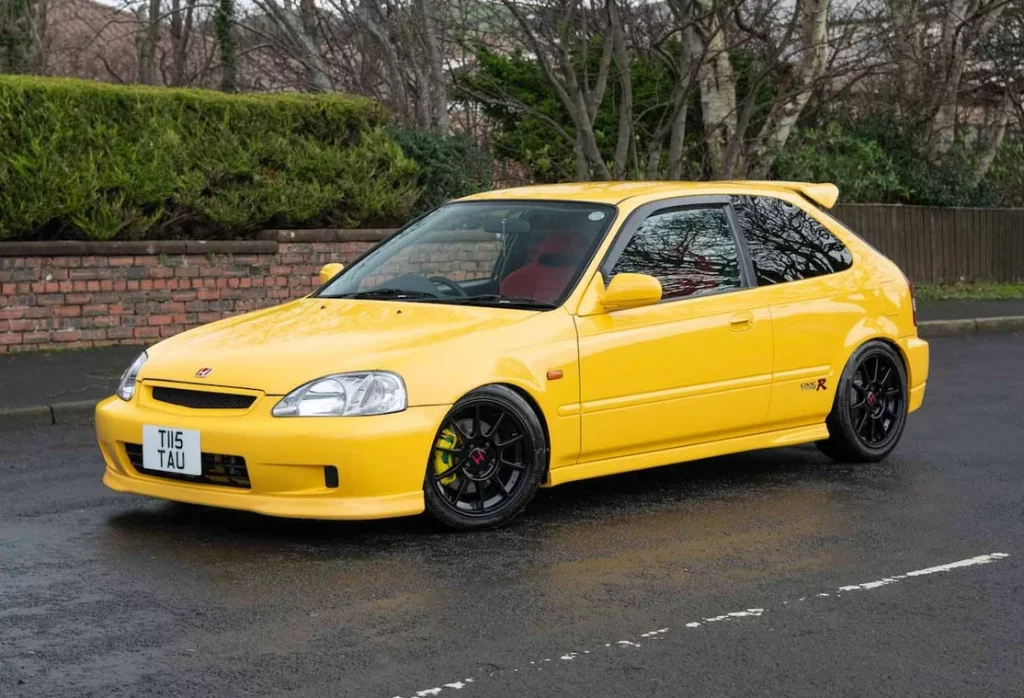
The answer to why a 1.6-liter hatchback from the 1990s commands that kind of money breaks down into four factors: the engine, the weight, the rarity, and the experience.
The B16B Engine — A Naturally Aspirated Benchmark
The EK9’s engine is the B16B, a 1.6-liter DOHC VTEC inline-four that produced 185 PS (182 hp) at 8,200 rpm and 160 Nm (118 lb-ft) at 7,500 rpm (source: Honda EK9 specifications; Wikipedia Honda B engine). VTEC engagement occurs at 6,100 rpm, with a redline at 8,400 rpm and a hard rev limiter at 8,600 rpm.
The B16B shares its block architecture with the Integra Type R‘s B18C but uses a destroked crank with the same 77.4 mm stroke as the B16A, combined with longer connecting rods. This gave the B16B a higher rod-to-stroke ratio — better for high-rpm durability. The cylinder head received hand-porting and polishing at Honda’s engine shop, a step normally reserved for racing engines (source: Honda B engine technical deep-dive).
The result was 116 PS per liter from a naturally aspirated production engine — a record at the time that exceeded even the McLaren F1’s BMW S70/2 V-12 (109 hp/L). It was later surpassed by the Lexus LFA’s 1LR-GUE V-10 at 115 hp/L, but the B16B held that title for over a decade (source: HotCars, Honda B16B specific output).
Weight and Chassis — The Other Half of the Formula
Curb weight ranges from 1,040–1,090 kg (2,293–2,403 lbs) depending on the variant. The Motor Sports Edition deleted power steering, air conditioning, power windows, electric mirrors, sound insulation, and even the Recaro seats to shed additional weight (source: Classic Register EK9 identification guide). The standard car was already light — thinner glass, a smaller battery, and reduced sound deadening versus the regular Civic.
The suspension is double wishbone at all four corners, carried over from the sixth-generation Civic platform. The Type R received unique springs, dampers, and anti-roll bars, plus a front Strut tower bar and upgraded sway bars. A helical limited-slip differential was standard. Brakes are ventilated discs front, solid discs rear, with sports-tuned ABS (source: CivicTypeR.org EK9 specifications).
| Specification | EK9 Type R |
|---|---|
| Engine | B16B 1.6L DOHC VTEC inline-4 |
| Output (JIS) | 185 PS (182 hp) at 8,200 rpm |
| Torque | 160 Nm (118 lb-ft) at 7,500 rpm |
| VTEC engagement | 6,100 rpm |
| Redline / Rev limit | 8,400 rpm / 8,600 rpm |
| Compression ratio | 10.8:1 |
| Transmission | 5-speed manual only |
| Drivetrain | FWD w/ helical LSD |
| Suspension (F/R) | Double wishbone / double wishbone |
| Curb weight | 1,040–1,090 kg (2,293–2,403 lbs) |
| 0–60 mph | ~6.3 seconds (Performance Car magazine), 5.7 seconds (JonHope Projects) |
| 1/4 mile | 15.0 seconds at 94 mph |
| Specific output | 116 PS/L — production NA record at launch |
Sources: Honda CivicTypeR.org specifications, Carfolio E-EK9 data sheet, Classic Register EK9 guide, Performance Car magazine (May 1998), JonHope Projects performance database, auto-data.net.
Production Numbers and Variants — Genuine Scarcity
Total EK9 production across all variants was approximately 16,241 units over three model variations (source: Classic Register chassis prefix breakdown):
- Pre-facelift (August 1997 – August 1998): Approximately 7,007 units. Chassis prefix EK9-100. Red Recaro seats, Momo steering wheel, titanium shift knob. Air conditioning was optional.
- Facelift MY99 (August 1998 – August 1999): Approximately 4,009 units. Chassis prefix EK9-110. Revised front and rear styling, updated center panel design.
- Type Rx (August 1999 – August 2000): Approximately 5,225 units. Chassis prefix EK9-120. Added standard air conditioning, CD player, keyless entry, power-retractable mirrors, and aluminum Sport pedals.
- Motor Sports Edition: A lightweight homologation variant that deleted power steering, air conditioning, power windows, ABS, Recaro seats, sound insulation, and the factory stereo to save weight. Fitted with a lightweight crank pulley.
The EK9 was sold only in Japan as a JDM model. It was never officially exported to any other market. Total production of 16,241 units across four years means the EK9 is genuinely rare — roughly comparable to the total number of Integra Type Rs sold in North America (3,823 units across five years) but with the added complexity of import requirements for buyers outside Japan.
What $30,000+ Actually Buys
The EK9 market separates into tiers by mileage, originality, and provenance:
| Tier | Mileage | Price Range (2025–2026) | Condition Notes |
|---|---|---|---|
| Entry | 100,000+ miles | $20,000–$28,000 | Import-quality driver. Timing belt history required. Surface rust possible. Modified cars at this price point. |
| Good | 60,000–100,000 miles | $28,000–$40,000 | Original Recaro seats intact, B16B unmodified, clean import paperwork. Most common sale tier. |
| Excellent | 30,000–60,000 miles | $40,000–$60,000 | One-owner or documented history. Original paint, original B16B seam welds, full interior. Highest collector tier. |
| Pristine / Mugen | Under 30,000 miles | $60,000–$100,000+ | Show-quality. Mugen-equipped cars (Mugen Si, Mugen Type R) command the ceiling. Record sale: $44,900 in January 2025 for a standard EK9; Mugen variants approach $100k. |
Sources: Classic.com EK9 market data (average $23,019, top sale $44,900), AutoMarkets Australia ($28,375 average, $33,250 high), DUB Magazine JDM car values January 2026, JDMBuySell EK9 buyer’s guide 2026.
Prices have risen sharply since the EK9 became US-legal in 2022. The typical appreciation curve for a clean Japanese performance car from the 1990s — finite supply, growing nostalgia demand, and the 25-year import pipeline — applies here, and the EK9 benefits from being the first Civic Type R.
Original MSRP vs Current Value
The EK9 Type R base model listed for ¥1,998,000 (approximately $18,000 USD AT 1997 exchange rates) when new in Japan. The Type Rx with added comfort features listed for ¥2,198,000 (~$19,800), and the stripped Motor Sports Edition started at ¥1,698,000 (~$15,300) (source: Motorz.jp EK9 pricing history, garivar EK9 catalog data).
A clean, 60,000-mile example selling for $40,000 in 2026 represents a roughly 2.2x multiplier over its original Japanese MSRP after adjusting for inflation — a return that outperforms most conventional sports car investments from the same era. Low-mileage pristine cars have multiplied 3x to 4x over original MSRP.
Reliability and Maintenance Considerations for a 25+ Year Old Car
The B16B engine itself is durable — Honda’s B-Series architecture is one of the most reliable four-cylinder engine families ever built. The common issues on an EK9 today are not powertrain failures but aging-related deterioration:
- Timing belt: Required every 90,000 km (55,000 miles) or 7 years. A 25-year-old car that has not had its timing belt replaced is a risk. Interference Engine — belt failure bends valves.
- Oil consumption: B16Bs that have not had regular VTEC engagement (high-rpm driving) can clog the VTEC solenoid and burn oil. The engine was designed to be driven hard.
- Rust: Rear Trailing Arm mounting points are the primary structural concern on sixth-generation Civics. Inspect before purchase.
- Original components: The factory Catalytic Converter, radiator, and rubber suspension bushings are now 25+ years old. Expect to replace these proactively.
- Parts availability: Many mechanical parts (Timing Belt kits, gaskets, water pumps) are still available through Honda Japan or aftermarket suppliers. Body panels are harder to source outside Japan.
The 5-speed manual transmission (coded S4C) with Helical LSD is robust. The sole common issue is 2nd-gear synchro wear on cars that have been aggressively shifted. “LSD” is stamped on the gearbox casing in thick black text — its presence confirms the original differential is still installed (source: Classic Register EK9 gearbox identification).
What the EK9 Is Not
The EK9 is not a daily driver for someone who wants modern convenience. The ride is firm, the cabin is loud, the air conditioning (if fitted) is marginal by modern standards, and the car lacks any modern safety electronics beyond ABS and dual airbags. It is a 25+ year old Japanese domestic market vehicle — parts and service require a specialist familiar with JDM imports.
The EK9 is not a car for a buyer who wants to go in a straight line fast. Its 0–60 mph time of ~6.3 seconds is respectable but unremarkable in an era where a base Honda Civic reaches 60 mph in 7.4 seconds. The EK9’s appeal is in corners, not drag strips.
And the EK9 is not something you buy as a practical ownership proposition. The $30,000–$45,000 price of a good example buys a much faster, more comfortable, and more reliable modern sports car — including a new 2025 Civic Si at $31,100 with destination. The EK9 buyer is paying for a specific driving experience that no modern car reproduces: high-rpm naturally aspirated VTEC, 2,300 lbs with double wishbone suspension, and the visceral connection of an unassisted hydraulic Steering Rack in a chassis built around a helical LSD.
Comparison — EK9 Type R vs USDM Civic Si Generations
The EK9 was never sold alongside a US-market Civic Si in the same showroom. The table below shows how its specs compare to the USDM Si generations that bracket it historically.
| Model | Years | Engine | Output | Weight | Trans | LSD | Current Value |
|---|---|---|---|---|---|---|---|
| EK9 Type R | 1997–2000 | B16B 1.6L | 185 PS / 160 Nm | ~2,300 lbs | 5MT | Helical | $30k–$75k |
| 6th gen Si EM1 | 1999–2000 | B16A2 1.6L | 160 hp / 111 lb-ft | ~2,600 lbs | 5MT | None | $8k–$15k |
| 7th gen Si EP3 | 2002–2005 | K20A3 2.0L | 160 hp / 132 lb-ft | ~2,744 lbs | 5MT | None | $2.5k–$5k |
| 8th gen Si FA5 | 2006–2011 | K20Z3 2.0L | 197 hp / 139 lb-ft | ~2,850 lbs | 6MT | Helical | $8k–$14k |
The EK9 Type R is 300+ lbs lighter than the EM1 Si, makes comparable horsepower from the same displacement, and adds a helical LSD that no USDM Si received until 2006. The weight difference is the defining gap — the EK9’s power-to-weight ratio (~175 hp/ton) is significantly better than the EM1’s (~124 hp/ton) and competitive with the 8th gen Si’s (~152 hp/ton) despite a 15 hp deficit.
Why the Price Keeps Climbing
Three structural factors support continued appreciation. First, the EK9’s US-legal status is recent (2022 onward), meaning the buyer pool expanded sharply just as supply began to shrink due to attrition, rust, and modification. Second, the EK9 is the first Civic Type R — it has brand anchor status within Honda’s performance hierarchy. Third, the 25-year pipeline for later JDM Type R models (FD2 sedan, FN2 hatch) has not opened yet, so the EK9 is currently the only legal way to own a Japanese-market Civic Type R in the US at a price below FK8/FK9 territory.
The $30,000 floor is likely to hold. The $20,000 entry point is gone for anything with a clean title and intact Recaro seats. The ceiling — driven by Mugen cars and sub-30,000-mile survivors — has room to grow as the 1990s JDM collector market matures.
☐ EK9 is the first Civic Type R — JDM-only, never sold in the US new
☐ B16B engine: 185 PS (182 HP) at 8,200 rpm, 118 lb-ft at 7,500 rpm, 8,400 rpm redline
☐ 5-speed manual only — no automatic, no CVT, no DCT option existed
☐ Helical limited-slip differential standard on all EK9 Type Rs
☐ Double wishbone suspension at all four corners — lightweight sub-2,400 lbs curb weight
☐ Total production: ~16,241 units across pre-facelift, facelift, and Type Rx variants
☐ Original MSRP in Japan: ~¥1.998M ($18,000 USD equivalent)
☐ US-legal since 2022 under the 25-year import rule
☐ Current market: $20k entry, $28k–$40k good, $60k+ pristine, Mugen variants ~$100k
☐ Structural supports: recent US eligibility, first-Type-R anchor status, limited production, no successor until FD2 opens in 2032
☐ Key inspection items: timing belt history, rust at rear trailing arm mounts, OEM Recaro seat condition, original B16B seam welds, gearbox LSD stamp