

Advanced driver-assistance systems (ADAS) on the Honda Civic evolved significantly across three generations. The 9th-generation Civic (2012–2015) had no forward-facing ADAS beyond ABS and VSA — the only camera-based system was LaneWatch on the passenger mirror. The 10th generation (2016–2021) introduced a radar-and-camera fusion system (Honda Sensing) on EX and higher trims, with a 77 GHz millimeter-wave radar behind the front grille and a monocular camera at the windshield. The 11th generation (2022–present) eliminated the radar entirely on most trims, consolidating all forward-sensing functions — adaptive cruise control, collision mitigation braking, lane keeping assist, road departure mitigation, traffic sign recognition, and auto high-beam — into a single forward-facing monocular camera (part 36160-T20-A01) mounted at the windshield. This architectural change has direct consequences for repair costs, calibration frequency, and system reliability after collisions. Sources: I-CAR RTS article CRN-1430 (2022 Civic ADAS), Core Auto Logic ADAS calibration databases for 2016–2025 Civic model years, Honda service manual calibration procedures, Honda parts catalog.
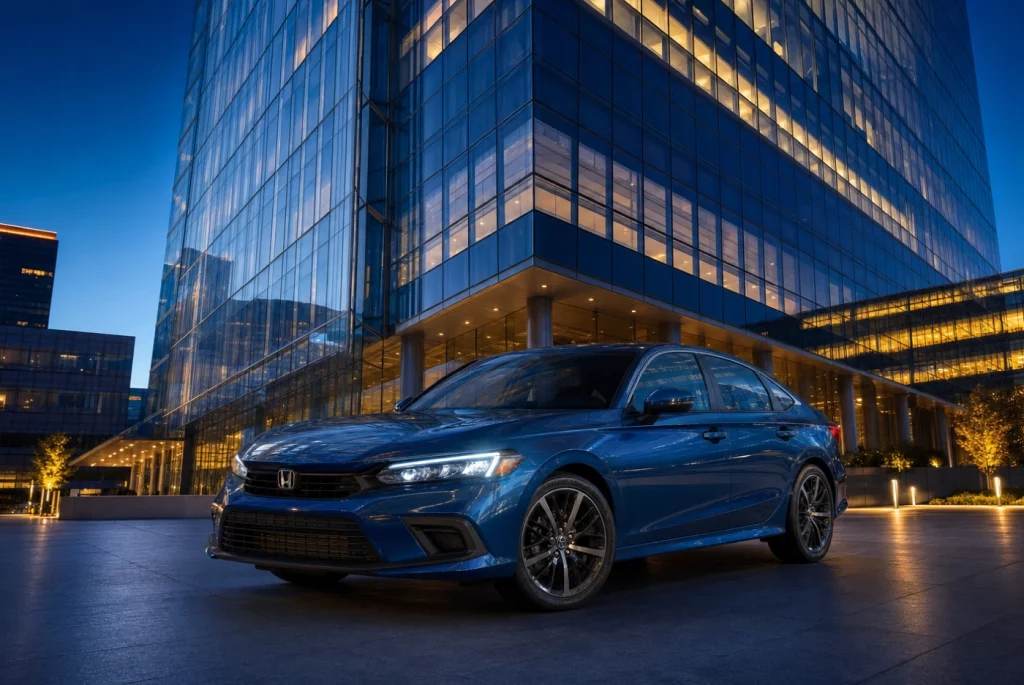
ADAS Architecture by Generation — What Changed and Why It Matters
The ADAS architecture determines which sensors require recalibration after which types of damage. The differences between the 10th and 11th generations are significant for owners and repair shops.
| Component | 9th Gen (2012–2015) | 10th Gen (2016–2021) | 11th Gen (2022–present) |
|---|---|---|---|
| Forward camera | None | Monocular (36160-TBG-A01), EX+ trims only | Monocular (36160-T20-A01), all trims standard |
| Forward radar | None | 77 GHz millimeter-wave, behind front grille emblem, EX+ trims | None — camera handles all forward functions |
| Blind spot / rear cross-traffic | LaneWatch (camera, passenger mirror only) | BSI radar (rear bumper), Touring/optional | BSI radar (08V67-T20-110), dealer accessory or Touring |
| Front park assist | None | None | 4 ultrasonic sensors in front bumper cover |
| Rear park assist | Optional (ultrasonic) | Optional (ultrasonic) | 4 ultrasonic sensors in rear bumper cover |
| Honda Sensing availability | Not available (FCW/LDW on 2014 Hybrid only) | Standard Touring, optional EX/EX-L; LX and Si none | Standard every trim including Si and Type R |
The 11th-gen change from radar+camera fusion to camera-only was a deliberate cost-reduction and reliability decision by Honda. The 10th-gen 77 GHz radar unit was mounted behind the Honda emblem in the front grille and required separate angular alignment after any front bumper removal or repair. The 11th-gen eliminates that radar entirely, so front bumper damage on an 11th-gen Civic does not automatically require radar recalibration — but it may still affect the forward camera if the camera mounting position or windshield angle changes. Source: I-CAR RTS CRN-1430, Core Auto Logic calibration triggers for 10th and 11th gen.
Windshield Replacement — The Most Common ADAS Calibration Trigger
Windshield replacement is the most frequent event that triggers ADAS recalibration on modern Civics. Both the 10th and 11th generations mount their forward-facing camera at the top center of the windshield, bonded to the glass. When the windshield is replaced, the camera is removed and reinstalled on the new glass. Even if the camera itself is not damaged, the change in glass curvature and mounting position requires recalibration to restore accurate lane detection, ACC, and collision mitigation functions.
10th generation (2016–2021): On EX and higher trims equipped with Honda Sensing, the forward camera (part 36160-TBG-A01) requires static calibration after any windshield replacement. Per Core Auto Logic’s documented procedure: “HDS camera static calibration required after any windshield replacement on Honda Sensing-equipped trims (EX+). Use 10th gen FC/FK specific procedure in HDS. Place horizontal target board AT approximately 1 meter from vehicle front bumper on level surface. No obstacles in forward zone. Approximately 5–10 minutes via HDS guided procedure. Verify all Honda Sensing warning lamps extinguish.” The LX trim — which did not have Honda Sensing — does not require any camera calibration because no camera is present. Source: Core Auto Logic 2016–2021 Civic calibration database.
11th generation (2022–present): The forward camera (part 36160-T20-A01) requires static calibration after every windshield replacement on all trims — because every 11th-gen Civic has Honda Sensing standard. The procedure is similar: “HDS 11th gen FE camera static calibration required all trims. Camera: 36160-T20-A01. Target approximately 1.0 meter from front bumper, level surface. HDS iN procedure. Use FE/FL procedure only — NOT 10th gen TBG. All Sensing lamps must extinguish post-cal.” Source: Core Auto Logic 2022–2025 Civic calibration database, I-CAR CRN-1430.
Calibration cost. The camera-only calibration for the 11th-gen Civic is typically less expensive than the combined camera+radar calibration required on the 10th-gen. Independent ADAS calibration services (such as Core Auto Logic) provide fixed quotes based on the scope of work. Dealer-calibrated windshield replacement — where the dealership or Safelite includes Honda HDS calibration — typically adds $150–$300 to the cost of a windshield replacement. A windshield replacement on an 11th-gen Civic without calibration will leave the forward camera in an uncalibrated state, causing the Honda Sensing warning lamp to illuminate and disabling ACC, CMBS, LKAS, and RDM. Source: independent calibration service data, dealer service pricing estimates, Honda service manual.
Consequence of skipping calibration. Driving with an uncalibrated forward camera after windshield replacement will trigger a persistent dashboard warning. The lane keeping assist system may not activate. The collision mitigation braking system will not function. The adaptive cruise control will cancel. Per Honda’s service bulletin, the system is designed to detect when the camera mounting position has been disturbed and will disable all camera-dependent functions until calibration is completed and verified. Some owners report intermittent false warnings or system unavailability even without a visible error, if the camera alignment is slightly off specification. Source: Honda HDS calibration documentation, owner forum reports.
Front Bumper Damage — Radar vs Camera Implications
The ADAS calibration consequence of front bumper damage is one of the most significant differences between the 10th and 11th generations.
10th generation — radar-equipped.
11th generation — no radar. The 11th-gen Civic eliminated the millimeter-wave radar entirely. The I-CAR RTS article (CRN-1430) explicitly states: “It is important to note that the 2022-present Civic does not use a ‘millimeter wave radar’ sensor behind the front bumper cover. On this vehicle, the forward facing-camera controls the systems that otherwise would’ve been controlled by the millimeter wave radar sensor.” This means front bumper damage on an 11th-gen Civic does not trigger radar calibration — there is no radar to calibrate. However, the 11th-gen front bumper cover does contain four ultrasonic park-assist sensors. These sensors require initialization (not full calibration) if replaced or if their mounting position is changed. The initialization procedure is simpler and less expensive than radar alignment. Source: I-CAR RTS CRN-1430, Core Auto Logic 11th gen calibration triggers.
Front bumper replacement cost with ADAS factors. A front bumper cover replacement on a 10th-gen Civic with Honda Sensing includes: bumper cover ($300–$600), paint ($400–$800), radar alignment ($150–$300). Total: $850–$1,700. The same repair on an 11th-gen Civic: bumper cover ($300–$600), paint ($400–$800), no radar alignment, plus possible park-assist sensor initialization if sensors were damaged ($50–$100). Total: $700–$1,500. The 11th-gen saves roughly $100–$200 on the ADAS portion of the repair. Source: Honda parts pricing, independent repair estimates, Core Auto Logic calibration cost data.
Rear Bumper Damage — Blind Spot Radar Sensors
Both the 10th and 11th generations mount their blind spot information system (BSI) radar sensors in the rear bumper area — specifically mounted on the lower quarter panels, behind the rear bumper cover. Per I-CAR: “The radar sensors are mounted on the lower quarter panel, behind the rear bumper cover.” The aftermarket/dealer accessory BSI radar kit for the 11th-gen is part 08V67-T20-110.
Rear bumper damage that requires bumper cover removal or replacement triggers BSI radar static calibration. Core Auto Logic documents: “BSM Rear Radar Installation / Replacement (08V67-T20-110)” as a calibration trigger. The radar sensors must be statically calibrated after any event that changes their mounting position — including bumper cover removal, radar sensor replacement, or quarter panel repair.
The BSI system is not standard across all 11th-gen Civics. It is a dealer-installed accessory or included on Touring and Sport Touring trims. Civics without BSI do not have these rear radar sensors and do not require this calibration after rear bumper work. Rear park-assist ultrasonic sensors (present on trims with park assist) require initialization if replaced — a simpler procedure than radar calibration but still an additional cost factor. Source: I-CAR RTS CRN-1430, Honda parts catalog, Core Auto Logic calibration documentation.
Calibration Frequency — When Calibration Is Required
ADAS calibration is not routine maintenance. It is required only after specific events that disturb the sensor mounting position. The table below summarizes the documented calibration triggers for each generation.
| Event | 9th Gen | 10th Gen | 11th Gen |
|---|---|---|---|
| Windshield replacement | No calibration needed | Camera static cal required (EX+ trims only) | Camera static cal required (all trims) |
| Front bumper removal/repair | No calibration needed | Radar angular alignment required | No radar cal; park sensor init if sensors disturbed |
| Rear bumper removal/repair | No calibration needed (LaneWatch unaffected) | BSI radar static cal if equipped | BSI radar static cal if equipped |
| Camera replacement | N/A | Camera static cal required | Camera static cal required |
| Radar replacement | N/A | Radar angular alignment required | N/A (no radar) |
| Suspension / alignment work | No calibration needed | Camera + radar cal recommended if ride height changes | Camera cal recommended if ride height changes |
| VSA modulator replacement | N/A | Radar alignment required (10th gen doc) | Not documented as trigger |
The most common calibration event across both 10th and 11th generations is windshield replacement. For a 10th-gen Civic LX (no Sensing), windshield replacement carries no ADAS calibration cost. For a 10th-gen Civic EX or Touring — or any 11th-gen Civic — windshield replacement adds $150–$300 to the total repair bill. Source: Core Auto Logic calibration trigger documentation for all model years 2016–2025.
Calibration Cost Breakdown by Generation and System
ADAS calibration costs vary by the number of systems that need calibration, the type of procedure (static vs dynamic), and whether the work is performed at a dealership or an independent calibration shop.
| Calibration Scope | 10th Gen (EX+ Touring) | 11th Gen (All Trims) | Typical Dealer Price | Typical Independent Price |
|---|---|---|---|---|
| Camera static (after windshield) | Required — camera only | Required — camera only | $150–$250 | $100–$200 |
| Radar angular alignment (after front bumper) | Required — radar only | None — no radar | $150–$300 (10th only) | $100–$200 (10th only) |
| Camera + radar combined (after collision) | Both required | Camera only | $300–$500 (10th); $150–$250 (11th) | $200–$350 (10th); $100–$200 (11th) |
| BSI radar (rear bumper, each side) | If equipped | If equipped | $100–$200 per side | $75–$150 per side |
| Park sensor initialization (front or rear) | N/A (no front sensors on 10th) | If equipped — simpler procedure | $50–$100 | $30–$75 |
The 11th-gen’s elimination of the forward radar saves approximately $100–$200 in calibration costs after front bumper repairs compared to the 10th-gen. However, the 11th-gen requires camera calibration after every windshield replacement — a cost the 9th-gen never incurred. Owners who keep their Civic long enough to replace the windshield once or twice over the vehicle’s lifespan will face this cost regardless of the generation. Source: Core Auto Logic pricing methodology, dealer service department estimates, independent ADAS calibration shop pricing.
Common ADAS Reliability Issues on the Civic
Camera condensation and fogging (11th gen). Some 11th-gen Civic owners have reported condensation inside the windshield camera housing in humid or rapidly changing temperature conditions. The moisture causes temporary loss of Honda Sensing functions — ACC cancellation, LKAS unavailability, CMBS warning light. The condition typically clears once the windshield is defrosted and the cabin air dries the camera housing. Persistent condensation may require camera housing resealing or replacement of the windshield bonding adhesive if the seal between the camera bracket and glass is compromised. Source: owner forum reports across 2022–2025 Civic forums (CivicXI, Reddit r/civic).
Radar misalignment after minor impacts (10th gen). The 10th-gen Civic’s forward radar, mounted behind the front grille emblem, is vulnerable to misalignment from minor Fender-bender impacts that do not visibly damage the bumper cover. The radar bracket can bend or shift even when the bumper cover appears undamaged, causing ACC to become erratic — sudden braking, loss of target vehicle tracking, or complete system unavailability. Honda’s service bulletin requires radar angular alignment whenever the front bumper structure is disturbed, and some dealers recommend checking radar alignment on any 10th-gen Civic that has been in any front-end impact, regardless of visible damage. Source: Core Auto Logic front bumper repair calibration trigger, Honda service documentation.
LaneWatch camera failure (9th gen). The 9th-gen LaneWatch camera, mounted under the passenger-side mirror, is subject to Water Intrusion and image degradation over time — a documented issue covered in the LaneWatch Camera Reliability and Replacement Cost article. The LaneWatch system does not affect forward sensing ADAS because the 9th-gen has no forward ADAS, but it is the only ADAS-like system on that generation and has its own reliability issues. Source: Honda service bulletin, NHTSA complaints, owner reports.
BSI radar false alerts (10th and 11th gen). Some owners report intermittent false blind-spot alerts from the BSI radar sensors — the system alerts when no vehicle is in the blind spot, or fails to alert when a vehicle is present. This can be caused by aftermarket bumper modifications, trailer wiring interference, misalignment after rear bumper removal, or radar sensor failure. Diagnostic procedures per Honda service manual include radar static calibration and sensor replacement if the fault persists. Source: Honda service bulletin, owner reports.
Calibration Procedure Details — What Happens During Calibration
Camera static calibration (both generations). The forward-facing camera is calibrated using the Honda Diagnostic System (HDS) with a physical target board placed at a measured distance (approximately 1 meter) in front of the vehicle on a level surface. The HDS guides the technician through a series of alignment checks. The vehicle must be on a flat, obstacle-free surface with proper tire inflation. The procedure takes approximately 5–15 minutes. After calibration, the system verifies that all Honda Sensing warning lamps extinguish. For the 11th gen, calibration requires the specific FE/FL procedure in HDS — not the 10th-gen TBG procedure — and requires iN (Honda interactive Network) access. Source: I-CAR CRN-1430, Core Auto Logic calibration documentation, Honda HDS service manual.
Radar static calibration (10th gen only).
BSI radar static calibration (both generations, if equipped). The rear BSI radar sensors require static calibration after rear bumper removal or sensor replacement. The procedure uses HDS with specific targets placed at the rear corners of the vehicle. Each side’s radar sensor is calibrated independently. Source: Core Auto Logic 11th gen calibration documentation, I-CAR CRN-1430.
Dynamic vs static calibration. The 11th-gen forward camera supports both static and dynamic calibration procedures. Honda’s service manual states that either procedure is sufficient — it is not required to do both. Static calibration uses physical targets and HDS. Dynamic calibration involves driving the vehicle at specified speeds in a straight line on a road with clear lane markings, allowing the camera to self-calibrate. Dynamic calibration is less expensive (no target setup, no dealership HDS time) but requires specific road conditions and may not be reliable in all situations. Static calibration is the preferred method for post-repair verification. Source: I-CAR RTS CRN-1430, Honda service manual.
ADAS Repair Cost Comparison by Generation — Total Cost of Ownership Impact
For owners comparing Civic generations on total cost of ownership, the ADAS-related expenses differ significantly:
9th gen (2012–2015): No ADAS calibration costs ever. Windshield replacement = standard cost ($200–$400) with no calibration. Front bumper repair = no radar alignment needed. LaneWatch camera failure is the only ADAS-related expense, at roughly $300–$600 for replacement of the side mirror-mounted camera. Lowest ADAS cost of ownership.
10th gen (2016–2021, EX+ trims): Windshield replacement adds $150–$300 for camera calibration. Front bumper repair adds $150–$300 for radar alignment. A Civic that gets one windshield replacement and one front bumper repair during ownership will incur approximately $300–$600 in ADAS calibration costs beyond the repair itself. LX trims with no Sensing: no calibration costs, same as 9th gen.
11th gen (2022–present, all trims): Windshield replacement adds $150–$250 for camera calibration (all trims). Front bumper repair does not require radar calibration, saving $150–$300 compared to 10th gen. The 11th gen is more expensive than the 9th gen on windshield replacement, but less expensive than the 10th gen on front bumper repairs. On average, $150–$250 in ADAS calibration costs per windshield replacement event.
Summary
The Honda Civic’s ADAS reliability and calibration requirements vary significantly by generation. The 9th-gen Civic had the lowest ADAS-related cost exposure because it had no forward-facing ADAS — windshields and bumpers were simple, no-calibration repairs. The 10th gen introduced a radar+camera architecture that added calibration costs to both windshield replacement (camera) and front bumper repair (radar). The 11th gen eliminated the forward radar, simplifying front bumper repairs but still requiring camera calibration after every windshield replacement. For owners, the practical impact is clear: any Civic with windshield-mounted ADAS equipment adds $150–$300 to the cost of windshield replacement. The 11th gen’s elimination of the forward radar is a net improvement over the 10th gen for repair cost exposure, but any generation with camera-based forward sensing carries ongoing calibration risk that the 9th gen never faced.
ADAS Reliability — Quick Reference:
☐ The 11th-gen Civic (2022+) has no forward millimeter-wave radar — all forward ADAS functions are controlled by the windshield-mounted monocular camera (part 36160-T20-A01). Front bumper damage does not trigger radar calibration on the 11th gen.
☐ The 10th-gen Civic (2016–2021, EX+ trims) uses both a forward camera (36160-TBG-A01) and a 77 GHz radar behind the front grille. Both require calibration after certain repairs.
☐ Windshield replacement always requires forward camera static calibration on any Sensing-equipped Civic (EX+ 10th gen, all trims 11th gen). The 9th gen and 10th-gen LX have no calibration requirement.
☐ Calibration cost after windshield replacement: approximately $150–$300 at a dealer, $100–$200 at an independent ADAS shop.
☐ Front bumper repair on 10th-gen Civics with Sensing triggers radar angular alignment at $150–$300 additional cost. The 11th gen eliminates this cost entirely.
☐ Rear bumper removal or replacement triggers BSI radar calibration on Civics equipped with blind spot monitoring — approximately $100–$200 per side at a dealer.
☐ Park assist ultrasonic sensors in the front and rear bumpers (11th gen) require initialization — not full calibration — if replaced. This is a simpler and less expensive procedure.
☐ The 11th-gen camera supports both static calibration (using HDS with a physical target) and dynamic calibration (driving procedure). Static calibration is preferred for post-repair verification.
☐ Condensation or fogging inside the 11th-gen forward camera housing can cause temporary loss of all Honda Sensing functions. This typically clears with defrosting but may require camera housing resealing if persistent.
☐ The 10th-gen forward radar is vulnerable to misalignment from minor front impacts that do not visibly damage the bumper cover — radar alignment should be checked after any front-end incident on Sensing-equipped 10th-gen Civics.
☐ On total cost of ownership: 9th gen (zero ADAS calibration cost) < 11th gen (camera-only calibration, ~$150–$250 per windshield) < 10th gen EX+ (camera + radar, ~$300–$500 for combined windshield and bumper repairs).