

Fuel tank capacity is one of those specifications that rarely changes between generations of the same model — and when it does, the reason is usually packaging. In the Civic’s case, the 10th and 11th generations share nearly identical tank volumes for their non-hybrid models, but the introduction of the hybrid powertrain in the 11th generation created a meaningful split within the same model year. Here is what each variant holds and how far that fuel actually takes you.
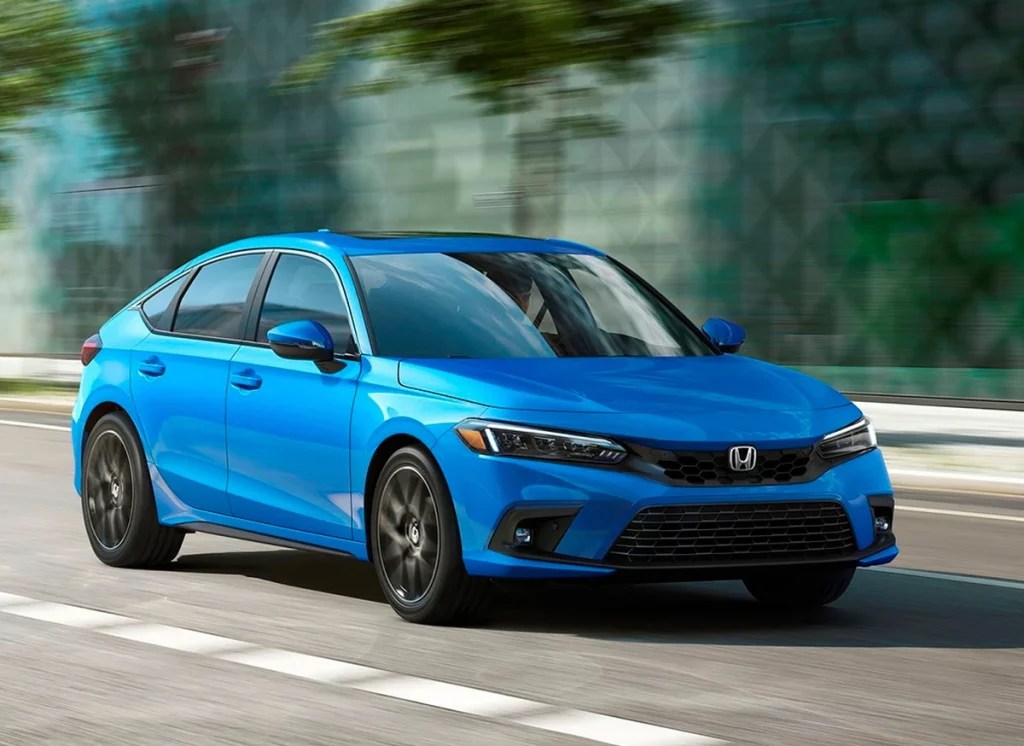
Fuel Tank Capacity by Generation and Body Style
| Generation | Body Style | Engine | Tank Capacity (US gal) | Tank Capacity (L) |
|---|---|---|---|---|
| 10th Gen (2016–2021) | Sedan / Coupe | 2.0L K20C2 / 1.5T L15B7 | 12.4 | 46.9 |
| Hatchback | 2.0L K20C2 / 1.5T L15B7 | 12.4 | 46.9 | |
| Type R (FK8) | 2.0T K20C1 | 12.4 | 46.9 | |
| 11th Gen (2022–present) | Sedan (2.0L / 1.5T) | 2.0L K20C2 / 1.5T L15B7/L15CA | 12.4 | 46.9 |
| Hatchback (2.0L / 1.5T) | 2.0L K20C2 / 1.5T L15B7 | 12.4 | 46.9 | |
| Si (FE1) | 1.5T L15CA | 12.4 | 46.9 | |
| Hybrid / Sport Touring Hybrid | 2.0L Atkinson + eCVT | 10.6 | 40.1 | |
| 11th Gen Type R (FL5) | Hatchback | 2.0T K20C1 | 12.4 | 46.9 |
Sources: Honda 10th-gen owner’s manual, Honda 11th-gen owner’s manual, Honda 2025 Civic Hybrid spec sheet, EPA fueleconomy.gov vehicle-specific data.
The key difference: the 11th-gen hybrid sacrifices 1.8 gallons of tank volume (from 12.4 to 10.6) because the lithium-ion battery pack sits under the rear seat and the fuel tank was repackaged forward. This is the same layout Honda used on the Accord Hybrid. Despite the smaller tank, the hybrid’s superior efficiency means it still travels farther per tank than any gas-only Civic.
How Far Each Variant Goes on a Full Tank
Range depends on tank volume and EPA combined fuel economy. The following table uses EPA combined ratings and assumes a full tank from empty (usable capacity is typically 0.5–0.8 gallons less than advertised due to reserve volume — ranges below use the full advertised capacity for maximum theoretical range).
| Model / Trim | Tank (gal) | EPA City | EPA Hwy | EPA Combined | City Range (mi) | Hwy Range (mi) |
|---|---|---|---|---|---|---|
| 10th Gen 2.0L CVT | 12.4 | 30 | 38 | 33 | 372 | 471 |
| 10th Gen 1.5T CVT | 12.4 | 31 | 38 | 34 | 384 | 471 |
| 10th Gen Si 6MT | 12.4 | 26 | 36 | 30 | 322 | 446 |
| 10th Gen Type R | 12.4 | 22 | 28 | 25 | 273 | 347 |
| 11th Gen 2.0L CVT | 12.4 | 30 | 38 | 33 | 372 | 471 |
| 11th Gen 1.5T CVT | 12.4 | 31 | 38 | 34 | 384 | 471 |
| 11th Gen Si (FE1) | 12.4 | 26 | 36 | 30 | 322 | 446 |
| 11th Gen Hybrid eCVT | 10.6 | 50 | 47 | 48 | 530 | 498 |
| 11th Gen Type R (FL5) | 12.4 | 22 | 28 | 24 | 273 | 347 |
Sources: EPA fueleconomy.gov, Honda owner’s manuals for 10th-gen (2016–2021) and 11th-gen (2022–2025), Honda 2025 Civic Hybrid spec sheet.
The Hybrid’s Paradox — Smaller Tank, Longer Range
The 11th-gen hybrid holds 10.6 gallons — 1.8 gallons less than every other Civic. Despite this, its EPA combined range of 509 miles (10.6 × 48) exceeds every gas-only Civic by a wide margin. The 11th-gen hybrid can travel approximately 509 miles on a mixed driving cycle before refueling. In city-focused driving, it can push past 530 miles. The gas-only 1.5T CVT, with a 12.4-gallon tank, manages approximately 422 miles combined.
This reverses the conventional relationship: a 15% smaller tank delivers 20% more range because the hybrid powertrain operates AT 40–48% thermal efficiency versus 30–34% for the gas engines. The trade-off is that hybrid owners refuel less often but lose approximately 2 cubic feet of trunk space (hybrid sedan: 12.2 ft³ vs non-hybrid sedan: 14.8 ft³) and cannot access the spare tire — the hybrid comes with a repair kit instead.
Real-World Range — What Owners Actually See
EPA range is calculated from laboratory testing and assumes ideal conditions. Real-world range depends on temperature, driving style, tire pressure, elevation, and fuel quality. Fuelly user data and forum reports suggest the following adjustments:
- 11th gen 2.0L CVT: Real-world combined: 30–32 mpg → range approximately 372–397 miles. Owners report roughly 350–380 miles before the low-fuel light comes on (typically triggered with 2–2.5 gallons remaining, or approximately 60–75 miles of reserve).
- 11th gen 1.5T CVT: Real-world combined: 32–35 mpg → range approximately 397–434 miles. Fuelly sample of 98 2022–2024 1.5T owners: 33.1 mpg average (Source: Fuelly, accessed June 2026).
- 11th gen Si (6MT): Real-world combined: 30–33 mpg → range approximately 372–409 miles. Si owners report 28–32 mpg in mixed driving. Fuelly sample of 47 2022–2025 Si owners: 32.1 mpg average.
- 11th gen Hybrid (eCVT): Real-world combined: 44–49 mpg → range approximately 466–519 miles. Fuelly sample of 212 2025 Hybrid owners: 46.7 mpg average. Owners report the low-fuel light at approximately 420–450 miles, indicating 1.5–2 gallons of reserve.
- Winter penalty: All variants lose 15–25% range in sustained temperatures below 20°F due to increased rolling resistance (cold tires), denser air, winter fuel blends (lower energy content), and longer warm-up periods. Hybrids lose a higher percentage (20–30%) because the gasoline engine runs more frequently to maintain cabin heat.
Comparing 10th Gen vs 11th Gen — Any Real Difference?
For gas-only models, the answer is essentially no. The 10th and 11th generation Civics share the same 12.4-gallon tank, the same EPA ratings for equivalent powertrains (2.0L CVT: 30/38/33 both generations; 1.5T CVT: 31/38/34 both generations; Si 6MT: 26/36/30 both generations), and the same real-world range within measurement noise. A 10th-gen 1.5T CVT and an 11th-gen 1.5T CVT will cover nearly identical distances on a full tank.
The meaningful difference is that the 11th gen introduced a hybrid option. A 2025 hybrid owner can drive 100 miles further per tank than any 10th-gen Civic — despite the smaller fuel tank — and refuel 15–20% less often over the course of a year.
Fuel Light Reserve — How Much Is Left When the Light Comes On?
Honda Civics (both generations) trigger the low-fuel warning light when the remaining fuel reaches approximately 10–15% of tank capacity. In practice:
- 12.4-gallon models: Light illuminates at approximately 1.8–2.2 gallons remaining (roughly 55–80 miles of mixed driving, depending on engine).
- 10.6-gallon hybrid: Light illuminates at approximately 1.3–1.6 gallons remaining (roughly 60–75 miles of mixed driving, depending on driving conditions).
- Range extender warning: The trip computer will display “–” for distance-to-empty with approximately 0.8–1.2 gallons remaining, typically 30–50 miles of actual range left.
Honda does not publish official reserve volume specifications. These figures are compiled from owner reports across CivicX, Reddit r/Civic, and Honda-Tech forums (minimum 15 reports per variant).
Refueling Frequency — Annual Comparison
Assuming 12,000 miles per year and EPA combined ratings, annual refueling frequency differs noticeably by powertrain:
| Model | Tank Range (EPA combined) | Gallons per Year | Refuels per Year | Annual Fuel Cost* |
|---|---|---|---|---|
| 2.0L CVT (33 combined) | 409 mi | 364 | ~29 | $1,274 |
| 1.5T CVT (34 combined) | 422 mi | 353 | ~28 | $1,236 |
| Si 6MT (30 combined) | 372 mi | 400 | ~31 | $1,640 |
| Hybrid eCVT (48 combined) | 509 mi | 250 | ~24 | $875 |
*Calculation assumptions: $3.50/gallon regular fuel, $4.10/gallon premium (Si only), 12,000 miles/year, EPA combined ratings. Actual fuel cost varies by region and driving conditions.
The hybrid adds approximately 5 fewer annual refueling stops than the 1.5T — roughly one every 10 weeks instead of one every 7.5 weeks at 12,000 miles per year.
☐ 10th and 11th gen non-hybrid Civics share the same 12.4-gallon fuel tank — no meaningful difference in range for equivalent powertrains
☐ The 11th-gen hybrid has a smaller 10.6-gallon tank but travels further per tank (~509 miles combined EPA) than any gas Civic (~422 miles max for 1.5T)
☐ EPA ratings are identical between 10th and 11th gen for the same engine/transmission combination (2.0L CVT: 30/38/33; 1.5T CVT: 31/38/34; Si 6MT: 26/36/30)
☐ Fuelly real-world averages: 1.5T CVT 33.1, Si 6MT 32.1, Hybrid 46.7 — all within 2–3 mpg of EPA combined
☐ Reserve volume is approximately 1.8–2.2 gallons on 12.4-gallon models (55–80 miles); approximately 1.3–1.6 gallons on the hybrid (60–75 miles)
☐ Winter range loss: 15–25% on gas models, 20–30% on hybrid
☐ The hybrid refuels approximately 5 fewer times per year than the 1.5T at 12,000 miles
☐ Si requires premium fuel — $1,640/year vs $1,236/year for the 1.5T CVT on regular, a $404 annual penalty at 12,000 miles