

The 11th gen Civic sits lower than the 10th gen. The Si sits lower than the standard car. And the Type R scrapes on things you would not expect. If you live anywhere with speed bumps, steep driveways, or poorly maintained roads, ground clearance is a real consideration — not just a spec sheet number. Here is what the data says and what it means in daily driving.
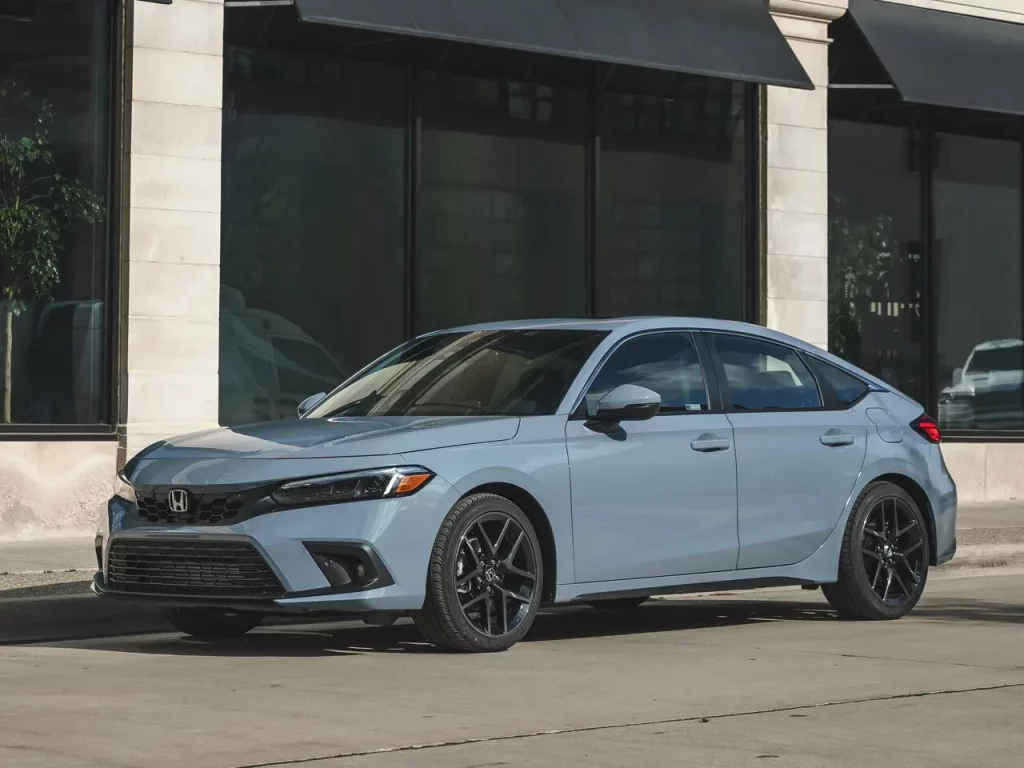
The Numbers — Official Ground Clearance by Model
Honda measures ground clearance in two states: unloaded (curb weight, no passengers, no cargo) and AT maximum permissible weight (fully loaded GVWR). The unloaded figure is what you see on spec sheets. The loaded figure is what matters when the car is full of people and gear. The difference is roughly one inch across all trims.
| Model | Unloaded Clearance | Loaded Clearance (GVWR) | Source |
|---|---|---|---|
| 11th Gen LX / Sport (sedan) | 5.28 in (134 mm) | 4.28 in (109 mm) | Honda Canada, 2025 sedan specs |
| 11th Gen Sport Hybrid (sedan) | 5.28 in (134 mm) | 4.21 in (107 mm) | Honda Canada, 2025 sedan specs |
| 11th Gen Hatchback (all trims) | 5.28 in (134 mm) | ~4.2 in (not published for all) | Honda Canada, 2025 hatchback specs |
| 11th Gen Civic Si | ~5.0 in (127 mm) | ~4.0 in (estimated) | Honda does not publish Si clearance directly. Estimated from Si-specific suspension lowering vs standard car |
| 10th Gen LX / EX (sedan) | ~5.1 in (130 mm) | N/A | CivicX forum owner data, Honda Canada archive |
| 10th Gen Civic Si | 4.72 in (120 mm) | N/A | Honda Canada spec manual, confirmed by CivicX owner measurements |
| 11th Gen Civic Type R | ~4.7 in (120 mm) | ~3.7 in (estimated) | Honda Type R specs; owner measurements on CivicX |
The 11th gen standard sedan dropped from approximately 5.1 inches (10th gen) to 5.28 inches (11th gen) unloaded — a small increase of about 0.18 inches. The Si, however, sits lower in both generations. The 10th gen Si had 4.72 inches. The 11th gen Si is estimated at roughly 5.0 inches — slightly higher than its predecessor but still lower than the standard car. The Type R is the lowest of the lineup at roughly 4.7 inches unloaded (source: Honda Canada spec sheets; CivicX owner measurements; Car and Driver Type R specs).
Where the Low Points Actually Are
Ground clearance is an average measurement. What matters is where the lowest hard point is relative to the obstacle you are trying to clear.
Front lip / lower bumper. The Civic’s lowest front point is the rubber lip under the front bumper. On standard trims, it sits about 6 inches off the ground. On the Si, the front lip is roughly 5.5 inches off the ground — half an inch lower because of the Si-specific front bumper design with a more pronounced splitter. The Type R’s front lip clearance is roughly 4.5 inches, which means it hits parking curbs and steep driveway transitions that a standard Civic clears easily.
Front subframe crossmember. The lowest hard metal point under the car is the front subframe Crossmember, located roughly behind the oil pan. On the 11th gen sedan, it sits at about 5.0 inches unloaded. On the Si, it is closer to 4.7 inches. This is the part that scrapes on speed bumps if you take them straight on at anything above a crawl.
Exhaust mid-pipe. The exhaust hangs below the floorpan tunnel. On the Si, the mid-pipe is roughly 4.5 inches off the ground — about the same height as a standard driveway curb. Scraping the exhaust on a transition is common on Si and Type R cars and produces a scraping sound that makes owners wince but rarely damages anything (source: CivicX “what did you scrape today” compilation threads).
Jacking point rails. The side sill jacking points are the lowest points along the sides of the car, at roughly 4.5 inches on standard cars and 4.2 inches on the Si. These are reinforced steel. They are designed to take the weight of the car on a jack. Scraping them on a curb or speed bump is not structurally damaging but can bend the pinch weld if the impact is sharp.
Speed Bumps — Which You Clear and Which You Do Not
Speed bumps are not all the same height. Standard parking lot speed bumps are typically 3 to 4 inches tall. Standard residential speed humps are 3 to 4 inches tall but wider, with a gentler ramp angle. Steep “tabletop” speed bumps in some parking lots are up to 5 inches tall with sharp transitions.
A standard 11th gen Civic sedan (5.28 inches unloaded) clears all standard speed bumps at a 5–10 mph approach. The front lip clears. The Subframe clears. The exhaust does not hit. The only risk is if the car is fully loaded (four adults + cargo), where clearance drops to roughly 4.25 inches. At that point, the exhaust mid-pipe may scrape on a sharp 4-inch bump with a steep transition angle.
The 11th gen Si (~5.0 inches unloaded) clears standard speed bumps but requires more careful approach. At 10 mph straight on, the front lip clears. The exhaust scrapes on some sharper tabletop bumps. At full load (four adults), the Si’s clearance drops below 4 inches, and the exhaust and subframe will hit most speed bumps. The answer is to take them at a 15–20 degree angle so that each wheel clears independently — a technique familiar to any lowered car owner.
The 10th gen Si (4.72 inches unloaded) is noticeably lower. Owners on CivicX report that the front lip scrapes on standard parking lot speed bumps at anything above 5 mph. The exhaust mid-pipe scrapes on tabletop bumps at any speed. Many 10th gen Si owners simply avoid certain parking lots. The 11th gen Si is a meaningful improvement here — about 0.3 inches more clearance than its predecessor, which is enough to make standard bumps manageable where the 10th gen struggled.
| Scenario | 11th Gen Standard | 11th Gen Si | 10th Gen Si |
|---|---|---|---|
| Parking lot speed bump (3-4 in) — driver only | Clears at 10 mph | Clears at 5-10 mph | Front lip scrapes at >5 mph |
| Tabletop speed bump (4-5 in) — driver only | Clears at <5 mph or angle | Angle required | Angle required + exhaust may hit |
| Speed bump — full load (4 passengers + cargo) | Angle required, may scrape | Will scrape exhaust | Will scrape subframe + exhaust |
| Steep driveway transition (6 in curb cut) | Angle in — front lip clears | Angle in — may hit front lip | Angle in — front lip hits |
How the Civic Compares to Competitors
Compact sedans are generally low. The Civic’s clearance is typical for the class. Here is how it stacks up:
| Model | Ground Clearance (unloaded) | Notes |
|---|---|---|
| Honda Civic (11th gen) | 5.28 in | Segment average |
| Honda Civic Si (11th gen) | ~5.0 in | Lowered ~0.28 in from standard |
| Toyota Corolla sedan | 5.1 in | Similar to Civic standard |
| Mazda3 sedan | 5.5 in | Slightly higher than Civic |
| Hyundai Elantra | 5.3 in | Comparable |
| VW Jetta | 5.3 in | Comparable |
Sources: Honda Canada, Toyota Newsroom, Mazda Newsroom, Hyundai Newsroom, VW Media, Edmunds specs database. All figures for 2024–2025 model years.
The takeaway: the standard Civic and its direct competitors are all within 0.2 inches of each other. None of them clear speed bumps as easily as a crossover (a Honda HR-V sits at 7.0 inches), but none of them are unusually low for the segment. The Si is lower than the class average by about 0.3 inches — noticeable but not debilitating.
Real-World Consequences — What Owners Actually Deal With
Snow and ice buildup. Low clearance cars pack snow under the front bumper in slushy conditions. On the Si, the gap between the front lip and the ground is small enough that packed snow can build up under the undertray and freeze into a solid block. Owners in northern states report having to clear snow from under the bumper after driving through unplowed streets. This is not unique to the Civic — it affects any low car — but the Si’s lower front lip makes it worse than a standard Civic.
Parking curbs. The 11th gen Si’s front bumper overhang is roughly 35 inches from the front wheel center. When parking nose-in to a curb, the front lip extends past the tire and can contact the curb if you pull in too far. The rubber lip protects against paint damage, but repeated contact can crack the lip on cars with the Honda accessory front lip spoiler. The 10th gen Si had the same issue, and aftermarket front lip protectors (rubber strips that bolt to the bottom of the bumper) are a common accessory on both generations.
Ferry ramps and steep transitions. Loading a Civic onto a flatbed tow truck or a ferry ramp is a known anxiety point for Si and Type R owners. The approach angle (the angle between the front tire and the lowest front point) on the 11th gen Si is roughly 13 degrees. A standard car ferry ramp is about 10–12 degrees. That means the Si clears with less than one degree of margin. Ferry crews have seen enough low cars that they will ask you to take the ramp at an extreme angle. The Type R requires this on every ferry crossing.
Is the 11th Gen an Improvement Over the 10th for Clearance?
Yes, for the Si specifically. The 10th gen Si’s 4.72-inch clearance was a genuine daily-driving compromise. Owners reported scraping on driveway transitions that standard Civics cleared easily. The 11th gen Si’s roughly 5.0 inches — while still lower than the standard car — brings it back into the range where standard speed bumps are manageable without a special approach. The standard 11th gen Civic at 5.28 inches is essentially unchanged from the 10th gen standard car (5.1 inches).
The Type R remains the problem child. At roughly 4.7 inches, it is as low as the 10th gen Si and has a more aggressive front splitter that extends further forward. If ground clearance is a concern and you want the performance version, the Si is the more livable choice — not by a huge margin, but by enough to notice on your daily commute.
Quick reference: Standard 11th gen — 5.28 in (134 mm) unloaded, ~4.25 in loaded. Si — ~5.0 in unloaded, ~4.0 in loaded. Type R — ~4.7 in unloaded, ~3.7 in loaded. Speed bumps under 4 inches: all clear unloaded. Speed bumps over 4 inches: Si and standard car need an angle approach; Type R scrapes regardless. Steep driveways: angle in on all. Snow: Si and Type R pack snow more than the standard car. If clearance is a primary concern, buy the standard Civic and skip the lowering. If you want the Si, expect to angle approach every bump and driveway, and accept that scraping the rubber lip is normal and not damaging.